Tightening Up the Business Structure of Your Writing

I have had this post sitting in my drafts since October 2019. I didn’t want to publish it until I had tightened up my own business structure and then Corona hit and I thought, “Maybe this isn’t appropriate right now” and I put it off. I have a habit of meditating on what I have to do throughout the day before I get up from the bed. This morning I thought, “Wait a minute, this could actually be the perfect time to present this information.”

Even though there aren’t many people working and the world is sick, this could be the perfect time for us to plan, organize, and restructure some things. The other day we cleaned out a closet that had served as the junk closet since we moved in, and Moshe (Husband) organized the garage. These days, we are paying attention to things we have neglected to give much attention to. Why not include our writing business too? Whether you will use this information now or later, this is an excellent time to give it some thought.

In the Beginning

For Self-Publishing a book, things are relatively easy in the beginning. You create a KDP account, connect your bank account (so you can get paid your royalties) and you are set. You can also create a PayPal account to collect funds from books bought through your website or blog and get a card reader to accept payments on the go, such as at book signings.

UPDATE: Card readers are becoming more outdated as apps like Cash App and Zelle become increasingly popular. I highly recommend authors to have a Cash App for book signings and festivals.

Next Level

Depending on your financial situation, it may be necessary to level up if you’ve been at this awhile.

How do you level up from this basic structure? How do you go from author to authorpreneur?

Author + Entrepreneurial Practices = Authorpreneur

An authorpreneur is an author with entrepreneurial practices. 

If publishing a book is like opening a business, you can do things to make sure you are running it like one.

It’s not 2008 and Self-Publishing is not what it used to be. The standards are higher.

Anyone can publish a book today (even if they aren’t good writers), by uploading a Word Document or PDF to Amazon’s Kindle Direct Publishing. In the past, this has brought down the quality of the prestigious process of book publishing and, specifically, Indie Book Publishing. Today, though, the stigma attached to Self-Publishing is fading, and authors who publish top-quality material are being separated from those who do not.

With the current Pandemic ravaging the world, realizing the value of Indie Publishing, social media, and doing business online is apparent now more than ever. A lot of brick and mortar bookstores are closed, and some will not reopen.

The basic system I started this post out as is good initially, but the Indie Author who goes beyond the bare minimum will set themselves apart from the pack.

Create a business name/structure that is legal and connected to a business bank account.

When your business grows, you will discover how important it is to have a legal business structure. It has done wonders for me and helps me keep up with how much is coming in and going out, which helps me have a realistic picture of my ROI or return on investment.  You work hard to write these books, publish them and spend good money to get them out into the world. Don’t let all this hard work go to waste.

You can get away with using a Pseudonym or creative business name at first, but if you are serious about using that name for specific projects, you will need it to be legit. What happens if someone sends you a check in your fake business name and you have not made it legal? Without a business bank account in that name, you will not be able to cash it.

    • Decide if you want to be a Sole Proprietorship, LLC, Corporation, Non-Profit (if you publish books for charity) or any other structure that suits you.

* Most people do not recommend a Sole Proprietorship, but it will work just fine. I am all about keeping things simple.

  • Set up a business bank account – You can set up your bank account once you have your business structure in place and monitor just how much is coming in from your book sales and other author endeavors separate from other forms of income. You will get a business debit/bank card and checks to use for your business. You can even establish a line of credit.
  • Creating a business structure can motivate you because you get to see your writing as a real business and not just a fancy play-name. You can get logos made if you want and do transactions under this name which comes in handy when completing W-9 forms and other paperwork that may be required for you to get paid.

Stay Legally Compliant

  • With a business structure, you will need to keep your business compliant with state and federal business laws. The requirements will vary based on your business structure. (For instance, the conditions are more strict for corporations than LLC’s). An example is that you may have to file once a year with a filing fee of maybe $30 to stay in compliance. The process is not tedious, and you may even be able to do it online. For details on staying compliant, you can visit the small business administration website here.

If you don’t stay compliant your business will fall into an inactive status.

Publish Your Books Under Your Own Imprint

Once you have your legal business structure and business bank account in place, it is time to publish your books like you own your business.

  • Buy Your ISBNs – The ISBN is a unique identifier for a book issued by an ISBN registration agency. In the US, this agency is Bowker.* In some other countries, the ISBN is free, but in the US they are not. They are expensive, so it’s best to buy them in bulk if you can. You can buy a block of ten which would cover ten separate paperback or hardcopy books. KDP, Lulu, and other POD (Print on Demand) companies do provide ISBNs for free if you absolutely cannot afford to buy one

But…

Free assigned ISBNs belong to the company that issues it, such as KDP or Lulu. This means they (KDP/Lulu/Other said company) are listed as the publishers of that book, not you.

*There are tons of fake ISBN companies out there. If you are in the US, be sure you purchase your ISBN from Bowker.

Once you have your own company, you will want to have your books listed under your company name. If you are the publisher, you should be listed as the publisher. If ownership is important to you, buying your own ISBNs is something you might want to look into.

With your company name legalized, your business structure secure, your EIN in hand, your bank account set up, and books under your ISBN, you have positioned yourself as a serious business person. It is now easier than ever for high-profile people to do business with you.

It’s easy to go the free route, but free is limiting, and it does not always set you apart. Creating an actual business complete with the necessary paperwork makes it easier for you to stay organized, file taxes, rise above the crowd, and stand out as a professional author.

Extra Tips

  • Your work is under copyright protection the moment it is created. Don’t let scam publishing companies fool you by saying “Keep 100% of Your Copyright.” This means they are promising you something you already have. For publishing rights (different from copyright) all you have to do is buy your own ISBN. If you want to go the extra mile and register a copyright with the copyright office you can do that inexpensively at copyright.gov.
  • When tightening up your writing business, be sure you have both a paperback and a digital version of your book available.

I talk a lot about paperbacks because a). I have personally done better with paperbacks and b). authors can sell paperbacks through their own author website along with cool author swag and things instead of relying only on Amazon. However, that doesn’t negate the importance of having digital versions of your book available too. We are living in a digital age, and with everything being online, authors without digital books will be left out. Brick and Mortar bookstores without an online presence are struggling right now.

For those who sell paperbacks, consider lowering your print book price if you do not see sales. I love buying paperbacks from Indies, but a lot of them are also costly. I am not saying you can’t raise your price (I have a separate post about that here), that there aren’t people who will buy at that price, or that your book isn’t quality enough to sell that price.

I am only saying to be realistic.

Who is buying a $30 (plus s&h) 100-page paperback from an unknown first-time Self-Published Author?

Do what works for you, but make sure you are being practical.

Photo by LinkedIn Sales Navigator on Unsplash

When I first drafted this post, I watched a video of Tyler Perry advising entrepreneurs. I am not a big Perry fan, but when people are advising about business, I listen. Perry talked about entrepreneurs learning when to let go. Here, he meant letting go of business practices that no longer serve you once your business grows. He spoke of not being so used to how it has always been done that we are not open to change. For example, Perry’s sister used to keep receipts in a folder, but as Tyler’s business grew, that kind of accounting system no longer worked for taxes. Not when you have over 400 employees.

As professional Indie Authors, we must have the same mindset. This may not be ideal for everyone, but if you fit one of these categories a legal business name and account may be worth it:

  • You’ve been publishing awhile and you are making a significant income from your books and services.
  • You want to separate your personal funds (finances from your day job or other income) from your book business.

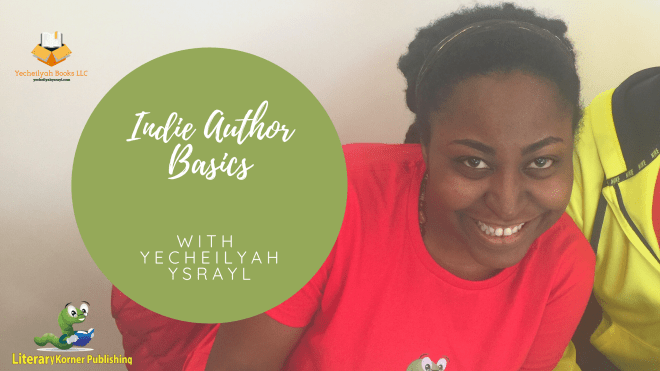
Want more Indie Author Tips? Visit the Indie Author Basics with EC page here!


My Author Presence online now looks like this. Please take note of the new twitter handle and Facebook Page.
👉Instagram: @yecheilyah
👉Twitter: @yecheilyah

Helping Indie Authors Amid the COVID-19 Pandemic

I’ve been spending my social distance-time staying at home as much as possible, reading books, writing books, catching up on some scriptures, enjoying time with my family and binging my favorite TV shows. Earlier last week I got an email from someone whose email I don’t remember subscribing to, but, it mentioned the point that Self-Publishers are small businesses too.

And I concur.

Small businesses are taking a big hit amid the COVID-19 crisis and I thought I’d share a way we can help Self-Publishers in this time of uncertainty.

Buy the author’s book directly from them if you can.

If the author has a website, purchase a paperback or digital version of the book from the author’s website. If you are an author and you don’t have a website or you’re not selling through your website, Joanna Penn’s article here goes into detail on how to set up a store.

Something to keep in mind:

Amazon pays authors royalties for print and ebook sales. A royalty is a percentage of a sale. An ebook going for $2.99 at 70% according to Amazon Kindle Direct Publishing will make the author $2.09. This means the author will have to sell at least 10 ebooks to make $20 and still have to wait a month to see that.

“If you publish through traditional publishing, royalties can take many months to arrive. You can’t control the schedule of payment and you don’t get any details of the customers.

If you publish independently through online publishers like Amazon, Kobo, Apple, Google, and other distributors, you will get your money sooner — but it will still be 30-60 days later and once again, you don’t get any details of the customers.”

Authors who sell direct can buy author copies of their books in bulk at a discount, sell those books from their website and fulfill the order themselves. The author also gets to see who their customers are which helps them to build a stronger relationship with them.

I wouldn’t be keeping it authentic if I didn’t also mention authors will have to account for shipping, state tax, and whatever website fees are associated with their platform of choice. The benefit, however, to selling direct is that the author doesn’t have to wait 30-60 days to get paid.

If the author got ten print book sales at $20 through their author website, they’ve already made $200 and $200 in the age of COVID-19 can be very helpful to families. Consider that most Indie Authors with day and night jobs are either working from home or not working at all. People are being fired, furloughed, and layed off left and right. Besides this, if we are being honest, some Indie Authors don’t even see $200 in royalty checks from Amazon from their Self-Published books.

Of course, there are pros and cons to everything. The major pros have already been stated, you are helping a small business to keep going at a time when money is scarce for everyone. The cons for authors include:

  • Not having the sale go toward your Amazon sales or ranking.


  • You must have the right to sell through your website first. You can’t, for example, sell your digital book anywhere outside of Amazon while enrolled in the KDP Select program and if you are signed with a publisher (includes Indie Publishers) you might be restricted from selling your print book through your own website depending on the details of your contract. You will have to check this and see.

“Many authors are so obsessed with chart rankings on Amazon that they forget the point is to reach readers who love our books — and for many of us, make a living with our writing. Selling direct enables readers to support us and money to arrive in our bank accounts quickly — but you will not see a spike in your Amazon rankings. So what do you really want?” – Joanna Penn

Here are ways to help Indies Amid the COVID_19 Pandemic:

  • Buy Directly From the Author (from their Website) If You Can.
  • Those ebook sales do add up. If you can’t afford the print book, buy the digital book.
  • Be sure to leave a review on Amazon so the author can attract more readers and get more sales.

Read Joanna Penn’s entire article “How To Sell Your Books Directly To Readers And Get Paid Immediately” here.


Book 2 is on the way! Get started on Book One.

Order a Signed Paperback* Here

Get it in ebook here.

*Due to the COVID-19 Pandemic, stay-at-home, and shelter in place policies I am shipping books in shifts so I don’t have to keep going out. If you want to be included in this week’s shipment, be sure to place your print book order today so you don’t miss it! Paperbacks are signed and includes my author seal.


Want more Indie Author Tips? I’ve written over 50 articles sharing my tips, process, and publishing journey as an Indie Author. You can find them on this page. Enjoy!

Revising The Stella Trilogy: Book Two – Beyond the Colored Line

Book one is out and we are on to book two!

My main challenge for book two is making sure that it stays consistent with book one. This is important for any series, but for Historical Fiction, it is even more critical.

Since writing Historical Fiction is writing set in a time that has already occurred, the details of the past must be realistic to what was going on. A good Historical Fiction book places fictional characters somewhere in a world that has already existed in a way that reads authentic. Readers should be able to reimagine what that world was like by immersing themselves in the life of the characters and the world around them. I like to think of it as a time machine, which is also what makes writing #Histfic fun to me.

Style, Language, Dialogue

Like book one, book two opens in 1996 and picks up where we left off at Mama Sidney’s house in book one. But book two also takes us back into the life of Mama Sidney, and we revisit history from the 1920s through the 60s. My focus for book two was to make sure the dialogue, language, racial and political events occurring during this time were realistic to what was happening in the world. We talk about The Great Depression and touch on the reoccurring lynchings taking place in both the north and south. We look at the brutal murder of Emmett Till, the shooting of Dr. King, Jim Crow Laws, and The Black Panther Party. While I immerse Stella in her own world, there is still the larger world to deal with and we watch how she navigates both. How does Stella’s personal identity crises correlate to the identity crises plaguing her larger community?

Racial Terminology

The biggest thing to deal with for book two is the racial classifications of blacks during this period. African Americans are the only people whose racial terminology has changed with the census. We have been “Niggers,” Negros, Coloreds, Blacks, and African Americans, and this can get confusing when trying to use the right term for the right year. This is also not to mention other racial “nicknames” we called ourselves, such as Afro-American and The New Negro.

The challenge of using the right term for the right years is because there were terms that blacks preferred to call themselves and terms used discriminately by the wider society. Although by the 60s Black Americans were preferring to be called blacks or Afro-Americans (as Malcolm X used a lot after leaving the Nation of Islam) white separatist signage still referred to us as coloreds. “Whites Only / Coloreds Only,” or “Welcome to the Colored Zone,” banners and store signs could have read.

Credited to W.E.B. Dubois and Booker T. Washington, blacks advocated for a switch from Colored to Negro in the early 1920s. As blacks redefined themselves, terms like “The New Negro,” became popular and sparked a movement that later became known as The Harlem Renaissance.

By the 1960s, though, African Americans had transitioned from being “Negros,” to “Blacks.” (Malcolm X specifically didn’t like the term Negro).

During the Black Power movement when sayings such as “I’m Black and I’m Proud,” were popular (think James Brown “Say it loud, I’m black and I’m proud!”) blacks wore their hair natural, read and published black literature and did what they thought would reconnect them with their lost heritage. In this process, many black political leaders of the time, such as Kwame Ture or Stokely Carmichael, helped to shift the terminology away from Negro and toward Black. Black publications like Ebony followed by switching from Negro to Black.

While a large majority of people still preferred Negro, “Black“ was becoming the preferred term with the New York Times and Associated Press abandoning “Negro” in the 1970s.

By the 1980s, Jesse Jackson called for a shift from Black to African American and while the change is still not as accepted or monumental as black was during the 60s, it is the term most socially acceptable when referring to black Americans.

I had to consider these changes when referring to blacks throughout this part of the book. What did they call themselves? What did society call them? How do I integrate this into the dialogue and setting realistically?

Setting, language, and dialogue is the backbone of Historical Fiction because the setting makes the story seem real and determines the character’s beliefs and actions. Not only do I strive to make the characters stand out but the culture of the time in which they live.


About Book Two:

In book two, we dig deeper into the McNair family’s legacy. Named after her great-grandmother, Stella has a very light complexion causing her to be the tease of her classmates. Unable to find solace among her African American contemporaries, Stella finds it challenging to adjust to a world where she is too light to be black.

After The Great Depression of the 1930s forces Stella’s family to move to Chicago, a conversation with Aunt Sara provokes Stella to do something that will dramatically affect not just her life but the life of her children and grandchildren.

Stella: Beyond the Colored Line will be available through my website and back up on Amazon in digital and print by April 24th. I am not putting the rest of the books up for preorder, so you’ll be able to order it immediately on 4/24.

If you have not already read book one, click one of the links below.

Amazon Kindle

Signed paperback

https://www.yecheilyahysrayl.com/bookstore/stella-between-slavery-and-freedom

Book Publishing in the Age of COVID-19

Kayana Szymczak (for STAT)

I know some of you are wondering about the effects of the Coronavirus on the book industry. Some of you have asked if you should still publish your books.

Yes, I do think you should proceed with publishing your books.

Based on the current climate, I also think it is wise for all businesses to expect some changes as a result of COVID-19, which is now a global pandemic, according to The World Health Organization. On Wednesday night, President Donald Trump also suspended travel from Europe to the US for thirty days, excluding the UK.

What we know for sure is there have been significant changes due to this virus. We have seen changes in the stock market, cruises, theme parks, tourism, sports, and travel. Factory closures in China (the world’s largest exporter, responsible for a third of global manufacturing. China accounts for more than 80% of imports of toys alone) led to a record low in the country’s Purchasing Manufacturing output. Italy, which has the world’s ninth-largest economy, is on lock-down, and the state department raised the worldwide travel advisory level to Level 3: Reconsider Travel. This advisory means there is an official warning against nonessential travel.

The entertainment industry has seen changes as well with Tom Hanks and his wife testing positive for the virus.  In the sports world, the NBA has suspended the season until further notice because of Utah Jazz center Rudy Gobert, testing positive. Yesterday morning, a second Utah player, Donovan Mitchell, also tested positive.

The NCAA men’s and women’s basketball tournaments have been canceled, the MLB suspended training, delaying opening day two weeks, the NHL suspended its season, and tons of other sports activities are being canceled.

Trillions of dollars have been wiped from the financial markets this week, and small businesses are already seeing signs of struggle as supply chains dry up. Yes, human suffering can be due to illness, but it can also be due to people not being able to pay their bills, subsequently losing their homes and going hungry.

Consider too the 24 states (more by the time this post is live) under a state of emergency.

What we are seeing is the potential unfolding of several crises, all happening at once. People are panicking and making up stuff, buying out the toilet paper for some strange reason, leaving their jobs; children are not going to school, and conferences, venues, and even sports games are being suspended until further notice.

Whether you want to believe this is media sensationalism or not, the reality is that things are different and there have been changes in the world that are affecting the lives of real people.

This post is about adjusting to these changes as a businessperson in publishing, the hope I see for authors in an age where the go-to form of entertainment (sports) is brought to its knees, and the good news in store for Self-Publishers.

Here are the changes I discovered so far in publishing. Please add on to them by commenting below on what you are hearing as well.

  • Book Fairs and Conferences (where large communities of people gather) are being canceled. This “social distancing,” as it is being called, includes The London Book Fair (The UK’s largest book fair event), the Bologna Children’s Book Fair, and the Leipzig Book Fair.


  • An employee at Amazon was diagnosed with COVID-19. The bookstores in NY have been holding up so far, I hear, but amazon workers from New York are working from home. “Sellers on Amazon’s marketplace are reportedly struggling to bring goods into the country.”


  • Not exactly sure if this is directly linked to the Coronavirus, but I am hearing it’s been a hard week for big publishers. Three of the big five are struggling, specifically MacMillan, Hachette, and Simon & Schuster.


  • Some individual authors have reported a decline in book sales since COVID-19, but some have seen an increase. There is no telling to my knowledge if there are any significant cases of falling book sales among Indies. I do know sales of apocalyptic type literature is on the rise.


  • Some Authors/Publishers are focusing on the online version of their book business to avoid contact with large groups of people. Examples include releasing digital products, blogging, and live streaming events and conferences. ALLi’s Self-Publishing Advice Conference will be online.

The good news for Indie Authors is that Self-Publishing has its strengths online. Making use of the internet by continuing to release books and digital products through author websites, blogs, live streams, and social media is a smart move in the age of COVID-19. Small book signings might be okay, but most states are now restricting larger gatherings.

My final thought is this:

If you are planning to publish a book in the next few days, few weeks, few months, my thought is to go ahead and keep to your schedule, but take the effect COVID-19 can have on small businesses seriously. Make preparations for working from home as much as possible just in case your city is the one on lockdown.

Update:

The US is officially under a National Emergency, so movement is even more limited, and there is talk of more travel bans.

Virtual Book Tours, Online Presentations and Conferences, Facebook and IG Live, Digital Products, Radio shows, Text Interviews, Online Services, Blogging, Guest Blogging, Blog Tours…are all things you can do as an author that doesn’t require face-to-face contact.


Preorder Stella: Between Slavery and Freedom today.

Don’t forget to pick up your copy of book one in The Stella Trilogy. Something tells me you’re gonna need something to read 😉

>>Get it Here<<

The Stella Trilogy: The Research (Book One)

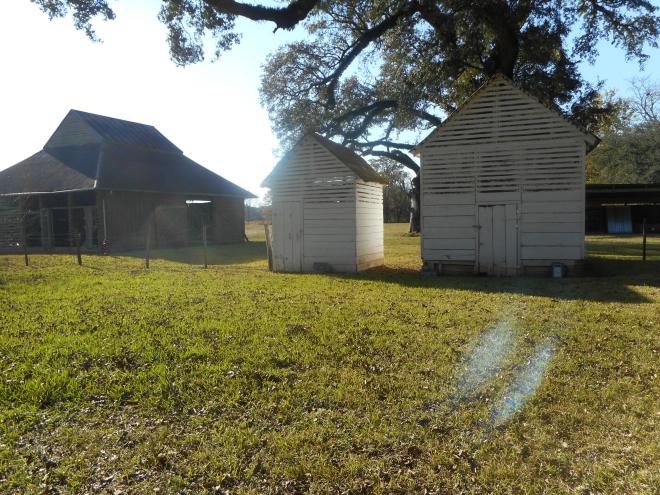
Cane River Creole National Park – Oakland Plantation, Natchitoches, Louisiana, November, 2016.

Since the meat of book one focuses on what life was like for a little girl, and then a young woman, growing up in slavery, the bulk of my research had to do with reading slave narratives and studying enslavement through the eyes of women and children.

Between Slavery and Freedom centers on Stella’s enslavement on The Saddler Plantation in Louisiana. As I introduce us to the first Stella, she is a six-year-old girl enslaved with her mother, Deborah. At this age, she is not aware that she is living property, which was typical for some enslaved children in their early years. She plays with the other children, including the slave owners’ daughter, but she does not yet understand the value of her flesh, that she could be bought, sold, traded, transferred, deeded, and gifted. Stella describes the plantation as a “big family.” She loves running through the dirt and the way it feels on her toes. She talks of childish things like eating sweet cakes, playing with Miss Carla, and trying to convince Mama, she touched the sun.

“One time, I made it where I touched the sun. It wasn’t even hot either. It didn’t feel like nothing but air. I told Mama the sun was tricking us. 

“And how it do that?”

“Cause Mama. I touched it, and it ain’t burn my finger none. It feels hot, but it ain’t really.”

– Stella, Between Slavery and Freedom

Historically, enslaved children who had a “childhood” in this way realized their status gradually. Their awakened consciousness may have been signified by seeing a family member sold for the first time or being sold themselves. The research points to ten as the age where the enslaved child knew and understood that he or she was property, except in the circumstances, as I have mentioned. As soon as they were old enough, the enslaved child’s life changed, and they realized that their lives as enslaved differed greatly from the lives of the white children they once played with as small children.

Slave-owners raised southern white youth as enslavers in training. Sometimes slave-owners gifted their children an enslaved person as a pet (sometimes it was the same child they played with). Literature also played a role in the training of southern youth to not only accept slavery as a regular part of society but to prepare them to own slaves of their own. Examples of such books is The Child’s Book on Slavery; or Slavery Made Plain. In a chapter called The Duty of Learning about Slavery, it states:

“if slavery is good, we ought to help it forward…”

In a chapter called Does Color Make Slavery, it states:

“Moses and all his people, I have said, were slaves in Egypt, but they were not colored people.” 

This explanation was to try to explain to the children that slavery wasn’t based on skin color, and it is a lie. Egypt is in Africa. Moses and his people were “people of color.”

In a chapter called What is a Slave, the author compares the enslaved to a horse, saying:

“Perhaps your father has a horse. That is his property. He has a right to make the horse work, only he should treat him kindly and give him good food. If the horse is his, nobody has a right to tell him he must not use the horse so. And then, if he thinks it best, he has a right to sell the horse to somebody else. Nobody has a right to forbid him. He need not go and ask even the horse, if he may have him plow the garden, or draw the wagon, for the horse would not understand him, and could not speak to him, and will never grow so old or so wise, that he can understand our words, and talk himself.”

Source: https://archive.org/details/ASPC0001969600/page/n5/mode/2up

Speaking of literature, another part of writing book one was reading many slave narratives, including Frederick Douglass An American Slave, and Up from Slavery. Other books included When I Was a Slave: Memoirs from the Slave Narrative CollectionBullwhip Days: The Slaves Remember, and Remembering Slavery: African Americans Talk About Their Personal Experiences of Slavery and Emancipation.

Cane River Creole National Historical Park

Cane River Creole National Park – Oakland Plantation, Natchitoches, Louisiana, November, 2016.

“Some people have to take the cotton and pick out the seeds, and others have to spin and weave. They don’t do nothing but spins and weaves. Some people even had to turn the weaves into threads.”

– Stella, Between Slavery and Freedom

More profound than this is my visit to a former slave plantation at The Cane River Creole National Historical Park in Natchitoches, Louisiana.

You might ask yourself why anyone would want to visit such a place. I was writing about people living on a slave plantation and what better way to get inside their heads than to visit one.

Originally called Bermuda, the founder of Oakland was Jean Pierre Emmanuel Prud’ Homme, who began farming the land in 1785 and received a Spanish land grant in 1789. The land’s first cash crops were tobacco, indigo, and cotton. The Prud’ Hommes were the first family west of the Mississippi River to farm cotton on a large scale.

Cane River Creole National Park – Oakland Plantation, Natchitoches, Louisiana, November, 2016. Slave Quarter turned home of Sharecroppers

“Down in the quarters, every family had a one- or two-room log cabin. Mostly one room though. We had mattresses filled with corn shucks. Sometimes the men build chairs at night. We didn’t know much about having anything, though. There were a lot of cabins for the slaves, but they weren’t fitting for nobody to live in. We just had to put up with them.”

– Stella, Between Slavery and Freedom

After the Civil War, sharecropper and tenant farmers continued to live on the land until the 1970s, and slave quarters became homes to sharecroppers later. The people worked twelve hours a day, six days a week. Seeing this with my own eyes put it into perspective how the south had reconstructed slavery by returning land to former slave owners and putting former slaves back into the fields under another name. Slave codes designed to control the enslaved became black codes intended to control freedmen, and cotton pickers became sharecroppers.

Martha Ann, an enslaved Laundress, worked in this wash house in the 1850s. In the 1940s, her descendant, Martha Helaire, earned $4 an hour working here as a Laundress. All we have to do is walk a few steps to the washer and dryer.

I blogged about this visit years ago. Get the full picture and see more pics by revisiting that post here.

Living on 40 Acres of Land

Finally, part of my preparation for book one also included where I was living at the time I started writing these books.

At the time I released the first book in this trilogy, my husband and I lived in an old house owned by our elderly cousin on 40-acres of land. Over the years, we planted a garden on the property, built a chicken coop and raised chickens, owned several dogs, goats, and even a horse. My grandmother-in-law also recounted stories of when she and some cousins picked cotton on this land.

The elderly cousin and her father built the house we rented many years ago. It was an old house and an old land. It was easy for my overactive imagination to envision what it would be like if we were not renting this house from our cousin; if we were not free to live life on our own terms; if this was not the 2000s, but the 1800s, and if we were not free but enslaved. I walked the property, breathed the air, and looked up at the trees. I had dreams of black people hanging from those trees and visions of people trying to escape.

We lived on that land for five years, eventually moving away in 2015, and I had a completed manuscript.


Preorder the ebook here for just 99cents

Preorder a Signed Paperback Here

Mark as Want to Read on Goodreads

(If you read Stella the first time around I would most appreciate you marking it as read on Goodreads!)

Revising The Stella Trilogy: Cast of Characters

I am always thinking about why Stella is so set-apart. Why are these books so effortless for me? The first time I released the series, things went smoothly, and the same is happening now. I can sit down, open Stella, and flow (or as I told a room of students, I sit down and bleed, to quote Hemingway).

A good fiction book, to me, has great character development. The characters are realistic in dialogue, how they talk to each other, what their lives are like, the decisions they make, and so on. When I am writing novels, I typically write Historical Fiction, so setting and dialogue are paramount. The setting is a significant element because the environment affects the plot and the characters. A story set in the 1800s must have language authentic to that time, and the characters must speak and interact like they are in the 1800s, not 2020.

My books tend to include a wide selection of people, some minor characters, some major characters. This is risky, but I’ve been told it’s one of my strengths. Somehow, I am capable of keeping up with everyone and letting them interact authentically.

Family Tree

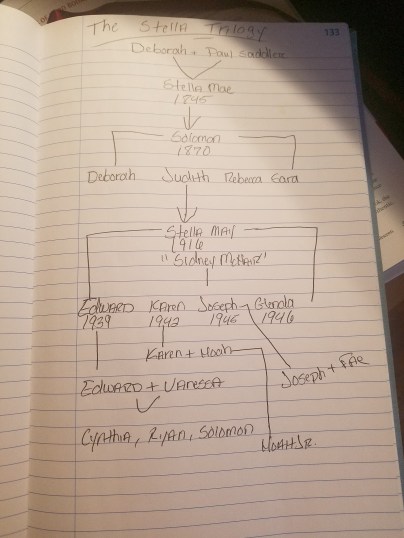
I’ve never fleshed out a family tree with any other series as I have with Stella, and I think it has helped with the writing. It doesn’t mean everyone in the tree are part of the central cast of characters or that I should include every detail, but it does make it easier for me when I am writing to remember who belongs to who. Stella is a short series (each book only about 100-115 pages). As Nathaniel, Hawthorne says, “Easy reading is damn hard writing.” Some may think a short book is quick and easy to write, but this is not so. It’s an easy read but requires just as much work as a full-length novel.

Let’s meet the family!

Paul Saddler and Deborah – Saddler is the owner of slaves on The Paul Saddler Plantation, including a young woman named Deborah. In 1845, Paul and Deborah had a little girl named Stella.

Stella and Solomon – Stella later gives birth to a little boy named Solomon. He is very light-skinned with jet black hair and green eyes like his father, John. Stella met John through her sister Clara, but you’d have to read book one to learn more about this awkward relationship.

Solomon – Solomon marries a white woman, and together, they have four girls: Deborah (named after Stella’s mother), Rebecca, Judith, and Sara.

Judith – It is in book two, we see that Sidney’s mother is Judith. Judith dates a black man and gives birth to a little girl she names Stella, in honor of her grandmother. But this Stella changes her name later in life (you have to read the book to find out why) to Sidney. Sidney marries a white man named Clarence McNair. Sidney and Clarence have four children: Edward, Karen, Joseph, and Glenda.

Edward – Edward marries a white woman named Vanessa, and together they have three children, Cynthia, Ryan, and Solomon. Ryan and Solomon aren’t major characters, but Cynthia is.

Karen – Karen dates a Black Panther in the 60s named Noah, and together they have a son, Noah Jr.

Joseph – Joseph marries a black woman, Fae, and together they have a boy and girl, Tanya and Micheal. It is in book three we learn what happened to Joseph after he left his mother’s house after the fight with Edward in book two, how he met Fae, and how he got mixed up in The Freedom Rides and Civil Rights Movement. His children are minor characters but add to the family tree and help to establish the depth of Jo and Fae’s relationship.

Glenda – Glenda is a single mom raising triplets, all boys.

In book one, we meet everyone here, including additional characters like Paul’s wife Elizabeth and their daughter Clara, Stella # 1’s friend Lola, Aunt Cecily, and others on the plantation.

What does writing out a family lineage as this do? 

It helps me to create vivid characters. Everyone didn’t come to me at once. I started with the first Stella and her mother, Deborah. The first time we go back to Stella’s time in book one, that first chapter is what started the series, with Stella and her mom at the store and Stella trying to tell mom she has to use the bathroom. I then went back to write what became the first chapter, with Cynthia and Alex later.

Even though the book is called The Stella Trilogy, I wanted to focus in on Cynthia in book one to explore how not passing down history can affect our children. In book two, Cynthia is two years old, and the year is 1979. In book one, we opened in 1996, and Cynthia is a young woman. The decision her dad made in ’79 causes her to grow up and not know who she is. We recount Stella’s story in book one because it is the glue that ties everything together. We then go backwards with books two and three to see just how things unfolded.

Why does Cynthia express racists thoughts toward blacks even though she has black blood? Why did Edward leave his daughter in the dark about the true nature of her race? What happened in 1979? What is Mama Sidney’s big secret? How did the history of this family get so lost? Will Stella’s legacy bring her family back together again?

One inspiration for this family tree was Roots. I love the “six degrees of separation” this groundbreaking series has to it. To learn more about the motivation of Alex Haley’s Roots, click here.


Coming March 24, 2020

About Book One:

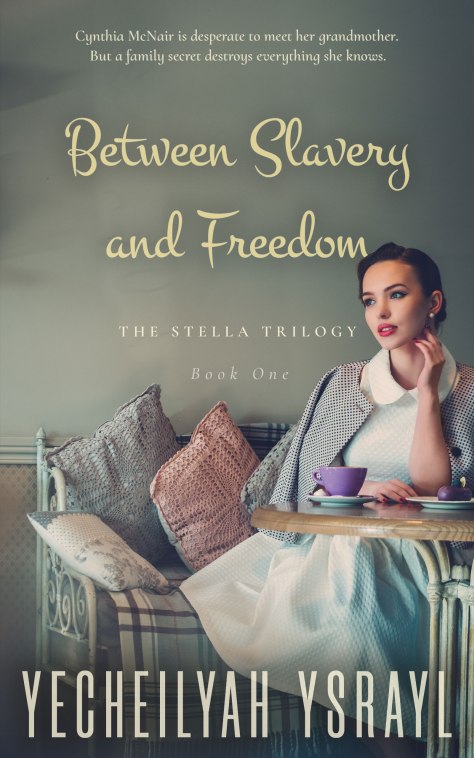
Cynthia McNair and her boyfriend, Alex, express some racist feelings toward blacks. The visit Cynthia’s grandmother Sidney McNair, who recounts the story of her ancestor, an enslaved woman named Stella Mae. Cynthia has no idea of her African ancestry or how deep this rabbit hole goes. Will she accept the truth about herself?

Why I Write Black Historical Fiction

Historical Fiction (specifically Black Historical Fiction) is my favorite genre to read and to write. I have to specify “Black” because I am not a fan of all Historical Fiction. My interest lies specifically in fiction stories that explore black history in some way.

Historical Fiction is the past recreated around the stories of people who seem real to us, including actual historical figures at times.

As we witness how fictional characters we care about interact with our ancestors and navigate a world now gone from us, it allows us to experience the past vicariously. Through the stories of the characters we can “visit” history and get a feel for what it was like to live in that time. But why is this important? I think a quote from the Toni Morrison Documentary “The Pieces of Me” (Hulu) sums it up:

“You imagine the past because the past has been ruptured. The record of the past of your people has been degraded. It’s been burned up, it’s been taken away.”

Tbt. The Historic Lorraine Motel, Memphis, TN

Not only has the black past been degraded but also entirely and tragically whitewashed. Dr. Martin Luther King Jr. is a good example of someone whose humanness has been reduced to the one “Negro” who bridged the gap between blacks and whites. A Civil Rights hero who succeeded in making blacks docile enough to accept that merging with white people was the best version of themselves possible. That, if we integrated, we were better people than if we had our own communities and businesses, and could determine the direction of our own destinies. Not that segregation was wrong, but that integration was better. That blacks were better when mixed with something else; that we could not be the midwives of our own selves. 

Although King was known as a civil rights leader and Malcolm X as a “black radical” both men were advocates of oppressed people. King told black people their blackness was beautiful, believed in economic freedom and establishing black businesses, preached on black power, and even owned a gun. King was just as “radical” as he was patient…but this isn’t the version of King we are given.

White America adopted Dr. King and used him as the black friend that is used by some to say, “Hey, I can’t possibly be racist because I have a black friend.” King is that friend. Sadly, we have someone whose name is widely known, but who, as a person, is not very well understood.

Forget about the Civil Rights icon, who was Dr. King as a man? Who was Malcolm X as a man? What could we imagine their persona’s to be like? Those of us born after they lived do not know but we can imagine.

What I do as a writer is to take the part of history not taught in schools, and use it as a tool to invent people who could have lived in a world that did exist. To then take these people and let them show us the truth about that time and place. To give these people real feelings and a voice that is authentic to what they could have said or what they could have done. I love to go back to a time before I was born and, through research and creativity, imagine what it would have been like to live in that era.


Stella Returns!

Book One Re-releases on March 24, 2020

About Book One:

Cynthia McNair and her boyfriend, Alex, express some racist feelings toward blacks. The visit Cynthia’s grandmother Sidney McNair, who recounts the story of her ancestor, an enslaved woman named Stella Mae. Cynthia has no idea of her African ancestry or how deep this rabbit hole goes. Will she accept the truth about herself?


There are only TWO days left of the $200 Amazon Giveaway! You can enter as many times as you like! Go, go, go! Link below:

$200 Reader Giveaway