
Author: Yecheilyah
Writing to restore Black historical truth through fiction, nonfiction, and poetry.

Why Do Authors Need a Copyright?
Excellent need-to-know information from Colleen. I’ve noticed that lots of people have been the victims of stolen work lately. It may be wise for all Self-Publishers to include copyright cost in our book launch plans.
7 Thoughts on the New Roots

When I first heard they were remaking Roots, I was skeptical. I thought, “Some movies do not need to be remade.” I admit, I was looking on the physical and thinking, “Maybe it won’t be as powerful as the first.” But after watching it I must say it remains one of the most powerful series on TV, followed by Underground. But first, here’s a little History:
What is Roots?
Roots: The Saga of an American Family is a book published by Alex Haley in 1976 with a miniseries of the book that first premiered on television in 1977. During this post-civil rights era the show is about the ancestors of Alex Haley, particularly Kunta Kinte, who was kidnapped from his life in Africa and sold as a slave on the Trans-Atlantic Slave Trade. The Show was put out in a series of eight episodes to try and get it out the way as the networks didn’t think it would do well. However, the show proved them wrong, airing over the course of eight days and helping to galvanize a nation. See, to understand why Roots the remake is important in this day and time is to understand the history behind it and what it did to America. The TV series led to a renewed interest in genealogy from blacks who, due to slavery, felt robbed of their identity and cultural heritage:
If you weren’t there—if you’ve only known television in its post-Big Three networks era—it’s hard to understand the impact of the original Roots. Based on Alex Haley’s book of “faction,” the ABC miniseries’ 12 hours (with commercials) were spread across eight consecutive nights in January 1977, an unprecedented programming move that consolidated the show’s status as an event. The subsequent audience ratings were also unprecedented: 85% of television households, or 130 to 140 million Americans (more than half the U.S. population) saw at least part of the series; an estimated 100 million viewers tuned in for the two-hour finale on Sunday, January 30. – http://www.biography.com/news/alex-haley-roots-tv-show
1. Our Culture
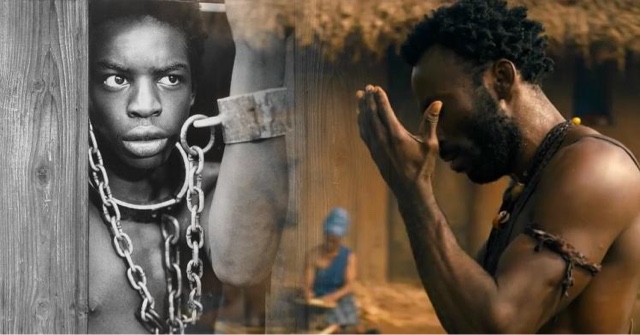
In the remake, it well represented the ancient culture of the African American. For centuries they have taught us we were animals running around naked with large hoops in our ears and swinging from trees. Taught that we were just Africans. While no TV show has gone as deep as to proclaim the unadulterated truth concerning our roots (not even Roots), I enjoyed the pieces of it sprinkled in the opening village scenes in the beginning because its an accurate portrayal of some of our culture. I loved that they showed the ancient garments, the head wraps and the midwives. Even the spreading of the palms to the heavens to pray. This is what we did and how we did it.
2. Stripped
By the time Kunta was on the slave ships he’s naked. Now we’ve seen this before in other shows, but what does it mean? This is highly significant of being stripped of your entire way of life. Gone is the beautiful blue garb, gone is the honor and the esteem, gone is the culture, and gone is the name that defines who you are.
3. Names
I don’t want y’all to sleep on the name part. Kizzy told Chicken George, “Your name is who you are. My daddy took beatings to protect his name”. Very powerful. People like to take names for granted. Often we look at them and they don’t hold any real significance but names are very important. Take away a persons name and you strip their entire identity. Your name is your character, and your persona. Your name is who you are. When we were stripped of our name, we were stripped of everything.
“People say what’s in a name? There’s a whole lot in a name. The African gets respect because he has an identity and cultural roots.” – Malcolm X
4. Biblical Insight
One of my most favorite scenes is when Chicken George introduced his mother Kizzy to his future wife and father-in-law and she said to him: “Massa don’t want you teaching about Exodus. About how the children of Israel walked across the red sea to freedom. He tore that right out the book.” Very powerful scene. Why? Because it’s the whole reason we weren’t allowed to read and write. Massa just didn’t say you couldn’t read because he thought you were an animal, an inhumane being. That’s only part of it. He didn’t want you to read because he didn’t want you to read the bible. Now why is that? Because the bible is black history.
5. Whites Persecuted
Another powerful thing this show portrayed is the persecution of Europeans who help blacks. This is also something they showed in the TV series Underground and I think its something that African Americans cannot sleep on. There are, and have always been, those of other nationalities who were wiling to help blacks to their deaths. Blacks were not the only ones lynched and maimed and murdered but also those who helped them.
6. Less is More
I didn’t like that they cut the series in half. I think it was too short. I also found it funny initially that Kunta’s character wasn’t switched out like in the first one so he looked the same throughout the series. However, I noticed that instead of going verbatim to the original they filled in those parts of the story that were missing from the first part. This was smart I think of the directors because this version has its own original feel. I thought this new Roots wasn’t going to be good compared to the first one but in truth they each are separate shows. While they tell the same story, the new Roots has a modern feel to it. Lawrence Fishburne, T.I. and Mekhi Phifer make their appearance and Kunta is a beast!
7. Now or Then?

I don’t think the new roots can compare to the original. To me, the 1977 version will always stand as a classic. I also do not think the original could speak to today’s youth like the new one can, which makes it an original of its own.
We have to consider that 2016 is not 1977. It’s a different world and the new roots is a fresh way of introducing to new generations the legacy of Roots.
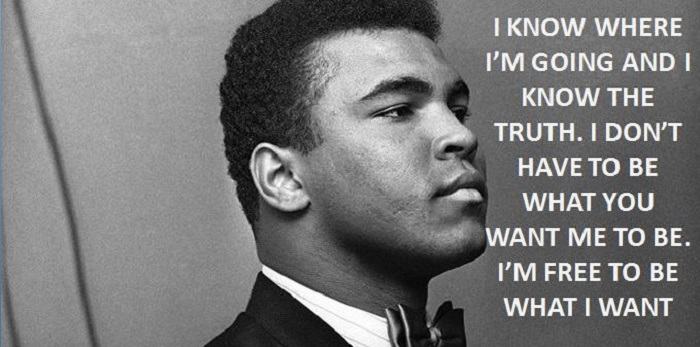
My Favorite Ali Quotes


EC Quote Friday

Movie Night Friday – Cooley High

Welcome back to another Movie Night Friday. It’s obvious you guys don’t like the movies I like but nonetheless lol, here’s another EC Fav: Cooley High.
Cooley High is a classic! First, its set in my home town of Chicago and I have a cousin whose name is on the bathroom wall in one of the scenes. In fact, everyone from Chicago probably has a relative who was in this movie. That’s because while the starring actors were pros, the extras were recruited right from the projects. Yup, many of these kids lived right over there in the Cabrini Green Projects.
Now, what is the movie about anyway?
Richard “Cochise” Morris (Lawrence-Hilton Jacobs), a local basketball hero, and Leroy “Preach” Jackson (Glynn Turman), who dreams of a career in writing, are likable Chicago high school students in 1960s Chicago. They’re into hanging out with friends, pretty girls and the Motown sounds so popular during the era. Each wants to make it big in his own way, but not everybody they meet is looking out for them, as they learn when a seemingly harmless outing goes awry.- Google
A simple film, Cooley High captured our hearts because of its realness. Though I wasn’t born in 1975 when it released, I too once lived in the projects on the city streets of the Chi. I too can remember growing up poor with a single mom. Movies like this are relatable and showcase the realness and often the struggle of inner city youth. The history behind the movie is also interesting:
The story behind “Cooley High” is even more dramatic than the comedy-drama that unspooled on the screen. It’s the story of Kenneth Williams, who, like protagonist Preach, left Chicago’s Cabrini-Green projects with dreams of becoming a Hollywood screenwriter. Having dropped out of high school, he hitchhiked from the Windy City to Hollywood with $5 in his pocket and no connections, and for a while he supported himself selling drugs. But the aspiring writer, who renamed himself Eric Monte, also befriended actor Mike Evans, who’d been cast as neighbor Lionel Jefferson on the groundbreaking sitcom “All in the Family.” Through Evans, Monte pitched the show’s producer, Norman Lear, a script introducing the characters of Lionel’s parents, George and Louise Jefferson. Lear bought the script and eventually spun off George, Weezy, and Lionel into their own hit sitcom, “The Jeffersons,” but Monte was neither hired as a staff writer nor given credit or residuals for “The Jeffersons,” which ran from 1975 to 1985.
– http://www.moviefone.com/2015/06/25/cooley-high-most-influential-movie/
Monte and Evans would go on to produce the sitcom hit Good Times.
Movie Trailer:
Since the movie is 41 years old, it was hard to find a Trailer that was clear enough and also interesting enough (Didn’t want to show scenes that made it look like a boring movie! It definitely is not). The one I found isn’t a trailer but just an excerpt from the movie. The only other option was from the old VHS and I didn’t enjoy that trailer. It wasn’t showing any interesting parts.
And that’s it for Movie Night Friday.

The Lotus

“The lotus is the most beautiful flower, whose petals open one by one. But it will only grow in the mud. In order to grow and gain wisdom, first you must have the mud — the obstacles of life and its suffering. … The mud speaks of the common ground that humans share, no matter what our stations in life. … Whether we have it all or we have nothing, we are all faced with the same obstacles: sadness, loss, illness, dying and death. If we are to strive as human beings to gain more wisdom, more kindness and more compassion, we must have the intention to grow as a lotus and open each petal one by one. ” ― Goldie Hawn
 The PBS Blog