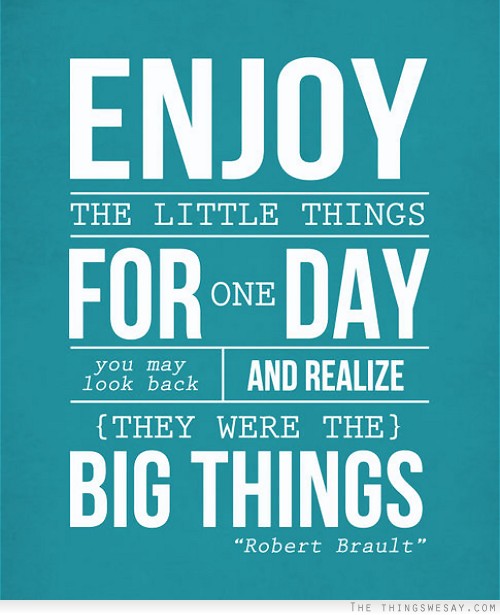
I’m a person who is either extremely excited, over the top silly or deeply saddened or concerned. I am either very serious or very silly. There is no lukewarm with me. There is no in-between. That said I try to also be very appreciative in my life. Appreciative of being alive another day. Appreciative of having a loving husband. Appreciative of loving family. Appreciative of supportive friends. Appreciative of a healthy mind and a healthy body. Sometimes you’ll see me get excited over certain achievements that may not look to be much but that mean everything to me. That’s because I think it’s important to always notice the little things.
It’s just that, the little things, that tests whether or not we are ready to move forward. It is the small steps we take every day, the trys that determine if we are worthy to move on. Without appreciating the small things it is not possible to hold on to the greater gifts to come. If I want my marriage to last I have to appreciate what is before my face now. Today. And when tomorrow comes, I can move forward and step into the shoes of what the future brings. And if I cannot for whatever reason appreciate what I have today, it is only hypocritical to think I am worthy of having possession of this relationship for an extended period of time.
I use my marriage just as an example, but we can apply this to our lives in general. Even when it comes to blogging. Yes, I blog a lot and I publish a lot and I share the work of others. I do this because I’m an all or nothing type of person. I am either going to put my all into it or I am going to abandon it. If I choose to give it my all, I will do so with the intent to nurture what I have been given and to plant the seeds that will grow to produce the kind of fruit I need to help to keep me fueled in whatever capacity that is. I believe blogging has been just as instrumental in my writing development as anything else in my life and though I do not see myself doing this forever, I take nothing for granted; or at least I try not to. The big things are always there and always will be there. They will always be at the forefront and on the top. They will always appear to be more shiny and glamorous and breathtaking. They will always promise to either validate you or break you but when it comes down to goals and ambitions and planning to implement a vision, it’s really not about the big things at all. It’s the little things that will actually help you to grow.
Blogging is not included because we are all obviously addicted to blogging. OK well, some of us. I’ll choose B for 200 Alex. Before I got involved with any social media, including blogging, I was on twitter. What attracted me is the limitation. I love having to say just a few words to get the point across, re-tweeting articles and quotes. Facebook is OK but I can really do without it. To me it’s kind of noisy and crowded whereas Twitter is a lot more laid back. Then again that could be due to the awesome people who follow me. I do think without cell phones people wouldn’t be so addicted to social media but that’s another post.
Enough about me, which are you? Don’t forget to follow this Twitter Bug by the way @ahouseofpoetry. It’s the best way to keep up with me, since I do like to fly and all. (No, seriously, I have wings)
It’s kind of hard to believe this today, but as recent as 1967, there was actually state laws that banned interracial marriage. These laws weren’t overturned until the Supreme Court case, Loving vs. Virginia in 1967. In that case, the Supreme Court found that it was unconstitutional for the state of Virginia to ban interracial marriage.
Although there are no longer any laws banning relationships, interracial dating remains a controversial subject for some people.
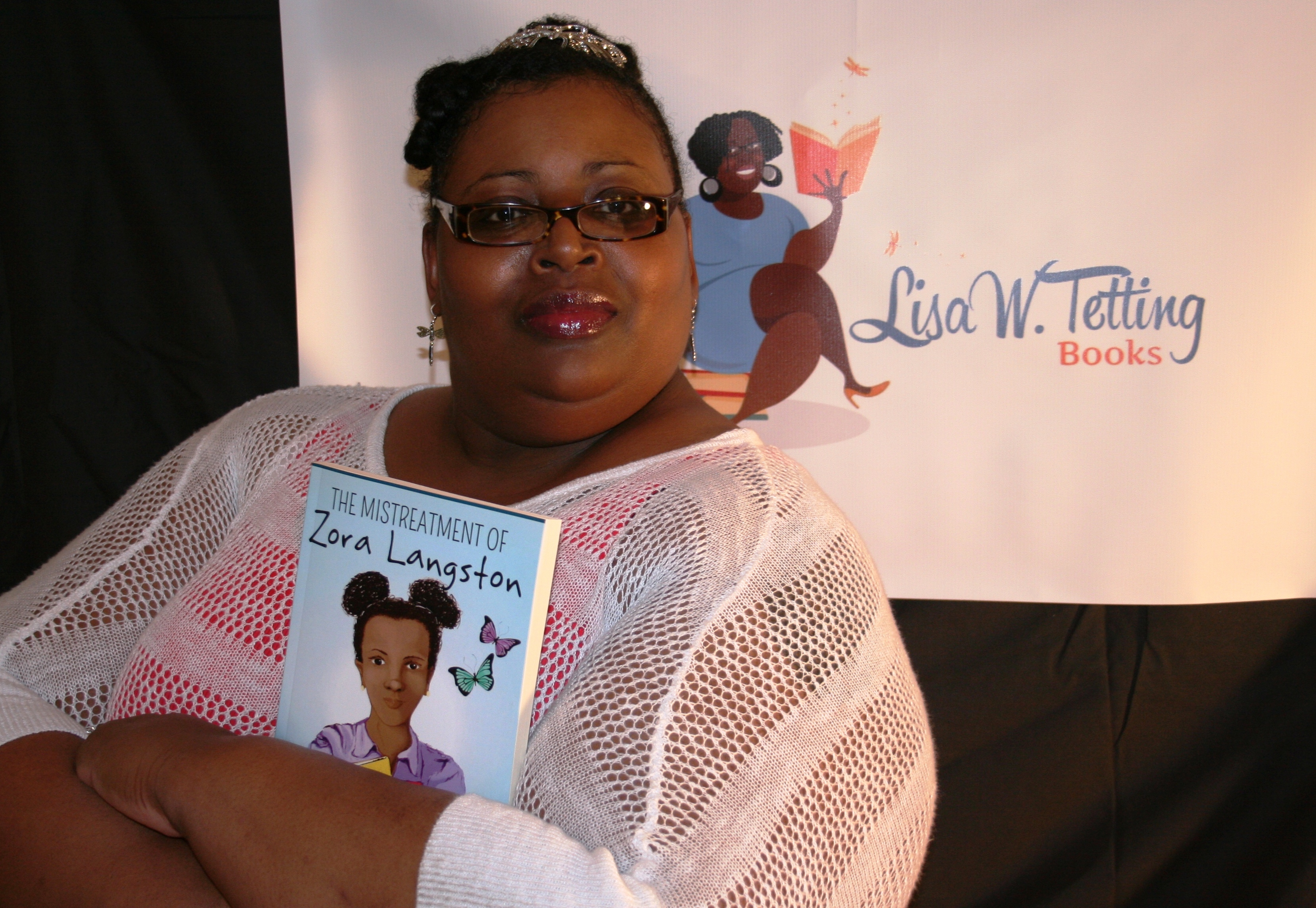
Welcome to Week #2 of my Fall Interracial Blog Feature! The Interracial Blog Feature was inspired by my new book, “Beyond The Colored Line”, and was created as a means to foster a better understanding of diverse relationships. Today, we welcome Lisa W. Tetting, author of “The Mistreatment of Zora Langston” to the convo.
EC: Hey Lisa, I’m so excited to have you spending time with us today. Can you give the racial background of you and your husband for the record and how long you’ve been together?
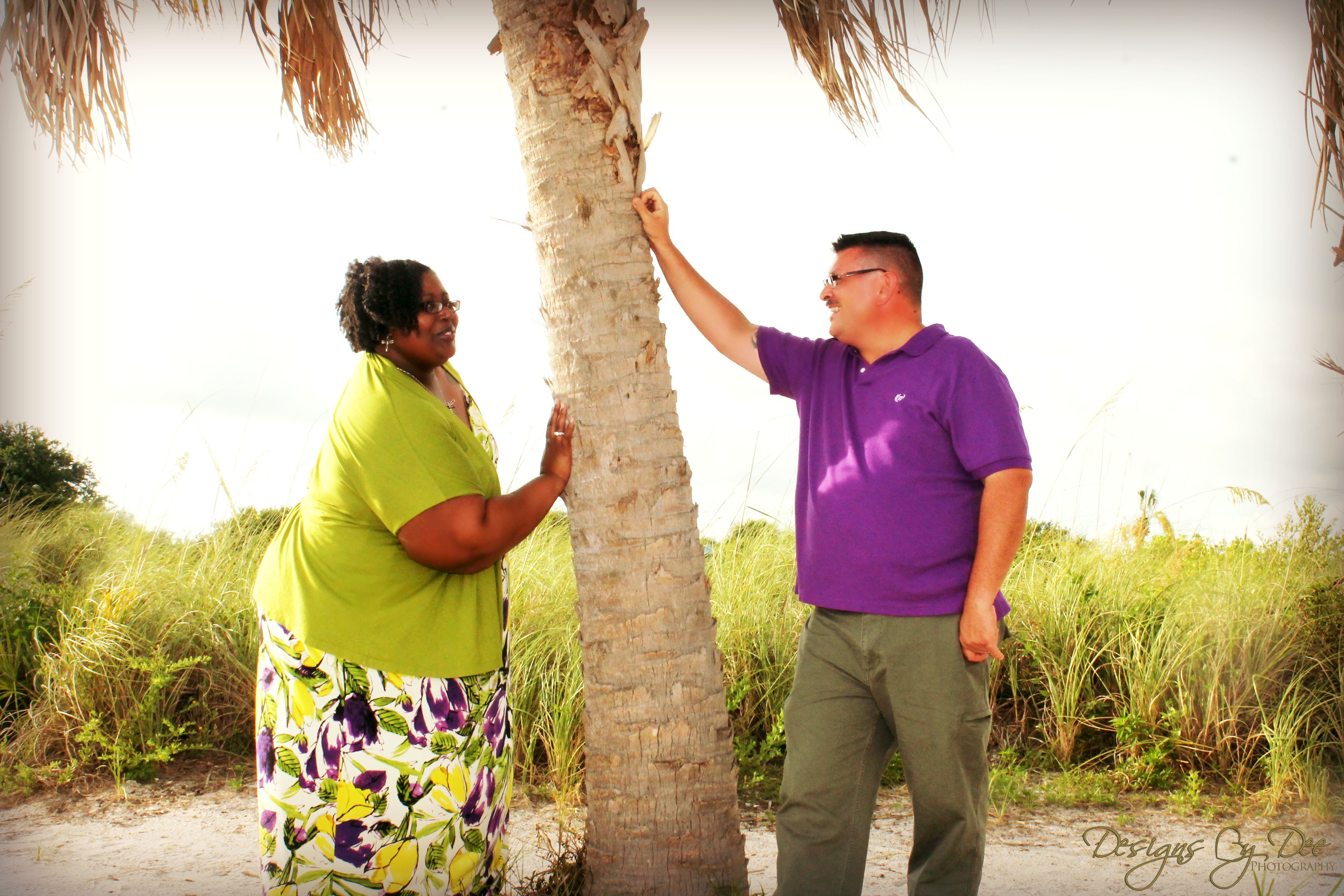
LT: Thanks for having me. My husband and I have been together for 20 years and married for 15 of those. I am of African American decent and he is Caucasian.
EC: Wow! So collectively you have been together longer than I’ve been alive! That’s so beautiful. Now, what are some challenges that interracial couples deal with that couples of the same race may not have to deal with?
LT: The obvious answer would be dealing with the stares of people who are not used to seeing mixed raced couples. Some people stare at us out of curiosity and others show complete disgust. Living in the south is somewhat challenging, but I will say it is easier today than when we first started dating. I can’t say for sure if it is a change in society or if we have simply gotten used to other people’s reactions.
Another challenge would be cultural differences. I have heard other mixed raced couples who say they struggle with their partner understanding their mindset and the differences in upbringing. I lucked out in that department because my husband was immersed in the culture and there have been very few times where he needs something explained. The same goes for me as I have always been someone who has an insatiable curiosity. This afforded me the opportunity to interact with people from all walks of life and all races.
EC: Awesome. Do you have any tips or advice to help couples overcome these challenges?
LT: As far as dealing with other people’s response to their relationship the only advice would be to ignore them. As with any relationship, you will never be able to please everyone so it is best to worry about pleasing the two people involved. No one else matters and that goes for family as well as strangers. If your family loves you they will come around and if not do you really want that kind of person in your life? You have the privilege of choosing your mate in this country so don’t let anyone deter you from being happy.
Speaking on cultural differences, you just have to show patience when learning the differences and be sure to wear your thick skin because there will be times when your partner will say something you may find offensive, but they are clueless to your interpretation. Be an open book and teach your partner instead of expecting them to know.
EC: Hmm, I love when you said your partner may not understand something, which is so true. Sometimes we are so used to being defeated that we are instantaneously offended at the mere thought of something when it was not intended to be that way from the perspective of the other person. I love that. Now, when African-Americans and Whites marry, there is more likely to be an African-American husband and a white wife. In fact, 73 percent of all African-American and White marriages have this setup. In your opinion and your experience with Interracial Relationships, why do you think Black men are more likely to date outside of their race?
LT: Actually, I have found that less than 12% of African American males marry outside of their race, this is according to the 2010 census figures. That being said, I feel when it comes to mixed race couples, black men may be more likely to date white females as opposed to black women dating white males. However, it seems the tables are turning in this aspect and more black women are allowing themselves to think and date outside the box.
EC: That is interesting since I hear a lot of black people, women in particular, accusing other blacks of being “sell outs” when they date outside their race. Have you ever had the misfortune of the title and why do you think this is?
LT: Actually I have never had that title bestowed upon me, at least not to my face. LOL. In my experience when dealing with other black women once they are aware that my husband is white; I am usually met with curiosity. Most of the time they have questions about how white men treat you as opposed to black men and my answer is always the same. A man is a man and he will treat you according to his upbringing and his interest in you. The manner in which he treats you depends on how you carry yourself, no matter his color.
EC: “A man is a man”, I love that. Let me know if this is too personal, but I have to ask: I’ve always known you to be married since following your blog, but I can’t remember ever seeing any pictures of your husband. Why is that?
LT: It is not too personal of a question as I am an open book. I try not to inundate my blog with pictures of my husband out of respect for his privacy because he is not one who indulges in social media. However, I have posted several pictures of my husband, some with me and some alone, on my blog.
EC: Oh, lol. So that means I ain’t been looking then huh? LOL. My husband is actually like that too. He’s not on social media, not even Facebook. His patience is really low with that sort of thing so I definitely understand that. Now, I’ve always wondered about the conversations between interracial couples concerning the ongoing racial tensions surrounding blacks and whites. Are there any moments where you and your husband disagree with a subject that is race related? If so, how do you deal with that?
LT: As far as conversations on racial tension, we are more times than not of the same mindset. The disagreements that may happen occasionally would arise from my inability to turn off my emotions when they are high and his need to move on from the subject at hand. Like most men, he feels a need to fix it and move on where me being an emotional female, I want to continue the conversation longer than necessary.
EC: LOL, right? These emotions I’m telling you. Now, any time before 1967 your relationship would technically be illegal. How does that make you feel today with the knowledge that you’ve chosen to be with someone outside of your race?
LT: I am very fortunate to have been born after 1967 and am thankful to Mildred and Richard Loving for the courage they showed in getting this archaic law removed from the books. It is very disconcerting to think I would not have been able to marry my soul mate if we had been born of that generation.
EC: Very true. Lisa, I want to thank you again for being part of this series. For the outsiders looking in, the people who are struggling to accept Interracial Relationships, do you have any advice for them?
LT: Open your mind! When you least expect it you may be surprised to learn you have more in common with someone who does not look or act like you. Get out of your neighborhood and travel. It is the one way to remove stereotypes and fear of the unknown. I’ve heard people say they are not racist, but feel people should stick to their own kind. I have a few words for them; I am sticking to my own kind… Human Kind!
EC: I know that’s right, gone girl tell it! I absolutely love traveling yaaass. You’ve been married for quite some time, what is the one thing that has helped you to survive your Interracial Marriage?
LT: This is not beholden to just Interracial Relationships; all marriages require love and care as well as good communication. You have to really like the person you have chosen to spend your life with; not just love them, but like them. If you don’t respect your spouse it is a recipe for disaster.
****
And that’s it family, Lisa W. Tetting on Interracial Marriages. As you can see from our Q&A, the purpose of this series is to shed light on the fact that mankind was made to be compatible with one another regardless of race. Thank you Lisa for joining me in this series. It was insightful, educational, and I had a great time!
Be sure to check out Lisa’s Social Networking sites and to purchase a copy of her book, “The Mistreatment of Zora Langston.” Stay tuned for another episode of Inside Interracial Marriages next week. You don’t want to miss our next interviewee!
Just want to remind you to join me tomorrow for another interview on the topic of Interracial Relationships. As you know, for the rest of this month I will be posting interviews I have conducted with some individuals on their thoughts on the topic of Interracial Marriages and the role race plays in relationships in general. This feature was inspired by the release of book two in my Stella Trilogy, “Beyond The Colored Line” this summer and will post every Thursday. Join me tomorrow at 8:00a CST to meet a good friend of mine and fellow WordPress blogger. You don’t want to miss this one!
OK, so you’re sitting down somewhere and you decide to read a book. Everything is going well and you’re sure that if given the chance you’ll win “The Best Reader Ever” award. You sit there and you think to yourself: “Wow, I am such a great reader!” All smiles as you professionally turn the pages. Then you decide, at a different time, to read a book. Only this time you decided to read it out loud instead of to yourself. It may even be the same book but somehow it doesn’t seem to be going as well as it did the first time. The same words that flowed smoothly in your head seem to have added more syllables. It’s to the point now that you stumble over words that were hard back in third grade. “Huh? Now I know I can read.” You say to yourself, you cannot understand it and for a second you even close the book and look at the cover. Yes, it’s the same book.
What is the correlation between reading in our heads (silently) and reading out loud? Does speaking guide us deeper into the conversation? What kind of power is there to a voice pumping out words? As I think about this, I wonder how this would sound if I was to record it for you. If instead of a blog post I sent a memo instead, do you think you would understand it better? After all, in this age of technology it is not always easy to discern the intent of text. I wonder if the tone of my voice, my mood, and my pronunciation would change the context in any way.
In my opinion, I think both the written and spoken word is important. And as I write, I do not believe every poem should be spoken. Some of the poems I write are structured in a way that must be read, while others are structured in a way that must be heard. In this way, I believe the difference in the way we react to the written and spoken word is in the differences in structure and style. For instance, in a letter I may write: “I ponder this as I prepare to release…” But if I was verbally speaking to you I would probably say something like: “I thought about this since I’m about to come out with…” It is not that I cannot write how I would speak; it’s just that we tend to speak in a less formal way when we’re talking than when we are writing. It is much more spontaneous, there is no preparation; we use the slang of our upbringing, and neglect complete sentences.
This is what I like most about the spoken word. There are so many additional elements available to help understand the meaning. You don’t just have words to work with, but there is also body language, facial expression, and tone of voice. A speaker is capable of both giving and receiving feedback instantly. Right away he or she is able to determine whether or not their way of dress, hair style, or accent influences the information in any way.
On the other hand when we write, it tends to present itself in a way far more grammatically correct (I use grammatically correct loosely and really for lack of a better word since my writing is not exactly grammatically correct in the English sense of the word but you get the point) than if we were to say it out loud; perhaps a symbolic way of representing things like pauses or tone of voice in speaking. While speaking is straight forward, writing must take on a form of speech in a way that demonstrates the moving of lips without physically seeing which is perhaps the implementation of a more proper usage. You can see my facial expression when I’m talking to you but to write it I must use words to create that image. That is what I love most about the written word, a portrait of something painted not by images but by words. A sound heard not because it is audible, but because it was etched into paper in a way that is loud.
Additionally, the most important, and also the most fun, thing about writing vs. speaking to me is also that it tends to live on longer. This can be a good and a bad thing. It can be a good thing because it gives us the chance to record beautiful words like poetry and stories to live on for as long as they need to. Our books can be passed down to our children and grandchildren like pictures. But it can be a bad thing because if you recorded something wrong or irrelevant that can also live on! I think this is one of the reasons writing has been associated with being a kind of skill. Perhaps it is because we learn to speak before we learn to write. We pick up the language of those around us and attach to them the context of our environment. Before you know it we’re “Mama” and “Dada” all over the place! Now, because we have understood this language and associated it with the people around, this does not mean we know at that moment how to write it which will come much later.
But today is a new day, and with technology the power of speech has taken on new meaning and it too is also considered a skill. Not only can you record permanent versions of speech such as poetry, memos, speeches, lessons, etch, but today writing is not alone but “Public Speaking” has also evolved into a skill.
An answer kept sacred inside the breast of nothingness. Thinking for the moment to have sent up hope into an empty sky. What becomes of silence? It ignores our hunger for answers and tugs away at anxious spirits. Uncontrollably the mind races to the next step, pondering what may become of lines uninterrupted by commas and periods. Of thoughts quickly running on to the “why’s” and “how comes”. Never once does it seek to ponder why silence makes such a covenant with our minds, commanding only a light breeze from the wind when not a sound is heard as it eases past our skins. Not once does the busy mind, always racing and so on edge care to ponder what is to be learned in the quite. Silence laughs at the foolishness of our impatience, grabbing time by the hands and together they leave us sick with questions. What is the next move to be made in the stillness? What revelation taps against the calm meditations of the heart? What revolution for our cries? What reproof must we seek to understand in the devastating muteness of the air?








 The PBS Blog