Timbuktu is a city in the West African nation of Mali, situated north of the River Niger on the southern edge of the Sahara Desert. Founded by nomads, it is most known as “The City of Gold.” While some scholars and proposed travelers attempt to debunk the “myth” (claiming to have reached the city where the homes are made of mud bricks), Timbuktu was one of the most important centers of trade and intellectual life in West Africa, flourishing through participation in long-distance trade networks directed north across the Sahara. The city is known as having traded goods that flowed through the center including salt, ivory, and gold. One of the reasons for Timbuktu’s wealth is the water supply. There are many wells containing sweet water in Timbuktu, where the Niger in flood canals delivers the water to the city. Grain and animals are abundant, so that much milk and butter is consumed.
A picture from a medieval atlas, drawn in modern day Spain. It shows the King of Mali, Mansa Musa, who reigned between 1312 and 132, wearing a Gold Crown, Gold Ingot, and Gold Scepter.
During the fourteenth century, the story of Timbuktu as a rich cultural center spread throughout the world. The beginnings of which can be traced to 1324, when the Emperor of Mali made his pilgrimage to Mecca via Cairo. In Cairo, the merchants and traders were impressed by the amount of gold carried by the emperor, who stated that the gold was from Timbuktu. Furthermore, in 1354 the explorer Ibn Batuta wrote of his visit to Timbuktu and told of the wealth and gold of the region. Thus, Timbuktu became renowned as an African El Dorado, a city made of gold.
“Until comparatively recent times, knowledge that black Africa was the seat of highly evolved civilizations and cultures during a time when Europe stagnated was limited to a small group of scholars. That great empires, such as Ghana, and later, Mali flourished for centuries while Europe slept through its Dark Ages almost has been ignored by historians. Thousands of years before that, civilization began with the black races of Africa and Asia, including the Hebrews, who were jet black. Because of the scarce literature on the contributions of blacks to world civilization, most people today hold the erroneous opinion that the black races have little real history. It was not known, for instance, that the ancient Hebrews, Mesopotamians, Phoenicians, and Egyptians were black. Now, a growing body of literature is presenting the illustrious history of blacks and their enormous contributions.”
And that’s it for this week’s episode of Black History Fun Facts. Below is last weeks episode in case you missed it:
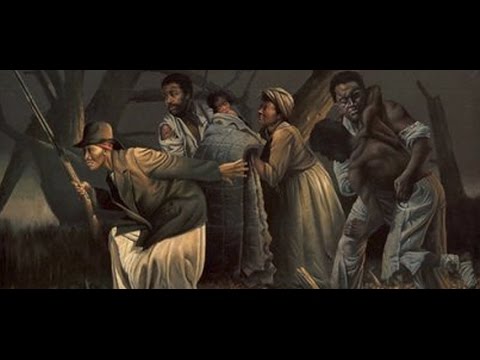
If you could go back to Harriet Tubman’s days and with what you know now, help her to free more slaves based on your knowledge of the future, would you be able to help her? With what you know about history today, would you be able to assist her in carrying more people to freedom? With all of the technology and historical knowledge and books and slave narratives and everything you’ve stored away to this point, could you honestly say that you could help her? Many of us don’t even know what direction the sun rises and sets in, let alone navigate without GPS. This is why I watch shows such as #Underground.
What amazes me is that when a Tyler Perry movie comes out, we don’t hear nothing about how we’re tired of seeing black men in dresses. I don’t hear anything about how we’re tired of seeing black men and women run around joking all the time about nothing. We make excuses for that. We don’t hear nothing about Fifty Shades of Black, Get Hard, or throwbacks like Don’t Be A Menace to South Central While Drinking Your Juice in the Hood. When Noah and Gods of Egypt came out, I didn’t hear nothing about all the biblical inaccuracies that can be proven just by reading the first few chapters of Genesis. But when it comes to a show comprised of information we need to know, now we’re tired of slave movies even though many of our brothers and sisters don’t even know what the half of slavery was really about and the psychological trauma it still holds today.
I’m still hearing people say that the light skin slaves were house slaves but this is not historically correct. The Mulatto was the first to be sold because the mistress did not want to look at the proof of her husbands infidelity with the “niggers” every time she looked at those children. Not that mulattoes were not in the house, but the point is they were “field niggas” too. There was a ranking system based on skill and worth and it didn’t matter what color you were a slave was a slave. Whether in house or in the field none of it was esteemed over the other you was still a slave. Some of us still think Rosa Parks was the first to refuse to give up her seat on a bus. She was not, but that’s the point. There’s still lots of people who don’t know. We don’t know what Reconstruction was about. We don’t know what Jim Crow was about. We don’t know what The Harlem Renaissance was about, or for a more earlier term, The New Negro Movement. We don’t know what The Civil Rights Movement was about. We don’t even know who The Black Panthers truly were aside from the hateful militia group people tell us they were. Prince just died and they say he had no will. Prince was a man who sued people all the time in regard to the legalities of his career. He’s not the kind of man who would not have a will but this is what they tell us. The point is that we don’t know half of the black history that we think we know and even what we think we know, we don’t really know. What Harriet Tubman and the many others had to endure, I had to endure too. For we are all connected, the human family. We are the bloodline and the experiences of our ancestors still runs through our veins. They say that if you don’t know your history, that you are bound to repeat it. This is why I go #Underground.
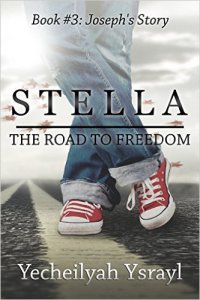
The road to Freedom: Joseph’s story, may be set In the time frame of the early 60’s but it’s contents is very relevant to today’s current events.
The writer takes you on a journey through the eyes of a young man named Joseph. He and his friends begin down a road with only the hope of wanting to somehow help the fight for equality of African Americans and to stop the mistreatment they suffered under segregation and Jim Crow laws. They realize that the task would be harder than they imagined. As they travel down the road of reality, they find that the segregated world they live in has been paved with cruelty, injustice, and was blinded by hatred and strong resistance to even the notion of change. Joseph and his friends encountered first hand the mistreatment and persecution of the African American people and those that helped them.”
Constance Says:
“In the book Stella: A Road to Freedom #3 Joseph’s story. In this 3rd installment of the series this book told the story of Joseph’s journey in finding himself. The truths that he faced were an eye opener for him. Joseph and his friends, all young, embark on this journey to fight for equality and freedom. In their journey they learn just how much racial inequality there is. They learn that even the friends that they that choose to align themselves with can possibly get them killed. Their alliances with one another in this fight showed just how unaware of the seriousness of the road they were traveling. This book was well written. I was worried for them being young and traveling across the country to fight for the freedoms of integration. I love the history that is told in this book and when it comes to telling this story through Joseph’s eyes, you have to question whether or not we as a society today are still traveling this same road to freedom and if we will ever find it. The characters in this book are relatable and the writer continues to leave readers wanting to take a look back into history. This series should be required reading in middle schools and high schools around the country…its just that good!”
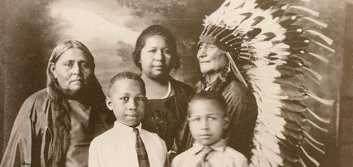
Is something I hear often among the black community. Even in my own family, my mom talks of how her dad was 100% Cherokee Indian and how our family were cow slaughters which explains my maiden last name which is Hereford, a kind of cow.
However, while many black families are proud to proclaim their Native Heritage, what is rarely passed around our dinner tables is an important fact in American History. This fact being that even the 5 Civilized Indian Tribes held slaves. A lot of black people jump at the chance to proclaim the above statement because oppressed people typically wants to identify with other oppressed people but the truth is stranger than fiction. Native Americans were oppressed by Europeans but they both had black slaves. In fact, Native Americans knew the layout of the land better than anyone else and it was they who taught the Europeans how to track and to capture slaves. (This is why in last weeks Underground Episode the little boy asked the black slave, “You used to live with the Indians didn’t you? And you taught my daddy how to track.” He used to live with the Indians because he was their slave same as he is the slave to the little boys father. Underground is a very well written TV show).
“Though the harsh treatment of enslaved Africans largely paled in comparison to that of white slaveholders, Blacks still were treated as an underclass among Native Americas. The Five Civilized Tribes even established slave codes that protected owners’ property rights and restricted the rights of Blacks.”
Cherokee is one of the tribes who took part in the Trans-Atlantic Slave Trade (along with Chickasaw and others). In addition, the term “Cow-Boy” is also derivative of slavery. The slave boys who handled the cows were called cow boys. So when you watch Quentin Tarantino’s Django the content is actually not out of context far as the cow boy theme is concerned and my maiden name is potentially much more deep than we know.
It is no secret. Racial tension in the United States has not dwindled. In fact, not only does racism, discrimination, and police brutality continue today but it does so with just as much vigor as if it had been torn from the pages of the 1940s, 50s, and 60s. It is today’s current events that will add to the history our children will one day read about. However, to understand one’s future one must first understand the past.
I spend a lot of time speaking about ancient black history but the truth is that many of us do not even know our current American history. The past is filled to the brim with African American contributions but our understanding of these endeavors is either unknown or utterly flawed. Uncle Tom was not a sell out, Christianity was not beat into black people, Rosa Parks is not the first person to refuse to give up her seat on a bus, Negro spirituals was not made up babble, and black people did not die for the right to vote (we died for Freedom). These are just a few of the common misconceptions that are not only regurgitated as truth, but even taught in our schools. And it is the inspiration behind why I write black.
Not only is slavery being taken out of school textbooks, but many people have no idea concerning what these times were truly like. Nor can many people name more than a handful of individuals in relation to black history itself. Many African Americans in particular have no idea of their rich and glorious past which started long before slavery. I write these books because we cannot guarantee that our present will preserve the rich legacy concerning the true birth of a nation. Today Martin Luther King Jr. and Rosa Parks are the only names many people know and it is a disservice to the many other influential individuals in the black community. Even so, what happens ten years from now? Will Martin King and Rosa Parks names ring foreign? What would have happened if someone long ago did not write about them? Would we have known? Can we depend on modern society to teach history? What happens ten years from now? Will we understand what slavery was really about? Sharecropping? Tenant Farming? Does the black man and woman know who they were before slavery?
The Stella Trilogy is a series of short stories about one family and their search for identity amidst the African American fight for freedom. These books are my attempt to remind all people of our forgotten legacy so we never forget what freedom looks like.
I was only two years old in 1989 so I obviously was not aware of these men when the story first broke. In 2002, when the man who committed the crime stepped forward and these men were officially declared innocent, you can still say that I was a baby being only 15 years old. As I think about my life and the things I was doing then, graduating Middle School and entering High School, I cannot help but to think about these men who, at 15, was on their way to jail.
You can say that they were doomed from the beginning. Let’s set the scene. In 1989, big cities like Chicago and New York City was overflowing with crack addiction within the black community.
“Crack popped up in Miami and Los Angeles in the 1970s. The Drug Enforcement Agency didn’t pay it much mind then. It was nothing more than a different version of cocaine, the agency figured. Crack arrived in New York City in the early 1980s before most of the public had heard anything about it. The department was understaffed. Budget cuts from the 1970s, when the city was almost bankrupt, had forced the NYPD to lay off nearly a third of its officers from 1975 to 1982. Meanwhile, crack began its spread across New York. It was cheaper than cocaine. Anybody could afford it, and anybody could sell it — anybody could buy a gram of coke, chop it up, cook it, and flip it for double the money. So now, all of a sudden, you have got a product that is saleable to a mass new audience,” Robert Strutman, a former New York city D.E.A. agent, told PBS Frontline in 2000. “And that is what the New York drug peddlers did. They mass-merchandized cocaine.” The media world first noticed crack in 1984, when the Los Angeles Times reported that “cocaine sales explode with $25 rocks.” According to a 1999 paper in Columbia University’s Souls journal, reporters began using the word “crack” in 1985. The earliest instance was a November 1985 story in the New York Times: “new form of cocaine, known as crack, was for sale in New York City.” By 1986, crack was available in 28 states. Newsweek called the drug’s impact a “national crisis.”
You can be sure that this was by no accident. The media practically advertised crack cocaine. Crack destroyed the Black community like no other weapon could. I speak not from a Google search or a spectator of the news, I speak from experience. I watched the drug take over the minds and bodies of those close to me. As a 90s kid, with crack being born in the 80’s, by the time I was growing up it was at its peak and those addicted were completely strung out. You see, it was cheaper than other drugs. This meant that everyone, including parents became junkies. No, not just parents, children.
This created gangs, drug dealers, and naturally, much violence. Because the victims of crack are African American in the majority, almost all crimes are presumed to be related, in some way, to blacks in the inner cities with an emphasis on males. So when a group of young men go to Central Park New York to hang out and witness numerous attacks that lead them to head home for curfew around the same time a young white woman (28yrs) is raped and beaten beyond recognition, it is no secret why police decide to bring these men in for questioning. Besides, it is a trend that has existed for centuries. Had this been 1929 instead of 1989, these men would not have had the “privilege” of an arrest, they would have just been hung from the nearest tree.
“Isa 42:22 But this is a people robbed and spoiled; they are all of them snared in holes, and they are hid in prison houses: they are for a prey, and none delivereth; for a spoil, and none saith, Restore.”
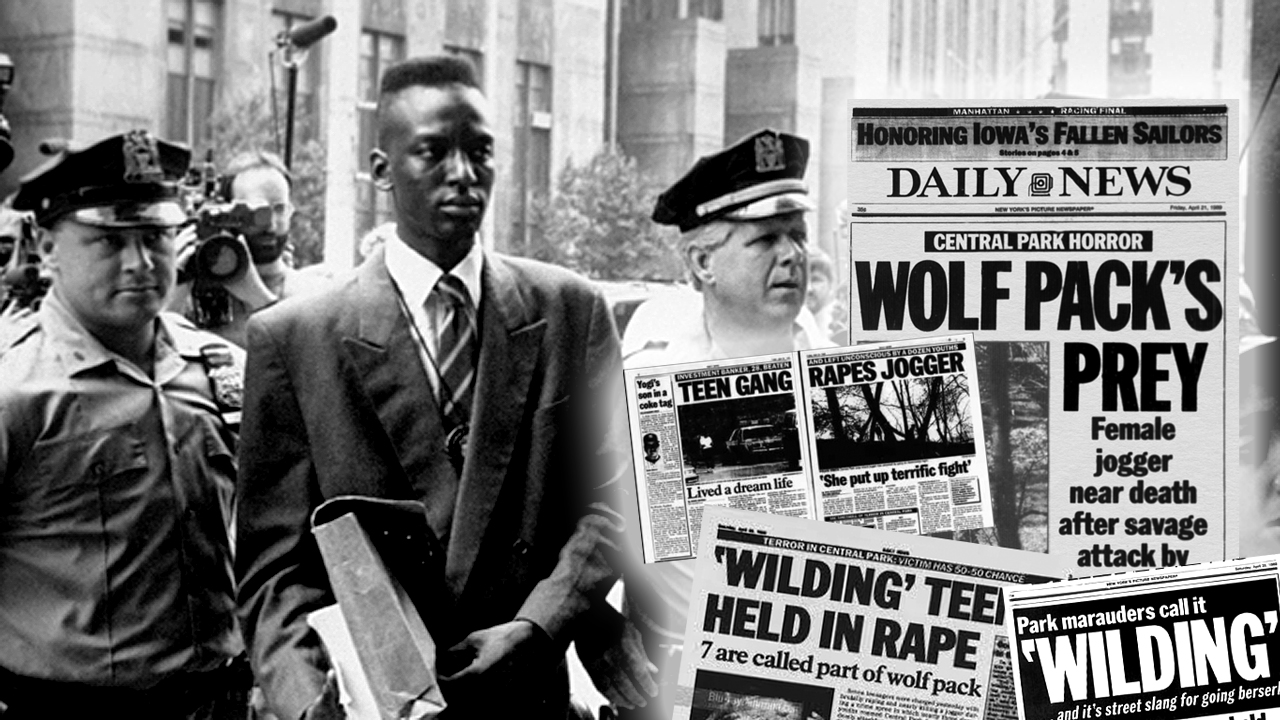
On April 19, 1989, five young men, ages 14 – 16 were recorded on video confessing to attacking, raping, and almost killing Central Park jogger Trisha Meili. In two separate trials, five young men were coerced into video taped and written confessions that sent them to prison. Still, after the confession, all of the young men pleaded not guilty and claimed that their videotaped confessions were concocted by the cops.
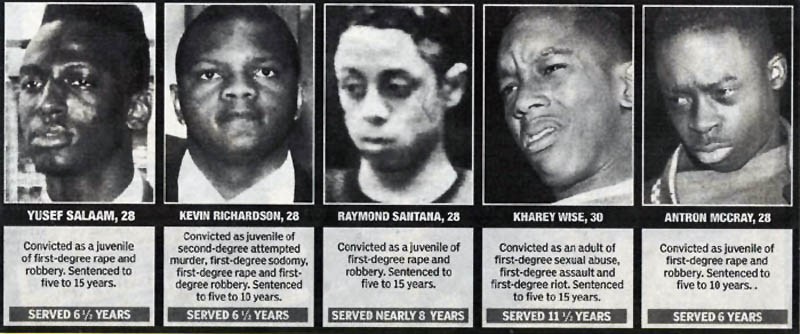
The story of the crime, as told by the police and prosecutors, was that a group of young people, were “wilding” through Central Park and after harassing a few other people, eventually led to the beating and sexual assault of the woman jogger. The story quickly exploded into the public eye, and I am sure those of you older than me remember the story. Because of the taped confessions, the jury ruled the young men guilt in two separate trials in 1990. Antron McCray, Kevin Richardson, Raymond Santana, Yusef Salaam, and Korey Wise served sentences ranging from five to thirteen years.
Korey, the oldest of the group, got the most time and was still enduring his sentence when he got into a confrontation with a man named Matias Reyes at the prison where they were both serving sentences. The confrontation was over something simple but Reyes apology had a far deeper meaning. Korey, presuming it was because of their jailhouse brawl, dismissed the man’s apology.
On August 12, 2001, just months after the only DNA collected at the crime scene, which was never tied to any of the accused, was matched, Korey got out of prison. Matias Reyes had committed to the crime that sent these young men to prison. In 2002, one year later, the young men were exonerated. However, their innocence did not ring as loudly as their assumed guilt.
The Central Park Five as Adults
In 2012, a documentary was premiered of this case titled “The Central Park Five”. For those of you on Netflix, you should find it there. Otherwise, I highly recommend you activate your Google skills and find it. It is a story far too familiar and is well worth the watch.

 Timbuktu is a city in the West African nation of Mali, situated north of the River Niger on the southern edge of the Sahara Desert. Founded by nomads, it is most known as “The City of Gold.” While some scholars and proposed travelers attempt to debunk the “myth” (claiming to have reached the city where the homes are made of mud bricks), Timbuktu was one of the most important centers of trade and intellectual life in West Africa, flourishing through participation in long-distance trade networks directed north across the Sahara. The city is known as having traded goods that flowed through the center including salt, ivory, and gold. One of the reasons for Timbuktu’s wealth is the water supply. There are many wells containing sweet water in Timbuktu, where the Niger in flood canals delivers the water to the city. Grain and animals are abundant, so that much milk and butter is consumed.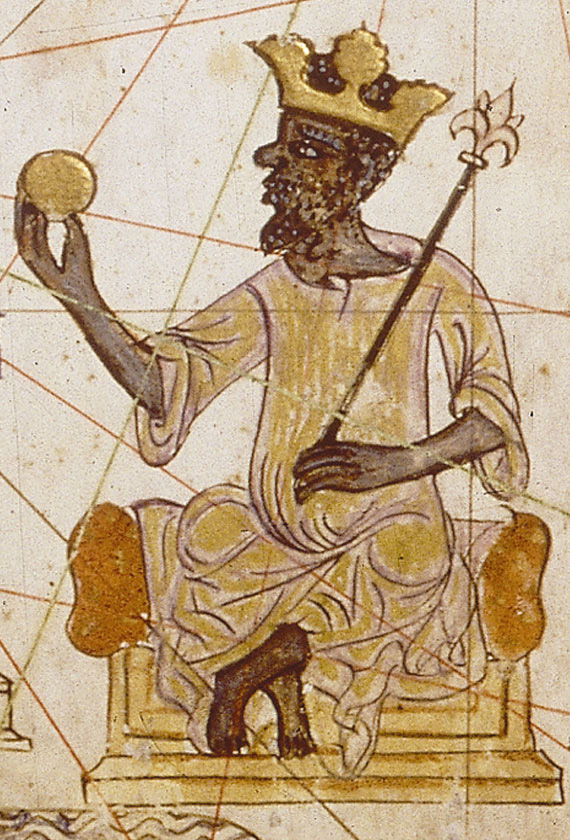
 “Until comparatively recent times, knowledge that black Africa was the seat of highly evolved civilizations and cultures during a time when Europe stagnated was limited to a small group of scholars. That great empires, such as Ghana, and later, Mali flourished for centuries while Europe slept through its Dark Ages almost has been ignored by historians. Thousands of years before that, civilization began with the black races of Africa and Asia, including the Hebrews, who were jet black. Because of the scarce literature on the contributions of blacks to world civilization, most people today hold the erroneous opinion that the black races have little real history. It was not known, for instance, that the ancient Hebrews, Mesopotamians, Phoenicians, and Egyptians were black. Now, a growing body of literature is presenting the illustrious history of blacks and their enormous contributions.”





 The PBS Blog