Title: Black History Facts You Didn’t Learn in School |Author: Yecheilyah Ysrayl | Publisher: Literary Korner Publishing | Release Date: February 24, 2024 |Cover Art by David Colon | Edited by Writing Endeavors®
It’s been a long time coming!
What started as a profound series on this blog has been transformed into a full-length history book you can carry with you!
Inspired by the Black History Fun Fact Friday series, I am incredibly honored to finally introduce the book version, Black History Facts You Didn’t Learn in School.
My greatest hope is that after reading this book, you are equipped with enough information to spark conversation and, if necessary, participate in your own activism for the continual education and restoration of Black historical truth.
I was away spending time with family when the now-viral Montgomery Riverboat brawl occurred.
When I finally logged into social media, I saw hilarious memes of folding chairs and pictures of Louis Farrakhan clamping his hands together proudly with the words: “Black people across America watching that video today…and ya’ll know what video I’m talking about.”
But I did not know what video they were talking about.
And then I saw it, but the fight video did not draw my attention as much as a specific viral meme.
This meme is inaccurate and should not be shared!
The meme identifies Nathaniel Alexander as the inventor of the folding chair, but the picture is of a different Black inventor.
The man in this picture is not Nathaniel Alexander. It is Lewis Howard Latimer who worked with Thomas Edison and helped make the light bulb possible.
Latimer is responsible for many of Edison’s patents because he worked as the original draftsman at Edison’s research laboratory.
Latimer also worked with Alexander Graham Bell on the telephone.
I cover more about Latimer in the upcoming book.
As for Alexander, he was not the first to patent the folding chair, which had already been used going as far back as ancient Egypt.
In the US, an early patent for a folding chair was by Jordan Cram in 1855.
Alexander’s invention improved the folding chair featuring a book rest which he patented in 1911.
“The purpose of my invention is to furnish a chair with a book rest or support that will be immediately placed in position when the seat of the chair is lowered…Another purpose of the invention is to provide a folding chair with a book holder and rest…”
Fredric Arnold also patented a folding chair in 1947.
The memes are funny, but historical context is important. A child somewhere now thinks Lewis Latimer is Nathaniel Alexander and that he invented the folding chair because it’s all over Google.
While both were Black inventors, the meme is decontextualized and could lead many astray.
Cause really, neither man invented the folding chair.
Let us do our part to ensure that we are not spreading disinformation. Black history is too rich and extensive for us to have to make anything up.
I wouldn’t say going viral is fun. I find it overwhelming. However, it could be less stressful if you are prepared. Here’s what I am learning.
Proper Preparation
When I first joined TikTok, I made my account a business account. I didn’t wait until a bunch of people followed or anything like that because I knew I wanted to use it to increase awareness about my poetry and black history book. I added my website link, which I customized for TikTok like I did on IG.
This made it easier for people to sign up to my email list and visit my website to order books once my videos took off. Without this seemingly small act, I would have been stressed about where to direct all these people. Thankfully, I had somewhere for them to go if they wanted to learn more about me.
Don’t Worry About the Numbers, Just Post Your Content
I immediately noticed that once a video goes viral, people binge the rest of your content. This means that even if your posts aren’t doing well (regarding numbers), you should continue to post! This way, you are not frantic about what to post next after your viral moment.
I had tons of other black history videos, and poetry content people could watch while I worked on creating more videos.
Every post on my page averaged over a thousand views after that one viral video. I followed this up with a welcome video, directing people to my email list, and then I posted again today (7/19) a whole week later.
The viral video is on its way to a million views, and I have reached 15K followers, up from the 3K I had when I first posted.
SN. I have never used ads or paid anything to boost my videos on TikTok. All my growth is organic.
Changes to My Account
After 5K follows, you can no longer see who views your posts. I don’t like this change because I enjoyed being nosy. (lol) I like to see who is just watching versus who is taking action.
You now have the option to create a playlist to organize your posts. I like this because I can now separate my poetry videos from the Black history ones. Even though the black history is more popular, I still do poetry and I don’t want my audience confused. You will get black history but you gonna get these poems too.
You can now have people subscribe to your page instead of just following it, apply to TikTok’s creator fund to start making money and sign up for the TikTok shop.
That’s it so far!
Authors, Are You on TikTok? Do You like it or Nah?
Once upon a time in Alabama, there was a racist white man named Charles Agustus Lamar who was angry with Northern states and their desire to end slavery. He devised a plan to send a ship to Africa to buy Africans for $100 and sell them for $1,500. His ship, called the “Wanderer,” made national news in 1858 that it had successfully imported 370 people from Africa who would be enslaved.
However, the slave trade had been outlawed, and Lamar was arrested for illegal slaving.
That’s when another racist white man, steamboat captain Timothy Meaher, made a bet that he could do the same thing but not get caught.
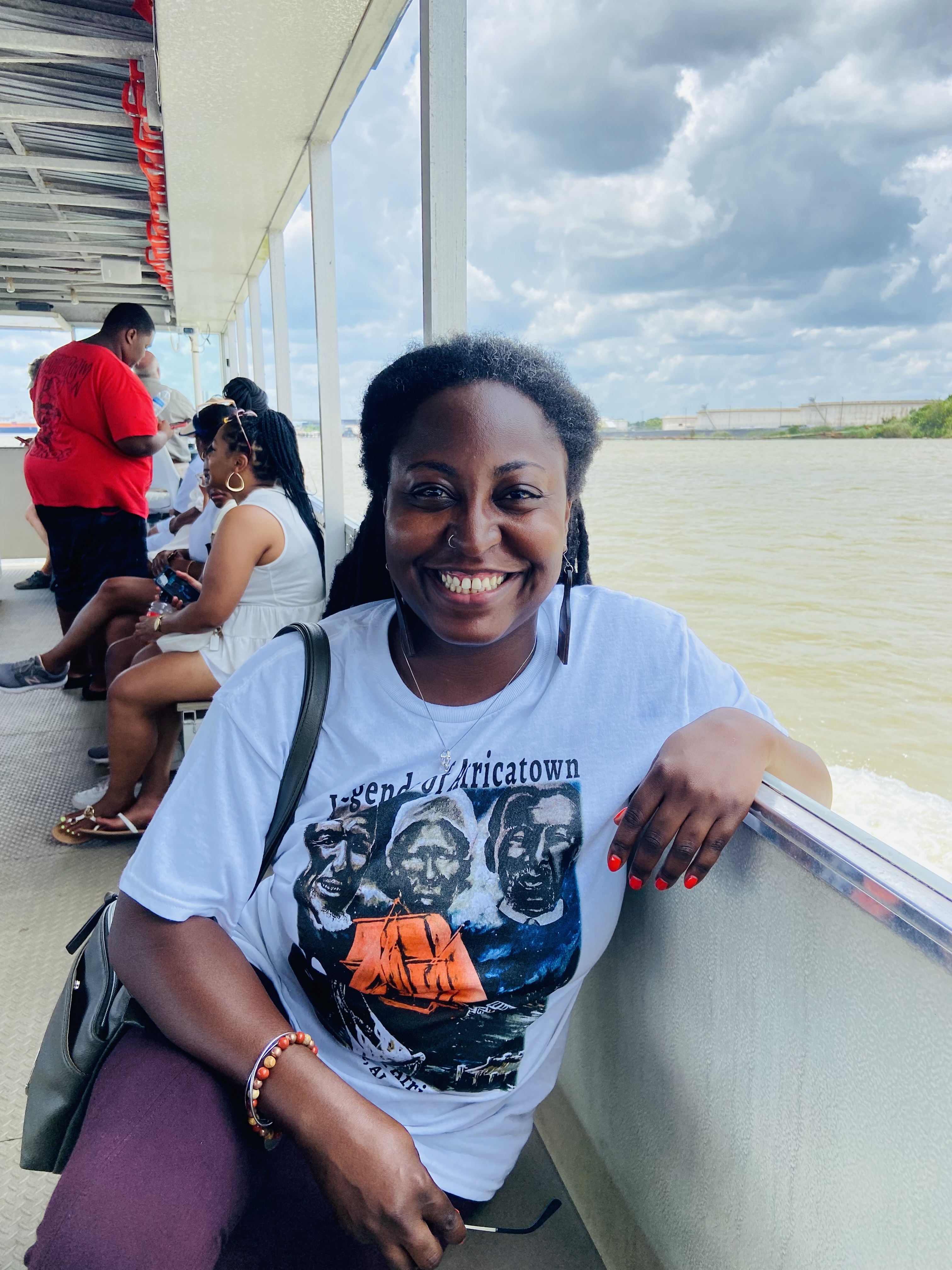
Photo: Yecheilyah
On July 8, 1860, the ship (called the Clotilde / Clotilda) sailed into waters near Mobile Bay carrying 110 men, women, and children stolen from Africa under the cover of night.
They were bought from the Dahomey tribe at $100 each.
After dropping the people off, they burned the ship to hide the evidence, and it was thought to be gone forever.
On Saturday, July 8, 2023, I and a group of others had the opportunity of a lifetime on the 163rd anniversary of Clotilda bringing our people into this land.
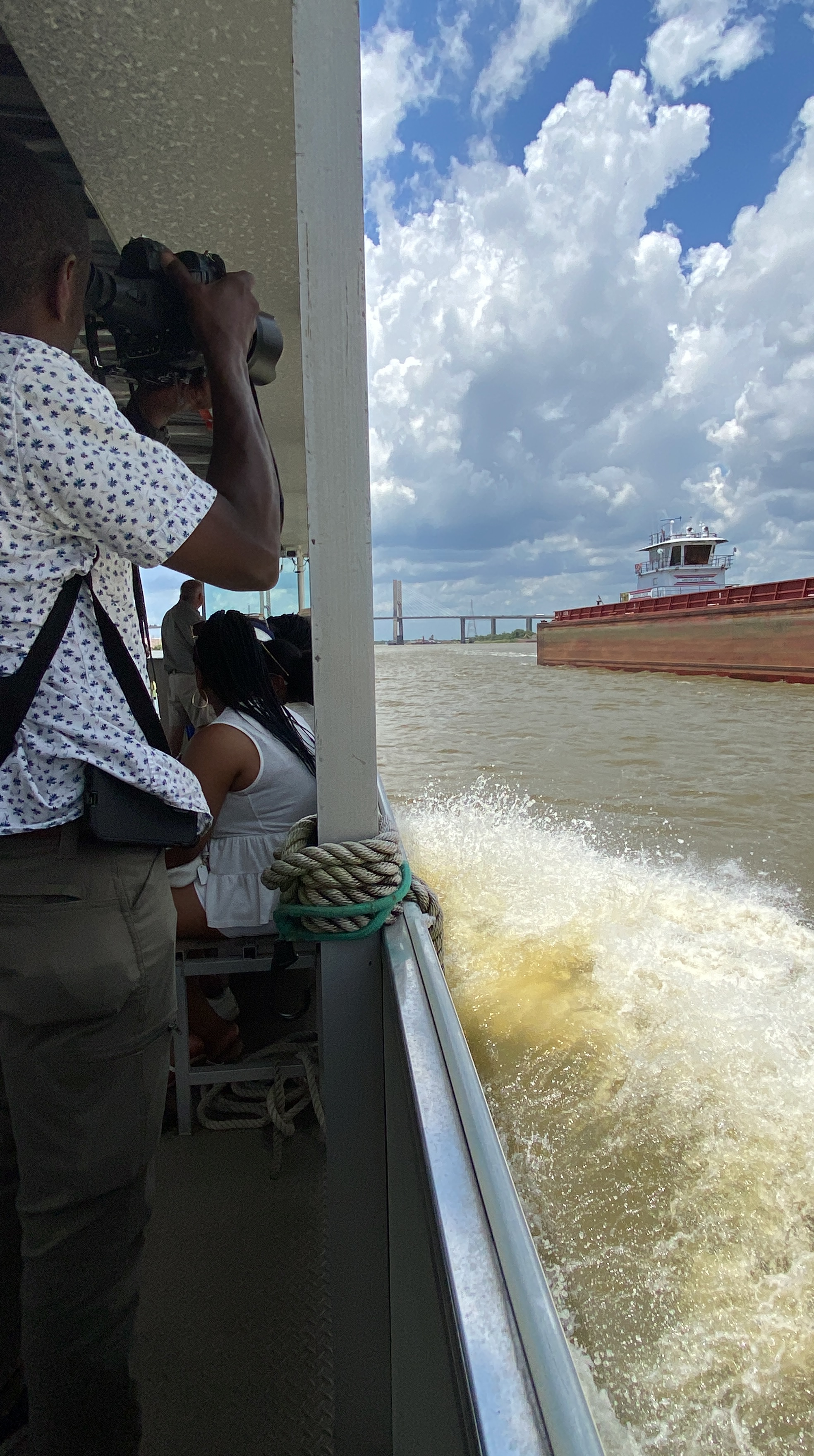
We met and talked with Raines about his journey and findings and sailed to the location of the wreckage, still buried underwater.
It was a humbling experience that filled my heart with much gratitude.
We saw the swamps our people had to walk through once they were let off the steamboat, and it made me truly not want to complain about anything ever again.
A festival was also taking place to celebrate the opening of the Africatown Heritage House.
It felt like 150 degrees out there and ya girl put this scarf on me. Imma let it slide cause she from Kenya, lol.
Once our people were freed, they built their own community and called it Africa Town, which was the original name because the founders ruled it according to the laws and customs of their African homeland. By the early 1900s, Africa Town (later spelled Africatown) was the fourth largest community in the nation governed by African Americans, attracting the attention of Booker T. Washington and Zora Neale Hurston.
Today, Africatown is on the brink of disappearing, though it is a huge part of why this story has been preserved, as the Clotilda prisoners passed it down to their descendants.
More on Africatown and the Clotilda will be covered in the book!
What’s Next?
On our way back from the site, we discussed hopes that there is more focus on preserving the community of Africatown and providing it with the resources needed to thrive. With the money pouring in from the Heritage House, the fear is people might want to come in and gentrify the area. The hope is there is money going into the community to help the people too.
We also hope they do not remove the Clotilda wreckage from the water. Not only will it cost millions of dollars just to remove it, but it might also decrease the value of the wreck and the area.
We propose that instead, a replica of the ship can be made. Again, this will bring resources to the community as everyone wants to see the actual ship. There could be tours conducted to view the replica, the Heritage House, and finally, a boat tour through the location (the same as the one we took this weekend). It can be an exciting three-day or full-day adventure with resources going toward rebuilding the Africatown community.
Photo: Yecheilyah
Africatown is the only known Black community that still exists today that was founded by Black people who had come straight from Africa.
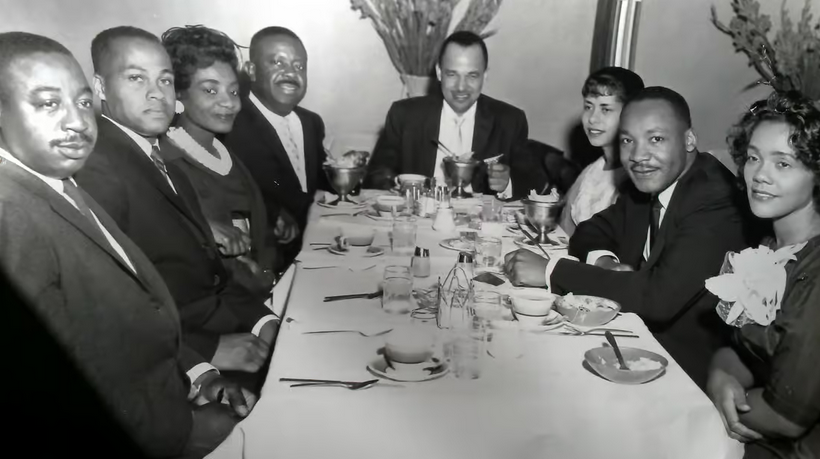
Rev. Fred Bennett, Mr. Isaac Farris, Sr., Mrs. Christine King Farris, Rev. Ralph D. Abernathy, Dr. Roy C. Bell, Mrs. Clarice Wyatt Bell, Dr. Martin Luther King, Jr., Mrs. Coretta Scott King; Pascal’s Restaurant, Hunter St., Atlanta, GA. ~1962 — Photo via Dr. Clarice Bell on Flickr
I am no longer doing anything uncomfortable to make others comfortable.
Yesterday, I turned 36, and you would think this is a lesson I’ve learned by now.
But Paschal’s restaurant was the straw that broke the camel’s back. It upset me for a number of reasons.
But first, a little history.
I chose Paschal’s because I heard about their fried chicken and soul food. Google also informed me that the area has a fantastic civil rights history, having served as the main gathering spot for movement leaders, such as Dr. Martin Luther King Jr., Andrew Young, Maynard Jackson, and others. It was founded in 1947 by two Black men, James and Robert Paschal.
I saw Dr. King’s and others’ images on the walls and was sold.
I didn’t look at any other spots after that. That was where I wanted to go. The prices were steep, but I didn’t care. I was told to pick out any place I wanted, and this is what I wanted.
Or so I thought.
The first red flag was the valet parking, which we paid for via cash app.
I frowned. Cash app?
Now I’ve used cash app for many things, but a restaurant isn’t one of them.
But I didn’t want to be difficult so I said okay.
We walked in, and I felt like I was back in High School.
Call me bougie, but I was uncomfortable.
I am all for having a good time with my people, but this looked a lot different from the layout on the website.
I expected a fine dining experience with adults and a hint of black history and soul food.
And while the historical images were there, I got a room full of black people blasting Beyonce and standing around like they were at a club.
I was disappointed in what had become of the place. Although I’ve never been, I am sure it was a lot more refined when Dr. King ate here.
You can tell just by the picture above. See how they are carrying themselves? See the arrangement of the dishes? See the dignity?
The lack of decency and respect for our ancestors enough to take care of what they left us (because I am sure the Paschal’s would expect more) saddened me.
To make a long story short, we left.
It is not that I would never eat there. There is a time to kick back in that way. It is that I expect more. I expect more from my people just like I expect more from myself.
Take care of the legacy your ancestors leave behind.
Being Unapologetically Me
Thus, as my heart began to race and irritation blanked my face, I realized all the times I settled because I wanted others to be okay even if that meant I wasn’t. And I decided right then and there that I would no longer accept anything that made me uncomfortable just because I didn’t want to be “too much.”
I am too much.
My standards are high, and from this point forward, I will walk unapologetically in this truth.
I suppose the message here is, I hope you will too.
Be unapologetically YOU.
Update:
We returned to Paschal’s months later and had a much better experience! The music was tasteful, it wasn’t crowded, and the fried chicken was divine. (The fried green tomatoes, not so much.) The first time, I didn’t consider graduation and Memorial Day weekend. I would recommend this place for sure. There is a grown and sexy vibe with the dimmed lights, bar, and jazz. Just ensure there aren’t any events happening that day and the children are still in school when you go.
I am excited to be on the finishing end of this book and start to send out ARC copies.
If you are familiar with the Black History Fun Fact Friday series, this book is that series in book form, only much more polished and with more information.
Beyond that series, what inspired the book?
We are particularly familiar with the names of Dr. Martin Luther King Jr., Rosa Parks, Frederick Douglass, Harriet Tubman, Langston Hughes, and Zora Neale Hurston. These outstanding leaders had a lasting impression on Black Americans’ history.
But two questions stick out:
How much do we really know about them?
What are some names and histories of other leading Black people and events we are unfamiliar with.
I am looking for:
Black / African American readers passionate about Black history
Readers of any ethnicity who love Black history
History buffs in general
Readers willing to leave an Amazon review of the book when it releases
What to Do Now
Please email me at yecheilyah@yecheilyahysrayl.com if you are interested in beta reading to receive a copy.
Please help me extend a warm welcome to Terry Lister.
Welcome to the PBS Blog!
What is your name and where are you from?
My formal title is The Honorable Terry Lister, FCA, MBA, JP. While l had to work very hard to be given these titles, today l am retired. And in retirement, l have more or less retired my titles. I live in a much more relaxed manner than that under which l was burdened when l was working.
Nice. And where are you from?
I am from the beautiful island of Bermuda. We, Bermudians, believe that everyone has heard of us and thus knows where our island is but l know that both of these beliefs are false. We are an extremely small island located in the Atlantic some 700 miles from North Carolina. I have lived in Bermuda all my life except for ten years when l studied and worked in Ontario, Canada. The title The Honorable is due to my serving as a member of the Bermuda legislature for 21 years including ten years as a Minister of Government. I retired in 2014 and immediately took on my most enjoyable task of my life, that of being a slow solo traveler.
What was your childhood dream?
What I do today was always a dream for me but before I could get to it life stood in the middle. I had to get educated and I had to have a job, preferably one that paid lots of money. Growing up black in Bermuda meant that any black male who did not seek a career in the trades would have three choices: doctor, lawyer or teacher. Not wanting to do any of these, I was stumped until one day when asked for the 100th time I responded by saying I wanted to be an accountant. The questioner was floored, never had a little black boy said he wanted to be an accountant. Seeing the reaction this answer produced, I said it every time from about 12 on. It didn’t matter that I had no idea what an accountant did, I just knew it had to be special by the reaction of my questioners.
By the time I needed to make an informed response and I found out what an accountant did, I was so on it and that is what I became. By the age of 27 I was a partner in the Bermuda firm of Deloitte, becoming the first black person to be a partner in a then Big 8 Bermuda audit firm. So I made my dream come true and I never regretted this. The FCA behind my name is a special recognition in my profession given to a small number of the members due to distinguished service to the profession and the community.
Terry outside Bascillica, Ivory Coast
Wow. What an amazing and inspiring story.
What would be the most amazing adventure to go on or that you’ve been on?
Given that I am a full time traveler, I have been on many amazing adventures. However, if required to name one I would say it would be trekking Mountain Gorillas in Uganda.
Wait, what?
Your stories get better and better! Go on, tell us more.
As we were starting to leave the Gorillas and head out, one quickly came down a tree and landed very close to me. The guides tried to act calm but I could see some degree of fear. However, I acted as calmly as I could and waited for the gorilla to wander off. Got some great shots! While I do enjoy writing, travel is my first passion and many of the experiences I have had were simply mind blowing.
Wow. I bet. So, what state or country do you never want to go back to?
To date l have been to 95 countries…
Say whattt??
Just about every country has something about it that makes me wish I could go back. However, the one place I will not go back to is Tunisia. This northern African country was recently in the news about their behavior towards black Africans. I was there for 12 days in 2019. I was not treated with any warmth most of the time, often I had to fuss with taxi drivers to get them to take me where I wanted to go and, worst yet, I had an incident with the police who detained me for several hours for the crime of walking along a country road going to see a point of interest. There was a nasty undercurrent as I moved through various parts of the country and for that reason I would not return.
I’m so sorry you had to go through that craziness. Thanks for the heads up!
Let’s get into your publishing journey. When did you publish your first book?
I published my first book, Immersed in West Africa, in August 2019 just two months before my bad experience in Tunisia. My wife had organized a launch party which went really well and the book should have been off to a great start. However, we had selected a launch date and refused to move from it. The result was the publisher rushed the book and it was not a good product. Some of the attendees who bought books that night have chosen to not buy any books since which l find to be such a disappointment. When l realized the extent of the problem we sat down and fixed the flaws and put out another copy which has sold well. Beyond that this book has won 12 awards. Today, l am very proud of my first book, Immersed in West Africa.
And proud you should be. It is a wonderful and informative read. I’m glad you didn’t give up and re-released it.
What takes up too much of your time?
The most time consuming part of my writing is the marketing of the books. I am not a known author so l have to work every day to keep my books in front of people. It is both very time consuming and very challenging. Naturally, my genre is Travel and l write about my travels. So l cannot say, “enough of this, I am going to be a sci-fi writer.” Therefore I use up many hours doing things to get my books in front of potential readers.
Who is your favorite historical figure?
When l started high school way back in the dark ages, as my children would say, my class was taught Latin. Little did we learn but some of us took to the stories especially the Punic Wars and General Hannibal. He became and remains my favorite historical figure. When l went to Tunisia I went to see the remains of his city, Carthage. Consistent with the removal or destruction of many other creations of Black Africans prior to colonization, there was little to see while throughout Tunisia there are many Roman sites from the same and slightly later time period.
So, is the Honorable Terry Lister a political man?
Am I political? Does a horse drink water!
Yes, l served 21 years in the legislature of my country from 39 to 60. These were the peak years of my work life so it is impossible to not be political. However, I see my role today as observer and scribe. I spend very little time in political discussions or arguments as I was expected to do for the previous 21 years. My experience does make me well prepared to observe and to ask questions as l travel along.
You’re amazing.
Thank you, Terry Lister, for spending this time with us.We enjoyed you!
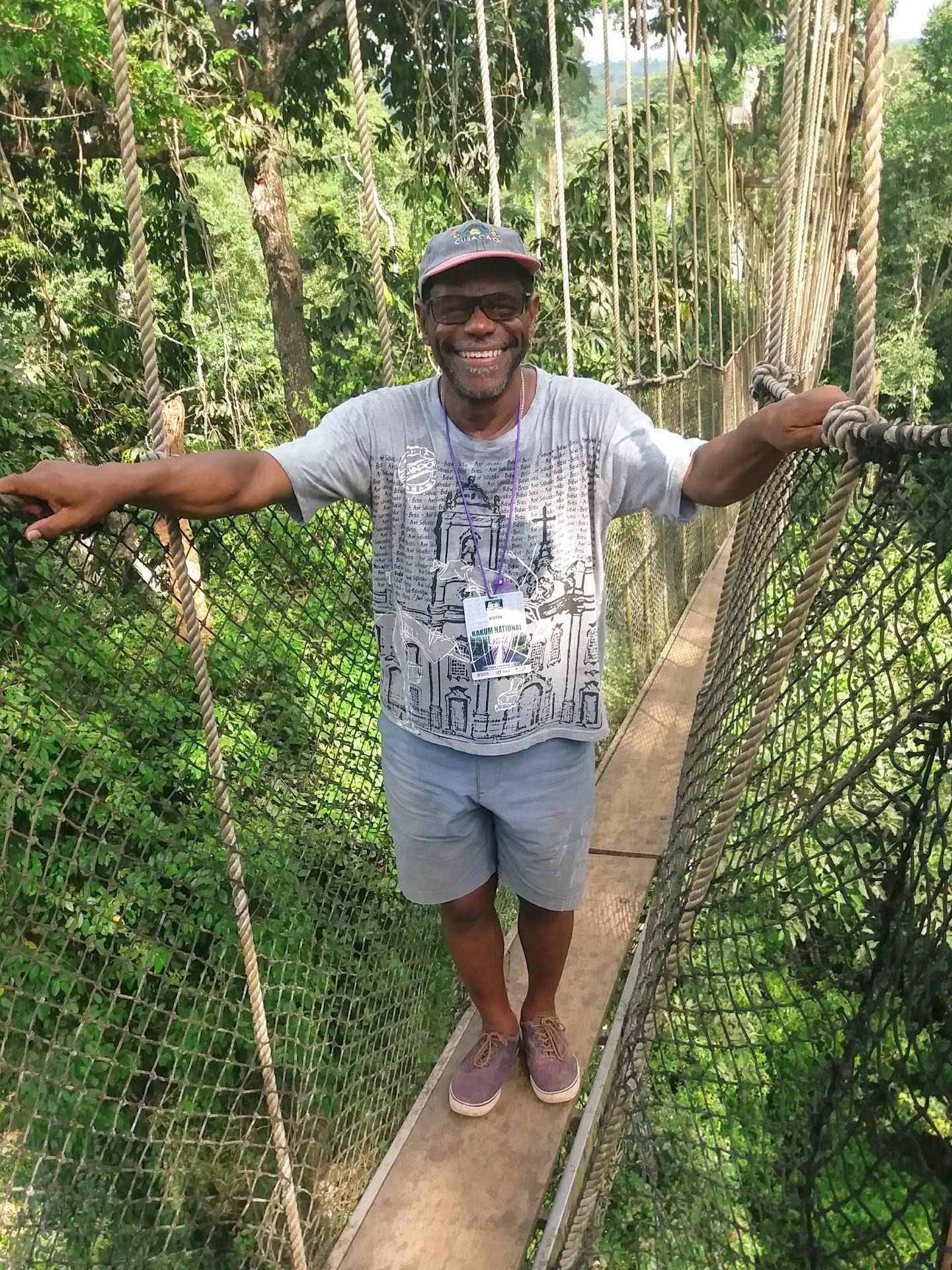
Terry Lister on the Skywalk at Kakum Nationsl Park in Ghana
Traveler and author Terry Lister enjoys both. Prior to this, he worked as a realtor, a minister in the Bermudan government, and a partner in the accounting firm Deloitte. However, he had always desired to travel, so in 2014, at the age of 60, he decided to retire and started traveling alone.
Lister had visited 48 nations when he retired, but since then, he has visited 50, staying in each for a week to six weeks. It’s been a journey! His first book, Immersed in West Africa, chronicled eight weeks of action-packed travel across five different West African nations. He has now traveled to 18 more countries in Africa and authored four more books.
While he is off the road, Mr. Lister enjoys unwinding with a good book, which must be historical or biographical. Although Terry would like to read more books in different genres, there are enough excellent novels in his field to keep him reading. He always has a few travel books in progress in anticipation of his upcoming trip.
Before leaving, Terry says he undertakes much research to identify activities that visitors are not always aware of. There is little time to be bored for this wanderer. He enjoys playing football and cricket in his spare time-cricket and football being his games. So little time to be bored!


















 The PBS Blog