Ever read a book that you could completely or almost completely relate to?
Made you feel like it was made specifically for you, right? This book did that for the first time in my life and I’m grateful and happy that I had the chance to read it.
Saying this is a must buy isn’t a stretch – it’s not just cause I can relate to it. It’s the knowledge you gain instead.
When seventeen-year-old Nora White successfully graduates High School in 1922 Mississippi and is College bound, everyone is overjoyed and excited. Everyone except Nora. She dreams of Harlem, Cotton Clubs, Fancy Dresses, and Langston Hughes. For years, she’s sat under Mr. Oak, the big oak tree on the plush green grass of her families five acres, and daydreamed of The Black Mecca.
The ambitious, young Nora is fascinated by the prospect of being a famous writer in The Harlem Renaissance and decides she doesn’t want to go to College. Despite her parent’s staunch protest, Nora finds herself in Jacobsville, New York, a small town forty-five minutes outside of Harlem.
Shocked by their daughter’s disappearance, Gideon and Molly White are plagued with visions of the deadly south, like the brutal lynching of Gideon’s sister years ago…
Did you know there was a woman writer during the Harlem Renaissance named Nora? Yup.
One of the things I wanted to do with The Nora White Story project is to make everything make as much sense as possible. I know how important it is that everything fits the era to include names. Thus, I used names that were familiar with the time. Some of the names, like Nora, jumped out at me from the start. However, some of them were not so easy. To make sure everyone’s name (even minor characters) fit the time, I Googled the census data for popular names of the 1920s and scrolled through male and female names. So, who was Nora Holt?
Nora Holt
Nora was a singer, composer and music critic. Born Lena Douglas in Kansas City, Kansas; Nora graduated from Western University of Quindaro, Kansas and later earned a Bachelor’s degree in music in 1917. In 1918, she earned her Master’s Degree in music at Chicago Musical College, becoming one of the first African-American women to complete a Master’s program in the United States. Her thesis composition was an orchestral work called Rhapsody on Negro Themes.
Nora was married quite a few times. On the fourth time, she changed her name from Lena to Nora when she married George Holt in 1916.
From 1917-1921 Nora contributed music criticism pieces to the Chicago Defender, a black daily newspaper. In 1919, she co-founded the National Association of Negro Musicians and then spent 12 years abroad in Europe and Asia singing at night clubs and private parties. Although composing over 200 works of orchestral music, one of the reasons Nora Holt is not well known is because her work was stolen. Upon leaving for Europe in 1926, she placed her manuscripts in storage when she returned they were gone. Only one piece survived because it was published prior to the theft and is called Negro Dance, (ragtime-based piano piece).
Nora
Holt moved to Harlem in the early 1920s, where she became an important part of the Harlem Renaissance. She became good friends with novelist and critic Carl Van Vechten.
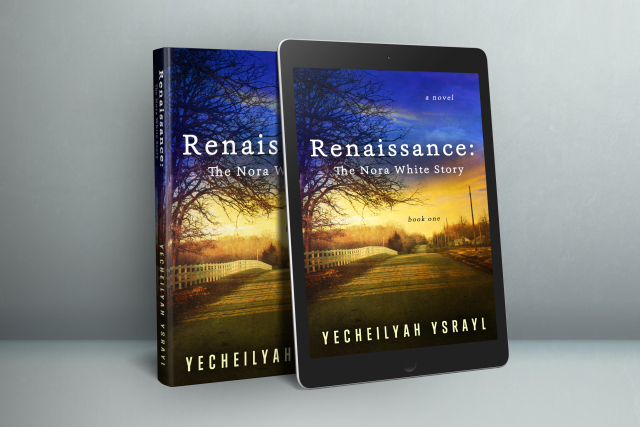
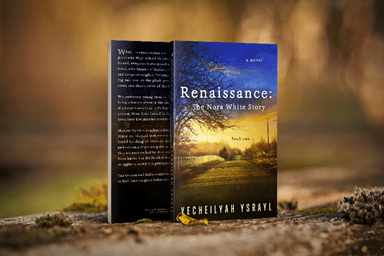
(You can meet some of these historical figures when they make special guest appearances in my new novel, Renaissance: The Nora White Story which releases tomorrow. Today (7/14) is the last day to get it at the reduced price of $1.99)
Nora was also a teacher. She studied music at the University of Southern California in the 1930s and went on to teach music in Los Angeles for several years. Nora was well rounded. Not only was she a writer and musician but she also ran a beauty shop. Apparently Nora knew how important it was to stay fly :-).
In 1943, Holt took a position as an editor and music critic with a black-oriented publication Amsterdam News and went on to live a full life. During the early 1950s and early 1960s, she hosted a radio concert series called “Nora Holt’s Concert Showcase”. It ran to 1964 and in 1966, she was a member of the First World Festival of Negro Arts in Dakar, Senegal.
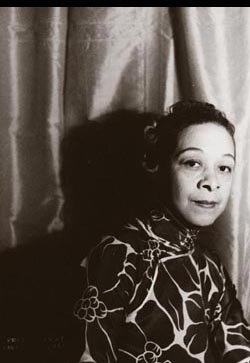
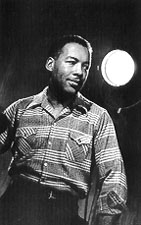
Photo of Nora Holt, taken by Carl Van Vechten, 1955
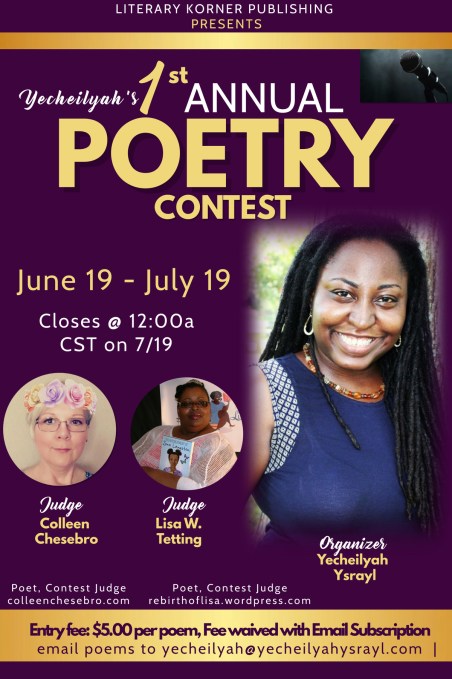
As you all know, I am running my first ever poetry contest in honor of my upcoming release Renaissance: The Nora White Story (Book One) which features poetry and is available now for eBook preorders.
Click Here to order at the low price of $1.99 before the price goes up on July 15th.
This book will also be available in paperback.
You can help further by marking Renaissance as to read on Goodreads. CLICK HERE.
Now, poetry…
I am writing to remind you that this contest will end soon!
First, what is this all about? For those of you who have not already checked into Colleen’s Blog where I made the initial announcement on June 19, 2017, here are the rules:
The Poem
Submit one or two original, unpublished poems to Yecheilyah at yecheilyah ysrayl dot com (yecheilyah@yecheilyahysrayl.com) between now through July 19, 2017. You will have until 12:00 midnight Central Standard Time on 7/19 to get your poems in before closing.
Poems must be your ORIGINAL work and UNPUBLISHED anywhere online.
There is one winner of this contest with up to 2 entries per poet.
Entry Fee:
There is a $5.00 Entry fee. Click HERE to pay the fee.
OR – Entry fees can be waived by signing up for my email list HERE. There is no other way to waive the fee.
If you are already on my email list, please mention this when submitting your poem.
Signing up for my email list represents one entry.
If you are entering more than one poem, you must pay the entry fee for any additional poems.
The Reason for the Fee:
The entry fee is in place to help pay for the prizes.
Current Prizes
At this time, we have one Grand Prize Winner who will receive:
Poem published to The PBS Blog (includes links to your social media, buy links to your books (if any) and promotion.)
Amazon Gift Card
Letters to a Young Poet by Rainer Maria Rilke
*From When I was a Black Girl by Yecheilyah Ysrayl
And Still, I Rise by Maya Angelou
*From When I was a Black Girl is my second collection of poetry. First published in 2012 with a second edition published in 2013, this book became a book of study at The Evergreen State College in Tacoma, Washington for the Fall 2014 semester. Part of an Independent Learning Contract, it remains part of the school’s files to this day. It is my honor to offer a paperback of this collection as a winning prize for this contest. This is an exclusive offer that you will not find on Amazon.
International Shipping
Please note: Winners outside the U.S. will be awarded Kindle downloads of the books listed if someone overseas wins.
Final Thoughts:
The winner will be announced on Monday, August 6, 2017 on both this blog and Colleen’s.
(If you win, you will be notified a couple days before the announcement via email you have won and that an announcement will go out featuring you. This is so that we can collect your information, social links and links to any books you have out if any).
The Grand Prize Winner will have their poetry featured on The PBS Blog with added promotion. The date for this will be revealed to the poet after they have won.
To enter this contest, please send $5.00 to the PayPal of Literary Korner Publishing HERE.
To waive your fee, please sign-up to my email list HERE.(Verification of sign-up will be reviewed before poem is accepted).
Since Renaissance follows the theme of The Harlem Renaissance and Black life in the South, poems should have something to do with these themes and can be as long or as short as you would like. The contest is open to all poets.
I understand not all of you are familiar with this era so I am opening this up a bit. The theme will remain the same but it is not mandatory. Poems of all kinds will be accepted and considered for the win.
Would a focus on the 1920s era and women in general be nice? Yes, but it is not required to win. Consider this open mic!
If you didn’t see the original announcement, CLICK HERE to learn more.
That is all and I look forward to reading your poems!
Learn more about Renaissance in Colleen’s Feature of my soon to be release. As stated I am still away from the blog but I will be re-blogging any guest posts or interviews as they come in. Introduce Yourself will also continue to go out on Mondays so be sure to stay tuned for a chance to meet some amazing authors in our Indie community.
Yes indeed, twins make history again. Meet Marvin and Morgan Smith, painters who focused on capturing the positive side of Harlem during the decline of the Harlem Renaissance and the birth of The Great Depression.
“During the 1930s, ’40s, and ’50s, Harlem spread itself before the cameras of Morgan and Marvin Smith like a great tablecloth, and eagerly they went about devouring what it had to offer.”
– Gordon Parks Sr.
We often discuss the writers of the movement and the musicians while the artists are often left out. Names like Kwame Brathwaite, Aaron Douglass, Lois Jones, and Morgan and Marvin Smith, are not as well known.
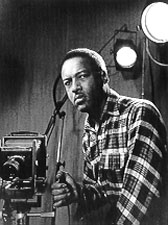
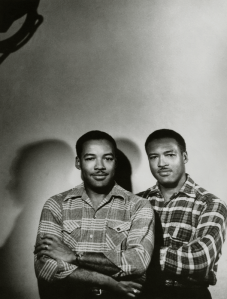
Morgan (right) and Marvin (left) Smith were born on February 16, 1910 in Nicholasville, Kentucky. The boys found a talent for art but wouldn’t pursue it much until the sharecropping family moved to Lexington in the late 1920s. Here Morgan and Marvin attended Dunbar High School, the only Black High School in Lexington at the time, and developed further their artistic abilities. They worked with oil paintings and sculptors until eventually, cameras.
In 1933, Morgan and Marvin graduated High School and pursued their art full time. However, Kentucky at the time provided little to no support for the young men and as I imagine, they could not grow in the way that they wished. They moved to Cincinnati with hope of a better future but not finding opportunities there, decided to move on to New York.
Marvin and Morgan
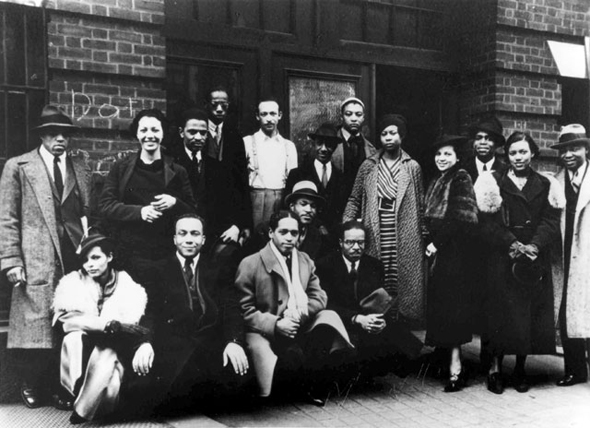
When they arrived to Harlem the twins did manual labor for the WPA or Works Progress Administration and took art lessons from Augusta Savage (another sculptor of the Harlem Renaissance) at her studio. Through Savage the twins became connected with the 306 Group, a collective of African American artists who worked and socialized together in Harlem, New York in the 1930s. The name of the group came from the address of a studio space, 306 W. 141st Street, used by two of the artists, Charles Alston and Henry Bannarn.
Marvin and Morgan became acquainted with prominent figures through Savage but it wasn’t until 1937 when the twins really came into the public’s eye when Morgan won an award for his photo of a boy playing.
Awwue!
After 1937, the twins decided to focus their attention on the community of Harlem overall. Their interest was in capturing the good instead of the bad. With the stock market crash of 1929 and The Great Depression smacked down in the middle, there was plenty to complain about, I am sure, and much of the glitter and glam of the Harlem Renaissance had begun to fade. People weren’t as interested in Black culture and art during these tough times which brings Marvin and Morgan into focus.
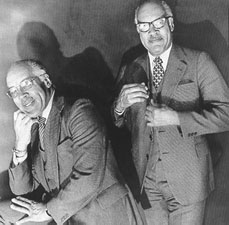
They look more alike as old men than they did when they were younger…or is it just me??
Over the next 40 years with their paint brushes and cameras, the brothers would record what remained, refusing to document anything negative. What’s cute is that the brother’s married identical twin sisters on the same day and three years later both divorced on the same day. They would die exactly ten years apart, Morgan smith at 83 and Marvin at 93. I am happy to see that they both lived full lives.









 The PBS Blog