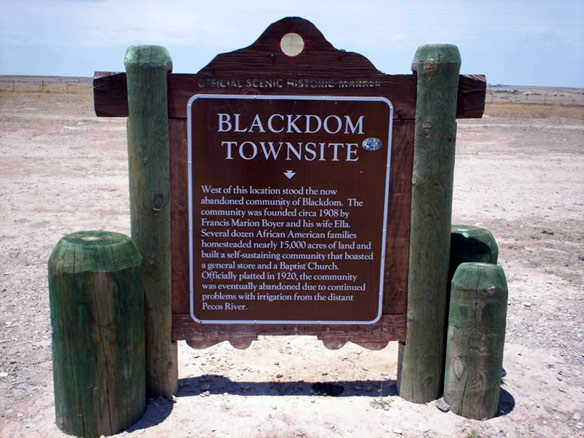
Blackdom: The First All-Black Settlement in New Mexico

Blackdom_NM

Many of us are familiar with the Greenwood Community of North Tulsa Oklahoma where blacks built the most prominent community of their time. Deemed “The Golden Door” of opportunity for blacks, the dollar  in “Little Africa” circulated 36 to 100 times, sometimes taking a year for currency to leave the community, hence its nickname “Black Wall Street” along with “Little Africa” before its systematic destruction that left it torn and desolate. But it wasn’t until my trip to New Mexico this past week that I discovered other communities that are also worthy of inclusion in Black Wall Street’s Hall of Fame.

Blackdom

4078441393_62652786a6

Blackdom was a little known African American community about 18 miles southwest of Roswell New Mexico and was founded by Frank and Ella Boyer. Walking 2,000 miles on foot from Georgia to New Mexico, Boyer left his wife and children behind to cultivate land in the free territory of the West before sending for his family some three years later. At this time in history Blacks had begun migrating from the south in great numbers in a movement called “The Great Exodus” following the Homestead Act of 1862, particularly in Kansas. According to a 2001 archaeological study on the Blackdom region from the Museum of New Mexico, “During the decade of the 1870s, 9,500 blacks from Kentucky and Tennessee migrated to Kansas. By 1880 there were 43,110 blacks in Kansas.”

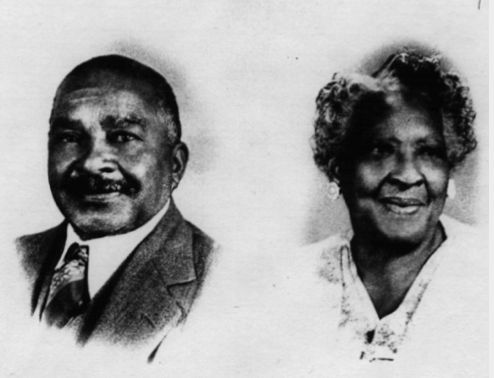
4078441937_d7e66a1164FrankandElla

The Homestead Act gave room for former slaves and free born blacks to reside in the West regardless of race. Here was an abundance of land, free and fertile to anyone who could keep it up. Influenced by W.E.B. Dubois and Frederick Douglass according to historians, Frank was a graduate of Morehouse University and a teacher of Black History which at this time was not very popular. He met his wife, Ella McGruder, a graduate from Haines Institute in Augusta, Georgia, at a teacher’s summer school session. The couple had four children (three sons, one daughter) when Frank set out for New Mexico in 1896.

4078441545_71ab054267

The desire and influence to build community was first conceived in the mind of Frank’s father, Henry Boyer, a free man. Henry was a wagoner in the American-Mexican war when he first set eyes on the New Mexico land. When he came home, he told stories to his family of the land. Growing up during the Reconstruction Era, after the Civil War, Frank naturally grew up with his father’s dreams in his head and saw the West as the Promised Land to a new start. Ironically, the same life force that made Blackdom thrive as a community was also its downfall. The Artesian Water sprang in abundance as more and more blacks were invited and nourished on the land. Blackdom had its own school, and post office. However, the Artesian Wells eventually dried up and citizens were forced to move to nearby cities such as Roswell to continue their lives. The Boyer family were the last to leave.

David-Profitt-house-a-typical-house-in-Blackdom-New-Mexico_1

After Emancipation, in theory black people were free. They were released from the physical chains of bondage. This freedom however, much like sharecropping, said that one could be self-sufficient by earning a profit, but by the end of the year the amount of debt incurred was a reality check concerning the freedom, or lack therof that actually existed. In the same way, Emancipation didn’t mean anything for a people who continued to suffer spiritually, financially, and mentally from the trials of chattel slavery. For this reason, not all blacks settled to continue occupation in the South but many of them invested in the hard work that slavery demanded and sought to use those skills to work their own lands and build their own communities. These stories fascinate me because it is a part of black history that is rarely, if ever, told. Not all blacks endured economic struggle and poverty after slavery but some, if only for a moment, maintained an air of economic dependency and not only succeeded, but prospered in the process.

A Year in Reflection: 2015

43946478_9f969e269e

The winds are picking up steam, the clouds are filled to the brim, and another year is gone. North Louisiana is bracing itself for what is to be a major storm. Why does the moment feel symbolic right now? I tried to write earlier on this topic but it wasn’t until the skies growled that I felt compelled to try it now. The air is cooling as we speak while my nose attempts one final sniff of what is left of 2015. I love the rain, and how thoughtful of it to show up now; in the midst of my thoughts concerning change.

When I look over this blog, I suppose the biggest evolution for me has been the evolution of my writing and the changes taking place in my career in general. When The PBS Blog was born August of 2014, I did not set out to enhance my writing in such significant ways. Thinking back I’m sure I was subconsciously aware of the connection between blogging and writing but I did not specifically set out to do many of the things I’ve done. Surely, I did not anticipate giving Indie Author Tips, Author Interviews, or Book Reviews. I think that’s what makes anything new so exciting, the surprise factor of it all. Not knowing what’s going to happen next. This is what Blogging has been for me in 2015, the evolution of my writing in general.

I thought about how to present this post. Should I give links to the best of the best like last years poetry wrap up? Should I bore you with random pats on the back concerning things I’ve done the years past? Nay, I decided to just keep this simple. What do I look forward to in 2016?

Well, that just depends on what there is in store. What I’ve learned about life in general is never to overexcite anything because you do not know what the next day will be like. We can want things and we can be given those wants but it doesn’t mean they will come in the fashion in which we desire them. For that I have learned never to rush time; just let it roll in nice and gently, like rain drops sliding down the vibrant green petal of a rose. Like tiny crystals all fragile and delicate, and yet brave enough to trust the fragility of a tree leaf to hold them. A collection of bodies all too weak to do anything but uplift each other. So, for Blogging Year 2016 I’m just going to continue riding the tide of the unknown and see where it takes me. I hope that you will come along with me and that we can continue to grow together. At some point I’ll sit down to outline some  specific goals but for now I’ll take it one blog post at a time. Before you know it I’ll be drafting the post to close out 2016 and hopefully I’ll have you here to share those memories with me.

Throwback Thursday Jam – My Love is Your Love, Whitney Houston

Cruise into your Thursday afternoon with the late Whitney Houston’s Throwback hit, your love is my loooovvveee

Writer’s Quote Wednesday – Break

I am taking this month (December, ’15) off for Writer’s Quote Wednesday. I will still post quotes as is my custom on this blog but I will not be participating in the weekly WQW posting as is hosted by Colleen of Silver Threading. The next few months are extremely busy for me so you may notice my posts lessen a bit in general. I believe its important to know your limits and to, as fellow blogger Whitney so eloquently put it, not to be an empty cup. If your no good to yourself you cannot be of service to others. That said, for those of you who I still owe book reviews I have not forgotten and intend to publish them either before years end or January at the latest. As for WQW, I will return in the new year time permitting, when I return from my end of the year travels.

Peace and Love

 – EC

Must Reads: Negro Slave Songs in The U.S.

51oVlfHmDDL._SX331_BO1,204,203,200_

This is a highly recommended book for African Americans who want to study history. “Negro Spiritual Songs” were not made up babble at random but they were songs that talked about the history of the African American in America. Massa was not just a broken dialect of the word “Master” but it is actually a Hebrew word meaning “Oppressor”. Black people were only illiterate to the extent that they did not read and write English but it doesn’t mean they could not read and write period. What if you were taken to China and dropped off, would you be able to read and write Chinese? Fluently at that?

The point is that if you do not know enough of your history to go back 300 years ago and help your people then, you will not be able to help your people today. If you couldn’t liberate them 300 years ago you cannot do it now.

Don’t allow someone to tell you your history, study your history. If they didn’t treat you right, what makes you think they taught you right?

Click Here To Buy On Amazon. Used Copies Are $0.01!