Black History Fun Fact Friday – Marital Relationships During Slavery

The inspiration for today’s topic comes from a heated discussion ongoing from an episode of the TV show The Real. The Real is a talk show that prides itself on being centered on conversations on current events, fashion, family, relationships, and celebrity news. The show’s hosts include Jeannie Mai, Adrienne Bailon, Tamera Mowry-Housley, Loni Love, and now Amanda Seales. The show’s hook is presenting real topics, having real discussions, and giving very real opinions. However, some audiences do not find the show as authentic as it prides itself to be, and Loni’s comments add a lot of fuel to that fire.

Co-host Loni Love found herself in some hot water over her comments about Black men, cheating, and slavery. Here is a clip of what was said:

“I don’t speak for the Black community, but I do think a lot of Black men…they really don’t know how to have true, faithful relationships. They think because they have money…because they have power that they can treat women any kind of way….What is happening is that we are still dealing with the point of slavery, and we are descendants of slavery, and because our families were broken up, we still do not know how to have…together, cause our families were broken up…”

She failed, in my opinion, to clearly articulate her point, but she is receiving backlash nonetheless. Her comment opened the door for further discussion on this topic. I would like to use it as the catalyst for exploring what relationships were like for enslaved men and women and whether there is any truth in Loni’s statement.

Questions to ponder as you read:

  1. Should we isolate Black men as cheaters who use money and power to take advantage of women?
  1. Is it fair to use slavery to support the theory that Black men, in particular, have a problem being faithful in relationships?
  1. Are we descendants of slaves? Or are we descendants of people who were enslaved?

Family separation became increasingly common during the antebellum period, and being sold on the New Year was common. Widely known as “Hiring Day” — or “Heartbreak Day,” as the Black abolitionist journalist William Cooper Nell described it — enslaved people spent New Year’s Eve waiting, wondering if their owners would rent them out to someone else, which would split up their families. (Waxman, O, 2019)

“Hiring Day” was part of the larger economic cycle in which most debts were collected and settled on New Year Day,” says Alexis McCrossen, an expert on the history of New Year Eve and New Year Day and a professor of history at Southern Methodist University, who writes about Hiring Day in her forthcoming book Time’s Touchstone: The New Year in American Life.

Enslaved people were bought and sold like cattle, and auctioneers appraised women based on their ability to reproduce. Women who birthed children during slavery were called “breeders,” and their children were referred to as the “increase.” The mother and father of the “increase” could have been a legitimate couple, or they could have been forced together.

Black people were not people in this sense; they were commodities. Their bodies had a price tag. Slave-masters/owners could mortgage, loan, trade, or exchange the enslaved body. “The nature of exchanging enslaved people meant that this seller was open to the idea of getting them back, perhaps after the child reached a certain age and the mother was no longer breastfeeding.” (Berry, D, pp 20)

Enslaved men, women, and children incurred interest, and even in death, the enslaved body was traded and sold, many of them ending up on the tables of medical schools for hands-on medical research. Slave farms existed, where Black men and women were raped and forced to have sex with one another. “The South,” writes Sublettes, co-author of The American Slave Coast: A History of the Slave-Breeding Industry, not only produced tobacco, rice, sugar, and cotton as commodities for sale; it produced people.”

“Because slaves were property, Southern slave owners could mortgage them to banks and then the banks could package the mortgages into bonds and sell the bonds to anyone anywhere in the world, even where slavery was illegal. Thomas Jefferson bragged to George Washington that the birth of black children was increasing Virginia’s capital stock by four percent annually.”

– The American Slave Coast: A History of the Slave-Breeding Industry

Enslaved couples were not married or in a relationship in the same way men and women are married or in a relationship today. Since this is a personal part of enslaved life, it’s difficult for historians to say how these relationships worked or did not work.

“Research into the intimate areas of slaves’ lives has proven problematic for historians because the typicality of private sentiments is always hard to establish, and within slave testimony such as the WPA narratives, the reference to issues of marital discord, abuse, or adultery is rare.”

Emily West (2004) Tensions, Tempers, and Temptations: Marital Discord Among Slaves in Antebellum South Carolina, American Nineteenth Century History, 5:2, 1-18, DOI: 10.1080/1466465042000257837

What we know is that it was illegal for Blacks to marry in the traditional sense, that many of them were forced together for breeding, and that some enslaved couples did not live on the same plantation. There’s something else we know: due to the complex and brutal system of slavery, relationship bonds between Black men and women (that weren’t forced or instituted by the slave owner) were strong. “Marital ties created bonds that warrant attention equal to the bonds of motherhood.” (Berry)

Enslaved couples who married under slavery loved each other deeply because there was no guarantee they wouldn’t be sold away from one another. Take the story of Tamar, an enslaved woman from Camden County, North Carolina, who ran away several times, was sold several times, and had her children sold multiple times. According to her brother’s testimony, Tamar “traveled by night, and hid herself in the woods.” (Berry) While in hiding, she had more children with her husband. Pregnancy, in this case, could have resulted from genuine love and marital affairs.

In The Chords of Love: Legalizing Black Marital and Family Rights in Postwar Texas, Crouch tells the story of Fannie, a slave woman who wrote a loving letter to her husband. “I haven’t forgot you,” she writes, “nor I never will forget you as long as the world stands.” (Crouch, B, Journal of African American History)

“…it’s not across the board because what is happening is that we are still dealing with the point of slavery. And we are descendants of slavery and because our families were broken up…” – Loni Love

Is there a correlation between a Black man who cheats and the enslaved Black man who was forced to have sex with and impregnate lots of women without attachment or commitment? Has this trauma passed down through generations caused Black men to perpetuate similar behaviors as were required during slavery? Is this what Loni Love of The Real was trying to communicate?

Certainly, we have all inherited both good and toxic behaviors from our ancestors in one way or another. Today, many Black families say they eat pork because “at slavery times that’s all we had to eat, so we made food taste good by trying things out,” says Big Mama in the 1997 movie Soul Food.

But Black people aren’t the only people who eat pork, nor are we the only people who are known for eating pork.

“Cheating is a matter of choice. And when you cheat it is a choice that you as a man are making to feed your ego. It has nothing to do with your boys not being around. It has nothing to do with men working too hard. It’s not a matter of race. Men make choices and cheating is always a poor choice because it’s ego-driven.”

– Charlamagne tha God

While there are certainly questionable actions we’ve picked up from being enslaved people, there is no evidence that directly links Black men cheating to slavery. Cheating is not a trauma-based response from slavery that causes Black men to be untrustworthy and unfaithful more than any other race. Men and women of all races and backgrounds make poor choices that cause them to cheat for one reason or another.

What further complicates things is that Adrienne adds that this is true “Across the board,” which is a good point. This could have been an opportunity for further clarity, historical context, and teaching. Still, Loni cuts her off, further clarifying her point that she is specifically talking about Black people and, in particular, Black men:

“No, it’s not across the board because what is happening is that we are still dealing with the point of slavery. And we are descendants of slavery and because our families were broken up we still do not have a idea of how to have…together, families were broken up…”

We are not descendants of slavery.

We are the descendants of a people who were enslaved.

If it’s true that because of slavery Black men struggle with fidelity, then we also have to say something about the white slave masters who raped and forced Black men and women to breed. And we have to talk about the white slaveowners who cheated on their white wives with Black women.

Black men during slavery did not have the same capacity to cheat as men and women have today. Marriage during slavery did not mean the couple could exercise fidelity because they did not have the right to their own bodies. While married, the wife may have had children by the master after being raped by him and the husband could have also fathered more children through force. The only guarantee was the love each had for one another and the hope that they could see each other as often as was allowed and cultivate some sense of normalcy for their families (as normal as was possible under slavery).

Is it fair to say, “Lots of white men beat their wives because they are the descendants of slave-owners and masters who beat their slaves?” Is it ever fair to make generalizations about a group of people, gender, or race?

Imagine the frustration of being a Black man in America, honorable and striving only to look and see your own woman (The Black Woman) consistently publicly declare to the world that you are not capable of doing right.

“Black men everyday are dealing with our character being shamed.”

– Willie D

If we say, “Black men don’t know how to be faithful because we are still dealing with the point of slavery,” we miseducate people on the history of our enslavement. Next, we alienate Black men, assume Black women and other races of people (across the board) don’t cheat, and throw Black men under the bus.


Books I recommend for further research on Slave Breeding and Blacks used as Commodities: 

The American Slave Coast: A History of the Slave-Breeding Industry by Ned and Constance Sublette

The Price for Their Pound of Flesh: The Value of the Enslaved, from Womb to Grave, in the Building of a Nation by Daina Ramey Berry

Medical Apartheid: The Dark Experimentation on Blacks from Colonial Times to the Present by Harriet A. Washington

Reminder: Guest Bloggers Wanted: Black History Fun Fact Friday

Hey guys!

I am stopping through to remind you I am looking for writers interested in submitting articles to this blog for my Black History Fun Fact Friday series. Below is a reminder of the qualifications for submission. Also, notice I have added a deadline to articles for Black History Month. There are four Fridays in February this year and so far we have one article submitted. This means there are only THREE slots left for those of you who want to get in for Black History Month. (This is not a Feb only opportunity, but a weekly one so don’t fret if a Friday in Feb is not open when you submit).

  • Because of the nature of this series interested writers must be Black/African American (this includes so-called Afro Cuban, Jamaican, Haitian, Cuban, Afro Brazilian, Dominican, etc.).


  • Must be original work. Do not copy and paste the article from other blogs unless that blog is your own. If you have a Black History article to share that you published to your site you are welcomed to submit it for Black History Fun Facts. I have no problem with that as long as it is your work.


  • Topics must be relatable to the history of Blacks/African Americans.


  • Articles must be emailed to me for approval at least one week before publishing. If you email your article on 1/31 for example, I will publish it on 2/7 if there are no needed changes. This series is not exclusive to Black History Month but if you want your articles published in time for February, please have them submitted no later than Monday, January 27, 2020. Writers looking for more exposure will be wise to try for a Feb slot. A Black History Article during Black History Month will naturally attract more readers.


  • Please send articles in a Word Document, 12p Font, Times New Roman text.


  • Please do your best to self-edit your work for basic typos/spelling/grammatical errors before submission. Grammarly andProWritingAid are good free self-edit software programs to use.


  • The BHFFF badge will be included in every post but you are welcomed to create your own image to add as well. Canva is a good program to use to make your own images. Unsplash is good for free images.


  • This is Black History Fun Fact Friday not Black History Opinions so do your best to submit articles covering accurate historical information. I will vet the submissions to make sure they do. If you have links to sources, please include them.


  • Please include a photo of yourself, social media handles, websites, or links to books you’ve written on the topic. This will be added to the end of the post as your call to action. This is where you give readers the chance to follow/learn more about you.

Benefits of Guest Blogging:


  • Increase traffic to your own website/blog
  • Build Relationships/Online Influence
  • Build Domain and Search Engine Authority
  • Capture Wider Audience
  • Develop Your Authority on a topic
  • Improve Your Writing
  • Opens the doors for paid business opportunities

The series is Black Historical so submissions should be articles detailing the history of Blacks in some way. You can talk about The Transatlantic Slave Trade, Enslavement, Civil Rights, Police Brutality, Medical/Educational discrimination, Black Power Movement, Inventors, Black Biblical History, and much more. Tell us about a little Known Black Historical Fact or introduce us to a little-known Black Historical person or place. (For example, I once published a post on Sundown Towns, all-white communities where Blacks were restricted from after Sundown).

Topics can vary as long as they cover Black History (this includes Jamaican, Haitian, Puerto Rican, Cuban, Caribbean, and Dominican.) Specifically, I am looking to feature full-length articles that inform and educate on some part of Black History at 300+ words or more. (Do not send a book, but make sure your article is at least 300 words. We want it long enough to inform but short enough to keep the reader’s attention.)


Email articles to yecheilyah(at)yecheilyahysrayl(dot)com

Questions? Comment below, use the contact form on the contact page or send me an email. 

Caution: Careful Not to Share Black History Memes with False Information

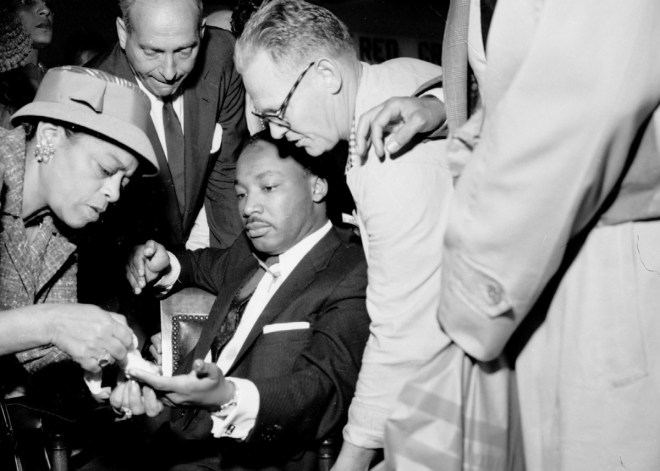
Martin Luther King Jr. recovers from surgery in bed at New York’s Harlem Hospital on following an operation to remove steel letter opener from his chest after being stabbed by a mentally disturbed woman as he signed books in Harlem. (John Lent/AP)

I am reposting this because February is approaching and we will see a lot of false information attached to Black History memes, same as always.

According to a famous Facebook post, King was not killed during an April 4, 1968, assassination attempt, but survived that shooting and was later “smothered by someone in the hospital.”

Is this true?

Let’s see.

Updated 1/28/2021

It’s Throwback Thursday so let’s go back in time a lil bit.

September 20, 1958

The year is 1958 and we are in Harlem, baby. Dr. King is signing copies of his first book “Stride Toward Freedom: The Montgomery Story,” at the Blumstein’s Department Store, on 230 West 125th Street.

It’s a nice afternoon and young King is just twenty-nine years old, releasing his first book and feeling good. And we are feeling good too because we are ready to get our copy. The line is long but before we get bored a voice makes us all stop and look in their direction.

“Is this Martin Luther King?” shouts a well-dressed black woman wearing rhinestone glasses and a matching necklace and earrings but carried an ugly brown bag and an even uglier scowl. The woman stepped out of line, causing groans from the people in front of her.

We don’t know this yet, but she is forty-two-year-old Izola Ware Curry, the black daughter of sharecroppers.

King nodded, “Yes, it is.”

“I’ve been looking for you for five years,” says Curry while pulling a letter opener with an ivory handle from her purse, which we don’t really know is a letter opener because we don’t use those anymore.

“Ooh, snap!” We gasp, placing our hands over our mouths. “Why she come so dressed up for if she was trying to kill somebody?”

“What is she doing?” says another one of us.

“Yea, man. Doesn’t she know this is Martin Luther King?”

“He not all that popular yet,” says a young black boy wearing chino pants and a white polo shirt. He put his hand in his pocket when he said it, smiled and then tilted his head like he was better than us. “Ya’ll not from here, are ya?”

Before we could answer, the sound of screams forces our attention back to the direction of the strange woman. She swings the letter opener at King, and sliced his finger then plunges the seven-inch blade into the left side of his chest.

“Oh, my God!” someone screams and just like that, the store is in an uproar. We are all screaming and running as someone apprehends the woman.

We look at King secretly hoping she didn’t get him because we still kinda want our book.

But when we see somebody who looks like our Grandma rush to his side, we know that’s not going to happen.

Dr. King is sitting in this chair all calm and cool like he ain’t just been stabbed. Meanwhile the letter opener’s ivory handle is still protruding just below his collar.

The police arrive. “Don’t sneeze, don’t even speak,” says Officer Al Howard, fearful of the blade’s proximity to King’s heart. Because of how the letter opener hit him, if King had sneezed, he would have died.

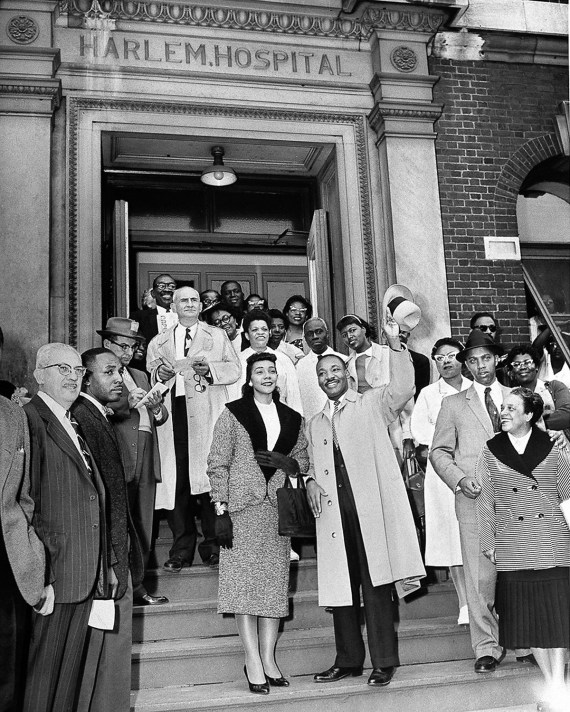
So, they move King slowly and carefully and take him to Harlem Hospital, and he undergoes emergency surgery.


Then, we jump in our time machine and head back to 2021 because it’s wild out here in the 50s.


Oct. 3, 1958
King leaves the hospital almost two weeks after the stabbing

The photo at the start of this post is not of Dr. Martin Luther King Jr. after being shot in Memphis, Tennessee in 1968.

That is a picture of Dr. King ten whole years earlier in 1958 at a New York Hospital after being stabbed at his book signing. He spent almost two weeks in the hospital recovering.

“If I had sneezed, I wouldn’t have been around here in 1962, when Negroes in Albany, Georgia, decided to straighten their backs up. And whenever men and women straighten their backs up, they are going somewhere, because a man can’t ride your back unless it is bent.” – Martin Luther King Jr., “I’ve Been to the Mountaintop.” April 3, 1968

I hope this creative backdrop added some perspective. Although I wrote it like a short story, everything I said here is the truth. Izola Curry, really did attack Dr. King at his book signing in Harlem.

Now to the original post…

There are tons of Black History memes circulating on the internet and this number has increased even more due to it being Black History Month. However, many of these memes are not historically accurate. Please be sure to double check your facts before sharing. Otherwise, you are guilty of spreading disinformation.

Black people have contributed to the world so that we don’t have to make stuff up. If you see a meme with a fun fact on it, just open the internet on your phone and type the name or fact into the search bar. You can tell from there if the material is accurate or not. Sometimes it will even come up that the information is an opinion or cannot be verified by any trusted source.

Use not only your phone to log into Facebook, Twitter, and Instagram. Use it to research these things and educate the people right.

Look for scholarly, peer-reviewed articles on .gov, .edu, or .org sites and trustworthy blogs. Peer-reviewed means information from a reputable source, information that shows that other professionals have reviewed and deemed it worthy of publication.

Wikipedia is not a credible source alone. Other trusted sources should support anything gained from Wiki.

And on the Monday of MLK day when everyone takes off and celebrates his legacy, remember that he was born on January 15, 1929, not whatever Monday you take off.

A Witness to the Experience

My Soul is a Witness: Poetry \ Coming Fall 2020


My Soul is a Witness is a title inspired by the Negro Spiritual song, “Witness,” but I did not choose such a title because I think of myself and my people as “Negroes.” I chose such a title because of the powerful messages and influence these songs had on our people as they transitioned from enslavement to freedom. Powerful messages I hope to also convey through my poetry.

There is a great spiritual awakening happening among Black people today as we strive to unlearn the lies they taught us for over 400 years. Whether that is starting and running our own businesses, embracing our natural hair or re-educating our young people on the parts of our history left out of the history books.

And to what am I a witness?

I am a witness to the trials and struggles my people have endured and I am a witness to our power to overcome those struggles. I am a witness also to my own sufferings which I am sure have been experienced by others. In this way, I am a witness to the fight that we all have. And why the fight? It is easy to present an image of healing and wholeness, but I believe it is much more fruitful if people knew of the struggles that got us where we are today.

From a historical perspective, I have not experienced the Middle Passage or enslavement or Jim Crow, but as a descendent of people who did, I am connected to those experiences just as if I had been there with them. In the Black community, we do not say, “when they fought for freedom,” we say, “when we fought for freedom.” The same can be true of the struggles of our own personal lives. If someone says they have been homeless before, I can relate because I have been homeless before too. I am a witness to what that’s like. If someone says they have a family member who is an addict, I can relate. I also have family members who are addicts. The anguish that causes in a family and what it does to that person and their loved ones are not lost to me. I can relate to that. I am a witness to that experience.

I believe epigenetic trauma is real. Epigenetics is the idea that trauma can leave a chemical mark on a person’s genes, which then is passed down to subsequent generations. (C. Benedict, New York Times) This means that a child or grandchild can experience side-effects from the traumatic experience of his/her elders. Since the concept of epigenetics, more and more studies hint to the inheritability of trauma where our own day-to-day health (and perhaps our children too) may have something to do with our inheritance of our parents and grandparents suffering.

One personal example is my own mother’s struggle with COPD (Chronic Obstructive Pulmonary Disorder). Her grandson, my nephew, suffers from asthma badly, though both his parents do not have asthma. Could he have inherited my mother’s affliction to a degree?

Thus, I do not find it far-fetched that Blacks/African Americans could still struggle from the mental and spiritual grief that plagued our forefathers long ago. We are witnesses to this pain on a deeply personal level which makes the Negro Spiritual deeply personal to us. While our ancestors were escaping physical enslavement, I believe we are escaping mental enslavement today.

As it applies to all people from the perspective of suffering and struggle, we all have a fight we are engaged in and when we overcome this fight, we become witnesses to that experience and can help others to overcome those same tribulations.

If trauma can be passed down, then so can healing. My soul is a witness.


Have you read I am Soul yet? Grab it here. My Soul is a Witness is coming this fall.

My Soul is a Witness

Annndd here she is!

My next collection of poetry releases this year and I have decided on the title, “My Soul is a Witness.” I want to thank the members of my email list for helping me to choose the perfect image (we had a contest featuring several images. If you are not subscribed for exclusive first-looks and sneak peeks, you may click here).

This book releases in the fall and will be available for preorder soon. Exact date to be announced.

Haven’t read I am Soul yet? Get it here.


One of my favorite movies (I have lots of favorites lol) is The Great Debaters. I love the use of language, history, and education, and it also feels like to me they are doing performance poetry, not just debating. When the movie comes on, the Negro Spiritual song, “Witness,” is being sung as the people dance.

Just as with I am Soul, My Soul is a Witness jumped out at me and I felt it in my spirit that this was the appropriate title for the book. The soulful, sacred, and riveting Negro Spiritual songs taught of freedom, of hope, of redemption, and biblical justice and righteousness. I hope these poems do the same for you. I hope that they are liberating, restoring, and reinvigorating. “My Soul is a Witness,” is poetry that reminds us that in our darkest moments, there is still hope. It reminds us that our scars do not cripple us but prepare us for a work, and that our greatest weaknesses make us strong. Here, I give you my ache and my praise. This is a love letter to our overcoming, of yours and mine. My Soul is a Witness.


What the Losses Taught Me

Top of the World, Observation Level, World Trade Center, MD, Copyright © Yecheilyah 12.31.2019
I couldn’t help but think about “Vision” on the Top Floor of the World Trade Center in Baltimore. The view is a beautiful layout of the city and the binoculars let you see everything up close. That’s what 20/20 is about for me, seeing clearly.

20/20 = Perfect Vision

At this time of the year, most people are talking about their wins but I believe it is my losses that have caused the most growth and given me the most lessons. It was the letdowns, betrayals, and disappointments that have cultivated in me the strength I’ve had to endure last year and all the other years before it.

Keep Yourself Full didn’t do as well as I had thought and while it bothered me at first, I can honestly say that as of today I’m okay with it. I’ve been Self-Publishing my books for a while now and what I’ve learned is that experience brings clarity.

Hindsight is 20/20 and what I see now are the mistakes I made with this particular book, the audience I thought would be there but wasn’t, and the solace in knowing that my poetry is inspiring enough.

A ‘Snellen chart’ is an eye chart that’s used to help you determine the clarity of your distance vision. Somebody with 20/20 vision has normal acuity (sharpness or keenness of thought, vision, or hearing) meaning if they were to stand at a distance of 20 feet from the eye chart, then they would be able to clearly see each row of letters. This person has good eyesight.

What’s being said is that if you look back at situations that went poorly, you can clearly see (20/20) what you could have done better.

This entire year is 20/20 which means a time of looking back and reflecting on all I’ve done. I know the word “reflection,” is being used a lot this time of the year so it may not hit you as hard but I caution you not to let its repetitiveness water down its powerful meaning.

Reflection is serious thought or consideration but it also shows, expresses, or is a sign of something and an image of something in the mirror. To reflect is to give serious thought and consideration to ourselves, the image in the mirror. It is to look at ourselves. What do we see? What are we showing or expressing?

My philosophy (for lack of a better term) is “do you but do you intelligently.”

I believed, and still, believe, we should not just decide, but that we should make informed decisions. From this point forward it’s not just about making decisions but knowing why I am making those decisions. It’s about being intentional in every way. From this point forward, everything I do has a reason. Everything is a strategic move. From publishing a book to publishing a post.

There are projects I will retire this year and projects I will relaunch. Looking back, I can see clearly what works and what doesn’t work for my writing business.

I am flawed and imperfect. I will mess up but I am striving every day, learning, and correcting as I go along (with all the failures and pitfalls that come with it). I know these losses can do nothing but make me stronger, and wiser so that when I look back, there is nothing to regret.

The losses taught me to focus the first time around and to trust my discernment so I can see things for what they are, not for what I want them to be. The losses are a reminder to see things clearly.


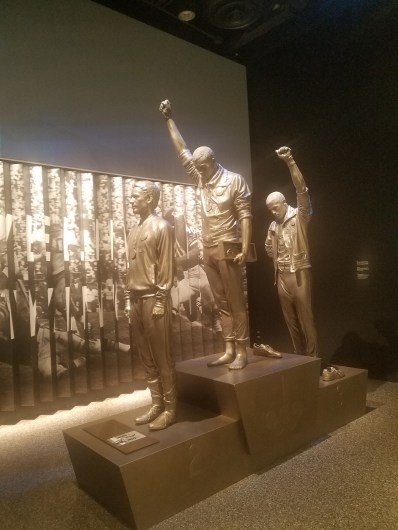
Go to my IG page here to check out more vacation pics at some awesome museums including The Smithsonian Museum of African American History and Culture. Visit me on the web at yecheilyahysrayl.com and subscribe to this blog for notification of more posts.

Black History Fun Fact Friday: What Hollywood Left out the Harriet Movie

I did not intend on writing about this today but then…

I saw the Harriet movie.

Yep. I went to see it.

I know many are protesting the film, but I don’t jump on bandwagons. I wanted to see it for myself to develop my own opinion. I also knew I wanted to write about it.

There are some truths, such as her being referred to as Moses. Unfortunately, there are also a lot of inaccuracies. The movie is Hollywoodish and leaves a lot out. In an interview, I heard the script was written twenty years ago, so that may have something to do with it. In any case, if you are planning to see it, here are some things you may want to know.

  • Harriet Tubman never had a friend named Marie Buchanon.
  • There was never a Black Bounty Hunter named Bigger Long after Harriet Tubman. The same is true of the Brodesses son. They did have a son (Jonathan) but little is known about him. His role in the movie is made up.

While “Bigger Long” is a fictional character, it shouldn’t be overlooked that Black trackers existed and were active during slavery. I think it is vital that as we are striving for historical accuracy, we are not so “Pro-Black” that we forget that a lot of our own people sold us out, and continue to sell us out. While Bigger Long may not have been a real person in Harriet’s life, there were black slave catchers. The movie, it seemed to me, had a lot of ‘women vs. men’ undertones. Not only was Bigger Long the sole antagonist against Harriet (even more so than the Brodesses, son), he was also the one responsible for the death of one of the Black women in the most diabolical, sinister, and brutal way.

The William Still character is based on a real historical figure. Still was a black abolitionist based in Philadelphia, Pennsylvania, businessman, writer, and conductor on the Underground Railroad. In the movie, he was over-the-top with his reactions to Harriet’s return from the missions. Holding his hand to his chest, spinning Harriet around, and at one point, he even falls out of a chair. Some people laughed, but I didn’t find it funny. To me, it made him look like a bufoon.

The Black men in this movie seemed weak to me. I worry this was intentional. Hollywood has a habit of showing black men as less capable when contrasted against the black woman’s strength. Rarely is there a balance to showing black couples as equally competent. The imaginative Marie shows Harriet how to shoot a gun and helps her in her cause. Harriet was a warrior but I am certain the surrounding men weren’t that simple-minded and faithless.

  • Tubman didn’t change her name when she reached freedom. She changed it before then, around the time of her marriage, possibly to honor her mother.
  • Three of Tubman’s sisters were sold, not just one.
  • Two of Tubman’s brothers, Ben and Harry, accompanied her (1) they went with her initially, at the onset of her escape not later as depicted in the film (2) after a notice was published in the Cambridge Democrat offering a reward for her return, Harry and Ben had second thoughts and returned to the plantation so she made the voyage alone.
  • Tubman had spells, dream-states, and visions (I believe she was deeply spiritual, her spells were my inspiration for Nora’s spells in Renaissance), but she also endured seizures, severe headaches, and narcoleptic episodes for the rest of her life from the hit to the head.

This next point wasn’t in the movie but since we are talking about Harriet Tubman I think it’s important to mention.

The Fake Quote:

It’s a good quote and a powerful one. I wish I could say it belonged to Harriet but with every source I checked there’s no documented, historical proof that Harriet Tubman ever said:

“I freed a thousand slaves. I could have freed a thousand more if only they knew they were slaves.”

According to Africacheck.org, The Maxwell Perspective, and Snopes, there are a few possible origins of the quote’s attribution to Harriet:

  • The confusion began when feminist writer Robin Morgan updated her 1970 essay “Goodbye to All That” during the 2008 US Democratic Party’s primary presidential candidate race between Hillary Clinton and Barack Obama. Morgan supported Clinton, and in the essay challenged other women who did not. She wrote: “Let a statement by the magnificent Harriet Tubman stand as reply. When asked how she managed to save hundreds of enslaved African Americans via the Underground Railroad during the Civil War, she replied bitterly, ‘I could have saved thousands – if only I’d been able to convince them they were slaves.’” The implication was that women who didn’t support Clinton were similarly enslaved, and didn’t know it.
  • One expert was Milton Sernett, professor emeritus of history and African American studies at Maxwell School“My impression is that this is a late 20th century quote from a fictionalised account of Tubman’s life,” Sernett told history blogger Ralph Luker, who first queried the quote.
  • More than this, at meetings in 1858 and 1859 Tubman repeatedly said she had personally rescued 50 to 60 people from slavery. So she would never have said she “freed a thousand slaves”.

A quote that has historical proof, and that has been proven to come from her that you can use:

“I was the conductor of the Underground Railroad for eight years, and I can say what most conductors can’t say — I never ran my train off the track and I never lost a passenger.” 

– Harriet Tubman at a suffrage convention, NY, 1896.

“During public and private meetings between 1858 and 1859, Tubman repeatedly told people that she had rescued 50 to 60 people in 8 or 9 trips (this was before her very last mission, in December 1860, when she brought away seven people.) Sarah Bradford exaggerated the numbers in her 1868 biography. Bradford never said that Tubman gave her those numbers; instead, Bradford estimated that it was the number. Other friends who were close to Tubman contradicted those numbers. Tubman also instructed another 70 or so freedom seekers who found their way to freedom on their own”

http://www.harriettubmanbiography.com/harriet-tubman-myths-and-facts.html

Is it possible Tubman freed far more than what is documented even if only through instruction? Absolutely, but we have no proof she said she freed a thousand and could have freed a thousand more.

“My impression is that this is a late 20th-century quote from a fictionalized account of Tubman’s life. “Whoever wishes to use the dubious quote as a political zinger ought to cite a reliable source.”  – Milton Sernett, Harriet Tubman: Myth, Memory, and History

A few more things not addressed in the movie:

  • Tubman’s time as a Union spy (touched on a little at the end of the film), nurse, and cook.
  • Her 1869 marriage to Nelson Davis—a soldier, some 20 years her junior—and the couple’s 1874 adoption of a baby girl named Gertie
  • Her work as a suffragist,
  • Neurosurgery undertaken to address her decades-old brain injury.
  • Her financial hardship later in life.
  • The opening of the Harriet Tubman Home for the Elderly in 1908.

Now, the movie wasn’t a total fail for me. There are some things I liked that are worth mentioning.

I loved the show of Harriet’s spirituality, which I do not equate to anything Christian. Her reliance on her faith, praying, and praising during difficult times. I loved the show of her hands raised and open, historically how we (Israelites/Blacks/AFAM) prayed. Harriet’s spiritual intuition was a beautiful show of faith and her belief that the Almighty was central in guiding her in her journey.

Should you see the film? That is up to you. I will caution that if you plan to bring your children, print this post out (or another fact sheet you’ve vetted), and use it as a reference so they can properly discern the facts in the movie from the fiction.


Check out more Black History Fun Facts here.