
Thanks so much Rachel for having me. Head on over to Rachel’s amazing blog for my latest interview. Also, don’t forget to follow her blog 🙂
Tag: historical
Black History Fun Fact Friday –Black Inventors / Inventions
There’s a funny story behind this post. My stomach was growling and I thought “Hmmm, what if there was a device where you could hook up to your body parts and see what’s going on in there??” Like, say your stomach hurts or you’re hungry or your leg is in pain, you could hook up to some technology screen type deal and see what is causing those changes. OK, you may already know but I mean in a way where you could see it .(medical genuis smarty pants lol) You can go to the doctor and already know what needs to be done. Anywho, that’s when I thought it would be fun to look at some inventors / inventions that we may not have known about.
The Pencil Sharpener

Also, known as The Love Sharpener, The Pencil Sharpener was patented by a black man named John Lee Love. John did not invent the pencil sharpener* but what he did invent would carry on to the same pencil sharpeners we use today. A carpenter in Fall River, Massachusetts, John invented several devices and in 1897, he patented a portable pencil sharpener known as the “Love Sharpener.” (*The first ever pencil sharpener was patented in France by mathematician Bernard Lassimone in 1828. A decade later another Frenchman, Therry des Estwaux, designed a conical-shaped device that, when a pencil was inserted and twisted, all sides of the pencil were whittled away at once and make the sharpening process much quicker.).
Heating Furnace — Ventilation System
Alice H. Parker, an African-American woman from Morristown, NJ developed, in 1919, an early concept of the modern home heating system. Her system gave birth to the thermostat and the forced air furnaces in most homes today, replacing what was then the most common method for heating – cutting and burning wood in fireplaces or stoves. Parker’s invention would be better known today as Central Heating.
The Mailbox
What would you know, a black man invented the mailbox. Known as The Street Letter box back then, Philip Downing designed a metal box with four legs which he patented on October 27, 1891. He called his device a street letter box and it is the predecessor of today’s mailbox. (A fellow blogger wrote a post about Downing awhile back. Check it out here!)
The Sanitary Belt, The Walker, The Toilet Tissue Holder
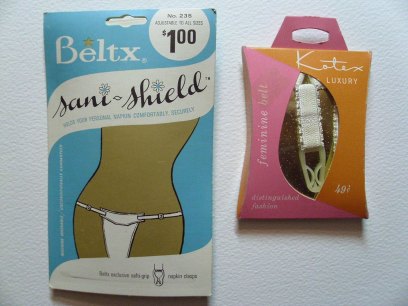
Before pads and tampons menstrual huts were common where women would be separated from communities while on their cycle (known biblically as a time of uncleanliness). Later women began using cloth or rags which is where the term “she’s on the rag” came from. Common forms of protection rabbit skins, rags, menstrual aprons (aprons??) homemade knitted pads and eventually, the sanitary belt. I heard of the sanitary belt from my mom, otherwise I would not have a clue what this is. Mary Beatrice Davidson Kenner, a black woman, had some pretty cool inventions, the Sanitary Belt being one of them. She also invented the walker and toilet tissue holder. Pretty neat. (Ladies, you can learn more about the evolution of the pad HERE.)
Toilet
Thomas Elkins, a black man, invented a lot of things (to include an improved refrigerator). Known then as a Chamber Commode, the modern toilet was patented by Thomas Elkins on January 9, 1872. Elkins’ commode was a combination bureau, mirror, book-rack, washstand, table, easy chair, and chamber stool. (The flush toilet goes back to the 1500s but the idea failed to catch on until later).
The First “Perm”

Did you know that Perm is short for Permanent? The first concept of the perm was invented by a black woman named Marjorie Joyner. The granddaughter of slave owner and slave, Marjorie developed an invention called “The Permanent Waving Machine” which permed or straightened hair by wrapping it in rods. Later, a black man named Garret Morgan (inventor of the Traffic Signal and Gas Mask) invented our modern version of the perm by accident. In his tailor shop, Garrett was thinking of a solution he could use to polish the needles to a high gloss and stop them from scorching clothes. When Morgan doctored this liquid, he decided to test the effects of the liquid on dog’s hair and saw how the texture had smooth out. Later trying this on human hair, the relaxer was born. Delighted with his success, Morgan coined his hair division the G.A. Morgan Hair Refining Company. This Company was also responsible for the black hair oil dye and the curved tooth iron comb (to be used as a hot comb.)
Blood Bank
Charles R. Drew was an African-American surgeon who pioneered methods of storing blood plasma for transfusion and organized the first large-scale blood bank in the U.S. Ironically, he died due to an accident that blocked blood flow to his heart (there’s a myth that he died at an all-white hospital among whites who refused to operate on him but this story cannot be verified. According to my research, Drew was treated at Alamance General Hospital, a facilities-poor “White” hospital. The White doctors at Alamance began work immediately but Drew’s injuries were so severe and his loss of blood so great that he could not be saved. It is possible that due his prominence he was treated better than most blacks were during the time but further research / insight is needed.)
Feeding Tube
Bessie Blount was a physical therapist who served during WWII. She invented an electrically driven feeding tube device that enabled wounded soldiers to consume a mouthful of food when biting down on a tube. At the time, it was hard to get a patent and she donated this invention to France. In 1951, she received a patent for a modified version from the U.S. called the portable receptacle holder, smaller tube that could be worn around the neck. However, many of Blount’s inventions are not very well known since she signed over her inventions to France.
Literacy’s Role in African American Education
Guest Blog Post. I’m on Rachel’s Blog today. Come on over!
Black History Fun Fact Friday – Black Land Ownership

Welcome back to Black History Fun Fact Friday where Black History Month is never over! BHFFF is coming to you every Friday where I strive to introduce to you lesser known faces and lesser known facts. Today, we are talking Black Land Ownership, the most underrated , least discussed black business yet.
Land ownership has always been important to African Americans, although we own less than 1% of rural land in the United States today, it has not always been this way.
At one point, Black Land Ownership was at its peak (the 1910s – 20s) and helped to start such communities as The Mound Bayou in Mississippi, Rosewood in Florida, Blackdom in Albuquerque New Mexico, and, Black Wall Street in Oklahoma and many, many more. (See 7 Black Communities that Prospered) “In the 50 years following the Emancipation Proclamation, African Americans held over 15 million acres of land. Today, African Americans own less than 7 million acres of land. In 1920, African Americans owned 14% of all farms. Today, African Americans own less than 1% of all farms.” (Vivian M. Lucas, Barren: The Decline of African American Land Ownership from 15 million to 7million acres).
In Roll of Thunder Hear My Cry, the book that opened me up to the world of Black Literature as a child, Mildred D. Taylor starts a slew of books centered around the Logan family and their fight to keep their land. Land, always that place families could come back to, where gatherings could be held and where communities could root themselves. In Forty-Acres, Phyllis R. Dixon centers her story around black landownership. Rising from a sharecropper’s son to the largest Black Landowner in Dwight Count, Arkansas, C.W. Washington’s stroke forces him to retire from farming and he must decide what happens to the land. And finally, In Queen Sugar, by Natalie Baszile, now a TV show executive produced by Oprah, it again brings to light the subject of black landownership when Charley Bordelon inherits her father’s eight hundred acres of sugarcane land.
Unlike today, where paper money is valued above anything else, land ownership had always been praised as a vital contributor to financial and economic stability for the African American community. Landowners could build houses on the land, raise animals on land and grow food. We sold food we grew, bartered among neighbors, had bountiful dinners and when The Great Depression hit, many southern black land-owners didn’t notice until years in. Land ownership was something cherished, something we could call our own, and something to which we could be proud of.
What happened to families like the ones we read about and have grown to love? Where did Big Mama go and the land with her? What happen to Black Land Ownership and why was it so important to the people who came before us?
“Comparing the U.S. Agriculture Census data on African-American farmland ownership for 1910 and 1997, it shows a drastic decline from its peak of 15 million acres in 1910 to 2.4 million acres in 1997. A recent study estimated that in the early 20th century, rural landownership among African-American farmers and non-farmers was between 16 and 19 million acres (Gilbert, J., 2002). The 1999 Agricultural Economics and Land Ownership Survey (AELOS), which assessed private rural landownership across race and use (i.e. farming, forestry, etc.), found that there are currently 68,000 African-American rural landowners and they own a total of approximately 7.7 million acres of land, less than 1% of all privately owned rural land in the United States. (AELOS, 1999). Sixty percent (60%) of which is owned by non-farmers. (AELOS, 1999). However, this acreage is valued at $14 billion. (AELOS, 1999).”
-Miessha Thomas, Jerry Pennick & Heather Gray, Federation/LAF staff, 2004
There are many factors that play into why land has lost its prominence among blacks today:
- Discrimination of Black Farmers
- Little political and technical understanding of the business of farming on behalf of the farmers themselves
- Poor land management
- Movement of blacks from the South to the North, in which case many sold their land
- Heir Property passed down to heirs who don’t really care about the land
- Underappreciated of the business of farming by young people who equate it to slave labor
- Landowners dying off without leaving Wills
When my husband and I lived on our cousins’ 40 acres, we loved it. The land I mean. The house wasn’t much to speak of, but oh the land! We lived there for five years of our lives and as a couple who is interested in acquiring land of our own we learned a lot.
Not only did many families leave their wealth (land) for better financial opportunities in the North (which many of them did not find), many blacks also did not leave Wills to their children and grandchildren. Known legally as Estate Planning, this is the process of arranging for the distribution and management of your estate after you die which, sadly, many black families fail to do. The generation just a few steps out of slavery more than likely cared very much about the land but if the children who will keep the land going do not care, then the land is lost. In most families, when the older generation dies off (and did not leave Wills to indicate who the land passed down to), the land then falls into the hands of the State who then controls who owns the land and how much of land they own. In the case, there was estate planning, the land may also become heir property.
Heir property is when the land is passed down to heirs according to the state or blood relative successors who are in place to inherit the land. The problem with this in the Black Community is that the land was typically passed down to family members who are not as interested in the land, who does not live in the state where the land is, who is only interested in the oil rights of the land (royalties given to landowners who have had their land drilled on for oil by the oil companies, which, taints the purity of the soil so many of these lands are no longer good for growing food), and who could care less about the land’s upkeep. Heirs also comprised of relatives who may not have known each other and will probably never know that the land exists.
Gary Grant, National President of the Black Farmers and Agriculturalist Association, a nonprofit organization created to respond to the issues and concerns of African American farmers in the U.S. and abroad, addresses the continued loss of African American farms:
“We are losing land and wealth that our parents, grandparents, and great-grandparents worked, fought, and died to acquire for us,” he says. “We owe our ancestral warriors a debt– We must help ourselves by ensuring that the next generation is ready to control the land.”
During our time on the land, from which we acquired dogs, chickens, a horse, and started two gardens, my husband and I had long petitioned our elderly cousins on what it will take for us to buy some of the lands. After all, this was family. However, the land is heir property that must first be passed down to certain individuals. Individuals who do not live near the land, rarely check up on the land, and who do not have a connection to the land in a way that would compel them to live on the property. This is not unusual. Many landowners, especially young ones, are more interested in living in the city and in brick houses. Thus, the land becomes abandoned since lack of land management can quickly get out of hand and little by little, the land is lost.
Still, land ownership is still a big deal in the African American community. There are still many blacks who own land and much more who are stepping out there in the quest to secure acres of their own. Whether it’s an acre, five acres, or forty, I encourage the reestablishing of Black Land ownership, the education of farming and the motivation of our young people to truly understand what land has meant to us as a people—long before slavery we were a farming people—and what it means to us today.
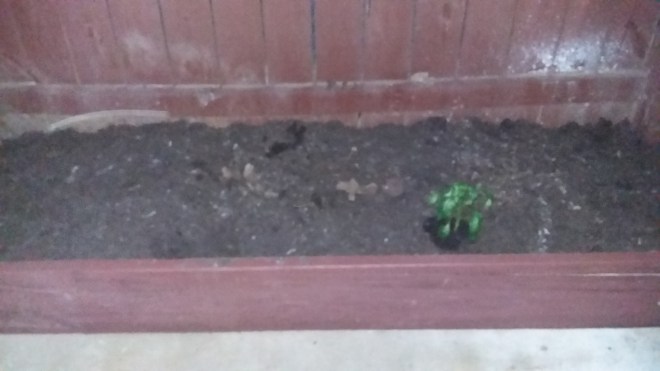
My husband and I are starting by growing our garden in the backyard. We may not have our acres yet but its a start! We’re growing Spinach, Onions, Tomatoes, Lettuce, Basil, Thyme, Rosemary, and Oregano.


Writer’s Wednesday – Papa’s House
Wednesday is your new favorite day! Lol. 🙂
I would like to share more of my writing with you. I mean, besides poetry. Soooo, I’ve come up with another Wednesday Segment. Welcome to Day One of Writer’s Wednesday. I was late to my workout this morning drafting this so excuse my delay on getting to the comments. I am currently sweating it out during my lunch as you’re reading. Gotta keep it together ladies!
Here’s our Writer’s Wednesday Badge.

Every other Wednesday, I’ll give you either an excerpt from one of my books or something new, a short story or something. I don’t really know but I’ll think of something creative every other week, time permitting.
This week, I am giving you a sneak peek into a scene from The Road to Freedom in a segment I like to call “Papa’s House.” Enjoy!
“This here make you grow hair on ya chest,” said Papa as we laughed, watching as Terry took in the liquor before coughing, and Papa patting his back for rescue as he laughed.
“Breathe, son, breathe.”
“What the hell is that!” said Terry, wiping his mouth with the back of his hand.
“Can’t handle it, huh T?” said Frank, laughing.
Papa’s shoulders bounced up and down when he laughed, slapping his leg as he did so. “That there’s what we call white lightening. Amazing what you can do with a little corn mash. You be alright son, breathe,” he said as Terry went back to his place on the sofa, holding his chest.
We were sitting at the home of Peter “Papa” Whitfield, the white man who offered us food and a bathroom once Ms. Mary’s vittles ran low. Peter ran a farm just outside of town and his faded blue jean overalls and heavy boots gave way to the hard work it took to run this place. Acres of land spread wide on both sides, cows grazed the area beyond the fences, and Rottweiler dogs alerted its master of strangers approaching Poplar Springs Drive in Meridian Mississippi.
The air was unusually cool tonight and the warm coffee blanketed our insides as we rested from the road. Though we would have liked to go on, Ms. Mary insisted we stop and refuel.
“You know, liquor does not actually warm you in the cold. It thins your blood and makes you colder in winter,” said Gary.
“Thank you, Gary, for that irrelevant piece of information,” said Terry.
“Well, I don’t think your friend’s gonna be worried about the cold anytime soon,” said Papa, chuckling.
“What is that heavenly smell?” said Laurie as Sara, Papa’s wife, appeared from the back of the house carrying a casserole dish.
“Why don’t you ladies come find out. Leave the men here to talk about men things,” she said, with laughter in her voice as Laurie and Fae marched on to the back to retrieve more food.
As the women disappeared, headlights invaded their places on the sofa. Papa’s dogs barked and raced toward the unknown vehicle as they growled in the night air.
“You expecting company Mr. P?” said Willie, peeking out the window.
Papa frowned and stood as Sara emerged from the back.
“Papa.”
I don’t think I like the way that she called his name.
“Alright boys, y’all head on over to the back now,” said Papa.
“Why?” said Terry.
“This ain’t the time to be asking questions now boy, go!”
We all scattered to the back of the house, walking past the thick, black curtain that separated the kitchen from the dining room table; where Terry had taken his first, or perhaps second, drink.
“What’s going on?” said Fae.
“I don’t know.”
“Shh,” said Sara as Papa’s voice roared from the front door.
“Tommy Lee, ain’t specs to see you out so late, how’s the wife?”
“Hey there,” said the voice of a deep southern drawl. From the sound of it, Terry wasn’t the only one drinking tonight.
“Oh, she’s be fine. Mighty fine. Say uh, you ain’t got no company on in there do ya, Peter?” said the Tommy Lee voice.
Papa chuckled, “You mean besides my wife?”
Tommy Lee’s drunken voice laughed. “How is Sara doing by the way? She so pretty. Hey! Sara! It’s Tommy Lee!”
“You alright, man? Perhaps we should take this on out in the yard.”
“Perhaps,” said Tommy, laughing. “That’s a funny word, “Perhaps!” he said again, laughing.
“Look a here,” said Tommy. “Word is you’s got some niggers in there.”
“Whoa,” said Terry.
“Shhh!” said Sara as we continued to listen.
“I think you better get on home now Tommy, it’s getting late now.”
“Kicking me out, huh? I ain’t gonna tell you how to run thangs, but you best be careful. Nigra mens and Nigra womens is on the loose now. They’s tryna inflame our nigras and our whites t-t-t…” Tommy’s voice trailed off as if trying to find the words as we listened.
I regretted the once warm caffeine that now had my blood racing, my hands shaking, and my heart pounding out of my chest.
“Alright Tommy boy, I think you best get on the road now, the Missis be waiting,” said Papa as their voices faded away. I noticed Papa’s voice remained calm, and I imagined they had now stepped outside since we could no longer hear the now distant voices.
“OK, everybody just remain calm and stay where you are until I come back,” said Sara, before disappearing behind the curtain.
“What do you think is going on?” said Laurie.
“I don’t know,” said Frank.
“How does anyone know that we’re here?” said Gary.
That was a good question. We’d made sure to keep our travels discrete since the New Orleans incident. But it would also make sense that Frank’s dad would be looking for him. But I kept my thoughts concerning his dad to myself. We all knew he was racist and it embarrassed Frank. Though I’m sure Mr. Hansen had something to do with it, I did not want to disgrace the face of my friend. I went with my second thought instead.
“I wouldn’t be surprised if we were being watched.”
“Or followed,” said Fae.
“I bet it was that punk ass Papa. What kind of name is that anyway? What man calls himself Papa?”
Terry’s eyes had a gloss to it as he spoke. I think by now he was really feeling the liquor.
“I’m tired of this,” said Willie.
“Oh, so you punking out too Willie?”
“Terry come on,” said Fae.
“Naw, I’m asking him a legitimate question. You punking out, Negro?”
“What you just call me?”
“Really?” said Laurie looking at both Terry and Willie.
“I know y’all ain’t gonna do this now,” said Frank.
“Please don’t do this now,” said Gary.
“Shhh!” I was sick of everyone’s talking. Though they spoke in whispers, it seemed our voices carried and would float on out the back room and into Tommy Lee’s ears. Who knows what he wanted or what he heard. We were in Mississippi after all. The stories of their crimes against the Negro were well known in the South. And after the murders of Emmett Till and others, Mississippi’s racism had gained increased attention. People all over the world could read in newspapers and watch on television the bizarre system that protected those who committed crime after crime. I didn’t understand why such hatreds existed for negroes, and my longing for the answer burned its own private hole into my chest. Unless I did my part to find out, I would never be quite whole again. If only I could have explained it this way to mother where she could understand. Being part of the fight for freedom on behalf of negroes wasn’t just some phase I was going through. More so than a desire, it was a need. Otherwise, as a young white man in white America, I could not help but feel guilty on behalf of my people. And as we stood here, fearful of the unknown, I knew that what I felt could not compare to Fae, Willie, and Terry. Considering I was shaking uncontrollably in my own skin, what kind of fear did they experience? And more, what was it like to have to experience it your entire life? The pangs of guilt sought to overwhelm me as we stood there behind the curtain and waited.
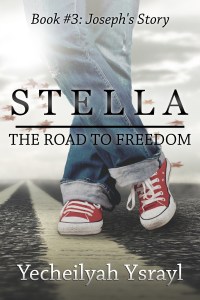
“I enjoyed the writing style of the author, who was able to capture different characters through their dialogue and how she wrote their accents. Though Ysrayl is not a white teenage boy, she is able to write his narration convincingly, while also being able to give other perspectives through the rest of the characters.”
– Swimming Through Literature, Amazon Review
*****
Remember, The Road to Freedom as well as Beyond the Colored Line and Between Slavery and Freedom is on sale this month! The Black History Month Stella Sale ends next week. CLICK HERE to order all three books at one low price. All books are paperbacks, signed by me with my author seal. Shipping is also free but this limited time offer won’t last.
An Untold Story: Slavery In Canada
Special Delivery. Did you know that Canada enslaved blacks too? We were scattered across the four corners of the Earth. Excellent History Lesson from the Blackmail4u Blog.
Black History Fun Fact Friday – The Attica Massacre
“ON SEPTEMBER 13, 1971, a four-day rebellion of over 1200 inmates at the Attica State Correctional Facility in bucolic upstate New York ended most horrifically after Governor Nelson Rockefeller ordered almost 600 state troopers to storm the prison. Even though the raid took only 10 minutes, when one could finally see through the haze of spent ammunition, it was immediately clear that the price of retaking this facility by force had been staggeringly high.” – Heather Thompson
Before we go on, let’s take it back…
Convict Leasing

With nearly half of all cotton investments in human bodies now gone, the end of chattel slavery no doubt left a sour taste in the mouths of slave-owners. Over four million African Americans (because who would know exactly how many?) were poured into a society that did not want them, cotton economies in shambles, cotton gins destroyed, and wealth that deteriorated before the ink could dry on the Emancipation Proclamation. A system so interwoven into the fabric of America could not just be taken away without serious consequences. Slave-owners could not sit back and watch; a reconstruction of slavery was necessary.
The Reconstruction Era, the process of rebuilding the south (which was really the time of restoring slavery to the south), introduced a new set of laws that would ensure that Blacks remained the property of landowners, sharecropping on the same plantations that held them as slaves. All of this despite General William T. Sherman’s plan to grant freedmen 40 acres on the islands and the coastal region of Georgia. But after the Civil War, blacks never did receive their “40 Acres and a mule” and were instead ordered to either sign contracts with the owners or be evicted, driven out by army troops. In the summer of 1865, all land had been ordered by the government to be returned to its original owners. Thus, millions of blacks remained poor. Still, this was not the only form of servitude to which they were subjected. In addition, something more law abiding would hold them in captivity. Ironically, within the same paragraph that abolished slavery, slavery was also reconstituted. According to the 13th Amendment:
“Neither slavery nor involuntary servitude, except as punishment for crime whereof the party shall have been duly convicted, shall exist within the United States, nor any place subject to their jurisdiction.”
According to this law, slavery could not exist in the United States except for punishment for a crime, permitting slavery in the case of imprisonment.
New laws targeted blacks, (Black Codes) criminalizing their lives. That is, almost everything was a crime. Farm owner’s incapable of walking by the railroad or selling the products of their farm after dark. Or, the infamous Pig Laws, where stealing a pig (or any animal) could result in five years’ imprisonment. Or Sundown Towns, all white neighborhoods where Blacks were not allowed after dark. The more Blacks broke these laws and were sentenced to prison, the more slaves the plantation owners, now masked under private parties and corporations, had back into their possession. They could work the prisoners from sun up to sun down again while providing them with food, clothing, and shelter. Also known as Convict Leasing—the leasing of bodies to coal and iron companies owned by former slave owners—slavery was back. In 1883, about 10 percent of Alabama’s total revenue was derived from convict leasing. In 1898, nearly 73 percent of total revenue came from this same source.
Attica State Prison

With awareness growing out of the Civil Rights Movement of the 60s, Malcolm X, The Black Panther Party, etc., Black and Latino Prisoners of 1970 began organizing rebellions against their treatment within the prison system. As with any information passed through the “grape vine” of the black community, the rebellions spread from prison to prison until it came to a head the Thursday morning of September 9, 1971. When the door prisoners used to go to the yard was locked, a fight broke out between the prisoners and the guards. As the fight grew, more prisoners joined until they broke open a gate connecting to another part of the institution and, to make a long story short, prisoners were let loose within the institution.
The Brothers locked the prison down, kicking butt and taking names. I mean (clears throat), taking staff members as hostages and implementing their own system of order within the prison. Appointing leaders to keep order and to be sure the staff was properly cared for, they demanded from the outside world better treatment within the prison system. Better medical treatment and less slave labor. But their “freedom” would not last long. When a hostage who was hit in the head at the beginning of the fight died from his injuries, the prisoners were responsible under the felony-murder rule. The felony was the riot and the murder was the death of the guard.
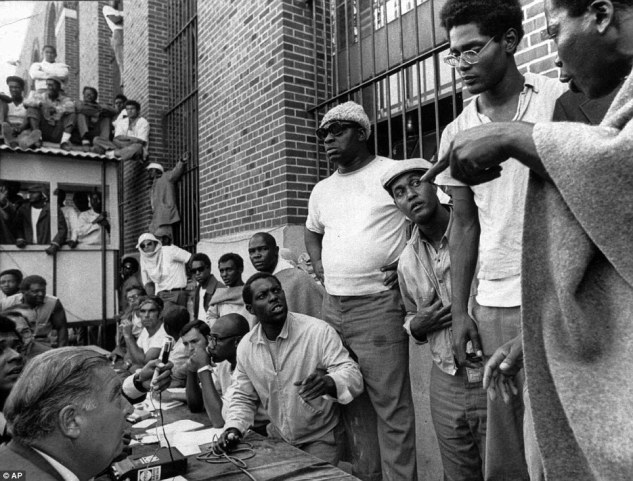
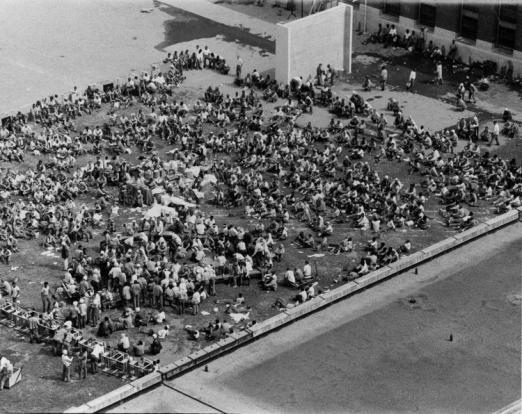
Shortly thereafter, a National Guard helicopter flew low over the yard and blew a cloud of military-grade CS gas into the crowd of men. As told to Attorney Jefferey Haas, under the name Big Black, one of the surviving prisoners of the time recalls:
“First came the tear gas. People looked for something to cover their face. When I first heard the shots, I thought they were blanks. Then the people around me in the yard starting dropping. I realized they were real bullets, and everyone ducked and ran for cover.” (September 16, 1971, Prisoner of The Attica Correctional Facility, New York, as told to Jeffrey Haas).
The gun shots Big Black is referring to are the marksmen who came in and started shooting, hitting 189 of the 1300 men in the yard and killing 31 people—29 prisoners and ten hostages. (There’s a conflict between the numbers. Some sources say 31 prisoners died and some 39. I use 31 because that is in accordance with the news articles of the time).
After the shooting, the beatings came:

“The guards stripped us naked after the shooting. They made us crawl naked in the mud through a gauntlet where they beat us.” – Big Black
Next, Big Black (Big, dark skinned and part of the security) was tortured as an example. They burned his body with cigarettes:
“They took me out of the line. They made me lie on a table naked on my back and put a football under my chin. They put their burning cigarettes out on me. Some dropped them from the catwalk above and was laughing.”
“Afterwards, a news photographer found and recorded a pair of inscriptions, in separate hands, written with a white marker on a dark steel wall that succinctly told the story of the Attica rebellion. The top one said, “Attica fell 9-9-71 – F*&k you pig!” Just underneath that was written, “Retaken 9-13-71. 31 Dead Niggers.”
– Dennis Cummingham, Prison Legal News
While seeking freedom the men had forgotten one thing: slavery is abolished except as punishment for a crime. They were given slave-like treatment because as prisoners under the law, they were still slaves.
Today, the message is still relevant.
 The PBS Blog