The Best Advice is Lived Experience

Photo by Ivan Samkov

I saw an Ad on Facebook where the person was telling authors that selling their books on Amazon is a waste of time and that they should sell directly from their website.

And, if you buy the course for $89.95, he’ll teach you exactly how to do it.
Be careful with this kind of advice.

It’s not even that it’s bad, but it is unbalanced.

Questions.

How many people visit your author’s website monthly? Not your blog, your static author website?

How many author websites do YOU visit regularly?

When you think about a book you want to buy, what is the first thing that comes to mind?

For me, the answer is not from the author’s website but from Amazon, and if I am going offline, I am hitting up Barnes and Noble or my local Independent bookstore.

Photo by Ivan Samkov

I have always advocated for author websites because they allow authors to track leads.

You can collect data to keep in touch with readers, like email addresses and phone numbers—something you can’t do through Amazon, which doesn’t show who bought the book. You only know if that person leaves a review.

But I wouldn’t consider Amazon a waste of time when they are the number one go-to for people looking to buy books.

This person’s perspective lacks balance. Authors can have books available through their websites and on Amazon. Also, consider everyone’s journey is different:

  • Some authors need help to afford or do not want to pay for a website, which requires buying a domain name, paying for e-commerce, and the percentage your cart of choice (say Stripe) takes out of every transaction. Meanwhile (at the time of this writing), setting up an Amazon Author Central page is free.
  • And some authors prefer to add a website outside of Amazon to track leads because they understand that a book is a product. And individuals don’t have products; businesses do. These authors see the value in their books not as the end but as the beginning of a thriving and profitable business, and businesses have websites. 
What I Recommend:

The best advice is lived experiences, and I recommend that everyone do what feels right with their souls. Otherwise, we risk stifling an author’s creativity and rob them of the opportunity to learn.

  • To increase traffic to your static website or landing page, promote it. Let people know the option to buy directly from you is available. Offer your books as signed copies and throw in some book swag. People do buy from author websites if you let them know.
  • Use your blog as your website. Because they are updated often with posts, they get much better SEO and traffic than static sites. You can set it up for free right here on WordPress. You don’t have to buy a domain unless you want to. (I did because I’m extra, lol.) It is also a great way to build community.
  • If you opt out of a website, set up your Amazon Author Central so you can send people there to buy your books and follow you. People who follow you on Amazon will get an email the next time you publish a new book!
  • Experiment! Test things out. Take risks. Sometimes we don’t know what we like because we’ve never stepped outside the box. Let experience be your teacher.

The Amazon Bestseller Approach: A Warning

In the words of James Baldwin, “If I love you, I have to make you conscious of what you don’t see.”

Here’s the Game:

Once upon a time, when print-on-demand publishing became more popular thanks to companies like Amazon and Lulu, self-published authors discovered a powerful manipulation tactic: they could reach a higher ranking by reducing their ebooks to 99 cents and getting all their friends to buy them, skyrocketing their books to the #1 spot.

And before you knew it, tons of Self-Published books, both excellently written and mediocre alike, hit the Amazon Best Sellers List. Some authors even put the sticker on their covers.

It was an exciting time…

…for a few minutes.

Most of these authors stayed at #1 for a maximum of a few hours.

Over time, their book sales continued to plummet until the next book, where they repeated this strategy: setting the price to 99 cents and telling all their friends to buy it.

The problem with this is it caused many Self-Published authors to lust after that pretty orange tag, even if it only lasted for a few minutes.

They’d refresh their browsers repeatedly to see where the numbers are.

When I first put I am Soul on preorder at 99 cents in 2017, it was #7 on Amazon’s Best Sellers list.

But I had only sold five preorders!

Chile, my bank account was dryer than a Popeye’s biscuit.

It looked good on the outside, though, and I was technically a bestseller on paper, but I wasn’t making any money.

By focusing on more organic ways to sell my book, I became a bestseller on and offline.

It wasn’t until I started to shop my books offline and talked to the owners of bookstores that I truly understood how little being an Amazon Best Seller meant to the outside world. I focused my efforts on getting my name out there and increasing my reviews, and this helped me to become an Amazon Best Seller the organic way.

I was also selling out of brick and mortar bookstores and I didn’t have to beg my family and friends to make it happen.

Back to the Story…

The problem with getting all your friends to buy your book is once they’ve bought their copies, the book stops selling.

And that’s what happened to these authors. Unlike traditionally published authors or Indie Authors who focused on other methods and reached the bestsellers through sales, the self-publishers who used the tactic couldn’t maintain the momentum. In a matter of hours, their orange tags were gone.

It’s exciting and praise-worthy to make it onto the best sellers list, whether it’s Amazon or USA Today. However, it is not something Self-Published authors should stress themselves over or allow to consume their writing career.

If the bestsellers list is a goal, authors should strive to do it more authentically. Instead of trying to manipulate the algorithm, focus on selling the book to your target audience, getting early reviews, offering sneak peeks, running Ads, book signings, book tours (virtual or in-person), speaking, and a host of other creative ways to get the word out about your book.

Click here for More Indie Author Basics

Author Scams and Publishing Companies to Avoid

I came across this excellent article this morning on identifying author scams and publishing companies to avoid. Click on the read more here link below for the full article.

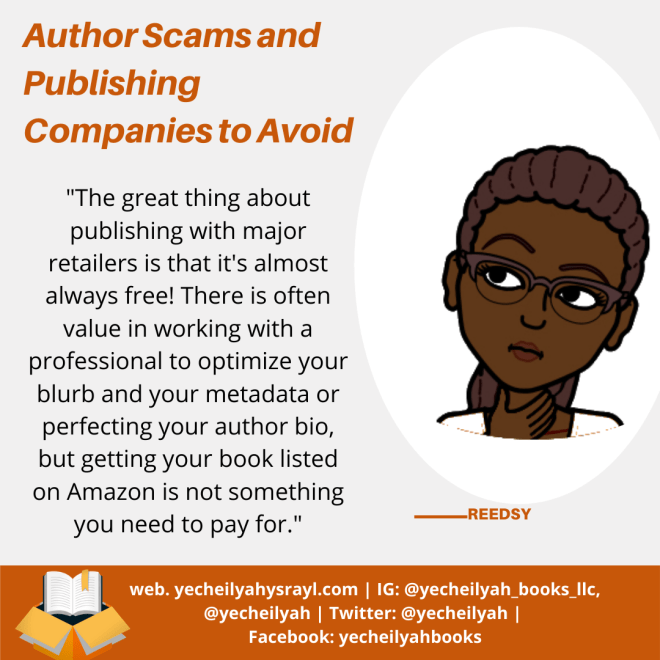
“The great thing about publishing with major retailers is that it’s almost always free! And unless you’re 100% technophobic, you shouldn’t have much of a problem uploading your book to Amazon or Kobo or Apple Books within a few quick minutes. There is often value in working with a professional to optimize your blurb and your metadata or perfecting your author bio, but getting your book listed on Amazon is not something you need to pay for.”

Read More Here

Author Caution: Be Careful Linking to Pirate Sites

STOP: Authors, Be Careful

Photo by Isaiah Rustad on Unsplash

I’ve been sitting on this article since February (See screenshot below) and had almost decided not to publish it.

After seeing Chris share the article on Piracy, Plagiarism and Impersonation however, I thought maybe it was time for me to open my mouth about this.

Back in February, information surfaced about a pirate website charging readers for a month of unlimited downloads of stolen books and many Indie Authors found their books listed (myself included). After hearing about this I was (obviously) concerned and have even shared the news on Twitter. Since then, I’ve seen more and more authors put the word out. But then…

After some observation, I deleted my Twitter retweet and stopped worrying about it. I had to take a step back and see what was really going on. This website popped up, seemingly out of nowhere and their website has been shared repeatedly over the internet.

Red flag.

Did you  read hear what I said? Their website has been shared repeatedly. They are getting more and more attention, more views and more clicks. You would think someone had just launched a new product. Personally, I am not going to post the link to that site on this blog but I am pretty sure you know which one I am talking about. While putting the word out is good, my caution is to be careful with those links.

When I first read about this, the only way to know if your book is listed was by searching for it on their website by typing your book title into their search box. I’ve even heard recommendations from people telling authors to type their name into the site to see if their book is there…errr…

Red flag.

In just one week from my initial viewing, I noticed that their website had been upgraded. It did not start off with a display of the book covers when I first *heard* about it. Today, it looks slightly more professional.

Red flag.

My warning is simple:

Be very careful linking pirate websites in any way, to your blog, of downloading your books from these sites, of typing anything into their search boxes, and of clicking on links or Ads on these websites whatsoever.

“Do not visit a pirate website to confirm whether your books are there, as this puts your computer at risk.” – Indie Author Self-Defense: Piracy, Plagiarism, and Impersonation

Do not blindly jump on the bandwagon but be cautious with your handling of those links and your promotion of them. It is also possible that many sites like this pull book covers and metadata from Amazon and Goodreads but they do not actually have the books. Instead, they are using the images to scam people by stealing their personal and financial information and then sending viruses to their computers.

“Piracy is the unlawful copying of your work, and it’s the most common form of content theft. However, there’s good news: only a tiny fraction of the piracy you find on the web is actually piracy. Most pirate websites don’t actually have stolen content. They use software to gather titles, covers, and descriptions from Amazon or other retailers to use as bait. Then they set up a convincing storefront on the web which claims to offer those books, usually free or for a ludicrously low “all you can eat” subscription.”

Source: Indie Author Self-Defense: Piracy, Plagiarism, and Impersonation

That’s why I said be cautious poking around. It’s not wrong to link to anything but with certain websites you don’t know if just clicking on something will give you a virus (or going to the website period.) It’s frustrating, I know, for people to take anything of yours but you can possibly do more harm than good linking those sites to your blogs.

Authors Beware: Amazon Gets Medieval on Paid and Traded Reviews | Anne R Allen

Very informative post. This could be why one of my Renaissance reviews went missing even though I have never (and would never) buy a review and have so far followed all of Amazon’s review rules. They are cracking down. I agree with the idea that reviews should be spread out, left not just on Amazon but also on places like B&N and Kobo if the author is there. I suppose this would also mean that authors would probably want to consider publishing on these other platforms as well, instead of just on Amazon.

Click through to the ORIGINAL post HERE to learn more.