It is important not to get emotional about it. I am just going to discuss the facts. Let’s just be real for one second here people. If they won’t even show you that the Egyptians were a BLACK SKINNED people, why would anyone admit the Israelites were black? (Who were often mistaken as Egyptians…also Israel is in Northeast Africa by the way.)
I am sure we’ve all heard it by now. It’s all over social media. In the midst of Black History Month The Today’s Show decided to showcase an image of a white Nefertiti. Not only am I not surprised, but I think maybe we (so-called Black people) deserve it. Maybe this is what it takes for us to wake up and stay woke. Maybe these are the kinds of shockers that is necessary for us to realize the truth. You don’t have to know much about history to know that the Egyptians were a black skinned people. “Egypt is in Africa, not some small island in Sweden.” (Paul Mooney)
The word Ham in Hebrew is Khwam, and it means “hot, burnt, and black.” The first-born son of Ham, Cush, forms the Kushite nation. They were also called and known as the ancient Ethiopians. Ethiopia comes from the Greek word, Aethipos, which means, “burnt or black face.” The Greeks applied this name to the people living south of Egypt. The name Egypt comes from the word Aegyptus though the Egyptians called themselves Khemet / Kemet, which is a variation of the Hebrew word Khawm (Ham). It means, “People of the black land.”
Gerald Massey, English writer and author of the book, Egypt the Light of the World, wrote, “The dignity is so ancient that the insignia of the Pharaoh evidently belonged to the time when Egyptians wore nothing but the girdle of the Negro” (p. 251)
Sir Richard Francis Burton, a 19th century English explorer, writer, and linguist in 1883 wrote to Gerald Massey, “You are quite right about the ‘AFRICAN’ origin of the Egyptians. I have 100 human skulls to prove it.”
King Tut
King Tut
Scientist, R. T. Prittchett, states in his book, The Natural History of Man, “In their complex and many of the complexions and in physical peculiarities the Egyptians were an ‘AFRICAN’ race” (p. 124-125).
The ancient Greek historian, Herodotus, who visited Egypt in the 5th century B.C.E., saw the Egyptians face to face and described them as black-skinned with woolly hair.
Anthropologist, Count Constatin de Volney (1727-1820), spoke about the Egyptians that produced the Pharaohs. He later paid tribute to Herodotus’ discovery when he said:
“The ancient Egyptians were true Negroes of the same type as all native born Africans. That being so, we can see how their blood, mixed for several centuries with that of the Romans and Greeks, must have lost the intensity of its original color, while retaining nonetheless the imprint of its original mold. We can even state as a general principle that the face (referring to The Sphinx) is a kind of monument able, in many cases, to attest to or shed light on historical evidence on the origins of the people.”
Volney also stated:
“What a subject for meditation. Just think that the race of black men today, our slaves and the object of our scorn, is the very race to which we owe our arts, science, and even the use of our speech.”
Egypt: Ham’s second born son < Blood brothers to the Ethiopians
Ethiopian > Burnt Face
Egypt > Burnt Black
Phut: The Somalians – According to the ancient record of Egypt, Phut has been traced back to the Somalian
“Every man has flesh and blood, which includes a skin tone, but the Israelites and Egyptians were black, I’m just making it known.”
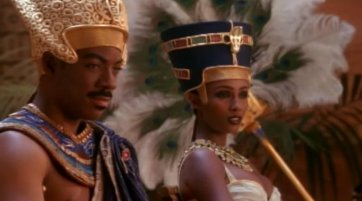
From Music Video: Remember the Time by Michael Jackson
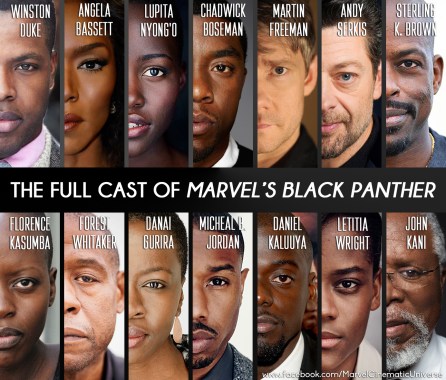
90% of the cast members are Black. This isn’t a racial thing. It’s just that people are tired of seeing movies where the heroes are white. Even biblical movies refuse to reflect the real identity of the people who lived in that time. The Samson movie is also about to come out but Samson was not white. It’s not about skin complexion it’s just a fact, the people of the Bible were Black.
Warriors, Not Slaves
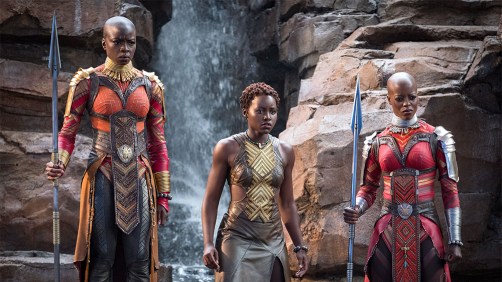
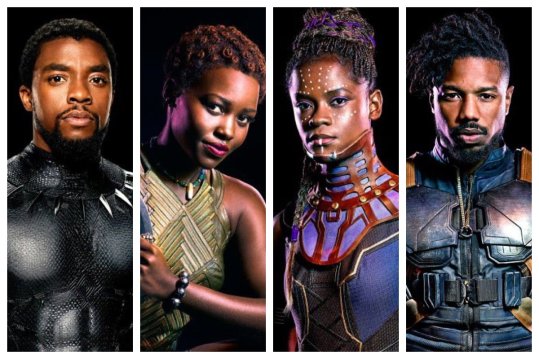
The Black people in the movie are not slaves, maids, housekeepers, and farmers (though there’s nothing wrong with farming, just saying). The Black people in this movie are warriors, Kings, and Queens.
Women Warriors
The Panther women go just as hard as the men without losing their femininity. They are supportive of their men, smart, fierce and they are fighters. Not to mention a showcase of the women’s natural beauty. I love how (far as the trailers go since the movie is not out yet) the movie shows them being beautiful while swinging those swords.
Historical
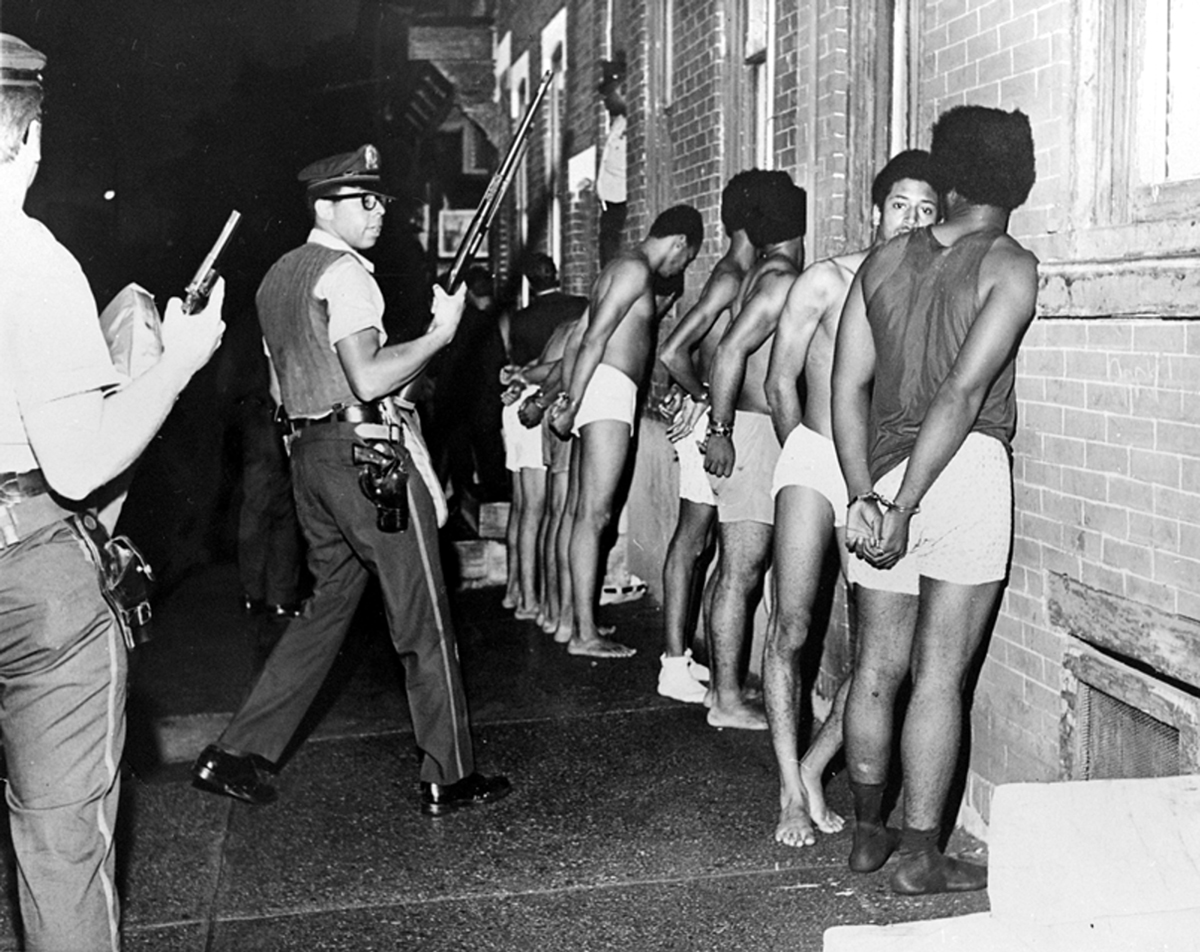
The Panther’s first appearance happened during the Civil Rights Movement of the 1960s, and I am sure the newscasts that showed Black Americans getting brutalized by police was a motivator for Marvel. This movie Black Panther comes at a sensitive time politically which further makes it reminiscent of revolutionary movements in Black History such as Huey Newton’s Black Panther Party For Self-Defense and Marcus Garvey’s Universal Negro Improvement Association, both of which promoted the freedom of the so-called Black people.
Educational
Speaking of history, Black Panther is educational for today’s youth, many of whom know nothing of the Black Panthers of the 60s, Marcus Garvey of the 20s or anyone of or before the era. The release of this movie at this time, therefore, makes it easier to start conversations about Black History (especially being it releases February) and inspires liberation among Black people in general. The men and women even have accents reflective of their “African” heritage. When you’ve spent nearly 400 years being afflicted and not seeing positive representations of yourself in textbooks, on television, in schools etc., it makes it difficult to have a positive image of yourself as an individual. My hope is that Black Panther delivers and helps to spark a resurgence of consciousness among Black youth.
Empowering
Wakanda is empowering and reminiscent of the Israelite nation (not a race of Blacks but a nation of people) and their position as rulers. It represents everything we could be if we embrace who we truly are. This movie, if done right, is not just a movie, it is a biblically powerful representation of Israel on the top and not the bottom for once. The birth of a nation and the rise of a people. It is our time.
About Black Panther
After the death of his father, T’Challa returns home to the African nation of Wakanda to take his rightful place as king. When a powerful enemy suddenly reappears, T’Challa’s mettle as king — and as Black Panther — gets tested when he’s drawn into a conflict that puts the fate of Wakanda and the entire world at risk. Faced with treachery and danger, the young king must rally his allies and release the full power of Black Panther to defeat his foes and secure the safety of his people.
Yecheilyah is an author, blogger and poet. Be sure to pick up your copy of I am Soul, her latest collection of poetry on Amazon.
After letting Revelation: The Nora White Story Book Two, sit for about two months, I am right back into revisions and getting excited all over again. As such, I decided to give those of you who have not read Book One an opportunity to do so.
Renaissance: The Nora White Story (Book One) is now available for just 99cents in eBook on Amazon from now through Friday, December 29, 2017. Also, be sure to leave me an honest review if you feel so obliged after this short read. Reviews greatly help readers to understand what to expect from these books and are a great source of feedback for Indie Authors. As always, your support is golden.
“The writing is of a very high quality, evoking period and place so well that I was transported to the Jazz Clubs and writers’ circles of nineteen twenties New York and to the equally hot and humid atmosphere of the Mississippi Delta.”
For those of you familiar with my latest novel, Renaissance, you know that Zora makes a guest appearance so I am excited to dig into her newest release from Harper Collins next year. It sounds like a powerful one. Here’s what’s going on:
HarperCollins will launch a never-before-published book by Zora Neale Hurston. Barracoon is a non-fiction work of anthropology, rather than a novel.
As Daniel Johnsonwrites for the Black Youth Project:
Barracoon tells the story of the last known person to survive the transatlantic slave trade, a man named Cudjo Lewis. Many know that Hurston was an acclaimed fiction writer, but here it is her work as an anthropologist that shines. Hurston was able to sit down in the Black community of Plateau, Alabama, which was founded by Cudjo Lewis and other ex-slaves from the ship that brought them to America, and talk with the then 95-year-old Lewis about his life in 1931.
The book’s name comes from the type of ship on which Lewis was held and brought to America. In Barracoon, Hurston captures, largely in Lewis’s own words, the horrors of his passage to America, the brutality of his time as an enslaved person in America, and the story of his life after the Civil War.
This sounds like it’s going to be a powerful read.
This is just a heads up that my short poetry collection I AM SOUL is now available for preorder on Amazon. CLICK HERE or on the image below to preorder now for 99cents.
Deu 28:68 “And YAH shall bring you back to Egypt in ships, by a way of which I said to you, ‘You are never to see it again.’ And there you shall be sold to your enemies as male and female slaves, but no one to buy.
“The United Nations (UN) revealed on Wednesday that hundreds of migrants from Nigeria and other West African countries passing through Libya enroute Europe are being bought and sold in what it described as modern-day slave markets before being held for ransom, forced labour or sexual exploitation.”
I haven’t had the chance to sit down and share my thoughts on the slavery taking place in Libya. I usually take my time with such things. I don’t want to echo what everyone else is saying or jump on bandwagons. I want to be logical, spiritual, and develop my own thoughts about it so I’ll just keep this short until then.
If you are new to what’s going on, The Slave Trade has basically reopened and Israelites, so-called Blacks / Africans, are being taken back into captivity throughout Libya. You can catch up on what’s going on HERE and HERE.
Since I started this blog I’ve spoken about Slavery, the Enslaved and the horrors of this time. I talk a lot about The Civil Rights Movement, Jim Crow, Police Brutality, and the overall mistreatment of Blacks in America and the mistreatment of Blacks period. For three years now I’ve tried to give as much historical information as I am able to inform you of these things and in return, I get people who are tired of hearing about slavery. Tired of seeing movies and TV shows and reading books where slavery is present. We believe it is an eyesore that must be covered up and hidden underneath our beds. We want to forget about this time and sugar-coat the details. And when good men seek to help those who need it they are called dictators and thus removed from power.
Few people know that Khadafi tried to help Blacks in Libya before his death. He wanted to protect them and for this, he was called a dictator and killed while American’s cheered their ignorance in front of TV screens that told them lies. (Wag the Dog is a good movie on how TV often controls our perception of reality.)
If there is one thing we should know about slavery is this: At least we knew we were slaves and fought collectively for freedom. Today, we think we are free so we don’t fight anymore. It usually takes us to experience something as traumatic and tragic as this for us to understand and realize where we stand not just in America but all over the world.
While what’s going on in Libya is heartbreaking, I hope that finally, we can see why these stories are worth telling and why these reminders are still necessary. I keep saying there’s nothing new under the sun, that what has been done is what will be done, and that we should not be shocked but to pay close attention to what’s going on in the world. Our eyes may very well witness more tragedy and our hearts more pain.
(FYI: Black History Fun Fact Friday continues next week….been busy but I haven’t forgotten.)
Welcome back to another episode of Black History Fun Fact Friday. It’s been a long time and we have a lot to cover today.
If you’re new to this blog or this segment be sure to visit the BHFFF page HERE for more EPs.
The Caged Man
Mbuti or Bambuti are one of the several indigenous pygmy groups in the Congo region of Africa. One famous Congolese Mbuti, who was made famous in a horrific way, committed suicide 100 years ago. On May 20, 1916, Ota Benga put a gun to his heart and pulled the trigger. Depression and sadness are modest terms we use to understand the spirits that troubled him. But who was he and why is knowing his story important in our time?
In the early 1900s, a “businessman” (more appropriately speaking a slave trader) named Samuel Verner, tasked with the responsibility of acquiring pygmies for a cultural evolution display at the Louisiana Purchase Exposition in St. Louis, Missouri, encountered Benga in 1904. Paid by the St. Louis Exposition Company a year earlier to hunt men instead of monkeys, he was to bring African Pygmies to America for the St. Louis World Fair.
Ota’s family were killed by a Belgium militia group who set out to control the natives of that land for the large supply of rubber in the Congo. Ota had a wife and two children who were killed in such raids on villages and survived because he was on a hunting mission. To make a long story short, Ota was kidnapped and taken to America by Samuel along with other pygmies who were kidnapped as well and brought to America.
Clockwise from top left: Ota Benga at the Bronx Zoo holding a chimpanzee. An article from the New York Times announcing the new exhibit at the zoo. Another photo from the zoo of Ota Benga and the chimpanzee. The Reverend James Gordon who protested Ota being exhibited in the monkey house and who took custody of him after he was released.
Benga’s physical appearance, as is most Mbuti, astonished onlookers who immediately compared him to an animal, specifically for his short stature and razor-sharp teeth. Displays of humans were very common in the early 20th century to prove the theory of the evolution of man. Most specifically, men and women of color from the Eastern part of the world were used as examples of the lower class of humans and often put on display. They were usually those with abnormal features and deformities. It’s no surprise then that Ota and his fellow men became an instant attraction. Ota’s personality was also said to have been lively and the men attracted spectators wherever they went until Ota was eventually caged at a Bronx Zoo in 1906. He eventually became fond, allegedly, of a monkey and so began The Caged Man in the Monkey House.
Identity
Ota’s story is worth telling because Africa is a continent with over fifty countries and comprise many different people and cultures. There are just as many cultures and nationalities of people as there are languages and just as many languages as there are colors. But when you group a people together and call them “Blacks” you deny them their right to heritage and nationhood, because Black does not properly define a people. While I use these terms (Black, African American) for understanding sake, the Bible says nothing about race, nor is the word or concept of different “races” found in the Bible at all (See Gen Ch 10) despite the fact that the term has been used to cause divisions among man. More appropriately, some of the Black “races” of the world are Israelites, some of them Egyptians, Ethiopians, Ghanaians, Senegalese, Congolese, Libyans and so forth. Thus, this story is important to the understanding of identity as well as the medical field and how it fits in with the racial oppression of Blacks in America going back for centuries.
Eugenics
Contrary to popular belief, Eugenics did not start with Margaret Sanger and The American Birth Control League but the concept started much earlier.
Coined by the cousin of Charles Darwin, Francis Galton, Eugenics comes from the Greek word eugenes, meaning “well-born.” It is a racist scientific process that set out to prove, through alleged psychological and medical evidence, the inferiority of Blacks. From 1924 – 1936, thirteen states in the U.S. utilized Eugenics programs that ranged from isolating those deemed “feeble-minded” from the general population to forced sterilization.
“When the infamous German eugenic sterilization initiative began in January 1934, seventeen U.S. states were already performing sterilizations routinely, and that year between two thousand and four thousand Americans were sterilized. Indiana passed legislation requiring the sterilization of the mentally unfit in 1907. By 1911, six states had passed laws providing compulsory sterilization of the mentally unfit. In 1935, twenty-seven states had such laws for the feeble-minded, those on welfare, or those with genetic defects. Forced sterilization was made legal in the infamous 1927 Buck vs Bell.” (Medical Apartheid, Harriet Washington, The Black Stork, pp 202)
Galton, in short, took Darwin’s philosophies and ideas on Evolution and put them into practice in what became known as Eugenics. He proposed that the poor, the sick, the weak and the untalented should be prevented from multiplying. Leonard Darwin, Darwin’s son, was also one of the supporters and proponents of eugenics in Britain. Galton maintained that the principle of the “survival of the fittest” had to be complied with and that only the strongest should be allowed to participate in the world.
“… modern eugenics thought arose in the nineteenth century. The emergence of interest in eugenics during that century had multiple roots. The most important was the theory of evolution, for Francis Galton’s ideas on eugenics – and it was he who created the term “eugenics” – were a direct logical outgrowth of the scientific doctrine elaborated by his cousin, Charles Darwin.” – Ludmerer, Eugenics, In: Encyclopedia of Bioethics, Edited by Mark Lappe, New York: The Free Press, 1978, p. 457
A reviewer of the time said:
“After 1859, the evolutionary schema raised additional questions, particularly whether or not Afro-Americans could survive competition with their white near-relations. The momentous answer was a resounding no…. The African was inferior—he represented the missing link between ape and Teuton.”
– John C. Burnham, Science, Vol. 175, February 4, 1972, p. 506.
Nineteenth Century scientists were convinced that the white race (something that doesn’t actually exist) were superior to other races and that this superiority can be found in Darwinian Theory. One key person in the perpetuation of this was Thomas Huxley who said: “No rational man, cognizant of the facts, believes that the average negro is the equal, still less the superior, of the white man.”
And while Darwin claimed to be opposed to slavery and the horrors of the brutality, his own words are questionable. He presumed that man evolved from ape-like creatures and surmised that some races developed more than others:
“I could show fight on natural selection having done and doing more for the progress of civilization than you seem inclined to admit…. The more civilized so-called Caucasian races have beaten the Turkish hollow in the struggle for existence. Looking to the world at no very distant date, what an endless number of the lower races will have been eliminated by the higher civilized races throughout the world.” – Charles Darwin: Life and Letters, I, letter to W. Graham, July 3, 1881, p. 316; cited in Darwin and the Darwinian Revolution, by Gertrude Himmelfarb (London, Chatto and Windus, 1959), p. 343.
And of course, the most debated statement of all:
“At some future period, not very distant as measured by centuries, the civilized races of man will almost certainly exterminate and replace the savage races throughout the world. At the same time the anthropomorphous apes… will no doubt be exterminated. The break between man and his nearest allies will then be wider, for it will intervene in a more civilised state, as we may hope, even than the Caucasian, and some ape as low as the baboon, instead of as now between the negro or Australian and the gorilla. – Charles Darwin, The Descent of Man, 2nd ed., New York: A.L. Burt Co., 1874, p. 178
In short, it is a fact that White Supremacists supported Darwin’s Theory of Evolution and used it to further racism. For them, the white race had, in short, moved up the evolutionary ladder and was destined to eliminate the other races in the struggle to survive.
Certain African Americans are not to be excluded. Many prominent Blacks also supported Eugenics. Fisk University’s first Black President and critical contributor to The Harlem Renaissance Charles S. Johnson, said that “Eugenic discrimination was necessary for blacks” and that “the high maternal and infant mortality rates, along with diseases like tuberculosis, typhoid, malaria and venereal infection, made it difficult for large families to adequately sustain themselves.” – Charles S. Johnson, A Question of Negro Health, The Birth Control Review, June 1932, 167-169
He later became an integral part of Margaret Sanger’s Negro Project, but he’s not the only one, many blacks agreed. According to Margaret Sanger’s most infamous quote:
“The most successful approach to the Negro is through a religious appeal….we do not want word to get out that we want to exterminate the Negro population, and the minister is the one who can straighten out that idea if it occurs to any of their more rebellious members.”
Sanger said this in a 1939 letter where she outlined her plan to reach out to black leaders — specifically ministers — to help dispel community suspicions about the family planning clinics she was opening in the South. It must be noted that Sanger was not the progenitor of this idea but reaching out to ministers and black leaders in the community was the idea of another very prominent man.
“The mass of ignorant Negros still breed carelessly and disastrously, so that the increase among Negroes, even more than the increase among whites, is from that portion of the population least intelligent and fit, and least able to rear their children properly.”
– National Association for the Advancement of Colored People Founder, W.E.B. Dubois, The Birth Control Review, 1932, Black Folk and Birth Control, pp 166
Dubois went on to say that the Black community were open to “intelligent propaganda of any sort”, and “the American Birth Control League and other agencies ought to get their speakers before church congregations and their arguments in the Negro newspapers.” It worked. Black pastors invited Sanger to speak to their congregations. Black publications, like The Afro-American and The Chicago Defender, featured her writings and the lines between Eugenics and Birth Control became blurred.
Sanger merged the Southern Clinics, the Clinical Research Bureau and The American Birth Control League, to form the Birth Control Federation of America (BCFA) and recruited black leadership as Dubois and others advised. Soon, BCFA clinics started popping up in poor black neighborhoods. The first clinic was The Bethlehem Center in urban Nashville, Tennessee (where blacks constituted only 25 percent of the population and no one made more than $15 a week), opened on February 13, 1940, and the second opened in rural Berkeley County, South Carolina. This site was chosen because South Carolina had been the second state to make limitations on the number of children part of its state public health program after a survey revealed 25 percent of infant deaths occurred in mothers deemed unfit for pregnancy. (These terms: Unfit, Feeble-minded, Poor, Poverty Stricken, Urban, Welfare, Disease Stricken, and the like have been used as code words to refer to the so-called African American since the end of Chattel Slavery.)
“The BCFA members voted unanimously at a special January 29, 1942, meeting to change the organization’s name to the Planned Parenthood Federation of America. By then, BCFA had 34 state league affiliates. The state leagues followed suit in changing their name and bylaws. Particularly, the New York State Federation for Planned Parenthood’s old bylaws stipulated that the object was: To develop and organize on sound eugenic, social and medical principles, interest in and knowledge of birth control throughout the State of New York as permitted by law [emphasis added]. The new bylaws replaced birth control with planned parenthood. Eugenics was dropped in 1943 because of its unpopular association with the German government’s race-improving eugenics theories.”
– Robert G. Marshall and Charles A. Donovan, Blessed are the Barren: The Social Policy of Planned Parenthood (San Francisco: Ignatius Press, 1991), 24-25.
Joice Heth, enslaved African woman whose birthplace was reported to be on the isle of Madagascar, off the coast of Africa. She was boldly advertised as “the 161 year old nursemaid to George Washington when he was an infant, The Father of Our Country to be.” – Bethel Historical Society
This brings us back to Ota Benga and others like him. Physicians and Scientists were dependent on slavery not just for economic reasons but also for clinical material. Even after chattel slavery had ended, persons like Saartjie Baartman, the first video vixen if you will, Henry Moss, whose leprosy prompted him to exhibit himself, Joice Heth, who racists claimed was the 161-year-old “Mammy” of George Washington and many others were put on display, to argue the “inferiority” and “animalistic” behavior of Blacks.
Finally, Ota’s story is important also to the understanding of the Institution of Chattel Slavery beyond the cotton fields, for in knowledge of what the business of slaveholding was like is a deeper understanding of the magnitude of its influence on American Society. The Slave Market and the “business” of owning slaves was about more than Plantation Life but was a very well thought out and strategic system that bled into every fabric of American life.
Yecheilyah (e-see-lee-yah) is an Author, Blogger, and Poet of nine published works including work in progress and short inspirational guide “Keep Yourself Full.” Learn more by exploring Yecheilyah’s writing on this blog and her website at yecheilyahysrayl.com. Renaissance: The Nora White Story (Book One) is her latest novel and is available now on Amazon.com.