Next month, March, we will be four months out from the release of Book One in The Nora White Story. To prepare for this, I’ve put together a Book Launch Schedule to help all of you to stay updated on this project.
To view the Launch Schedule and to stay updated, I have put together a temporary website dedicated to The Nora White Story exclusively.
You can help me spread the word by sharing and checking out the site HERE.
I’d also appreciate any shares of the site with those who you know are interested in this kind of story.
As the time draws near, I will give more information about the special events leading up to the release for that particular month. As you can see, yes, there will be a blog party! But I’m not giving out any details right now. I will real soon and your patience is most appreciated.
Special Delivery. Did you know that Canada enslaved blacks too? We were scattered across the four corners of the Earth. Excellent History Lesson from the Blackmail4u Blog.
What if you identified as one race but because of geographical differences you were told you were another race? Even if your skin tone said otherwise? Is it right to determine race by skin tone alone? Does race itself even exist?
In today’s episode of Black History Fun Fact Friday, we will explore The Race Card and how it has handicapped the life of one man who is still fighting to reclaim his identity. He is quickly becoming an important part of history as his story tells us so much about race.
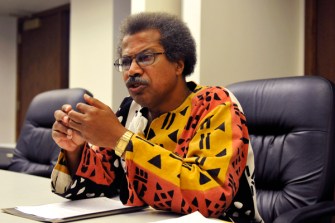
Dr. Mostafa Hefny in Detroit.(AP Photo/Detroit News, Max Ortiz) DETROIT FREE PRESS OUT; HUFFINGTON POST OUT)
Introducing Mostafa Hefny, an Egyptian Immigrant who came to the United States and was told he was white, despite his skin color. To understand this, let us first establish the U.S. racial classification system. The U.S. Census Bureau defines race as “a social category recognized by the United States and does not attempt to define race biologically, anthropologically, or genetically”. The Census Bureau recognizes five categories of race:
• White (people with origins in Europe, the Middle East, or North Africa,)
• Black or African American (Africa)
• American Indian or Alaska Native, Asian,
• Native Hawaiian
• Other Pacific Islander
Nicknames for race has also been applied to colors: White, Black, Red, and Yellow.
The census also includes a Hispanic ethnic category. It is an ethnic category rather than a race category because the Latino community is said to include many races, such as White, Black, Native American, Asian, and mixed. Keep in mind these are not classifications based on culture, land, or language, but skin tone alone. This means that anyone from Europe according to the lands designated for the specific color is considered white and anyone from Africa (according to the lands specified) is considered black.
In the ancient world, the Greeks, Romans, Israelites, Egyptians, Ethiopians, e.g. did not have racial categories. Rather people were divided according to their nationality. People from Europe may identify themselves as Irish, Russians, Greeks, Swedish, so forth and so on instead of simply whites. Likewise, people on the continent of Africa may refer to themselves as Ethiopians, Somalian’s, Nigerians, Egyptians, Israelites, Ghanaian’s, so forth and so on instead of simply blacks. The ancient Hebrews, Egyptians, Ethiopians, and Libyans didn’t speak of a place called Africa even though they were indigenous to that continent.
Since 1997, Mostafa Hefny, has been suing the U.S. government because when Hefny immigrated to America, the U.S. government told him he was no longer a black man. This is because according to the U.S. racial system of classification, we’re not supposed to realize that Egypt is in Africa, just that it is the Middle East, and as such anyone from the Middle East is considered White; obviously despite their skin tone.
“Dr. Hefny was a Bilingual Resource Teacher with Wayne County Regional Education Service Agency (Wayne County RESA) in Wayne, MI, USA for thirteen (13) years. When he stated on his employment records that he is black the Director of Human Resources sent him a letter which was copied to the Superintendent threatening him that his education career will be ruined if he did not change his racial classification on his employment records from black to white. A few days later one of the top administrators told him “If you ever say that you are black again no one will hire you and if hired you will be running from one job to the other for the rest of your life”. Even though Wayne County RESA provides support and consultant services to all of Wayne County which is 30% black, the Superintendent was white, his four Associate Superintendents were white, and 95% of the administrators and consultants were white.
Wayne County RESA did not fire Dr. Hefny, instead they denied him promotion twice, persecuted him, harassed him, called him nigger, and psychologically tortured him to the point that he left on social security psychiatric disability which lasted ten (10) years (1989-1998.) Additionally, he was hospitalized in psychiatric hospitals twice(1992 & 2000.) All the doctors who treated Dr. Hefny stated in their medical reports that his psychiatric injury was work related. When Dr. Hefny recovered and returned to the work force Wayne County RESA followed up on their threats and he was fired five times in one year.”
How did Hefny respond? He was shocked when his government-issued identification classified him as “white.”
(AP Photo/Detroit News, Max Ortiz) DETROIT FREE PRESS OUT; HUFFINGTON POST OUT
According to the Detroit News: “As a Black man and as an African, I am proud of this heritage. My classification as a white man takes away my black pride, my black heritage and my strong black identity.” – Mostafa Hefny
This begs the question, what is black and what is white? We use them for clarity, but are they colors or nations of people? What about other nations? Asians, Chinese, Japanese?
According to the Office of Management and Budget Standards for the Classification of Federal Data on Race and Ethnicity, citizens are designated as White if they have “origins in any of the original peoples of Europe, North Africa or the Middle East.” For this reason, because of Hefny’s geographical location, his classification makes sense within the context of America’s definition of race. Again, according to the U.S. racial system of classification, we’re not supposed to realize that Egypt is in Africa, just that it is the Middle East, and as such anyone from the Middle East can be considered White; obviously despite their skin tone.
“Egypt is on the coast of Africa. It is not some small village in Sweden.” – Paul Mooney
From the foundation of man, we have been divided according to our nations and lands. In Genesis Chapter 10, we find the Table of Nations. After the flood Noah and his sons and their wives were saved and from this family repopulated the Earth. How they were divided is found in The Table of Nations.
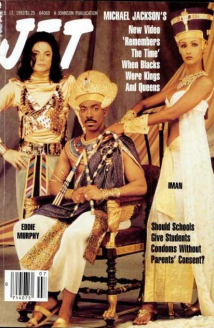
Ancient Egyptian Wall PaintingJET Magazine Cover, Michael Jackson’s “Remember the Time”
Since Ham had the most descendants we are not going to go through every last one, but he birthed the African nations populating Africa and other parts of the “Middle East.” The word Ham in Hebrew is Khwam, and it means “hot, burnt, and black.” The first-born son of Ham, Cush, forms the Kushite nation. They were also called and known as the ancient Ethiopians. Ethiopia comes from the Greek word, Aethipos, which means, “burnt or black face.” The Greeks applied this name to the people living south of Egypt. The name Egypt comes from the word Aegyptus though the Egyptians called themselves Khemet / Kemet, which is a variation of the Hebrew word Khawm (Ham). It means, “People of the black land.”
While many of us are already familiar with Ham’s sons, Shem’s descendants are not always acknowledged. Though not “Africans”, they were also black as were the Israelites who were often mistaken for Egyptians. Paul was mistaken for a black Egyptian (Acts 21:38), Moses passed as the grandson of Pharaoh for 40 years (Acts 7:22-23) and the messiah hid in Egypt:
“Now it’s very unlikely that Jesus would have been able to be HIDDEN in Egypt, if he had a very different color of SKIN from the people in Egypt.” – University of Birmingham historian, Dr. Mark Goodacre, BBC program called The Complete Jesus, 2001
Statue of King Tut
I am not sure where Henfy is today with his case. Last I read he was still fighting to be classified as black and this was back in 2012. The ancient Greek historian, Herodotus, who visited Egypt in the 5th century B.C.E., described the Egyptians as black-skinned with woolly hair and anthropologist, Count Constatin de Volney (1727-1820), spoke about the Egyptians that produced the Pharaohs. He later paid tribute to Herodotus’ discovery when he said:
“The ancient Egyptians were true Negroes of the same type as all native-born Africans. That being so, we can see how their blood, mixed for several centuries with that of the Romans and Greeks, must have lost the intensity of its original color, while retaining nonetheless the imprint of its original mold. We can even state as a general principle that the face (referring to The Sphinx) is a kind of monument able, in many cases, to attest to or shed light on historical evidence on the origins of the people.”
How do you think race influences our society today?
Speaking of Underground, here are some Fun Facts about Harriet Tubman from the Blackmail4u blog. (I believe Harriet adopted a baby girl too named Gertie)
“ON SEPTEMBER 13, 1971, a four-day rebellion of over 1200 inmates at the Attica State Correctional Facility in bucolic upstate New York ended most horrifically after Governor Nelson Rockefeller ordered almost 600 state troopers to storm the prison. Even though the raid took only 10 minutes, when one could finally see through the haze of spent ammunition, it was immediately clear that the price of retaking this facility by force had been staggeringly high.” – Heather Thompson
Before we go on, let’s take it back…
Convict Leasing
With nearly half of all cotton investments in human bodies now gone, the end of chattel slavery no doubt left a sour taste in the mouths of slave-owners. Over four million African Americans (because who would know exactly how many?) were poured into a society that did not want them, cotton economies in shambles, cotton gins destroyed, and wealth that deteriorated before the ink could dry on the Emancipation Proclamation. A system so interwoven into the fabric of America could not just be taken away without serious consequences. Slave-owners could not sit back and watch; a reconstruction of slavery was necessary.
The Reconstruction Era, the process of rebuilding the south (which was really the time of restoring slavery to the south), introduced a new set of laws that would ensure that Blacks remained the property of landowners, sharecropping on the same plantations that held them as slaves. All of this despite General William T. Sherman’s plan to grant freedmen 40 acres on the islands and the coastal region of Georgia. But after the Civil War, blacks never did receive their “40 Acres and a mule” and were instead ordered to either sign contracts with the owners or be evicted, driven out by army troops. In the summer of 1865, all land had been ordered by the government to be returned to its original owners. Thus, millions of blacks remained poor. Still, this was not the only form of servitude to which they were subjected. In addition, something more law abiding would hold them in captivity. Ironically, within the same paragraph that abolished slavery, slavery was also reconstituted. According to the 13th Amendment:
“Neither slavery nor involuntary servitude,except as punishment for crimewhereof the party shall have been duly convicted, shall exist within the United States, nor any place subject to their jurisdiction.”
According to this law, slavery could not exist in the United States except for punishment for a crime, permitting slavery in the case of imprisonment.
New laws targeted blacks, (Black Codes) criminalizing their lives. That is, almost everything was a crime. Farm owner’s incapable of walking by the railroad or selling the products of their farm after dark. Or, the infamous Pig Laws, where stealing a pig (or any animal) could result in five years’ imprisonment. Or Sundown Towns, all white neighborhoods where Blacks were not allowed after dark. The more Blacks broke these laws and were sentenced to prison, the more slaves the plantation owners, now masked under private parties and corporations, had back into their possession. They could work the prisoners from sun up to sun down again while providing them with food, clothing, and shelter. Also known as Convict Leasing—the leasing of bodies to coal and iron companies owned by former slave owners—slavery was back. In 1883, about 10 percent of Alabama’s total revenue was derived from convict leasing. In 1898, nearly 73 percent of total revenue came from this same source.
Attica State Prison
With awareness growing out of the Civil Rights Movement of the 60s, Malcolm X, The Black Panther Party, etc., Black and Latino Prisoners of 1970 began organizing rebellions against their treatment within the prison system. As with any information passed through the “grape vine” of the black community, the rebellions spread from prison to prison until it came to a head the Thursday morning of September 9, 1971. When the door prisoners used to go to the yard was locked, a fight broke out between the prisoners and the guards. As the fight grew, more prisoners joined until they broke open a gate connecting to another part of the institution and, to make a long story short, prisoners were let loose within the institution.
The Brothers locked the prison down, kicking butt and taking names. I mean (clears throat), taking staff members as hostages and implementing their own system of order within the prison. Appointing leaders to keep order and to be sure the staff was properly cared for, they demanded from the outside world better treatment within the prison system. Better medical treatment and less slave labor. But their “freedom” would not last long. When a hostage who was hit in the head at the beginning of the fight died from his injuries, the prisoners were responsible under the felony-murder rule. The felony was the riot and the murder was the death of the guard.
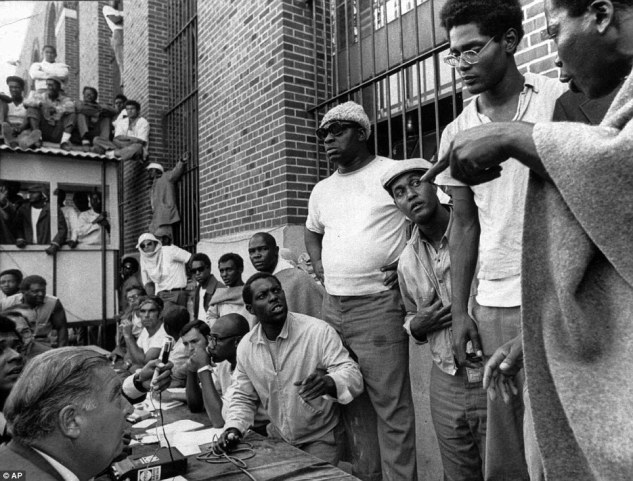
Inmates of Attica State Prison (right) negotiate with Commissioner Russell Oswald (lower left) inside the jail where prisoners took control
Shortly thereafter, a National Guard helicopter flew low over the yard and blew a cloud of military-grade CS gas into the crowd of men. As told to Attorney Jefferey Haas, under the name Big Black, one of the surviving prisoners of the time recalls:
“First came the tear gas. People looked for something to cover their face. When I first heard the shots, I thought they were blanks. Then the people around me in the yard starting dropping. I realized they were real bullets, and everyone ducked and ran for cover.” (September 16, 1971, Prisoner of The Attica Correctional Facility, New York, as told to Jeffrey Haas).
The gun shots Big Black is referring to are the marksmen who came in and started shooting, hitting 189 of the 1300 men in the yard and killing 31 people—29 prisoners and ten hostages. (There’s a conflict between the numbers. Some sources say 31 prisoners died and some 39. I use 31 because that is in accordance with the news articles of the time).
After the shooting, the beatings came:
Source: Getty Images. Prisoners marching naked.
“The guards stripped us naked after the shooting. They made us crawl naked in the mud through a gauntlet where they beat us.” – Big Black
Next, Big Black (Big, dark skinned and part of the security) was tortured as an example. They burned his body with cigarettes:
“They took me out of the line. They made me lie on a table naked on my back and put a football under my chin. They put their burning cigarettes out on me. Some dropped them from the catwalk above and was laughing.”
“Afterwards, a news photographer found and recorded a pair of inscriptions, in separate hands, written with a white marker on a dark steel wall that succinctly told the story of the Attica rebellion. The top one said, “Attica fell 9-9-71 – F*&k you pig!” Just underneath that was written, “Retaken 9-13-71. 31 Dead Niggers.”
– Dennis Cummingham, Prison Legal News
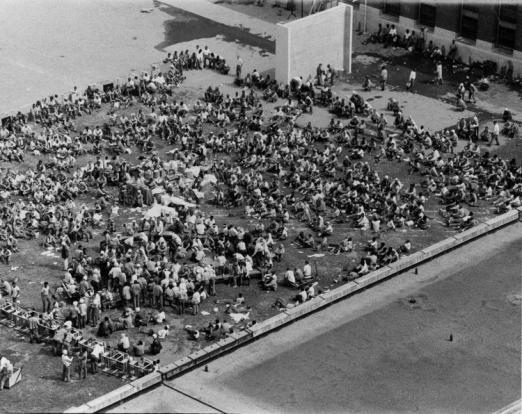
Riot: Prison guard hostages and inmates gather in the exercise yard of cell block D inside Attica State Prison in New York on September 9, 1971
While seeking freedom the men had forgotten one thing: slavery is abolished except as punishment for a crime. They were given slave-like treatment because as prisoners under the law, they were still slaves.
Speaking of Black History month, one of the primary concerns I hear among African Americans about the bible is: “Where am I?” With movies like Noah, Exodus Gods and Kings, and The Ten Commandments it is difficult for most black people to have faith in a book that rarely include them. In fact, many of them have been told that the bible is a white man’s book (which is not just insulting to black people but other nations as well). For centuries we’ve been taught that we’re non existent in this book or that we have small rather than significant contributions. But is this true? Were there any black people in the bible at all?
Fun Facts:
Location of The Garden of Eden:
Pishon surrounding Hawilah > East Africa
Gihon, surrounding Kush > Southern Egypt
Hideqel, East of Assyria, Euphrates
A skull of Mitochondrial Eve was discovered, and through digitally reconstructing her features, this image was constructed.
The Garden of Eden stretched from East Africa to the Euphrates River
Ham: Means Burnt Black
Moses, the Israelite, passes as the Grandson of the black, Egyptian, pharaoh for 40 years – Acts 7:22-23 (This means that he had to look just like him)
Kush > Ham’s first born son. Traced back to the Ethiopians and Nubians
Moses Hand Turns White – Conveniently left out of every 10 commandment movie is the second miracle. The one where Moses puts his hand in his bosom and it comes out white as snow. Wouldn’t be much of a miracle if it was already white- Ex. 4:1-7
Paul mistaken for a black Egyptian – Acts 21:37-38
The Kushites lived south of Egypt in what is called the Sudan today.
The Israelites with dred locs: Numb. 6:5, Ezk 8:3, Samson, etc
The messiah’s feet compared to burnt brass, hair like wool – Rev. 1:14-15
Ethiopian comes from the Greek word Atheops meaning burnt face
Joseph looked like the Egyptians – Gen. 42:7-8
Egypt: Ham’s second born son < Blood brothers to the Ethiopians
Ethiopian > Burnt Face
Egypt > Burnt Black
Phut: The Somalians – According to the ancient record of Egypt, Phut has been traced back to the Somalians
Shem: Means Name
Elymites – Descendants of Shem, black men with Afros and full Beards













 The PBS Blog