Black History Fun Fact Friday – The Chicago Black Renaissance

black-history

Many of us have heard of The Harlem Renaissance, the literary, musical, and artistic movement that exploded during the 1920s in Harlem New York. Also known as The New Negro Renaissance, the New Negro Movement, the Negro Renaissance, and the Jazz Age, the Great Migration of blacks from the south to northern cities like New York produced a national movement centered around black culture and tradition.

Music, poetry, literature, art, and theatre was brought to the mainstream from a black perspective in a huge way. Magazines such as The Crisis (the NAACP monthly journal) and Opportunity (the monthly publication of the Urban League) employed Harlem Renaissance writers on their editorial staff, published their poetry and short stories, and promoted African American literature through articles, reviews, and annual literary prizes. Names like Alain Locke, Langston Hughes, and Zora Neale Hurston come to mind.

However, though termed Harlem Renaissance, the time was much more complex than Harlem itself (which in many ways can make it hard to define). While standing as the anchor for the movement, Harlem was just one piece of a much larger puzzle. Across the United States and the Caribbean, The Renaissance was taking place. In fact, only some of the writers, musicians, and artists were native to Harlem itself. The Renaissance did not just happen in Harlem but a Black Metropolis was brewing in other big cities as well, such as Chicago.
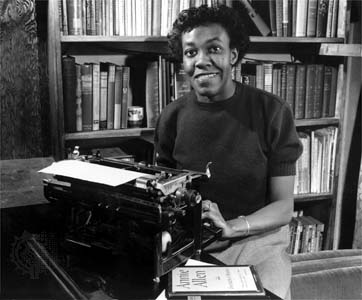
Gwendolyn Brooks
Gwendolyn Brooks

As the Harlem Renaissance was winding down, The Chicago Black Renaissance was getting started, or rather, continuing. Creativity and activism was blooming from the great number of blacks coming up from the south to escape Jim Crow and The Great Depression. While it’s true many blacks did not suffer as much during the depression due that many of us were already struggling (having been depressed since we got here) there were some who came to Chicago from southern states like Mississippi and secured well paying jobs that were no longer available. While at first blacks could work at factories, meat packing places, and steel mills, the great depression shut this down.

Blacks were also dealing with extremely poor living conditions and fighting housing discrimination. As more and more blacks moved to Chicago the city was also still getting a large immigrant population pouring in from Europe so there was always competition for jobs and since segregation was in full effect, many blacks found themselves at a loss. However, there is great beauty that often springs from the depths of struggle and The Black Mecca of Chicago’s South Side was quite literally a diamond in the rough.

The black belt of Chicago’s South Side, as it was called, was the location for such diamonds.  Jazz, Blues, and Literature flourished as an outlet for blacks to voice their discontent not only about the city but also the whole of the black experience in America in general, and when Gwendolyn Brooks passed a pool hall in a Chicago neighborhood and took notice of a group of young men standing around, “We Real Cool” (a poem that speaks from the point of view of these seven young men, see my analysis of the poem here) was born. Chicago exploded in culture from the 1930s through the 1950s and the south side remains the most cultured part of city today.

Music, art, literature, and journalism were all part of The Chicago Renaissance. Though never deemed “Chicago Renaissance” officially, there are many who contributed to the movement whose names we’ve grown to know. The writers: Richard Wright (born in Mississippi but moved to Chicago in 1927), Frank Yerby, Margaret Walker, Willard Motley, John H. Johnson (publisher of Ebony), St. Clair Drake and Horace R. Cayton (who later co-authored Black Metropolis), Gwendolyn Brooks, Arna Bontemps, and Lorraine Hansberry; entertainers Nat King Cole, Ray Nance and Oscar Brown, Jr.; dancers Katherine Dunham and Talley Beatty; photographer Gordon Parks, and the artists Elizabeth Catlett and Hughie Lee Smith.


Yecheilyah Ysrayl is the YA, Historical Fiction author of eight books, most notably The Stella Trilogy. She is currently working on her next book series “The Nora White Story” about a young black woman who dreams of taking part in The Harlem Renaissance movement and her parents struggle to accept their traumatic past in the Jim Crow south. “Renaissance: The Nora White Story -Book One” is due for release summer, 2017. For updates on this project, sneak peek of chapters and the pending book cover release for this project, be sure to follow this blog and to subscribe to Yecheilyah’s email list HERE.
Unfamiliar Faces – Lost to History: Afro Puerto-Ricans, Cubans, Jamaicans, Haitians

porto_rican_peones_puerto_rican_peons-_children
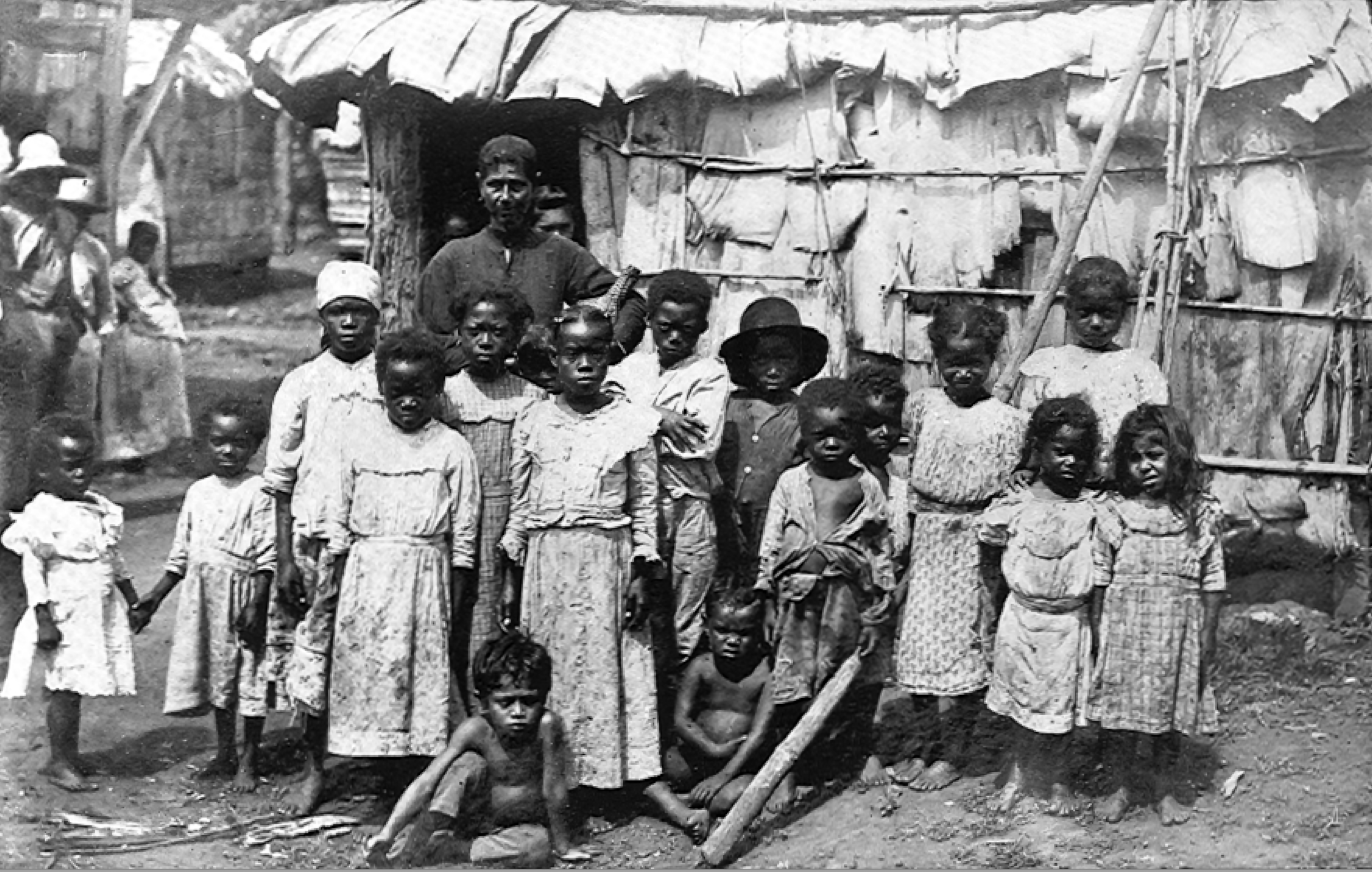
Enslaved Afro Puerto Rican children

Though many students will learn about slavery in the U.S. at some point, our teachings are usually narrow in that we only learn about the European Slave Trade and the wrongs that Europeans have done. We won’t be told that we weren’t just dropped off in America. We won’t be told that every people, from Jews to the Five Civilized Native American Tribes, held us as slaves. We won’t be told of the difference between the Africans themselves who had slaves and those who were enslaved, and we won’t be told of the many different tribes and nations of black people that occupy the continent.

Contrary to popular belief, mostly brought on by television and movies, slave traders did not go into the interior of Africa to pick up any “African” but they were looking for a specific people. However, since the continent has been lumped up into one big mass, all blacks are assumed to be the same people and as a result, many ancient practices and truths faded from memory.

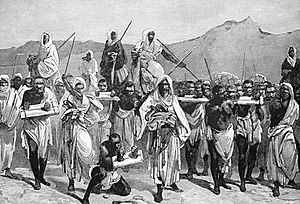
Engraving of Arab slave-trading caravan transporting African slaves across the Sahara.

The trade of slaves across the Sahara has a long history. Dr. John Alembellah Azumah in his 2001 book, The Legacy of Arab-Islam in Africa estimates that over 80 million black people died en route to the Islamic world. Having enslaved blacks about one thousand years before the Europeans, the Arabs had already identified the people of the book. That is the people of the covenant. The people of scripture. The chosen and the prophecies surrounding their captivity.

Indeed, they were not after just any African, but the ones who held principles that were distinct from the other tribes. Differing by way of culture and spirituality, these blacks could easily be spotted by way of their traditions. Olaudah Equiano, known as Gustavus Vassa, captured, enslaved, and then freed, told in his book, The Interesting Narrative of the Life of Olaudah Equiano, of his life in Africa before the abduction.

Born among the Ibo people in the kingdom of Benin, along the Niger River, Olaudah recounts in his narrative of how they still held many Hebrew customs and traditions, such as the circumcision, the division of the tribes by twelve, and the marrying of their brother’s wife after death just to name a few. What is not recounted is that not only did Olaudah’s family uphold such traditions but so did many so-called African tribes.

That said, many of the slaves who came to Puerto Rico were from Congo, the Ashanti, Yoruba, Igbo and Bantu tribes. In all, 31 known African tribes were brought to the island from Central and West Africa through the slave trade but they weren’t the only ones.

Not only was Afro-Puerto Ricans largely made up of these Hebrew tribes, but so were the Jamaicans, Dominicans, Cubans, and so-called African Americans of today. Though we see each other as separate, the truth is that many of us (even if we’ve mixed) are all the same people and were all part of the dispersion.

Today’s lost to history segment focuses not on one individual but a group of individuals who have gone on to war within themselves due to the lost historical fact that we are not a different people but the same. Having been separated by land, we were taken from the same areas because we are descendent of the same people. The only difference is that we were dropped off in different places. Some to Jamaica, some to Haiti, some to Puerto Rico, and so on. As a result, some of us speak English, some of us speak Spanish, and some of us speak French.

Why I Speak

Why I Speak

“We often forget that the current state of Black Americans is directly related to history.”

Black Then Staff

It is clear that we live in a system that is unfair and a civilization that is not just. I speak of these things not because I want to focus on the negative experience of blacks in America only. I speak of these things not because I’m a dark person who just wanna keep bringing up bad stuff. I speak of these things because we’ve become comfortable here in this land. We have been blinded from the truth as a people. We’ve forgotten that the constitution did not include us and that civilization for us is outside of this system. We’ve been tricked into believing that we are citizens in this land and that we have some kind of rights here. We’ve forgotten that when “All men were created equal” that didn’t include us. For what to the slave is the 4th of July?

You see we’ve forgotten where we’ve come from and as a result have no idea where we’re going. How can a slave pursue freedom when he thinks that he is already free? You see the black man does not exist. Black is a color, not a nation of people. Where is African American land? It does not exist. Africa and America are the combinings of two continents. There are over 50 countries in Africa, how then can “African” properly define a people? Which country in Africa are we talking about? African American is also therefore not a nation of people.

I speak because our roots stretch deeper than colors, bywords, proverbs, and mockeries that conceal true identities.  I speak because we forget that we were never part of this constitution. To amend. It means to alter, modify, and to revise. This document had to be revised, altered, and modified just to include you. No justice no peace, my people. It means that there’s no justice for you here and there’s no peace here either. This is the world we live in. We condemn the Confederate flag and we praise the American flag because we’ve been blinded to think there’s a difference between the two. They both drip with the blood of the saints.

We continue to march and to protest because we believe it will change things. How is it that we’ve gone from fighting for freedom to settling for Civil Rights? What is a civil right? What about human rights? So yes, I speak. I speak because we think we know slavery and we know nothing. I speak because we think we know freedom and we know nothing. I speak because we think we have rights and we have nothing. I speak because we think we know justice in a land that is anything but just.  Don’t matter who becomes president. It is the system that is broken and it is my responsibility to speak.

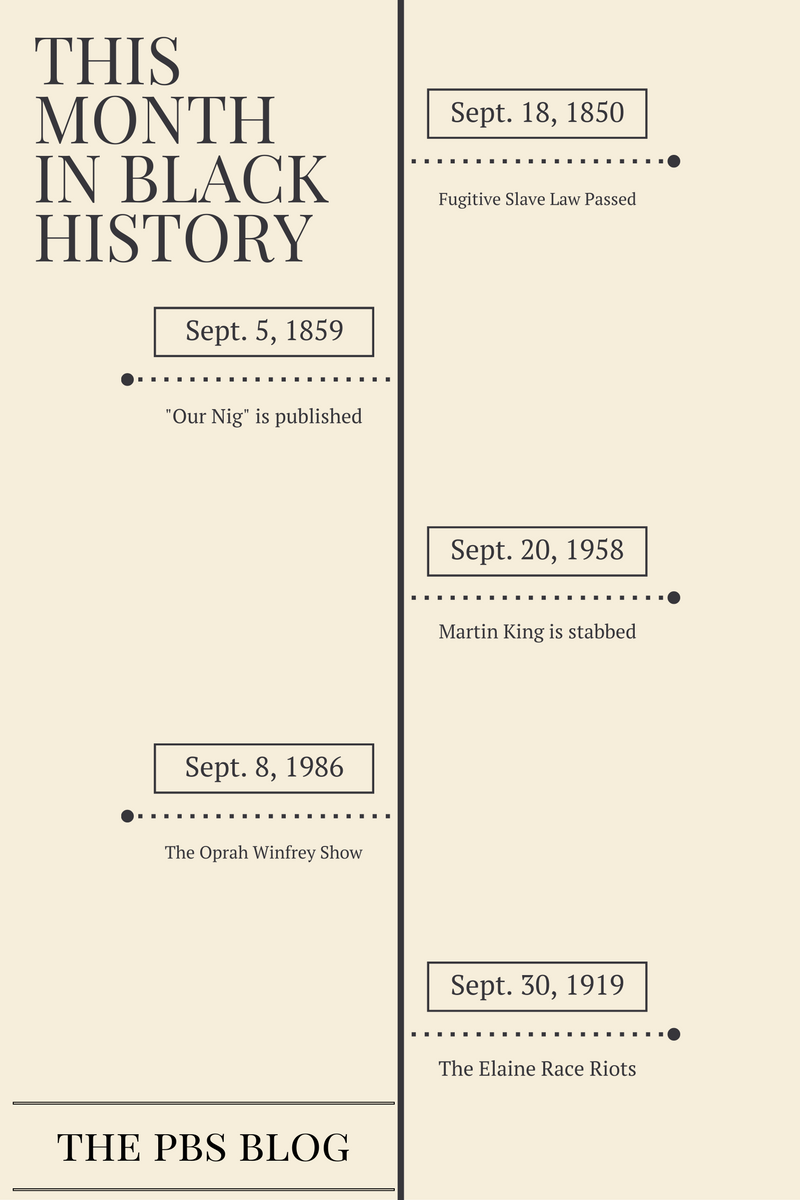
This Month in Black History – September

this-monthin-blackhistory

This month sped by so fast I almost missed this month’s history wrap up!

******

September 5, 1859 – Harriet Wilson’s novel Our Nig is published

September 8, 1965 – Dorothy Dandridge found dead

September 8, 1986 – The Oprah Winfrey Show debut

September 9, 1739 – The Stono Rebellion, the largest slave uprising in the British mainland colonies prior to the American Revolution, occurs in South Carolina

September 10, 1963 – Schools in Alabama desegregated

September 11, 1977 – Roots wins 9 Emmy Awards

September 12, 1905 – Master Horseman John Ware is killed when his horse trips, crushing him and breaking his neck

September 12, 1913 – Jessie Owens is born

September 12, 1947 – Jackie Robinson named rookie of the year

September 13, 1885 – Alain Locke of the Harlem Renaissance is born

September 15, 1963 – The 16th Street Baptist Church is bombed in Birmingham Alabama leaving 4 little girls dead and one blind in one eye

September 15, 1978 – Muhammad Ali becomes the WBA Champ

September 16, 1794– The French Abolish Slavery. (Slavery is reinstituted under Napoleon in 1802 along with the reinstitution of the “Code noir”, prohibiting Blacks from entering French colonial territory or intermarrying with whites).

September 17, 1858 – Dred Scott dies of Tuberculosis 17 months after emancipation

September 18, 1850 – The Fugitive Slave Law is passed by Congress

September 18, 1919 – Frederick Douglass “Fritz” Pollard is the first African American professional football player for a major team

September 18, 1970 – Jimi Hendrix dies in London (at the young age of 27)

September 20-24th 1830 – The First National Negro Convention met in Philadelphia

September 20, 1958 – Martin Luther King Jr. stabbed in the chest while signing copies of Stride Toward Freedom in Blumstein’s department store in Harlem

September 24, 1957 – Eisenhower orders the 101st Airborne Division to Little Rock Arkansas to force desegregation at Little Rock Central High School

September 24, 1935 – Joe Louis defeats Max Baer at Yankee Stadium, Bronx New York

September 26, 1967 – Riots erupt in Tampa, FL after police shoot Martin Chambers, an unarmed  black teen

September 28, 1991 – Miles Davis dies

September 30, 1919 – Oct 1 –  The Elaine Race Riots (also known as The Elaine Massacre) occurs in the Elaine town of Phillips County Arkansas

****

In Case You Missed It: This Month in History – August

Discover My Top 8 Historical Reads (That you’ve probably never read!) Get it Here.

Why Black Girls Need Diverse Books

afamreading

“Storylines with Black female main characters’ supplement in-school experiences where the stories of Black people are often misrepresented or excluded from the classroom curriculum. Stories with Black main characters fill in where classroom curricula leave gaps. In addition, narratives with people of color at the forefront introduce readers to new vocabulary words, customs, people, and places that they otherwise might not have learned about.”

http://educationpost.org/why-black-girls-need-diverse-books/

‘Queen Sugar’ Author Wants More Diverse Stories About Black People

“As I started to write Queen Sugar, especially in the late ‘90s … all of these great diverse stories that I had grown up on and was inspired by, started to disappear. All of a sudden you saw a very, very narrow portrayal of the African-American experience on the bookshelf. All of a sudden the only thing you saw were titles like The Bitch Is Back or Stackin’ Paper, and there’d be a picture of a woman, scantily clad, on the hood of a car.”

http://www.huffingtonpost.com/entry/queen-sugar-natalie-baszile-interview_us_57d337dfe4b06a74c9f4e712

Popular Indie Book Publisher Launches Campaign to Prove That Diversity in Publishing Matters

Rosarium Publishing was founded in 2013 by scifi/fiction writer Bill Campbell with one goal: to bring true diversity to publishing so that the high-quality books and comics the company produces actually reflect the fascinating, multicultural world we truly live in today.

https://www.newswire.com/news/popular-indie-book-publisher-launches-campaign-to-prove-that-diversity-9870669

50 Books That Every African American Should Read

http://www.huffingtonpost.com/2012/07/03/50-books-that-every-african-american-should-read_n_1647614.html

“Huffington Post BlackVoices has compiled an extensive book list, featuring a range of genres including fiction, non-fiction, poetry, science-fiction and the autobiography.

From Ralph Ellison to Jesmyn Ward, many of the authors have been heralded with national awards in the United States. Others, such as Zadie Smith and Tsitsi Dangarembga, have broken literary ground abroad in countries such as Zimbabwe, the United Kingdom, South Africa and Uganda. Stemming back to 1789 with Olaudah Equiano’s “The Interesting Narrative of the Life of Olaudah Equiano,” these 50 titles have heavily contributed to contemporary narratives about the black experience across the globe.”

13 Books That Every African-American Should Have in His/Her Home

“Oftentimes, rich literary treasures are not associated with writers of African descent, but objective evidence has shown and continues to denote that some of the world’s finest books have evolved from the minds of black authors. Whether fiction or non-fiction, these writings have been important not only as poignant reflections of reality, but also as interesting opportunities for cross-cultural understanding.”

http://madamenoire.com/108532/13-important-african-american-books-that-you-should-have-in-your-home/

This Month in History – August

THis MonthIn BlackHistory

  • 1834 – Slavery was abolished throughout the British Empire – Slavery Abolition Act 1833 came into effect.
  • August 2, 1850 – The start of The Underground Railroad, a network of secret routes and safe houses used by 19th-century enslaved people in the United States in efforts to escape to free states and Canada. The Underground Railroad was neither underground nor a railroad. It got its name because its activities had to be carried out in secret, using darkness or disguise, and because railway terms were used by those involved with system to describe how it worked. Various routes were lines, stopping places were called stations, those who aided along the way were conductors and their charges were known as packages or freight.
  • August 2, 1924 – James Baldwin, author of Go Tell It On The Mountain, The Fire Next Time, and Another Country, is born.
  • August 3, 1800 – Gabriel Prosser, a literate enslaved blacksmith, planned a large slave rebellion in the Richmond  area in the summer of 1800. Information regarding the revolt was leaked prior to its execution, and he and twenty-five followers were taken captive and hanged in punishment.
  • August 4, 1901 – Jazz trumpet player Louis Armstrong was born in New Orleans, Louisiana. Known as “Satchmo,” he appeared in many films and is best known for his renditions of It’s a Wonderful Worldand, Hello, Dolly.Three young civil rights workers, James Chaney, Andrew Goodman and Michael Schwerner, were found murdered and buried in an earthen dam outside Philadelphia, Mississippi.
  • August 5, 1962 – Nelson Mandela imprisoned.
  • August 11, 1841– Frederick Douglass, an escaped slave, spoke before an audience in the North for the first time.
  • August 11, 1965 – Watts Riots: In Los Angeles, racial tension reaches a breaking point after two white policemen fight with a black motorist suspected of drunk driving. An angry crowd gather near the corner of Avalon Boulevard and 116th Street to watch the arrest and soon grew angry by what they believe to be another incident of racially motivated abuse by the police. A riot kicks off and lasts for five days (ending on the 16th) with 34 dead and 1,032 injured.
  • Roots author Alex Haley was born in Ithaca, New York. His Pulitzer Prize-winning novel, published in 1976, explored seven generations of his family from its origins in Africa through slavery in America and eventual hard-fought freedom. Roots was translated into 37 languages and also became an eight-part TV miniseries in 1977 which attracted a record American audience and raised awareness concerning the legacy of slavery. A remake of Roots aired in on May 30, 2016.
  • August 18, 1859 – Harriet Wilson’s Our Nig is first novel published by a black writer.
  • August 20, 1619 – 1st known African Americans (approx. 20) land at Jamestown Virginia aboard Dutch vessel then sold or traded into servitude for supplies.
  • August 21-22 1831 – In Southampton County, Virginia, on August 21-22, 1831, Nat Turner, led the first slave revolt of magnitude. The revolt was crushed, but only after Turner and his band had killed some sixty whites and threw the South into panic. After hiding out, Turner was captured on October 30, 1831, and hanged in Jerusalem, Virginia, on November 11th. Thirty other blacks were also implicated and executed. It was not until John Brown’s raid on Harpers Ferry, Virginia, in 1859 that another slave revolt became known.
  • August 21, 1971 – George Jackson assassinated by prison guards during a Black prison rebellion at San Quentin on August 21, 1971. Three prison guards were also killed during that rebellion and prison officials charged six Black and Latino prisoners with the death of those guards. These six brothers became known as the San Quentin Six.
  • August 23, 1926 – Carter Woodson, historian, author, inaugurated Negro History Week and later producer of the Negro History Bulletin. Negro History Week would later be known, as it is today, as Black History Month.
  • August 25, 1908 – National Association of Colored Nurses founded.
  • August 26, 1900: Hall Woodruff was born. He was a nationally known print-maker, draftsman and painter and a leading artist of the Harlem Renaissance. He died in 1980.
  • August 27, 1935 – Mary McLeod Bethune founds the National Council of Negro Women.
  • August 28, 1955 – While visiting family in Money, Mississippi, 14-year-old Emmett Till from Chicago, is brutally murdered for flirting with a white woman four days earlier. His assailants–the white woman’s husband and her brother–made Emmett carry a 75-pound cotton-gin fan to the bank of the Tallahatchie River and ordered him to take off his clothes. The two men then beat him nearly to death, gouged out his eye, shot him in the head, and then threw his body, tied to the cotton-gin fan with barbed wire, into the river. (Duet. 28:49-50)
  • August 28, 1888 – Granville T. Woods patents railway telegraphy.
  • August 29, 1920 – Saxophonist Charlie “Bird” Parker born
  • August 30, 1967 – Thurgood Marshall ~ became first Black Supreme Court Justice
  • August 30, 1838 – The first African American magazine, Mirror of Freedom, begins publication in New York City.
  • August 31, 1836 – Henry Blair patents cotton planter (also patented a corn planter), and became the second African American to hold a United States patent.

Do Black Lives Really Matter

Abortion is the number one killer of black lives in America. It has killed more Black lives than AIDS, Cancer, Sexually Transmitted Diseases, and even the entire Vietnam War, but no one speaks out about this. Alcoholism, drug addiction, child abuse, and molestation plague the Black community, but no one speaks out about this. 70% of African American women are single, and 42% have never married. This means 70% of African American women are left alone and unprotected, and 70% of Black children grow up without fathers. Contrary to popular belief, fathers provide more to the household than just money. They provide financial stability, yes, but also protection, leadership, and guidance for our children.

In fact, the state of the black man and woman relationship is worse today than it was over 50 years ago (and even during slavery. We were more communal as a people during slavery than we are today). In the 1960s, 40% of Blacks had their own businesses and 87% of black families were two-parent. Today, less than 7% of blacks own their own business and only 25% of black families are two-parent. But, no one talks about this. However, African Americans have been told over and over again what the problems are so this post is really not about that. This is not just about Slavery, Jim Crow, and Discrimination. This is about the revolution of self.

The African American community is in a state of spiritual crisis. As a community of people, we continue to fight for change that never comes. We continue to vote in an attempt to change our political clout. We continue to march, speak, and debate about the many changes necessary in this world, from education to discrimination and from discrimination to gender equality. But while we seek to change everything around us, we have yet to seek to change ourselves. We know what our problems are, but what we need at this point are solutions. Solutions that are deeper than government-funded organizations, protest marches, and ballot boxes. People cannot change anything around them if they cannot first change what is inside them, no matter their color.

In the words of the African Proverb, “When there is no enemy within, the enemy outside cannot hurt you.” Freedom is deeper than social economics. Freedom is spiritual and spiritual freedom begins inside the individual. To change the way that we live, we must first change the way that we think. Otherwise, if we continue to depend on outside sources to change our current conditions, we will be marching for the next 50 years while our sons’ blood cries out to us from the ground.