Yecheilyah’s 7th Annual Poetry Contest: Open for Submissions

Poetry Business Network Meeting in Atlanta this Weekend

I had an amazing time this weekend at the first in-person Poetry Business Network meeting in Atlanta. As I told my email list folks, it was refreshing to fellowship with people in person and to glean from the wisdom of legendary poets like Georgia Me (Def Poetry Jam), Rewop (who I met at the Poet Life Fest in 2022), and Taalam Acey.

The passion everyone displayed was empowering and helpful in motivating me to rescue my pen from the shadows and immerse myself deeper into Atlanta’s vibrant poetry community. Listening to these poets made me realize there is a lot I don’t know and helped me to understand the importance of knowing the individuals and the history of those who contributed to the development of the craft. It is not just about the writing. Studying the industry that houses these arts and their role in our evolution is also equally important. Imagine saying you are a poet and not knowing Gwendolyn Brooks or Maya Angelou.

It helps to sharpen your writing skills when you know more about your topics and community.

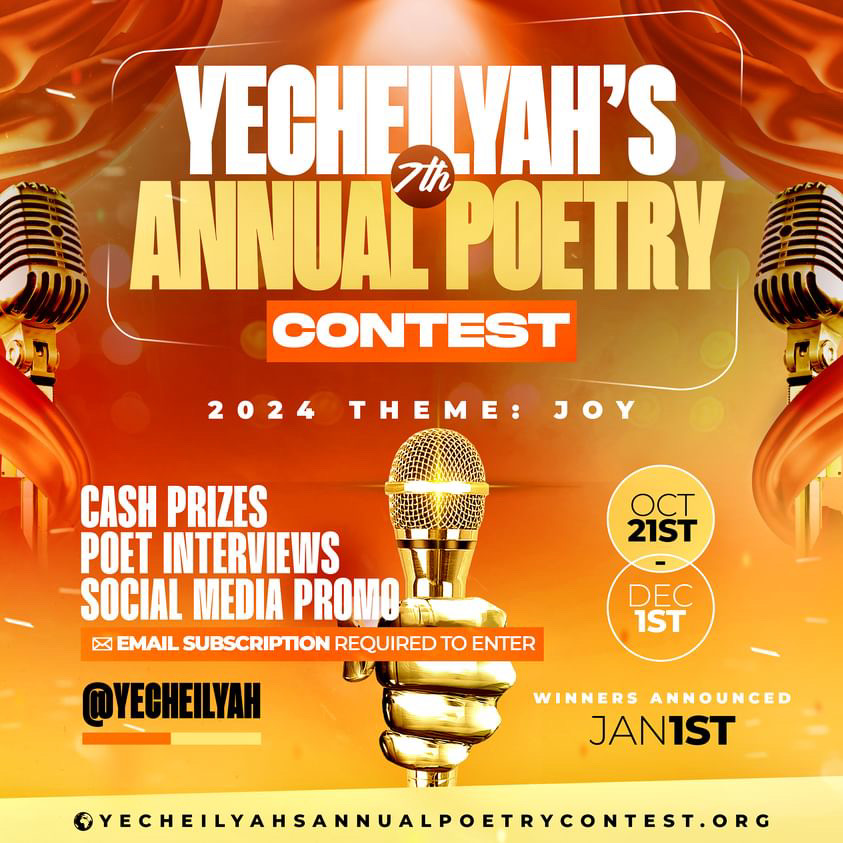
That said, I am excited to announce this year’s poetry contest is now open to accepting submissions!

You will have until December 1, 2024, to submit your poem. Our theme this year is Joy, and we will award our three finalists with cash prizes ranging from $50 to $150! For details on entering, please click on the link below, and be sure to share this with the poets you know!

Click Here For the Entry Rules, and Guidelines

If you would like to support our poets with a donation, you may do so by clicking on the website’s donation page here.

Hope to see you soon!

Yecheilyah’s 1st Annual Poetry Contest Winners, 2017

Yecheilyah’s 2nd Annual Poetry Contest Winners, 2018

Yecheilyah’s 3rd Annual Poetry Contest Winners, 2019

Yecheilyah’s 4th Annual Poetry Contest Winners, 2021

Yecheilyah’s 5th Annual Poetry Contest Winners, 2022

Yecheilyah’s 6th Annual Poetry Contest Winners, 2023

Yecheilyah’s 7th Annual Poetry Contest 2024

It’s that time of the year, good people!

We are excited to announce that this year’s poetry contest will begin later this month and run through the end of the year.

This time, we will choose semi-finalists who will be highlighted on our social media. From those semi-finalists, we will choose three winners from the poets with the highest ratings by the judges.

It’s about to be a time!

The entry rules, guidelines, and list of prizes are now available on the website. (Remember, we have a website for the contests now!)

We are also doing something different: We are having the interview with the winners (semi-finalists and finalists) on Instagram Live! Words are too powerful to be limited to paper, especially when expressed in this medium. To quote Maya Angelou, Words mean more than what is set down on paper. It takes the human voice to infuse them with deeper meaning.”

So that is what we will do!

I got my Sidney Shaw voice ready to ask, “When did you first fall in love with poetry?”

Here are the official dates:

Submissions Accepted:

October 21st – December 1st

Semi-finalists announced:

December 20th

Finalists Revealed:

January 1, 2025

Please Click this Link For the Entry Rules, Guidelines, and Prize List

If you would like to support our poets with a donation, you may do so by clicking on the website’s donation page here.

Please feel free to share the flyer with all your poet friends. Even if you don’t enter, someone else might want to!

Hope to see you soon!

Yecheilyah’s 1st Annual Poetry Contest Winners, 2017

Yecheilyah’s 2nd Annual Poetry Contest Winners, 2018

Yecheilyah’s 3rd Annual Poetry Contest Winners, 2019

Yecheilyah’s 4th Annual Poetry Contest Winners, 2021

Yecheilyah’s 5th Annual Poetry Contest Winners, 2022

Yecheilyah’s 6th Annual Poetry Contest Winners, 2023

Black ReWrite

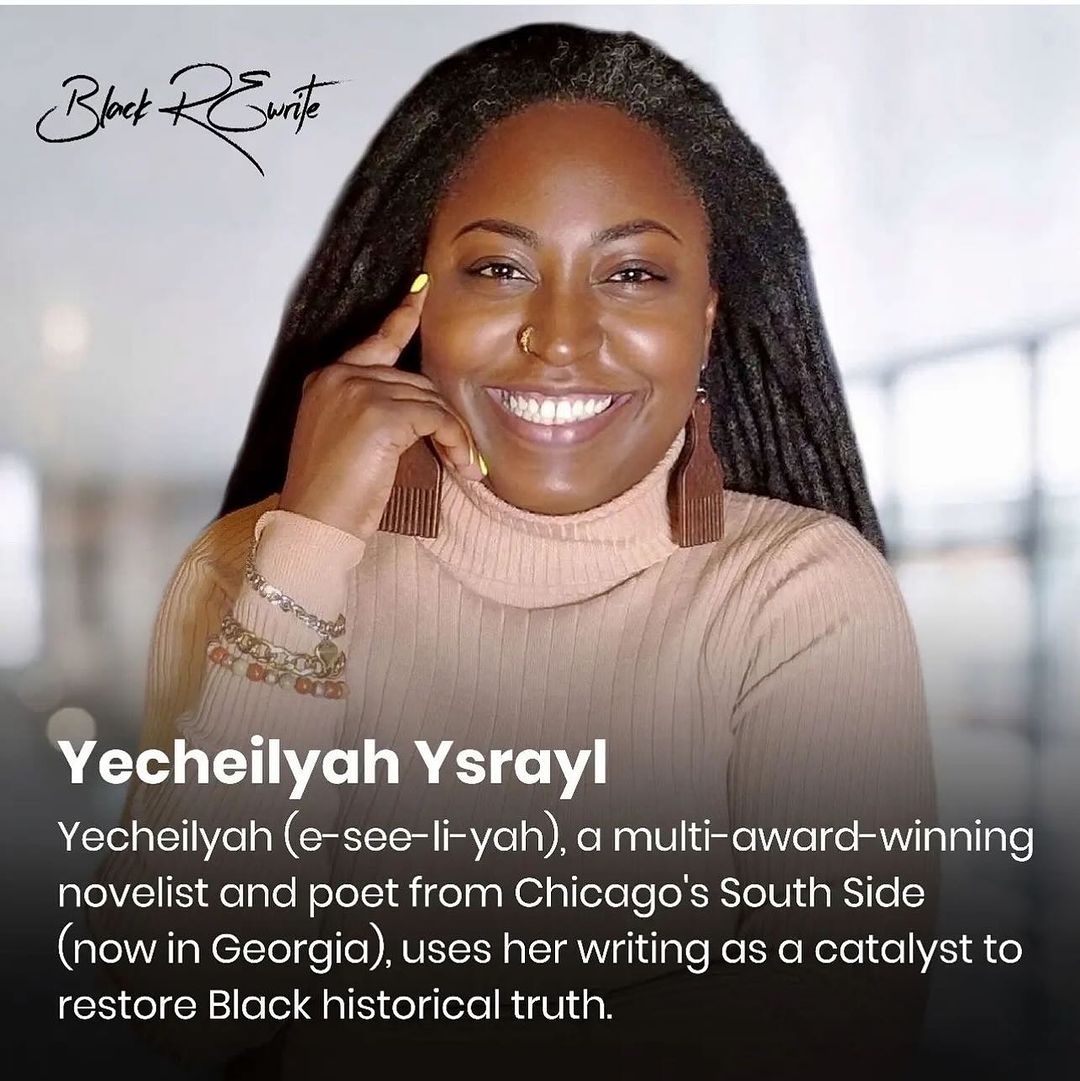
I was blessed to come in contact with an organization called Black Rewrite, which focused on amplifying and celebrating narratives of Black and Brown authors. They dedicate space for Black authors each week, and I am honored to be featured this week!

At Black Rewrite, they provide space for authors to share their work, and I would be delighted if you could check out my article, “American History X,” on the site. Please be sure to like, share, and comment if you choose and share with your Black author friends!

Here’s the link to the piece. Thanks so much!

Angels in Black Skin

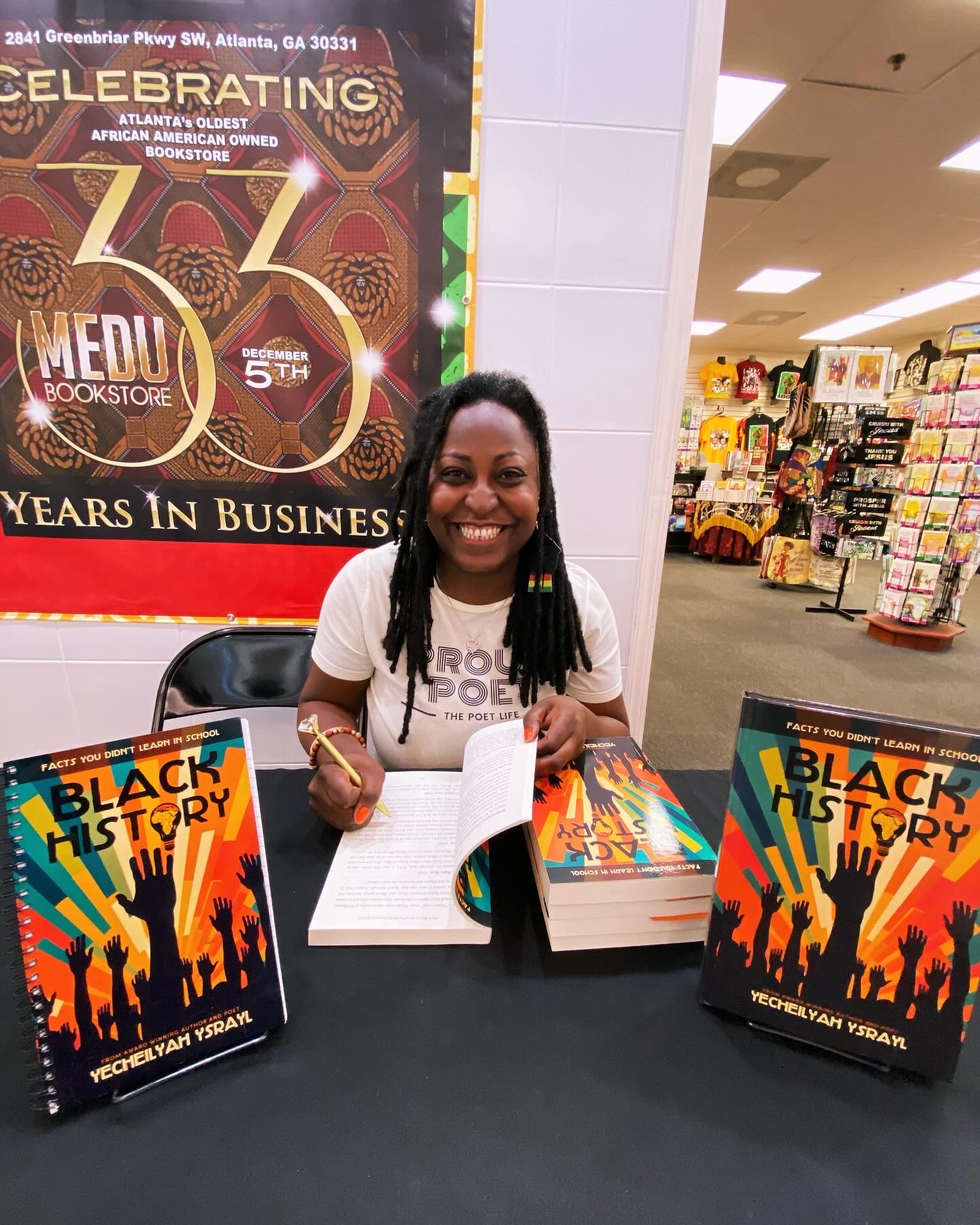
Listen, yesterday started out annoying and frustrating for me.

Watching all these Black people walk past my table and frown at the title of my book (Black History Facts You Didn’t Learn in School) was disheartening and sad.

It wasn’t about the money. It never is. It was about the sheer audacity of people to be offended.

I wanted to run to the bathroom and burst into tears at the arrogance of a people with no interest in their own history. There was even an interracial couple who walked by, him Black, her white.

Chile, do you know this man looked at his white friend/wife/woman and asked if she wanted the book while laughing as they walked on?

Trifling does not even begin to describe the moment.

But then…

There was an older Black man. He walked by my table and dropped a crinkled 20, whispering, “Keep doing what you are doing.”

You have to understand how he did it.

In African American families, elders (grandma’s, grandpa’s, aunts, uncles, etc.) will hug you and whisper in your ear, “How you?” While slipping cash into the palm of your hand.

There is no conversation about it and they are not interested in your explanations. It is simply an act of love wrapped tight in spiritual discernment. You need this even if you don’t think you do.

You could be struggling with bills.

You could be frustrated.

You could be facing any unforeseen tragedy, and this person who has lived long enough to know what love looks like in the flesh slips you with just enough money to cover whatever was bothering you.

Now, I was not in a financial catastrophe but a spiritual one. An emotional one. One that almost made me pack up my things and walk out the door.

There is something about not being appreciated that sends me boiling.

My tolerance is zero.

But then, here comes an angel, dressed casually, with a brimmed hat and gray beard wrapped in golden black skin.

He drops a 20 on my table like it was the sweaty palm of my hand and whispered words of confidence into my spirit without losing stride. He spoke while walking, always keeping sight of his mission.

This man’s simple act gave me everything I needed to keep going.

People took notice, stopping at my table suddenly, almost like they had been commanded to.

There is no moral to this story that you have not already read.


No. This is not the angel man, lol.

The Kindle Version of Black History Facts is 99c for a Limited Time! Click Here to Get Yours.

Want a signed paperback? Click here!

To Be, Or Not to Be, a Historian

As I read the latest review of my new book, I stumbled across the word historian and paused. “Historian? Me? Nah.”

“Yecheilyah Ysrayl is a renowned author and historian known for her commitment to uncovering and sharing the untold stories of Black history. Her expertise and passion for the subject matter are evident throughout the book, making it a credible and authoritative source of information.”

-Vigil Honor, Amazon Review

“Wow,” I thought, an eyebrow raised. Really? Me? He can’t be talking about me. I am no one’s historian.”

When I think of a historian, I think of a person with a wall crammed with degrees from every university on the planet and a vocabulary that would terrify the most seasoned thesaurus. I see an elderly person who is wise and perceptive about how the world came to be. They sit down to write 500-page books and devour scholarly articles for breakfast.

And let’s not talk about memory.

Neil deGrasse Tyson, aka the smartest man in the world, lol.

Historians, I suppose, have perfect recall and spiritual compasses that allow them to travel from portal to portal and retrieve relics from the past. These folks recite information like a machine. When I think of a historian, I think Neil deGrasse Tyson.

But me?

I can’t even remember where I left the remote half of the time.

While I did well in history class, I wasn’t too interested in it. It was just a class to get through, but nothing I thirsted for outside school. I didn’t seek it out like I did books. I didn’t eat it up like I did poetry. I didn’t love it like I did literature.

Ahh. There it is. Books. It always comes back to books.

My love for reading, particularly about my people’s history, has led me to write about it. Writing about it has led me to research it. Researching it has led me to document it. Documenting it has created in me a fascination to share it.

I got a revelation while watching a podcast episode with Donni Wiggins and Jessica Dupart, and I found myself laughing at Dupart’s candor. She dropped a few F-Bombs and talked about her life growing up as if she and Wiggins were sitting in their own living room. She doesn’t speak corporate or exhibit the characteristics that someone might consider appropriate to be a CEO, yet she runs an 80 million-dollar business.

While I didn’t finish the entire episode, watching it made me think about how dope it is that in today’s world, people are redefining what success looks like just by being themselves. I realized I never considered myself a historian because I didn’t think I knew enough. (I also dislike titles)

I was also clinging to an aged stereotype.

I learned I don’t have to look like that old-school, white male version of what a historian was once thought to be to qualify as such.

It didn’t occur to me that writers are historians, too, documenting history and archiving them into books that live forever.

According to Google, “a historian is a person who studies and writes about the past and is regarded as an authority on it.”

“Her expertise and passion for the subject matter are evident throughout the book, making it a credible and authoritative source of information…”

Well now. I suppose historian doesn’t sound too bad after all.

“The book’s storytelling approach brings history to life, making it accessible and engaging for readers of all ages. Ysrayl’s narrative style ensures that the experiences and contributions of Black Americans are not just facts to be remembered but stories to be felt and understood.”

-Vigil Honor, on Black History Facts You Didn’t Learn in School by Yecheilyah Ysrayl


Concrete Rose Episode Two: The White Lady

“I give a holler to my sisters on welfare
Tupac cares, if don’t nobody else care”

You know, it’s funny when it rains it pours
They got money for wars, but can’t feed the poor.”

-Tupac, Keep Ya Head Up

Even though life tried to take me out in a toilet, I got here healthy, drug-free, and a head full of hair.

After two weeks in the hospital, Mama was allowed to take me home, if that’s what you wanna call it. Our building had been built in the 60s, but it wasn’t much of a building by the late 80s and into the early 90s.

Rats and roaches plagued our apartments, and the housing authorities couldn’t care less. Brand-new babies like me were brought home to nothing but drug dealers and addicts, children sprawled about like clothes somebody left on the floor and forgot to wash, so it wasn’t no surprise when The White Lady came.

That’s what people said when the social workers came to inspect the low-income apartments, “The White Lady.” They ain’t never have a name.

The woman stood in the kitchen, talking to Mama, and looking around our place with distaste. She gazed at the Crisco on top of the stove, as well as the dish rack, which was piled high with plates, bowls, cups, and cutlery. It wasn’t cute, but it was clean.

Her gaze moved to my brother and me, who were playing on the thick blanket on the floor we called a pallet. Well, he was playing, and I was doing whatever it was babies do.

My Uncle Rome hid in the closet next to the bathroom cause he wasn’t on the lease. Black women weren’t allowed to have a man in the house in those days if they wanted to get the Welfare. We also had to hide the new toaster, dish rack, and telephone so they wouldn’t take away any money.

“Mrs. House, your son is developing slowly for his age…”

The short, green-eyed blonde balanced a clipboard in her arms and scratched her nose with the tip of her writing pen. The hoop ring in her right nostril and the sunflower tattoo on her exposed arm caught my Uncle Jerome’s eye.

My favorite uncle and unofficial babysitter, we called my mother’s little brother Rome for short. He thought he was Romeo to every woman’s Juliet. His dark chocolate skin tone and thick lips drove them crazy. Mama said if he took the time to read Romeo and Juliet’s story, he might want to be somebody else.

“Ain’t nothing romantic about no Romeo and Juliet,” she’d lecture him when he bragged about his latest escapades.

“Why is that?”

“They both died fool.”

Uncle Rome said he wasn’t into white women like that, but this one was “sho-nuff fine.” Unk was lying. He loved him some white women. He just wanted to know why she was so young and how long she’d been working with social services to where she could take his sister’s kids.

“…and your 2-month-old is malnourished,” said the White Lady.

“It’s Miss House,” said Mama, taking a drag of her cigarette, inhaling smoke, and blowing it out of her nose. “Since you know so damn much.”

Uncle Rome did one of those fake coughs you do to cover up a laugh.

The lady ignored my mother. “Miss House, have you been using the Food Stamps?”

Unk said Mama frowned, “Yes, I use my stamps. Fuck I look like not to use Food Stamps?”

“I just wanna make sure you didn’t sell them, is all,” said the white lady.

“Oh, so you my judge now? I look incompetent to you?”

See, that’s what I loved about Mama. Yeah, she was a heroin addict, but she wasn’t no fool. A wordsmith with a mouth like a two-edged sword, she’ll curse you out every which way but loose and diversify her vocabulary while at it so you can know she’s cursing because she wants to, not because she doesn’t have the words to say what’s on her mind.

Mama used to write poems and stories before she got pregnant with Aaron. She also went to school to do hair. There wasn’t nothing my Mama couldn’t do. I wished she would get back to her art. Maybe that would help keep her away from the drugs.

“Look, are you done? Cause, as you can see, I have kids to look after.”

The woman scanned the apartment once more, frowning at a roach crawling on the wall. “Let’s just hope you are taking care of these children. This is your final warning, Miss House. If I have to come back here again…”

“Yeah, I know,” interrupted Mama, blowing out more smoke. “Are we done?”

The woman nodded, “We are.”

As she walked toward the door, she stopped to look once more at us and then back at my mother. “Probably not a good idea for you to smoke in front of the children.”

Mama rolled her eyes, dropped the cigarette on the floor, stomped it with her foot, and waved the woman off.

According to my uncle’s story, the woman left us alone after that. But, in my fifth month, someone new came to visit, and I was taken away from Mama and placed in foster care, where I would stay for the next five years.


Did you miss episode one? Check it out here!

Again, I am sharing based on interest! If you like this episode and want to move on to episode 3 (“Miss Sophia,”) let me know! 😃

Concrete Rose: Episode One

“Did you hear about the rose that grew from a crack in the concrete? It learned to walk without having feet. Funny, it seems, but by keeping its dreams, it learned to breathe fresh air. Long live the rose that grew from concrete when no one else cared.”

– Tupac Amaru Shakur

I was almost born in the toilet.

My brother, Aaron, had just turned two, and Mama was only five months pregnant when Theresa (we call her Reese) caught her shooting up in the bathroom. That’s when she felt my head. “I think I feel my baby,” she slurred.

People around my way love to quote Tupac’s Rose That Grew from Concrete, but they don’t really know what it means. They don’t know nothing about coming up from the hardest part of the earth, snuggled between nothing but weeds, dirt, and the butts of cigarettes.

Then, the sun is so hot sometimes, the poor flowers (that are not really flowers cause they ain’t get the nutrients they need) just wither up and die. That’s what we really fight against here in these slums, in this place they want us to call home, but it ain’t never feel like it. Never felt like a hug or Big Mama’s greens.

That’s how the bathroom was almost my birthplace. Right there at 4840 South State Street, apartment 602. I feel sorry for Reese having to see her auntie slumped over like that and her own mother high as a kite in the other room. How is somebody supposed to get ready for school in this mess?

Reese was strong, though. She banged her fist against the door real hard like the police when they raided the sniper apartments. What is a sniper apartment? It’s just what it says: Empty flats on the top floors drug dealers used to shoot their enemies down below, like snipers on the battlefield.

Photo Cred: Williams Humbles

“Aunt Helen! Auntie, I gotta get ready for school!”

Frustrated, my mother, belly hanging over blue jeans now too small to zip up all the way and a dingy white t-shirt, finally opened the door.

“Come on, girl, shit,” she said, pointing to the tub. “Hurry up,” she rushed as Reese undressed and ran the water.

Mama sat back on the toilet and wrapped the belt tight around her forearm, a burned spoon dangling on the edge of the sink like it was supposed to be there. Like it was a toothbrush waiting to be used. Reese said she remembers praying Aunt Helen wouldn’t ask her to help tie her off like the other times.

“Close that curtain. Hurry up!”

After Mama said she could feel my head, Reese ran out of the bathroom, butt naked, and into her mother’s room. Dazed from her own high, Auntie Lorraine jumped up nevertheless. She knew her sister was pregnant and hurried to the bathroom, except she didn’t use her fist like her daughter. Auntie Lorraine, big-boned and shaped like Sara Baartman, used the back of her foot, slamming it against the door.

“Helen!” she screamed, but Mama wasn’t opening the door, so Auntie Lorraine had to kick it in, the needle falling from my mother’s long, skinny fingers like a witness eager to expose her secrets.

And as they say, the rest is history.

My name is Rosalind House, but everybody calls me Rose for short. I was born two months later, on June 21, 1987, premature and weighing a whopping 3 lbs and screaming at the top of my lungs. They say that’s why my voice is so high-pitched and sweet. They say it’s like something the Lord made. Say, I’m gone use it to shout my way out of this place.

And I did.

Let me tell you how it happened.


I missed writing fiction, so I started a new story!

I am calling it Concrete Rose (for now). I’ll be sharing the first few chapters based on response, so if you wanna read more, let me know! 🙂

Up Next: “The White Lady.”