re: Book Reviews For Beyond The Colored Line: A Short Story


Last week was Launch Week for my new book, Beyond The Colored Line. This week, I am seeking the assistance of people who are willing to volunteer their time to provide me with some reviews.


Featured Image -- 4819

I will send you a Free paperback copy in exchange for an honest review. Please email me (ahouseofpoetry@gmail.com) if you are interested in helping and I will give you further information. I will say that this is not a novel; it is a short story so it will not take up too much of your time.

(I also Review Books so if there are any authors who are also book reviewers, I’d be willing to swap books. You do a book review for me and I will do one for you. Team work makes the dream work so let’s make it happen. Self-Publishers rock.)

Thanks a lot for the consideration. I am traveling this week so I will respond to all inquiries by next week. Thank you all for your patience.

– Yecheilyah

The Winning Letter

So Monday I set up a poll asking you guys to help me to choose what I should do this week in preparation of launch day, based on what sounded like the most fun. Your choices were:

a). Hold a 3 Day Giveaway (8/19 Wed-8/21 Fri)
b). Hold a 1 Day Giveaway the day of Launch (8/24)
c). Create a Contest with one grand prize winner announced on Launch Day
d). A and C

And the winning letter is (drum roll please):

C. Create a Contest with one grand prize winner announced on Launch Day.

I thought sure A would win!

To spice this up a bit, I have decided to do a Trivia Day instead of a contest to give more people a chance to win lots of FREE prizes. This gotta be fun!

Thanks guys! Stella will see you all Launch Day with the Grand Trivia Event.

file-6

Its the countdown! 5 Days to Go!

Family Tree Chart: Character Development

So last week, in a post called 3 Reasons I am Not a Professional Author, I spoke about how I started using a Family Tree to build my characters. I do this using Microsoft Word which I am learning more and more about each day. Family Trees can also be done in Microsoft Power Point.

What this method helps me to achieve is a greater depth in character development. It helps me to create a background, a foundation if you will, for my characters so that they evolve into real living people and are not just stick men and women with names. By creating a background, I can better design the main character out of the genetics of the people that came before them. In this way, I am not just making people up, but they are coming from an ancestral bloodline of sorts. Your primary characters can actually have a lineage and a family to which they belong to go with the personality your writing gives them.

Over the course of this week, I have put together a sample Family Tree and a few steps to help you to get started. I thought I would be able to accomplish this over the weekend but quickly discovered it was a lot more work than I remembered. To make this as simple as possible I will give you the steps as to do this the easiest way possible (which is not exactly how I put mine together but it works). Please understand that this is just a sample and that you can go much deeper than what is presented.  To save time, I only scratched the surface here:

Step #1: WRITE

So if you read the previous post to which I mentioned this method, you know that I don’t use a timeline when I write. I start by writing the story as it comes to me. You can use this method either way. It is however, a good idea to start writing first because the juices start to flow and you have an idea of the characters you can start adding to the chart. Once I’ve written a few pages and I have an idea of the characters, I can then proceed to build on their lives by way of the timeline. All of this is simultaneously done as I’m writing so the timeline is not completely finished in one sitting. I may get to a point in the book where I want to switch some things around or change some names. In simplest form, I’m writing the story and using the family tree to organize my characters as I move along the process. The chart also helps me to sit back and take a full view of everyone even after the book is finished, to study the characters, and to recall names quickly. It’s easier for me to look at my chart instead of rely on memory or scan the document, to recall an important feature so as not to create inconsistencies when I’m writing. I know it seems like a lot and some of you are probably asking yourself, “Shouldn’t I just write so that the emotion and descriptive language  makes the characters realistic?” Of course. The chart does not replace writing in personality and all of that good stuff, it just helps with names and family history.

Step #2: OPEN MICROSOFT WORD

LZ0022-2-newdoc

Step #3: GO TO THE INSERT TAB

word2007-insert-tab

Step #4: CLICK ON SMART ART (it is between Shapes and Chart in Microsoft 2007 & 2010)

insert-menu-for-smart-art-word-20101

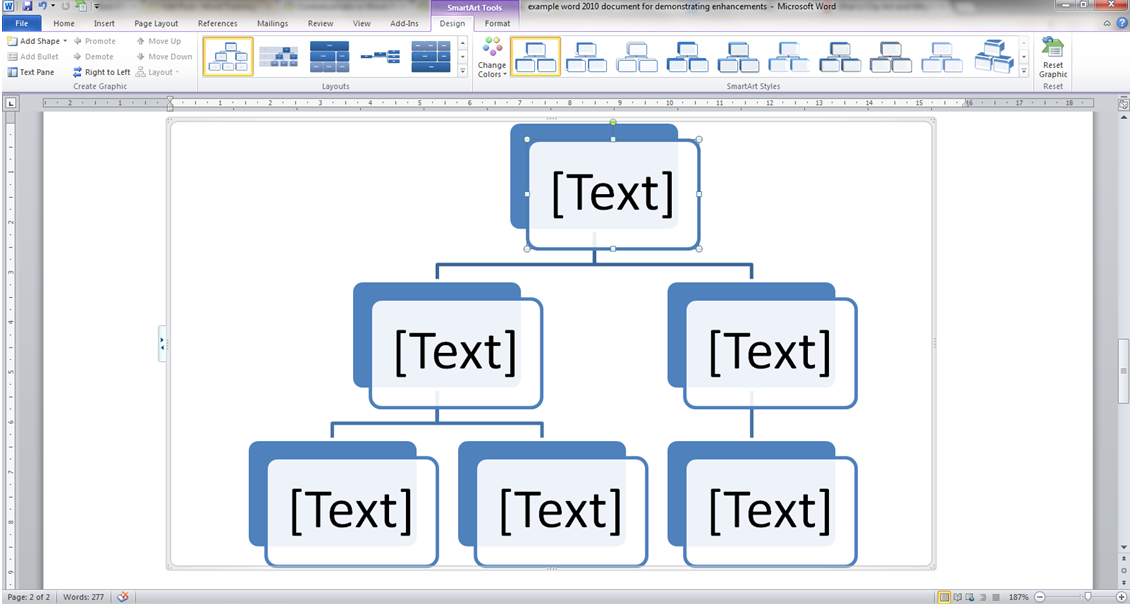
Step #5: When you get into Smart Art, CLICK ON THE HIERARCHY CHART and choose a chart

SmartArtDialogBox

Step #6: Start building, adding names and traits or whatever it is you want to add

gxECf

Remember that this is not a normal family tree. You don’t have to just add names but in this chart you will also add other important things about the character, such as height, weight, hair and eye color, etc.

Picture1
My Chart

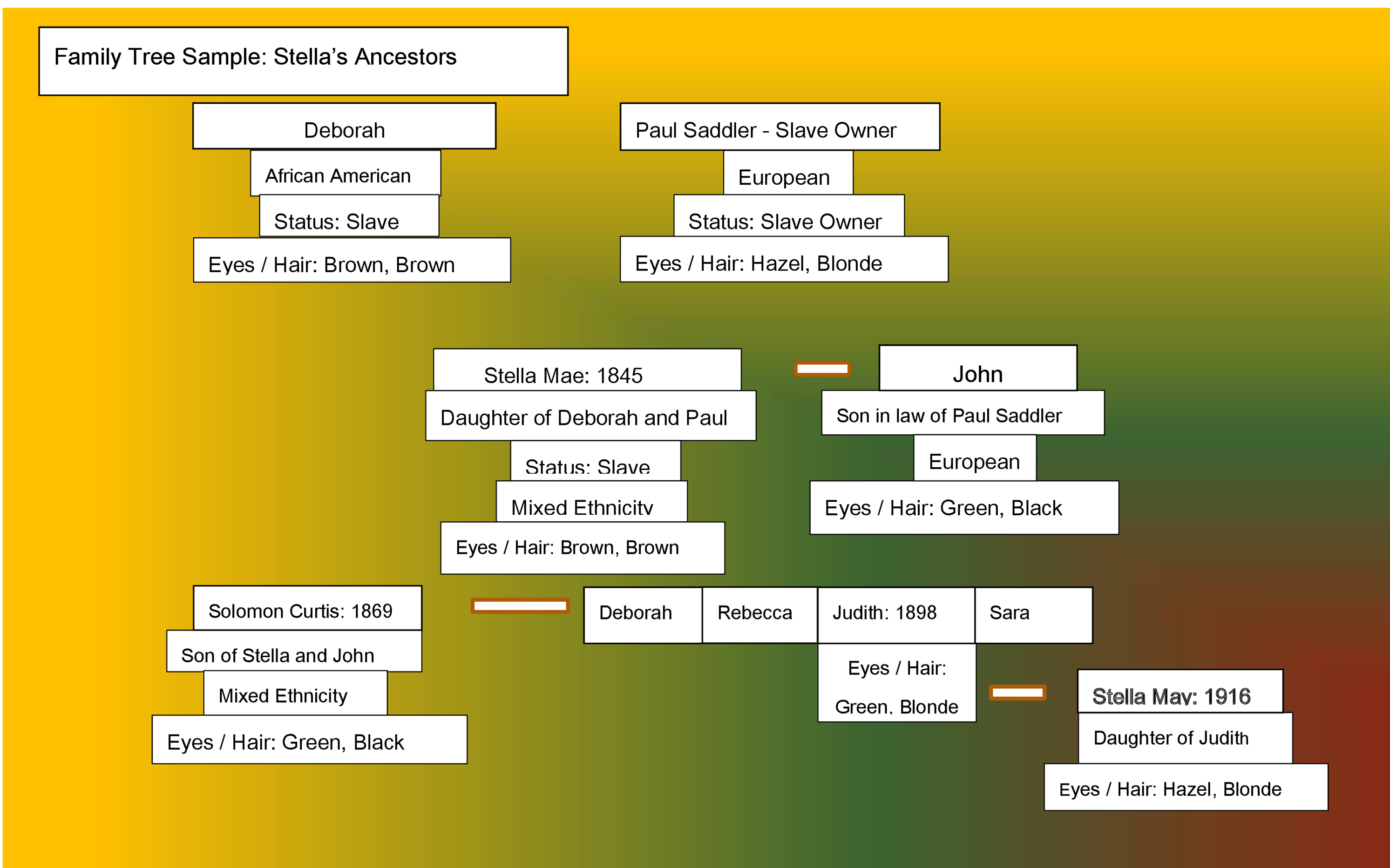
OK so I hope that you can see this well. This is my chart which I created using a slightly different design than the Smart Art. I customized it and created my own boxes. I saved it as an image file and then used Microsoft Publisher to crop out the white spaces that come from Word.

In my chart, we see that Stella is named after her great grandmother Stella Mae.

When Blacks stepped off the slave ships and into the shoes of their new lives, their ancestral names were stripped away. After chattel slavery ended, one of the first signs of freedom was for slaves to change their names. Having started with just a first name, they wore the last names of their masters, in which the majority of them continued to wear after emancipation. Others altered their last names slightly after freedom to disassociate from their masters.  Another percentage went far as to just make up a last name, as in Booker T Washington’s case. According to his Autobiography, “Up From Slavery”,  Booker noticed while in class that many of the students had two names. So when the teacher called for his name he calmly announced “Booker Washington” so as to fit in. Later, he found out that his mother had named him “Booker Taliaferro”. And just like that he became Booker T. Washington:

“By the time the occasion came for the enrolling of my name, an idea occurred to me which I thought would make me equal to the situation; and so, when the teacher asked me what my full name was, I calmly told him “Booker Washington”, as if I had been called by that name all my life; and by that name I have since been called.”- Up From Slavery, Page 17, Boyhood Days

Instead of take on the last name Saddler, the first Stella decides to take the last part of her first name, Mae, and change it into May. Her family would then go on to be known as the May’s.

Interpretation of Chart:

  • Deborah was a slave on Paul Saddlers Plantation. They produce a daughter who Deborah names Stella Mae.
  • Stella Mae and John produce a son who Stella names Solomon Curtis. According to the chart, he inherits his father’s green eyes and black hair but this is an error on my part. His eyes are actually Brown like his mothers, but he inherits his father’s jet black hair.
  • Solomon goes on to have four girls: Deborah, Rebecca, Judith, and Sara.
  • Judith, the middle daughter, goes on to give birth to a daughter who she names Stella, after her grandmother.
  • We see that Judith inherits her green eyes from her father Solomon and her grandfather John. For the sake of space I did not include Judith’s mother in the sample chart; she is white.
  • Stella inherits her eye and hair color from her great great grandfather Paul. Stella’s father is also not included in the chart; he is black.

As genetics would have it, Stella is easily capable of easing on pass the color line by inheriting more external European features than African American.

3 Reasons I am Not a Professional Author

(The post where I originally mentioned this in case you missed it)

see also

Word to the Wise

Beyond The Colored Line – Part 2 of Book 2

Book2****************************

Disclaimer: The following post is excerpted from a book written by Yecheilyah Ysrayl and is property of Yecheilyah Ysrayl. No part of this publication may be reproduced, or stolen. Permission is only given to re-blog, social media sharing for promotional purposes and the case of brief quotations embodied in the critical articles and reviews and pages where permission is specifically granted by Yecheilyah Ysrayl. (For permission write to: ahouseofpoetry@gmail.com)  Copyright © 2015, All Rights Reserved.
*************************************

Part 2
_________________________________________________
1928
5 Years Later
Age 12
*******************************
Daddy run off to who knows where on account of his life. Some racist whites had seen him and Mama together and threatened to lynch him if found. So he run off to nobody knows where. The community gossip is that his brothers know, but they won’t say. We weren’t alone though, Mama and me. Seems like Mama filled the hole where Papa should have been with our whole family. The house always stayed filled with guests: my people, and peoples of my people. My granddaddy was a colored man, and so owned this land. My name sake, his mama Stella, was a slave and was given this house by her owner. As the story goes, after Grandma died, I was born. Since Mama was the closest, she named me after her. We got stories going all the way back to her girlhood, and stories of Grandpa Solomon too. I heard the stories mostly on Sundays, since all the family come down. My aunts would gather around the table with my mom and they laugh and cry most of the night about they girlhood. I don’t have any uncles except from my daddy side, but they don’t come around much cause of my aunties. Uncle Roy say Mama acts different around her sisters and that they too uppity, especially Aunt Sara. She’s the youngest of my aunties and the most spoiled. She’s the one who convinced Mama to send me to a private school to escape all the worry, and boy were my uncles hot! They said we were breaking the law – that a Negro had no business in a white school. But Aunt Sara said I had all the right in the world since I was technically half white after all.

“But does the school know she colored?” one of my uncles would ask.

“That’s none of the school’s business now is it?” Aunt Sara would say and they’d just go back and forth until Mama break it up.

That’s the story of my life: Was I white? Was I Negro? Race wars always concerned these two groups of people, and there ain’t seemed to be much place for a mulatto. Speaking of race, not all talks were good talks. Not all round table discussions were filled with laughter and jolly drinking. I used to sit up until my eyes were red with fatigue to hear Mama and my uncles talk about all the killings that were taking place around the country, and especially in the south.

“That’s what I say,” said the voice of Uncle Keith. “Up there in Minnesota.”

“That close?” Mama gasped. I could just picture her now with her hand over her chest. Mama had a thing for the dramatics.

“Yea that close. What, woman you living under a rock? They just had one on over in DeKalb last month,” said Uncle Roy.

“It’s a crying out loud shame,” continued Keith. “Say they dragged the boys from the cell and a whole mob of ‘em lynched ‘em. Say it was bout least a thousand of ‘em.”

“My my,” said Aunt Rebecca.

“Well you know what I say, if you can’t beat ‘em, join ‘em,” said Sara.

“Where did you come from?” said Deborah, annoyed.

“From betwee–,“ began Sara.

“Please, spare us,” said Mama.

“I didn’t ask the question,” said Aunt Sara, smacking her lips.

But there were times, of course, I witnessed for myself evidence of the events rocking the country. One day, Mama and I went to visit Cousin Mary in Texas, and drove the truck up to a general store. We walked in, and being only about five at the time, I picked up a post card hanging on one of the shelves. It was of a man hanging on a tree that supported an iron chain that lifted him above fire. The man didn’t seem to have much of a body left. His fingers were cut off, his ears and his body burned to a crisp. On the back of the postcard read:

“This is the barbeque we had last night. My picture is to the left with a cross over it.  Your son, Joe.”

I learned later the picture was of a 17-year old mentally ill boy named Johnny, who had agreed to having raped a white woman. And everybody at home still talked of the Cairo circus of 1909, the public lynching that took place here in Illinois. I asked Mama once if we could go to a circus like that, and she told me to never ask her of such things again. I couldn’t understand what had Mama so upset till I found out what kind of circus it was. It was events such as this that caused my aunts not to want much to do with the land or the house. They say it’s too close to slavery. So when Granddaddy died, Mama took on the burden of keeping it, and keeping it full too. I got kinfolk I see every weekend, and some I never met before. And some I don’t think are kinfolk at all; they just come for a hot meal and a bed. But that was alright with Mama. She didn’t care none about being taken advantage of. She just wanted to be around people she could feed and clothe. Her heart was just full of love like that. Sometimes they spend the night, but other times they just come and go. Sundays were the biggest days. Mama cook a feast of a dinner: fried chicken, yams, macaroni and cheese, fried brim and crappy, greens, pies, cakes. You name it, it was on our table. Everything except pork. Mama say Granddaddy was always talking about his Hebrew Heritage and teaching them about it too. Said he didn’t like being called Negro and African, and they weren’t allowed to call him that either, or themselves for that matter. Granddaddy say with his face all proud, “There are two things in the world I would never be: Christian and a Hog Head.”

Then he’ll light his pipe and go on rocking in his favorite chair, like the conversation was supposed to be over, even though folk mouths hung open. That’s another reason my uncles say we uppity:

“Everybody due for a lil fat back every now and again. Everybody Negro that is,” Uncle Roy would say, cutting his eyes over at Mama.

“Good thing we ain’t Negro then huh?” Deborah would shoot back.

Deborah, named after my great great great grandmother, fit right into her biblical name and was the most like Daddy, taking her Israelite Heritage seriously and practicing the laws of the Old and New Testament. Most of the family thought she was crazy. That didn’t stop her from speaking her mind though. But good eating and conversation was just the half of it. There was music, dancing, drinking, smoking, and gambling too. Cousin Walter would bring over some of his hooch and the grown-ups forget all about the children, which was just the way we liked it. I had a lot of cousins and friends, but no one was as close to me as Thomas. Tommy’s mom died off when he was just a baby, and his dad come across the road looking for direction one day when me and Mama come walking along. Come to find out they didn’t really need direction so much as a bed to sleep in. Mama let them stay with us for a while until Luther, Tommy’s dad, got off his feet. But that didn’t stop them from coming around. Luther and Mama became good friends and Tommy was over every weekend. My aunties used to think there was something going on between Mama and Luther till she shut up the gossip with news of Luther’s lady friend, who also became friends with Mama. So naturally Tommy and I were good friends, but we were also enemies and partners in crime. Tommy was dark as charcoal with big lips, nappy hair, and a wide nose. And I envied him for being so obviously Negro. It’s the same reason I liked him too.

“How you get so dark?”

“I don’t know,” said Tommy. “Just lucky I guess.”

“Lucky? What you got to be so proud for? Ain’t no girls liking no skin that dark.”

“Shut up white girl,” said Tommy.

“Shut up big head,” I say.

That’s usually when he punches me in the arm and I’d have to hunt the rest of him throughout the house.

We weren’t much of a church going family; party going is more like it. Except when Mama wanted to show off a new dress or hat, when somebody died or needed saving, and on Holidays and such. Folk would come from all over southern Illinois to hang out with “Cousin Judy”, as Mama was often called. Sunday’s sure were fun, my second favorite day of the week.

Saturdays was my favorite day of the week. It was the day for shopping and that only meant one thing: Chicago. First, Mama would wake me to the smell of biscuits or pancakes. This was to keep me full enough throughout the day so she didn’t have to worry none about food buying. Then, I was commanded to bathe down real good, paint my arms and legs with oil, untie my curls from the night previous, and we’d both put on our Sunday’s best and be two of the most beautiful women you’d ever seen. I was a young lady now and shopping was the best thing to a young lady next to boys (but you couldn’t like them in public). You could like shopping though. I loved going from store to store in search of the finest. Skipping along while Mama scanned the insides of magazines for stuff she only saw on TV. We would squeeze our way through crowds of people, just bumping into each other. They weren’t dressed as professional today. Instead, they wore their weekend wear, bought ice cream for their children and went inside movie theatres, and so did Mama and I. We could buy candy or jewelry, or perhaps a new hat or two with the money Mama made from the laundry. We drank from water fountains without label, and spent money without prejudice. Everything was so easy on Saturdays, life itself was better. We had us a good time on Saturdays because on Saturday, no one knew we were colored.

– Stella M.

**********************************************

What did you think about the second part? I hope it held your interest and you’re ready for chapter three. I am leaving you with a surprise part from  Book 1 below. For the prologue to Book #1, see last week’s post. If you like this story so far, would you do me the favor of sharing this post with your friends who might enjoy reading it also? Re-blog or share on your social networks. Thanks a lot! And I’ll see you next week for Part 3.

Click Here to Read a Surprise Part from Book #1

Beyond The Colored Line – Tomorrow’s Sneak Peek Reminder

sneak-peek2[1]

This post is a reminder of the continuation of the sneak peek series into my upcoming book “Beyond The Colored Line”. Tomorrow, we will be reading through Part 2.

“Beyond The Colored Line” is Book #2 in a short story series I’m writing called Stella. Stella is a work of Historical fiction, and is distinctive in its focus on one woman’s road to self-discovery against the backdrop of the African American fight for justice, racial equality, and freedom. The 3-Part series focuses on the history of one family in their struggle for racial identity. Discover in this Trilogy how 3 individuals living in separate time periods strive to overcome the same struggle, carefully knit together by one blood.

The first 4 parts to Book #2 is being released right here on this blog every Thursday; they started last week and will go on until May 7th. I’m giving these parts away for free because one of the things I enjoy about blogging is the direct feedback available to us. I think it is an awesome way to network, to build relationships with other authors, and to enhance our writing skills so I’m taking advantage. I am also seeking to broaden my platform and make it easier to connect with readers.

In case you missed it, below is the link to last week’s story, Part 1 of Book #2. I hope it captures your attention, and I look forward to the revealing of Part 2 of Book 2 early tomorrow morning:

Click Here for Part 1 of Book 2

Beyond The Colored Line – Part 1

 Today is the debut release of Part 1 of Book #2, “Beyond The Colored Line” in the Stella Series.Below is a reminder of what this book series is all about:

Stella is a work of Historical fiction, and is distinctive in its focus on one woman’s road to self-discovery against the backdrop of the African American fight for justice, racial equality, and freedom. The 3-Part series focuses on the history of one family in their struggle for racial identity. Discover in this Trilogy how 3 individuals living in separate time periods strive to overcome the same struggle, carefully knit together by one blood.

Log-Line for Book 2:

“Determined to be accepted by society, a black woman desperately seeks to hide her true identity when a prevailing conversation with her aunt provokes her to pass for white.”

Find out in this Stella Sequel what’s truly Beyond The Colored Line.

*****************************************************

Disclaimer: The following post is excerpted from a book written by Yecheilyah Ysrayl and is property of Yecheilyah Ysrayl. No part of this publication may be reproduced, or stolen. Permission is only given to re-blog, social media sharing for promotional purposes and the case of brief quotations embodied in the critical articles and reviews and pages where permission is specifically granted by Yecheilyah Ysrayl.

Copyright © 2015, All Rights Reserved.

Book2

Part 1
___________________________________________

September 4, 1923

“You’s white.”

Margaret and Josephine had their hands on their hips again, Josephine taking the lead role as always. The soft wind swayed the handmade dress in all directions, hovering well below her long skinny legs. Her hair was pulled up into a collage of pony tails with twists that never really wanted to stay together. Stella got lost for a minute, slightly envious. She wished her hair was that thick. But instead she was given a sandy blonde that could never keep a braid. School had just started at Crestwood Elementary of Belvedere City, just south of Boone County, Illinois. And already Stella could see this would not be a good year, same as the others.

“I’m not white; I’m Negro, same as you,” said Stella.

Josephine rolled her eyes, “You look white. You sound white. I thinks you white.”

The girls laughed. Meanwhile, Stella’s blood boiled, the blush of anger showing quickly in the space of her cheeks and around her ears.

“You’s white cause we say you’s white,” said Margaret.

“That’s right,” co-signed Josephine, “What kind of name is Stella anyway? What you some kinda slave?”

“Naw,” said Margaret, “she ain’t no slave, naw, she massa.”

Josephine turned her head slightly, laughing hysterically in Margaret’s ear, who saw it coming out the side of her eye.

“Josephine!” yelled Margaret. But it was too late. Stella was already on top of Josephine, pulling at her neatly pressed hair and slamming her face into the dirt. Stella could hear the screams of the teachers nearby calling her name, but she just couldn’t stop.

“I’m not white! I’m not white! I’m the same as you!” Stella yelled.

Josephine was crying now, as Margaret tried to peel Stella off of her.

“I’m Negro the same as you!” she yelled.

Later That Day

Judith stood by the door tapping her feet impatiently against the hardwood, and burning a hole in the back of Stella’s head, who sat silently on the sofa with her head down.

“You’re going to have to learn to control yourself Stella.”

“But ma–“

“Did I ask you to say a word?” scolded Judith, answering the door at the same time. Expecting her guest, she opened the door before the bell rang and gracefully let in Mrs. Velma Conner, Stella’s teacher.

“Good afternoon”, said Judith. “I’d like to apologize again for what happened today. May I offer you some coffee?”

“Never mind that,” said Velma. “I don’t specs to be here long.”

“Well let me offer you to a seat then,” said Judith.

Judith sat beside Stella as Velma took the sofa across from them and cleared her throat.

“Stella seems to be having a very difficult time adjusting. Her temper is far too easily tickled, if you catch my meaning.”

“I do,” said Judith.

“We think perhaps she would be better off in a more comfortable environment, somewhere more of her liking, if you catch my meaning,” said Velma.

Judith straightened and looked Velma in her sparkling blue eyes, “Not exactly.”

“Well, Ms. May, the accusations from some of the children are hard to ignore.”

“What accusations?” Judith interrupted.

“Well, you know, children will be children,” Velma laughed slightly. “It’s just that they don’t take very well with our kind. Surely you’d prefer for Stella–.”

“Our kind?” Judith interrupted again.

“Why yes,” said Velma, shaking her head.

“You don’t have to say anything more, Mrs. Conner.”

Judith stood up, smoothed the apron hanging from her waist and approached the door.”

“Stella May?”

“Yes mama?”

“Go on upstairs so me and your teacher can talk.”

“Yes ma’am,” said Stella, hurrying off upstairs.

Velma remained seated, “Is there a problem?”

Judith smiled, “No, there’s no problem. But I do want you to leave my house.”

Velma stood, pointed her nose into the air and walked toward the door, clearly offended.

“By the way, the school has placed Stella under suspension, you understand why.”

“Oh, I do,” said Judith. “You see, defending ourselves, is what we’re taught.”

An expression of confusion spread across Velma’s face as she stared into the green eyes of the white woman in front of her, disgusted that she would stoop so low as to lay with one of them.

“What we’re taught? I’m not sure I’m following you,” said Velma.

“Oh yes,” said Judith, “It’s one of the first things my Negro father taught me, you know, our kind I guess.”

The pink rushed to the woman’s nose as she hurried out the door.

And that’s how things had been for us growing up. I couldn’t understand what made mama so strong. She loved daddy with every bone in her body, but they couldn’t be together. Society would never have of it. Mama was Negro sure enough as she was white, but Papa didn’t trust it. I thought about Papa that day and all the other days like it as I stood at the top of the stairs and watched as my mother waved goodbye to my racist teacher, with a smile on her face.

– Stella May

**************************************************

I really hope you  enjoyed the first part of my book! The fun continues with Part 2 next Thursday. If your enjoying yourself so far, would you mind sharing this on your social networks? Thanks a lot! Also be sure to come back for the continuation next week. And that’s not all, for your convenience, I’ve provided the link to the prologue to Book #1. I love writing and learning and sharing what I’ve learned and I’m really excited to be sharing this journey with you.

Prologue to Book #1

The Stella Trilogy – An update

Book2

As many of you know, I have a few projects that I am putting out this year. One of them is The Stella Trilogy. It began years ago when I was helping a student with a creative writing assignment. I am not sure what it was exactly, but it had to do with descriptive writing. To make a very long story short, I wrote the first scene to Book #1 which was at the time not a book at all. It wasn’t until years later, after the paper had collected enough dust on my computer, that I realized how much I adored the layout of the scene and how I wanted to make it better. I wanted to expand it and to add to it. But what I enjoyed most about it was how short it was. I noticed then how writing the short had made me so content. It was basic, sweet, and engaging. I decided then that I would try my hand at writing short stories, and The Stella Trilogy was born.

As I prepare to send Book #2 in for editing, I would like to share some of it (unedited) with you. Because of the length of this series, it is broken down into Parts instead of Chapters. And I intend to release the first 4 Parts  to Book #2 right here on The PBS blog. As I do so, I would love your feedback. 🙂

About Stella:

The Book:

Stella is a work of Historical fiction, and is distinctive in its focus on one woman’s road to self-discovery against the backdrop of the African American fight for justice, racial equality, and freedom. The 3-Part series focuses on the history of one family in their struggle for racial identity. Discover in this Trilogy how 3 individuals living in separate time periods strive to overcome the same struggle, carefully knit together by one blood. Book #1 is Available Now in Print and E-Book. 

The Character:

Just barely two generations from slavery, Stella is the daughter of Judith May. Mother and daughter share the blood of a black woman and her white slave owner. Unable to cope with the teasing and bullying from both the white and black kids, Stella struggles with identity and a place to belong. She does not feel she can find her rightful place among the blacks and neither among the whites. That is except on Saturdays. Stella loves Saturdays! Where her and mother take occasional walks on the town and enjoy all of the privileges that come with a light skin tone. Eventually, after a discussion with her Aunt persuades her to pass, Stella decides to live her life as Sidney McNair, a white woman. But living Saturdays isn’t as easy as visiting them.

I’m giving these parts away for free because one of the things I enjoy about blogging is the direct feedback at our fingertips. So before I publish this second part, I would like to broaden my platform and make it easier to connect with my readers. I am scheduling the post now and the first Part to Book #2 will post next Thursday, April 16, 2015. I will then proceed with the following Parts over the next 3 weeks:

Beyond The Colored Line:

Part #1: 4/16/2015
Part #2: 4/23/2015
Part #3: 4/30/2015
Part #4: 5/7/2015

“That’s the story of my life: Was I white? Was I Negro? Race wars always concerned these two groups of people, and there ain’t seemed to be much place for a mulatto” – Stella May