I’m in a sharing mood today. Do you have a post you’d like re-blogged? Poetry? Short Story? Promo? Attach the link in the comments section and I’ll get to it as soon as I can (rated G please). If there are any special tags you’d like to include (such as your name or the name of your blog) to help people find the post better, include them as well.
Enjoy the rest of your evening and remember, sharing is caring 🙂 lol.
Your voice wants to be held. Close tucked into the palm of my ear and bent like crooked fingers curling, you smolder. Burnt notes crackle. You are the tip of an unfiltered cigarette. You ash where others breathe. When my hand opens, you’re caught, finger fried in the molding of what wants to be said and what slips behind. Forever binding, you fall in between the cracks of my hearing. Softer words were never said.
As a writer, what’s the point of keeping a success journal?
Isn’t keeping a success journal extra work? I mean, after hours of writing, who wants to crack open a diary and write even more?
Valid questions, all?and that’s what I thought, too. I first learned about the concept of a success journal at a seminar by T. Harv Eker, a motivational speaker who has helped millions of people attain financial freedom.
The concept is simple, really: every day, write down the 5 biggest successes you had that day.
That’s it. Simple, but powerful.
So I bought myself a notebook, and each evening, I would mentally review my day and write down every positive thing I could think of.
I am not exaggerating when I say that the first week I kept a success journal, I became a success junkie. I actually started going out of my way to do…
Good Morning everyone and welcome to another week of Movie Night Friday. Where I present some of my favorite movies and why I love them.
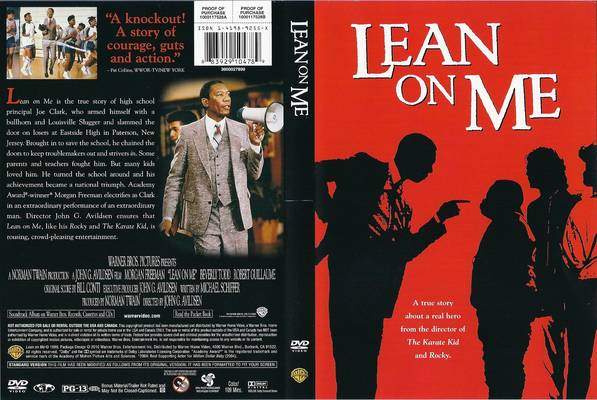
“Lean on Me” is one of my most favorite movies. In fact, as I think about it, this one should have been first! Then again, I’ll probably say the same thing about next week’s pick. This is after all my most favorite movie list.
“Lean on me” (’89) is a movie based on the real life story of a New Jersey High School principle, Joe Clark, who was called in to be principle of East Side High School. A former teacher of the school back in the 60s, the place to which he returns is anything but the way he left it. It is no longer a place of learning, but a place of drug abuse, gang violence, and despair. The premise of Clark’s return is built on the coming closure of the school. If Clark cannot get the children to pass the minimum Basic Skills Test, the school will close.
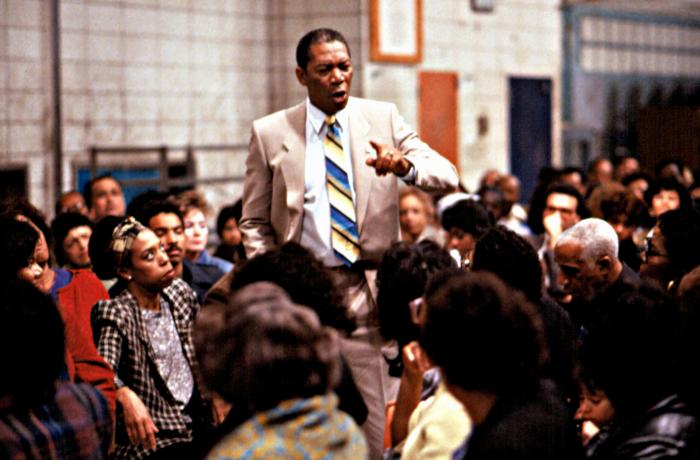
What I like about the movie is the dramatization of someone who truly cares about his students and their well-being. Joe Clark is a principle, a teacher, and also a father. I also like Clark’s no non sense demeanor. When he steps into the school to find it in such chaos, he focuses his attention on the teachers. He scolds them for their lack of authority and effort in maintaining the school. He does not accept their excuses, nor does he accept their advice; for if they had done it right the first time, he would not be there. His methods are strict yes, and he is in many areas arrogant and in need of a little scolding himself, however, his stern approach is exactly what the school needs. Why is the music teacher preparing her students to perform Mozart at a concert when they can barely read? The school is overrun by students who’ve been there over five years and have no intention of getting an education. As a result, those trouble-makers are thrown out and everyone, from student, to parent, to teacher, to Vice Principle, is held strictly accountable for their actions. Even the school board feels Joe’s rage.
LEAN ON ME, Morgan Freeman, Lynne Thigpen, and cast, 1989.
But eventually, his unconventional methods lead to a clash with city officials and outraged parents of students who’ve been expelled. One parent in particular is out for Clark’s blood. If only she can be added to the school board to vote Clark out. And when Clark puts chains on the school doors to keep the gang members out, the Fire Marshall warns about the fire hazard, though Clark dismisses his threats. But if the Fire Marshall catches Clark with the chains on the doors however, it won’t be good for him, his students, or the new school he is trying to build from what’s left of the rubble.
Movie Trailer:
Funny Movie Error:
When Joe Clark is having his talk with Sams on the edge of the roof of the school, Sams is on the right and Clark is on the left (when viewed from the ground). When they’re done talking, Sams turns to his left and walks away – turning to his left would have made him fall off the roof after just a few steps.
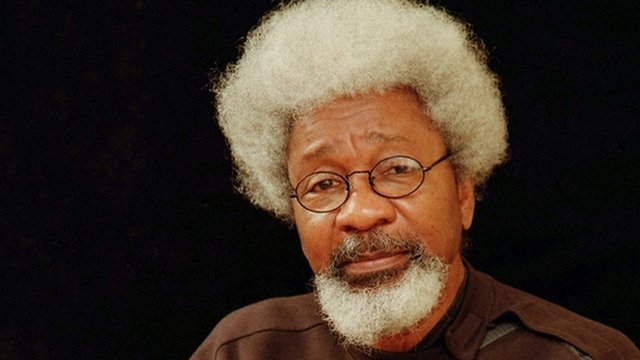
This week, my Writer’s Quote inspiration comes from Wole Soyinka:
Also known as observation or people watching, you’d be surprised how much you learn just watching and listening. I think that not to pay attention to the works of others will only rob us of an important part of the growing process. It’s one thing to be taught something in the organized sense of the word, to be instructed and shown. We know that this is important in the cultivation of our minds, acquiring and using information (information that’s useful that is, can’t give ear to everything, it’s just not wise). However, I think everyone needs an example. For every question, there is someone living the answer. Somewhere someone is doing it right. They are usually not out in the front, not the most outspoken and not always aware of the pivotal role they play in just being themselves. But they exist and when it comes to writing or blogging, or photography or art or music or whatever it is we are seeking a better understanding of how to implement into our lives at this moment, for every craft there is someone who can give you a tangible example of how to get it done. But you gotta pay attention.
About the Author:
Wole Soyinka is a Nigerian playwright, poet, author, and teacher, and received the Nobel Prize for Literature in 1986.
Wole Soyinka was born on July 13, 1934, in Nigeria and educated in England. In 1986, the playwright and political activist became the first African to receive the Nobel Prize for Literature. He dedicated his Nobel acceptance speech to Nelson Mandela. Soyinka has published hundreds of works, including drama, novels, essays and poetry. As a result, colleges all over the world seek him out as a visiting professor.










 The PBS Blog