Revolution

Revolution comes from the German word Umwalzung and means a complete change. It is a complete change or replacement of a system. The destruction of the old for the new. What the so-called Black man and woman have been doing is seeking to be included in a system that already exists. We have been fighting to be accepted into a current system even though said system has excluded us for nearly 400 years. This is not revolution. This is not a separate system. This is the same system. Until we are comfortable having our own we will never truly revolutionize. There is nothing wrong with being a separate people and building a nation and until we understand this without the fear of being labeled discriminatory, we will never truly revolutionize. All other people have done it but as soon as the Black man says he wants to run his own businesses, as soon as he says he wants to live among his own people, as soon as he says he wants to build Black schools that teach Black children about Black history now he’s acting funny. He’s a supremacist, a racist, a separatist, extremist, and every other “-ists” in the dictionary. He’s radical and he’s militant because he wants his own same as others have their own.

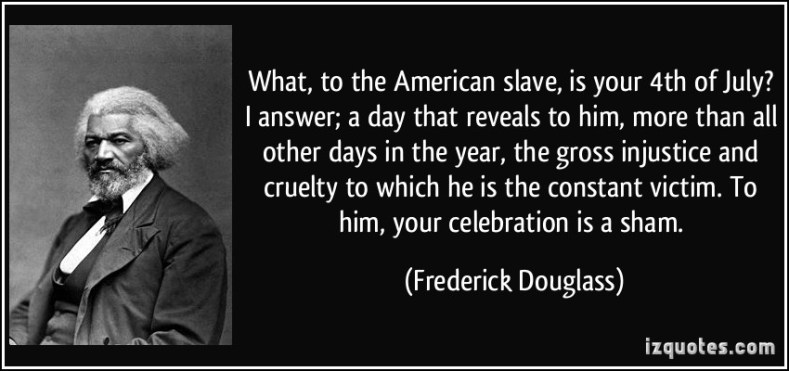
Only in America is so much emphasis placed on color and other countries to which she has infected follow her traditions. Only the dishonest will fail to admit that the social, political, and economic atmosphere of this country (U.S.) encourages racism. Doesn’t matter where a man is, if he is rich or poor, skinny or fat, smart or ignorant, black, white, Chinese, or Asian, whether he is a plain man or an artist, if he reads books or not, if he is intelligent or simple, whatever he is he must be able to think for himself. As long as the so-called Black man and woman has been in America he has not been encouraged to think for himself or to seek anything of his own without America’s permission. He has not been capable of fully revolutionizing. He has been emancipated but his freedom only meant a transfer of ownership. He has gone from the property of the plantation to the property of the state. Then he was amended into society. He’s an add-on. He was added to the Constitution since before then he was America’s slave and unworthy of sitting down at her table to eat. So these people she referred to as Black had to be included into the system and still he was a slave and what to the slave is the Fourth of July?

He is taught to fight for a country that has never fought for him. To honor heroes who were never heroes to him. Twelve U.S. presidents were slave owners and four of the first five presidents were products of a Virginia society in which slavery was a part of everyday life. So while Washington, Jefferson, Madison, and Monroe were all considered patriots who valued liberty, they were also all slave owners. Yet this people given the name Blacks are encouraged to regard her heroes as his own. This is not revolution. This is not a new system. This is begging to be part of a system that has long since rejected him. But before a people can revolutionize anything that people must first have a revolution of self. A shifting of perspective and complete change in thinking and if a man cannot change the way he thinks then he cannot change anything. Everything begins in the mind and so the revolution is in our thoughts. The revolution begins in the mind of the revolutionary first. If you cannot change yourself then you cannot change me.

“Emancipate yourselves from mental slavery. None but ourselves can free our minds.” – Marcus Garvey (he said it before Bob Marley’s Redemption Song)
Black History Fun Fact Friday – The Attica Massacre

black-history1


“ON SEPTEMBER 13, 1971, a four-day rebellion of over 1200 inmates at the Attica State Correctional Facility in bucolic upstate New York ended most horrifically after Governor Nelson Rockefeller ordered almost 600 state troopers to storm the prison. Even though the raid took only 10 minutes, when one could finally see through the haze of spent ammunition, it was immediately clear that the price of retaking this facility by force had been staggeringly high.” – Heather Thompson

Before we go on, let’s take it back…

Convict Leasing

sharecroppers_chopping_cotton_-_1941-h

With nearly half of all cotton investments in human bodies now gone, the end of chattel slavery no doubt left a sour taste in the mouths of slave-owners. Over four million African Americans (because who would know exactly how many?) were poured into a society that did not want them, cotton economies in shambles, cotton gins destroyed, and wealth that deteriorated before the ink could dry on the Emancipation Proclamation. A system so interwoven into the fabric of America could not just be taken away without serious consequences. Slave-owners could not sit back and watch; a reconstruction of slavery was necessary.

The Reconstruction Era, the process of rebuilding the south (which was really the time of restoring slavery to the south), introduced a new set of laws that would ensure that Blacks remained the property of landowners, sharecropping on the same plantations that held them as slaves. All of this despite General William T. Sherman’s plan to grant freedmen 40 acres on the islands and the coastal region of Georgia. But after the Civil War, blacks never did receive their “40 Acres and a mule” and were instead ordered to either sign contracts with the owners or be evicted, driven out by army troops. In the summer of 1865, all land had been ordered by the government to be returned to its original owners. Thus, millions of blacks remained poor. Still, this was not the only form of servitude to which they were subjected. In addition, something more law abiding would hold them in captivity. Ironically, within the same paragraph that abolished slavery, slavery was also reconstituted. According to the 13th Amendment:

“Neither slavery nor involuntary servitude, except as punishment for crime whereof the party shall have been duly convicted, shall exist within the United States, nor any place subject to their jurisdiction.”

According to this law, slavery could not exist in the United States except for punishment for a crime, permitting slavery in the case of imprisonment.

New laws targeted blacks, (Black Codes) criminalizing their lives. That is, almost everything was a crime. Farm owner’s incapable of walking by the railroad or selling the products of their farm after dark. Or, the infamous Pig Laws, where stealing a pig (or any animal) could result in five years’ imprisonment. Or Sundown Towns, all white neighborhoods where Blacks were not allowed after dark. The more Blacks broke these laws and were sentenced to prison, the more slaves the plantation owners, now masked under private parties and corporations, had back into their possession. They could work the prisoners from sun up to sun down again while providing them with food, clothing, and shelter. Also known as Convict Leasing—the leasing of bodies to coal and iron companies owned by former slave owners—slavery was back. In 1883, about 10 percent of Alabama’s total revenue was derived from convict leasing. In 1898, nearly 73 percent of total revenue came from this same source.

Attica State Prison

6a0120a69a468c970c01b7c8912fa9970b

With awareness growing out of the Civil Rights Movement of the 60s, Malcolm X, The Black Panther Party, etc., Black and Latino Prisoners of 1970 began organizing rebellions against their treatment within the prison system. As with any information passed through the “grape vine” of the black community, the rebellions spread from prison to prison until it came to a head the Thursday morning of September 9, 1971. When the door prisoners used to go to the yard was locked, a fight broke out between the prisoners and the guards. As the fight grew, more prisoners joined until they broke open a gate connecting to another part of the institution and, to make a long story short, prisoners were let loose within the institution.

The Brothers locked the prison down, kicking butt and taking names. I mean (clears throat), taking staff members as hostages and implementing their own system of order within the prison. Appointing leaders to keep order and to be sure the staff was properly cared for, they demanded from the outside world better treatment within the prison system. Better medical treatment and less slave labor. But their “freedom” would not last long. When a hostage who was hit in the head at the beginning of the fight died from his injuries, the prisoners were responsible under the felony-murder rule. The felony was the riot and the murder was the death of the guard.

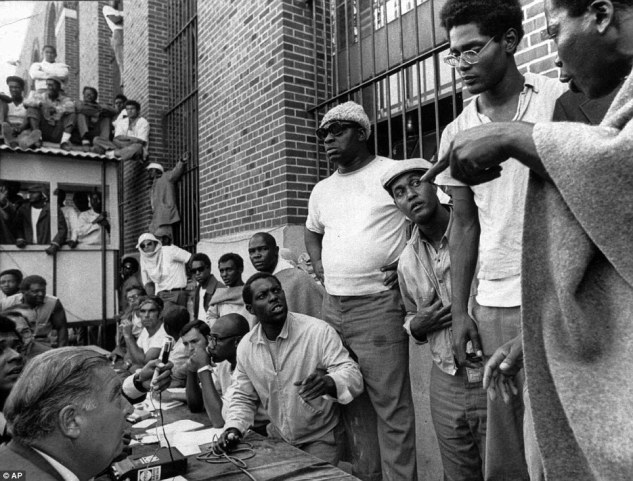
Inmates of Attica State Prison (right) negotiate with Commissioner Russell Oswald (lower left) inside the jail where prisoners took control

Shortly thereafter, a National Guard helicopter flew low over the yard and blew a cloud of military-grade CS gas into the crowd of men. As told to Attorney Jefferey Haas, under the name Big Black, one of the surviving prisoners of the time recalls:

“First came the tear gas. People looked for something to cover their face. When I first heard the shots, I thought they were blanks. Then the people around me in the yard starting dropping. I realized they were real bullets, and everyone ducked and ran for cover.” (September 16, 1971, Prisoner of The Attica Correctional Facility, New York, as told to Jeffrey Haas).

The gun shots Big Black is referring to are the marksmen who came in and started shooting, hitting 189 of the 1300 men in the yard and killing 31 people—29 prisoners and ten hostages. (There’s a conflict between the numbers. Some sources say 31 prisoners died and some 39. I use 31 because that is in accordance with the news articles of the time).

After the shooting, the beatings came:

attica_1971
Source: Getty Images. Prisoners marching naked.

“The guards stripped us naked after the shooting. They made us crawl naked in the mud through a gauntlet where they beat us.” – Big Black

Next, Big Black (Big, dark skinned and part of the security) was tortured as an example. They burned his body with cigarettes:

“They took me out of the line. They made me lie on a table naked on my back and put a football under my chin. They put their burning cigarettes out on me. Some dropped them from the catwalk above and was laughing.”

“Afterwards, a news photographer found and recorded a pair of inscriptions, in separate hands, written with a white marker on a dark steel wall that succinctly told the story of the Attica rebellion. The top one said, “Attica fell 9-9-71 – F*&k you pig!” Just underneath that was written, “Retaken 9-13-71. 31 Dead Niggers.”

– Dennis Cummingham, Prison Legal News

attica-30th
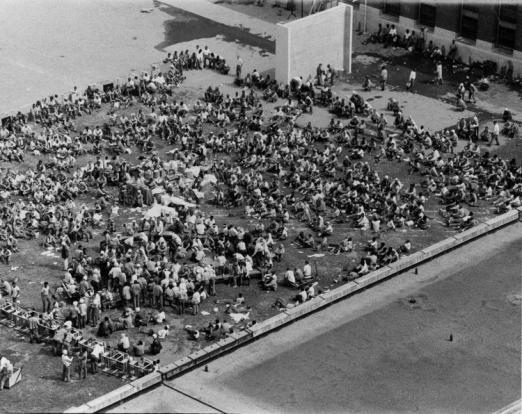
Riot: Prison guard hostages and inmates gather in the exercise yard of cell block D inside Attica State Prison in New York on September 9, 1971

While seeking freedom the men had forgotten one thing: slavery is abolished except as punishment for a crime. They were given slave-like treatment because as prisoners under the law, they were still slaves.

Today, the message is still relevant.

Black History Fun Fact Friday – Free Frank

black-history

This is a man who was free in more ways than one. Welcome back to Black History Fun Fact Friday. Meet, Free Frank.

The first African American to found his own town in the United States, Free Frank was born Frank McWorter on September 7, 1777 as a slave in South Carolina to a West African woman named Juda. Having been abducted and then enslaved it is commonly assumed that his father was the Scots-Irish master George McWhorter. In any event, Frank was leased by McWhorter to neighbors as a laborer. This experience (despite the situation) lead to him gaining entrepreneurial skills and businesses skills being around those he was leased to.

free-frank

He later married an African American woman from another plantation named Lucy.  Together they had four children. The extra money Frank was making gave him the opportunity not only to free himself but also his wife ($800) and oldest son. Earlier in life he’d founded a saltpeter plant which he sold later in exchange for the freedom of Frank Jr. who was a fugitive in Canada. Lucy and Frank also had three more freeborn children.

Free Frank did more than free individuals from slavery but he was also an entrepreneur. Frank and his family moved to Pike County, Illinois in 1830 and in 1836 founded what is now Philadelphia Illinois. Frank built the community on 80 acres of land, but it didn’t stop here. Limited by state statutes, McWorter petitioned the Illinois General Assembly using a legislative loophole, and by 1836 he and his sons owned 600 acres in Hadley Township without restriction. Frank leased plots to both white and black residents.

Although the railroad sliced through Pike County in 1869, there were some parts of the community that remained active until the 1920s and is considered one of the most famous antebellum towns.

The town size grew to approximately 160 people, 29 households, and several craftspeople and merchants by 1865. Frank witnessed that growth until his death in 1854 at the age of 77 years, while Lucy lived to 99 years of age, raising their family until her death in 1870.

Black History Fun Fact Friday – Sarah Rector

black-history

Welcome Back to Black History Fun Fact Friday!

I introduce to you Sarah Rector who was just eleven when she received international attention for being a millionaire.

In 1913, The Kansas City Star publicized the headline, “Millions to a Negro Girl.”

Sarah Rector was born on March 3, 1902, in Twine, Oklahoma, on Muscogee Creek, Native American land where her family had been enslaved.

The Dawes Act of 1887 was created by the United States to “bridge the gap” concerning their acquisition of Indian Land. Authorized to survey American Indian tribal land and divide it into allotments for individual Indians and their families, Native Americans were offered U.S. Citizenship in return.

This included land for the people they formerly had enslaved.

In 1907, The Dawes Allotment Act divided the land among the Creeks and their former slaves, and thus, Sarah and her family all received land.

“Long before the births of Sarah and her three siblings, the Creek Nation agreed with the federal government to emancipate their 16,000 slaves, giving them citizenship in their nation and entitling them to equal interest in soil and national funds. They became known as Freedmen.”

-Steve Gerkin, The Unlikely Baroness

One fact this story brings to light is the ownership of blacks as enslaved people by the Five Civilized Native American Tribes. The Cherokee, Choctaw, Chickasaw, Creek, and Seminole Nations all had Blacks as slaves. In fact, Sarah and her family had a rich history as enslaved by the Creeks.

“Sarah’s father Joe Rector was the son of John Rector, a Creek Freedman. John Rector’s father Benjamin McQueen, was a slave of Reilly Grayson a Creek Indian.  John Rector’s mother Mollie McQueen was a slave of Creek leader, Opothole Yahola.  Their history is a rich one. The son Joe was enrolled with them on the same card.”

-Angela Y. Walton-Raji  Educator, Genealogist, Author & Researcher

Per the Act, the head of a family would receive a grant of 160 acres, and this is what Sarah and her family received. “The Creek Nation was sliced up into 160-acre squares, “more or less,” and doled out to the Natives and former slaves; each received 120 acres for agriculture and 40 acres for homesteading.” (Gerkin)

This is when the story gets interesting concerning Sarah’s portion.

To help with taxes on the land, Sarah’s father leased her portion to the Devonian Oil Company of Pittsburgh, and in 1913, everything changed when it struck gold. The oil was booming, bringing in 2500 barrels a day, bringing Sarah $300 a day. Multiple new wells were productive, and Rector’s portion became part of the Cushing-Drumright Field in Oklahoma, “The most prolific early oil field in Oklahoma discovered in Creek County about twelve miles east of Cushing and one mile north of present Drumright.” (Oklahoma Historical Society)

As word of Sarah and her wealth circulated, many people sought to ask for her hand in marriage and acquire loans, and perhaps the most bizarre is her change in identity. Sarah went from a young black girl to a white one.

sarahheadline sarah2

Being that this was the early 1900s, after all, many whites could not accept that someone like Sarah could have so much money. Thus, many began to seek to change her from black to white. Even more, Sarah’s guardianship, like our story last week, also changed, switching from her parents to a white man named T.J. Porter.

An article published in 1914 by The Chicago Defender claimed that Sarah was being ill-cared for by her “ignorant” parents, that she was uneducated, dressed in rags, and lived in unsanitary conditions.

On the contrary, Sarah and her siblings attended an all-black school in an all-black town (Taft, a town in Muskogee County, Oklahoma) in a five-room house. Rector would also go on to attend Children’s House, a boarding school for teens at Tuskegee Institute in Alabama, now Tuskegee University. This could have something to do with her acquaintance with men like Booker T. Washington, and W.E.B. Dubois.

diaspora_02-14-16c

Sarah left Tuskegee when she turned eighteen and moved to Kansas City, Missouri, with her family. By now, she was a full-fledged millionaire owning a Busy Bee Café, boarding house, and bakery, stocks, and bonds. As Sarah’s money increased, so did her male suitors. At twenty, she married Kenneth Campbell, and together, they had three sons. The couple divorced, and she married again, this time to  William Crawford.

Sarah Rector died on July 22, 1967, at 65. Though there is much speculation on the remainder of her life, I believe that because she is not as known as some, Sarah shielded herself and her family from the spotlight as much as possible. After the false claims and accusations concerning her identity, her life seemed to fade away in the background. She went on to college and afterward moved to a different state where she and the family lived in what is known as The Rector Mansion today.


Sources: Special to The Chicago Defender

The Chicago; Nov 15, 1913; ProQuest Historical Newspapers The Chicago Defender (1910 – 1975)

Remembering Sarah Rector, Creek Freedwoman

http://african-nativeamerican.blogspot.com/2010/04/remembering-sarah-rector-creek.htmlThe Unlikely Baroness by Steve Gerkin http://thislandpress.com/2015/03/24/the-unlikely-baroness/

CUSHING-DRUMRIGHT FIELD.

http://www.okhistory.org/index.php?full

Find more Articles at Black History Fun Fact Friday

Your Playing Small Does Not Serve The World

55a47cfb078ce8c7d4b1fd0d17784804

“Our deepest fear is not that we are inadequate. Our deepest fear is that we are powerful beyond measure. It is our light, not our darkness that most frighten us. We ask ourselves, ‘Who am I to be brilliant, gorgeous, talented, fabulous?’ Actually, who are you not to be? Your playing small does not serve the world. There is nothing enlightened about shrinking so that other people won’t feel insecure around you. We are all meant to shine, as children do. And as we let our own light shine, we unconsciously give other people permission to do the same. As we are liberated from our own fear, our presence automatically liberates others.”
Marianne Williamson