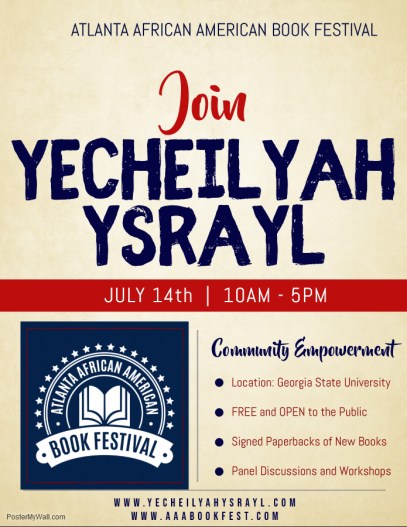
The inaugural Atlanta African American Book Festival is FREE and OPEN to the PUBLIC and will take place on Saturday, July 14, 2018, at Georgia State University. Over 70 authors will convene in Atlanta to present their work to the Atlanta community. Author categories include fiction, non-fiction, romance, YA fiction, middle-grade fiction, and children’s picture books. Journalists, editors, publishers, literary critics, and scholars from various fields will be present. Panel discussions and workshops will engage festival attendees in topics concerning literary industry tips, civil disobedience, activism, emotional and spiritual well-being, restorative justice, and health and wealth. Children’s activities include a story corner and festival dance floor.
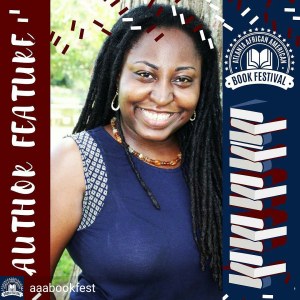
I will be one of many authors in attendance and I would be honored to have your support at my table. Since I did not have a launch signing or gathering for Revolution, I’d like to use this as an opportunity for a post-launch celebration. You will have the chance to purchase signed paperback copies of my two most recent books (and not just mine but other authors too), take pictures, take part in workshops, and meet industry professionals. Again, attendance at the festival is FREE so you’ll just need to make it here (food is not allowed inside the venue but there will be food trucks on the outside). This is not just an entertainment event but we also seek to implement community programming that promotes black literary arts and family sustainability within our community. To check out my AAA blog feature, click here.
Today, we are taking a look at a woman whose husband we know well. Frederick Douglass is well-known but his first wife is not. For the sake of time, I am combining sources from various articles since I have not had the chance to put something together for you this week. Enjoy.
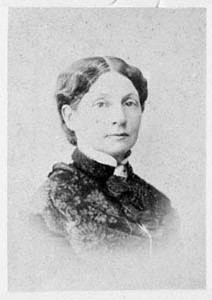
Anna Murray Douglass
Frederick and Anna met in 1838, when he still went by the surname Bailey and she by Murray. The daughter of enslaved parents in rural Maryland around 1813, Anna was the first of her siblings to be born free after her parents were manumitted (set free). She lived with her parents until the age of 17, at which point she headed for Baltimore and found work as a domestic helper. Over the years she managed to earn and save money; the vibrant community of more than 17,000 free blacks in the Maryland city organized black churches and schools despite repressive laws restricting their freedoms. When she met Frederick—historians disagree on the when and where their acquaintance occurred, but it may have been in attending the same church—she was financially prepared to start a life with him. But first, he needed freedom.
By borrowing a freedman’s protection certificate from a friend and wearing the disguise of a sailor sewn by Anna, Frederick made his way to New York City by train (possibly spending Anna’s money to buy the ticket, says historian Leigh Fought). Once there, he sent for Anna and they were married in the home of abolitionist David Ruggles. According to Rosetta, Anna brought nearly everything the couple needed to begin their life together: a feather bed with pillows and linens; dishes with cutlery; and a full trunk of clothing for herself.
In 1837, Frederick met a free Black woman, Anna Murray, who was born in 1813. Her parents had been freed before she was born, and Anna worked as a laundress and a housekeeper. Anna used her savings and sold a bed to pay for train tickets for Frederick, which he used to escape to freedom. She also sewed a sailor outfit for him, which he wore as a disguise. Fredrick had tried to escape before, but it was not until Anna helped him that he escaped successfully.
Once Frederick got to New York, Anna joined him and they married and moved to New Bedford, Massachusetts. They had five children together. When they moved to Rochester, New York, she turned their home into an Underground Railroad stop, providing shelter for runaway slaves en route to Canada.
Frederick Douglass
As Frederick became more involved in activism, their relationship became more strained. Anna could barely read and write, and felt out of place among Frederick’s friends. His friends, most of whom were highly educated and intellectual, openly looked down on Anna (to his credit, he vigorously defended her against any who suggested she was not a worthy wife). Anna enjoyed being part of the Black community in New Bedford, but in 1847 Frederick moved the family, and as his circle of friends widened, hers diminished. Anna was also tormented by rumors that Frederick had affairs during his many travels. On two occasions, Frederick had women he was rumored to be sleeping with move into Anna’s house, causing controversy between the couple and within Frederick’s political community.
While Frederick began his climb as an abolitionist orator, Anna cared for their children, born between 1839 and 1849: Rosetta, Lewis, Frederick, Charles, and Annie. In 1847, they moved to Rochester, New York, where Frederick began publishing his newspaper, the North Star. The gulf between Anna and Frederick widened over the years; she could barely read and write and was rarely a part of his activist life and growing circle of prominent white and black abolitionist colleagues. After the death of their youngest child, Annie, in 1860, Anna’s health steadily deteriorated. She died on August 4, 1882 at their home, Cedar Hill, across from Washington, D.C. She was carried back to Rochester, New York, where she was buried in Mount Hope Cemetery.
One year after Anna’s death, Frederick remarried. His second wife was Helen Pitts. She was born in 1838. Her parents were abolitionists, and she was an ardent abolitionist and suffragette. In 1880, her family moved next door to the Douglass family, and Helen assisted Frederick with his work. She also worked as a clerk and co-edited a women’s rights magazine.
Their marriage was quite a scandal. Helen was white and twenty years younger than Frederick. His children felt the marriage disrespected their mother. Frederick and Helen’s friends were shocked because they felt the marriage was too sudden and because they were worried about the race and age differences. Helen’s family cut off contact with her altogether, and their local society was appalled that a black man and white woman were married at all.
Helen Pitts’ response: “Love came to me, and I was not afraid to marry the man I loved because of his color.”
Frederick’s response: “This proves I am impartial. My first wife was the color of my mother and the second, the color of my father.”
EC thoughts: I feel kind of sad for Anna and I can’t help but to wonder why Frederick, intelligent as he was, did not teach her to read and write. Did she not want to learn? Or did he not want to teach her? We can only speculate.
Very well said. Fav. Post Quote: Beta Reading is not editing, and the reader should not make comments that are editorial in nature. Those kinds of nit-picky comments are not helpful at this early stage because the larger issues must be addressed before the fine-tuning can begin, and if you are beta reading for someone, the larger issues are what the author has asked you to look at. *Comments disabled here. Please comment and share the original post*
Once again, the question of the difference between beta reading and editing has arisen in one the many forums I frequent on Facebook. So, I feel the need to revisit a post from 2015, Beta Reading VS. Editing. If you’ve already seen this post, nothing has changed in the world of editing and beta reading since this first appeared. But thank you for stopping by!
Indies rely heavily on what we refer to as beta readers to help shape their work and make it ready for editing. But in many online forums, authors use the term used interchangeably with editing, and the two are completely different.
And unfortunately, some indie published works are clear examples of work by authors who don’t realize the importance of working with an editor, although it is apparent that they have had assistance from beta-readers.
What is quite disappointing to me, is the many traditionally published works that seem to fall…
My new book releases on May 30, 2018 and is $12.00 to pre-order the paperback (this includes shipping within the U.S.) and I am not ashamed of that. I am worth it. Surely, those who support me can spend $12 in support of an Independent Author who does it all herself. I am not signed with a traditional or small press publisher, Literary Korner Publishing is my business (spelled with a K on purpose) and I run it myself. This book will be available for pre-order in ebook soon at $2.99 and will go up once the book is out. This thought led me to an Indie Author Tip I thought I’d share.
There’s nothing wrong with charging what you’re worth. There are lots of books on Amazon that are free. According to Google, there are between 40 – 60,000 free books swimming in the Amazon sea. Many of them are also poorly edited (if at all) and mediocre in production. If you’ve been publishing awhile, consider raising your book prices. Usually, when people pay for something, they invest their time in it because they don’t want to waste their money. Even if they dislike the book and feel like they did waste money, they still read it. Paying for anything adds value and when people buy something of value they feel committed to not wasting it. I don’t know about you, but I don’t want to sit on people’s Kindles. I write books so that people can read them. Not so that I can say I’m an author and feel awesome about myself. No. I write to be read.
People are more invested in things they pay for. Higher pricing means higher quality
Pricing is positioning
Pricing is not length but value
If you’re not a new author (meaning you have multiple titles out) consider raising your ebook prices above 99cents and I would go as far as to say to do this for preorders as well. The reason is like I already said, there are tons of books available for 99cents already and they are poorly produced. Even if you sweat blood writing your book, paid good money to edit your book and paid good money for a decent cover (not to mention if you paid for formatting), to some readers it won’t matter. They will see your price and ignore it on the way to the “good” stuff.
Some people are also brand buyers. This means that they only buy stuff that are named-brands. This could be a book, a shoe or an article of clothing. But many of us are not famous writers and we are not well known (yet). For this, we are inferior by definition. We are not actually inferior of course, but brand-buyers don’t care how cheap the book is if they never heard of the author or are not familiar with the writing. They are not going to buy the book no matter how cheap it is.
I am no one special and you don’t have to listen to me. I am sure there are better articles written by better writers. However, I do pay attention and my suggestion would be that if you are a new author (never published a book before), set your price to 99cents for pre-order for the ebook and then raise the price (not too high though, remember no one knows you yet) when the book releases. If you are not a new author (multiple titles out) and you know that your book is a good read (you got good feedback on it, you got it edited and all that) I would say to start setting your ebook pre-order prices higher than the 99cent price point.
I would recommend 99cents or free only for a limited time. Maybe your book is free for one day or 99cents for one week but I would recommend putting a limit on it. I think that Indie Publishing has progressed tremendously and that better quality books are expected. You would not see a famous traditionally published author (who actually writes good books) with an ebook for pre-order at 99cents and as a reader, I notice that books above 99cents are the books that are actually worth the read.
Its late but Friday is not over people! Well, not for some of us anyway so we’re going to squeeze this article on in.
Today, we have a special fun fact for you. My maiden name is Hereford and I have a mother, brother, and sisters who still carry this last name. In fact, I’ve met very few people with this name I was not related to. Unlike Johnson, Brown or Jackson (no shade to those with these last names), Hereford is not as common. So when I came across this man online, I was noticeably interested. My mother says that my grandfather, her father, is from Alabama and that Sonnie looks like her dad. This has prompted me to do more research on the man and to plan a visit to Alabama to discover more. It’s possible we had a Civil Rights Activist in the family and didn’t know it. In 1961, Hereford was one of the plaintiffs suing the Huntsville school system to end segregation, and in 1963, his son, Sonnie Hereford IV, was one of the first four black children to enroll in a previously all-white public school in Alabama. But, let’s start from the beginning.
Dr. Sonnie Wellington Hereford III was born on January 7, 1931, in Huntsville, Alabama. The family had no running water or electricity and Sonnie had to walk seven miles to school. The school, next to a garbage dump, didn’t have a library or cafeteria, much like most black schools at the time. Hereford was a farmer but developed a love for education. Even though his school had no library, the teachers were invested in him as they were in all their students. Though lacking in resources, black schooling at the time was exceptional, involving a strong community spirit and discipline. Teachers took on more than just a role as a teacher but they were also mothers, fathers, and mentors. For this, Sonnie received a good education and decided he wanted to become a doctor.
Sonnie graduated first in his class and applied to the University of Alabama for their pre-med program. However, Sonnie’s application was denied because of his color so he enrolled at Alabama A&M University instead. Hereford graduated from A&M in 2 years and went on to receive his medical degree from Meharry Medical College. He began his career at Huntsville Hospital in Huntsville Alabama and went on to play important roles in the struggle for Civil Rights. Not only was he a doctor but he also helped to aid men and women attacked during the Selma to Montgomery march, welcomed Martin Luther King Jr., to the city in 1962 and helped to integrate the city at various establishments. In fact, school desegregation is what Sonnie became most known for.
Sonnie IV was among four children chosen to desegregate schooling in Alabama and on September 3, 1963, Hereford took his six-year-old son to school but they could not get in. Instead, a mob waited for them and none of the other children were admitted to the other schools either. Sonnie didn’t give up, he returned but the school was locked down and guarded every day with armed troops. Eventually, Hereford contacted the federal judge and over time an order was issued to desegregate the schools in Huntsville. On Monday, September 9, 1963, Hereford successfully enrolled his son at Fifth Avenue School making Sonnie Hereford IV the first African-American student admitted to a previously all-white public school in Alabama. That following week, Sunday, September 15, the church bombing occurred in Birmingham killing four little girls at the 16th Street Baptist Church.
Sonnie died at 85 years old, two weeks before the ribbon cutting ceremony at the Sonnie Hereford Elementary School in Huntsville Alabama, named for him by the Huntsville board of education. The school ranges from Pre-K to sixth grade.
Learn more about Sonnie at the informative video below!
April is National Poetry Month and I am gearing up to host my 2nd Annual Poetry Contest this summer! This year we have stepped it up BIG time with some AMAZING prizes! Be sure you’re following this blog, my IG, and my Facebook business page to stay updated. Details on how to enter, rules and guidelines will be published to this blog next month (May). Next week, I’ll be introducing our sponsors and judges.
With the success of the Black Panther movie based on the super-hero comic, I am re-posting this Black History Fun Fact from two years ago based on real-life super-heroes for those of you new to this blog (or who missed it the first time around). To understand our present, we must understand our past so that in the future we do not make the same mistakes. The Black Panther Organization actually did more community-outreach than they did protest. The protest is what we saw the most on television however it is not the bulk of their work. They were not a hate group, they were not supremacists and they were not a “black only” group. The Panthers promoted ALL POWER to ALL PEOPLE with an organization comprised of many nationalities of people.
Has history been accurate in its portrayal of the group affectionately known as The Panthers?
In Whitewashing the Black Panthers, Michael Moynihan argues that PBS’s documentary The Black Panthers: Vanguard for The Revolution, tries to excuse a “murderous and totalitarian cult” saying, “Almost anything that reflects poorly on the Panthers is ignored or dismissed and no critics of the party are included. The story is told entirely through the testimony of former Panthers and sympathetic historians.”
(Umm, so is every European, Western focused story ever made, but we won’t go there).
Often portrayed as a militant, black supremacists hate group, it’s amazing to me that this group of people wrote a ten-point program outlining the details of their belief system and there are still misconceptions about who they were and what they stood for.
For the record, I did not set out to write about The Panthers based on Michael’s article (I came across it much later), or because of the documentary. After doing some reading I decided today’s Black History Fun Fact Friday will focus on three basic principles that everyone should by now, understand about The Panthers. But first, we must cover some additional facts.
The Freedom Movement has always been portrayed as a southern only movement on television and even in some books. Mississippi, Alabama, and Georgia are states where trees no doubt bore the remnants of strange fruit. We could see it on the news, the newspapers, and from the mouths of relatives who grew up there. If we didn’t see it, the whole world did when Chicago native Emmett Till went down south and never came back and the whole world saw the ugly face of America. At that time, I am sure, we all had the same consensus on our hearts (among other things): “If only he would have stayed home, this would not have happened.”
This is because seldom did we then, and even today, hear about the racism and discrimination that took place in Northern cities like New York, Chicago, and California. Many blacks, no doubt, escaped the southern states for better opportunities in the North. Still, even this part of history is only a half-truth as not all blacks left because they did not have.
There were many African American’s who, after slavery, suffered tremendously economically but not all of them. Not every black family had to sharecrop or endure poverty. On the contrary, many families started their own businesses, educated their own people, and founded their own communities. From the Mound Bayou in Mississippi, Blackdom of New Mexico, or the famed Black Wall Street in Tulsa it is clear, not all blacks were financially incapacitated. For this, it is only a half-truth that blacks escaped the south for a better financial and economic opportunity in the North and it is only a half-truth that they all left to escape Jim Crow. In truth, many of us sold what we did have to flee North because we were told (both by whites and black elites) that it was better. Many blacks were told that the North was the land of “Milk and Honey” so we sold our land, packed up our families, and left the Jim Crow South only to run into the police brutality of the North.
Martin Luther King, Jr., is hit in the head with a brick Marching in an all white Chicago neighborhood
It was Martin Luther King Jr., who said his trip to Chicago’s segregated Cicero was worse than Alabama and Mississippi. “I have never seen, even in Mississippi and Alabama, mobs as hateful as I’ve seen here in Chicago,” King told reporters. That statement is saying a lot considering what we know about the brutality of these states and had I not been born and raised in the city (Chicago), I’d doubt King’s words were true. But as I was born in Chicago and spent the first nine years of my life in the concentrated poverty-stricken projects of The Robert Taylor Homes on Federal Street, the most segregated and poorest urban city in the United States at the time, I can tell you that what King said was no exaggeration.
The truth is that while many segregationist laws were abolished in the South, poverty increased in the North. Black unemployment was higher in 1966 than in 1954, 32% of Black people were living below the poverty line, 71% of the poor living in metropolitan areas were Black, and by 1968, two-thirds of the Black population lived in ghettos, or impoverished communities, also known as slums. And so, it was for this hushed truth concerning the brutality of northern cities that two young men from Oakland California founded what would one day become the most hated black revolutionary organization of its time.
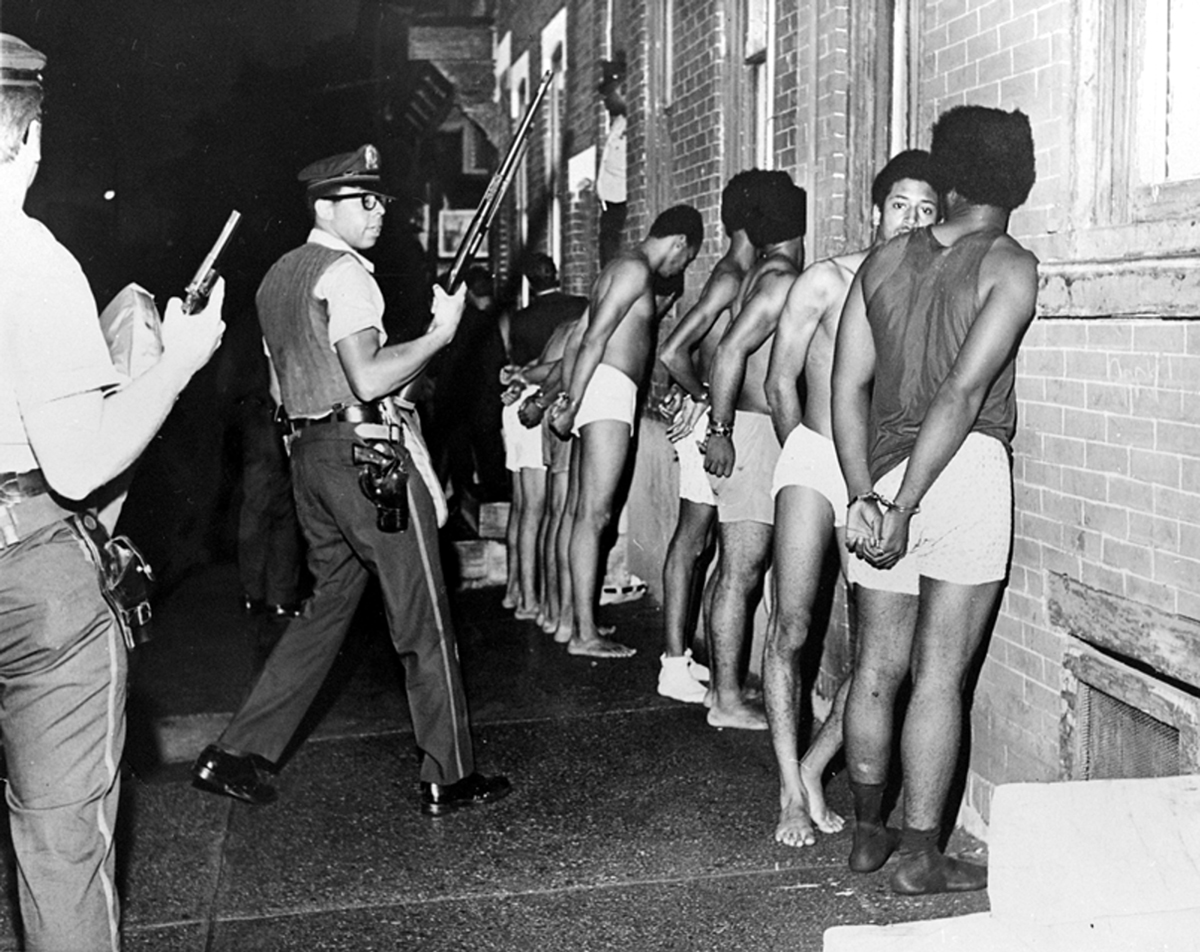
Founded in 1966 by Huey Newton and Bobby Seale in Oakland California, The Panthers took notice of the police brutality taking place in their own lives and the lives of members of the black community. They saw black men, and women, being beaten (some of them to their deaths) and nothing being done about it. They saw children who were malnourished because they didn’t have food at home and families denied access to proper medical care and education. Having met at The Meritt Junior College and is active in political movements there, Seale and Newton came together to form the Panthers. Following the passion of men like Malcolm X, and Stokely Carmichael, who were against the passive resistance movements of men like King, Newton, and Seale set out to be examples of what they saw was needed.
This leads me to three basic truths concerning why The Black Panthers were started and while I am not a black panther or black nationalist enthusiast (nor do I agree with their beliefs), I thought this would be a great way to re-introduce to you what this organization was initially built on and the things that they did that rarely made, and rarely make, the news:
Community Protection
One of the first reasons for the organizing of this group was to assist in the protection of members of the black community. Specifically, the Panthers wanted to protect blacks from police brutality, whether it was helping the elderly across the street, being human traffic signals, or standing between police and civilians to ensure the laws of California, of the time, were being adhered to. Being students of history and discipline, The Panthers were aware of the laws governing where they lived and they made sure both civilians and the police understood those laws and acted accordingly. Bobby Seale recounts, in Seize The Time: The Story of the Black Panther Party:
“He (Huey) defended himself in court and had beaten a petty theft case, and he was running it down how he got Olsen. Olsen was the dean of Merritt College. Dean Olsen had got up on the stand and testified to the fact that he had called the police in to have Huey P. Newton arrested, and had the police bring Huey to his office because some paddy boy over in the store had accused Huey of stealing a book. Huey explained to me that Olsen had asked him if those were his books. Huey said:
“Yes, this is my property.”
Olsen: “Well, I’ll just keep these books.”
Huey: “No, you won’t keep those books. That’s my property and I’ll keep them myself. You called me in the office for something. I don’t know what you want me for, but I’ll keep my property.” And Huey snatched the books back out of his hand and said, “If you want to arrest me, you’ll have to arrest me, but I’m not going to stand here talking.” And he walked right on out of the office. So, the same thing came up on the stand, and Huey asked Olsen on the stand, “Dean Olsen, why didn’t you have me placed under arrest if you thought I had stolen the books?”
Olsen: “Well, at that time, I just didn’t know my rights as to whether or not I had the right to arrest you.”
Huey: “Mr. Olsen, you’re a dean at a college; have a Ph.D. in education. Here I am a student in the college, learning my rights, and you’ve got a Ph.D., and you tell me you didn’t know your rights?”
(Caution. I post this excerpt as an example that The Panthers were aware of the laws of their state, not for anyone to mimic. With the number of black men gunned down for nothing, I do not advocate for anyone to try this at home. This was in 1966, this is 2016. I would not want anyone to be hurt for trying to mimic the actions of Huey as stated above. It’s important to obey the governing authorities, diffusing the situation if it is at all in your power to do so).
Free Breakfast Program and Medical Care
In 1966, students were not given free lunch as they are given today. Part of that revolution was due to the free breakfast program set in place by The Panthers where they fed children who would otherwise not have anything to eat. The Panthers had a lot to do with why the Public schools offer free lunches to students today. In addition, they implemented their own schools and system of medical care. The Panthers were, in short, of service to their community for no one knows the trouble we see and no one knows our sorrows. Preaching can only go so far, for if a man is hungry physically he won’t hear you spiritually. There must be physical action to accompany the spiritual and that is what The Panthers instilled in their communities: Physical and practical action.
All Power to All People
I do not want this article to be too long as I believe I’ve said enough, but I don’t want to leave without reiterating that despite all the black, The Panthers were not a black-only organization. Having recruited members of all nations they recounted repeatedly that they stood for restoring “All power, to all people”. In fact, they were separate from the black nationalist groups often associated with them and conflicted often with them. In his own words, Bobby Seale states:
“Cultural nationalists and Black Panthers are in conflict in many areas. Basically, cultural nationalism sees the white man as the oppressor and makes no distinction between racist whites and non-racist whites, as the Panthers do…Although the Black Panther Party believes in Black nationalism and Black culture, it does not believe that either will lead to Black liberation or the overthrow of the capitalist system and are therefore ineffective.”
– Bobby Seale
The truth is indeed stranger than fiction and for that most conscious grassroots organizations are deemed cults and militant to prevent, what Cointel pro deems, “the rise of a black messiah.” The Black Panthers were seeking to empower black people and that in itself is dangerous, for in the words of the poet Brook Yung, “They used to put to death people like me.”









 The PBS Blog