

“Books are meat and medicine
and flame and flight and flower
steel, stitch, cloud and clout,
and drumbeats on the air.”
― Gwendolyn Brooks
“Books are meat and medicine
and flame and flight and flower
steel, stitch, cloud and clout,
and drumbeats on the air.”
― Gwendolyn Brooks
I know I am not the only one to have been confused between these words. I love writing, but grammar has not always gotten me very excited. It’s like running for fun (writing) but not wanting to exercise (Grammar). While I’ve always excelled in English, this is one confusing language! It’s the only one where a maybe, possibly, perhaps, and I’ll try exists. Everyone else just says yes or no! In any event, we must know these things as writers because our English teachers said so. Sooo, below is an excellent breakdown I found online on the difference between Lay, Lie, Laid, and Lain by Brian A. Klems:
Lay
Lay and lie are both present-tense verbs, but they don’t mean quite the same thing. Lay means to put or set something down, so if the subject is acting on an object, it’s “lay.” For example, I lay down the book. You, the subject, set down the book, the object.
Lie
Lie, on the other hand, is defined as, “to be, to stay or to assume rest in a horizontal position,” so the subject is the one doing the lying—I lie down to sleep or When I pick up a copy of my favorite magazine, Writer’s Digest, I lie down to take in all its great information—and not acting on an object. In both these cases, you, the subject, are setting yourself down. Are you with me so far?
I Lie Down vs. Now I Lay Me Down (to Sleep)
To clarify things further, I’ll answer this question that you’re probably wondering: How can you be lying down in your examples while the classic nighttime prayer for kids clearly begins “Now I lay me down to sleep”? You must be out of your mind! It’s true, I’m totally out of my mind, but both the examples I used and the kids’ prayer are correct—and here’s why.
In I lie down to sleep, there is no object to the sentence, just subject (I). In Now I lay me down to sleep, there is a subject (I) and an object (me). Even though the subject and object are one and the same, the object is still present in the sentence, so you must use lay.
Laid vs. Lay vs. Lain
In the past tense, “lay” becomes “laid” (Last week I laid down the law and told her it was inappropriate for her to pick her nose) and “lie” becomes “lay” (Yesterday she lay down for a nap that afternoon and picked her nose anyway). Yes, “lay” is also the past tense of “lie.” And the confusion doesn’t end there.
To throw you for another loop, “laid” is also the past participle form of “lay.” So, when helping verbs are involved, “lay” becomes “laid” and “lie” becomes “lain.” Grandma had laid the chicken in the oven earlier this morning. The chicken had lain there all day until it was cooked all the way through and ready for us to eat.
Remember: Lay and laid both mean to set something down, while lie, lay and lain all mean the subject is setting itself down.
And now, I lay this question to rest. (Enjoy this totally awesome chart below to help you keep track of when to use lay, lie, laid, lain and more.
Infinitive Definition Present Past Past Participle Present Participle
to lay to put or place lay(s) laid laid laying
something down
to lie to rest or recline lie(s) lay lain lying
Nice. This the kind of writing that makes me want to write a poem, yesss. Excellent. Love the Imagery.
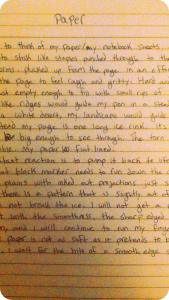
I like to think of my paper, my notebook sheets, as having texture. I want the lines to stick like staples punched through to the other side. Their long, skinny forms, plucked up from the page in an effort to rise above. I want the page to feel rough and gritty. Hard and torn through in spaces just empty enough to fill with small rips of imperfection. Lines like ridges would guide my pen in a steady cadence. Trotting through a white desert, my landscape would guide me in the right direction.
Instead my page is one long ice rink. Its smoothness leaves no gaps big enough to see through. The torn spots and crinkled edges are invisible. My paper has flat lined.
My instant reaction is to pump it back to life. Electricity in the shape of a fat black marker needs to run down the center. Cutting up…
View original post 54 more words
Be good to yourself.
It’s easier said than done, but extremely important to remember. Humility does not ask that we think less of ourselves, just that we think of ourselves less. Many of us spend our days constantly looking out for others and it is a great work. We encourage, inspire, share, and overall put others above ourselves. But we have to remember to give this same kind of love to our own selves too. People who are good to themselves are strong enough to be good to others. On the other hand, there’s a saying that says to beware when a naked person offers you a shirt. What kindness can I offer you if I don’t first have the same kindness for myself? We have to learn to humbly accept compliments, rest when we need to, and treat ourselves every now and again. It’s not asking too much to implement some kind of exercise routine for your physical body, reading for your mind and prayer and reflection for your spirit. Our worlds can be so chaotic at times that we may even need to pull away for a while to tend to ourselves. This is not just a suggestion, but we need this. If you can’t function you can’t perform. We need to take care of ourselves so that we can continue to be of service to others. So take some time today and be wonderful to yourself this Wednesday.
Martial Law.
I have one request to ask of you: Stop Listening to Alex Jones people.
The man doesn’t know what he’s talking about, he’s just trying to sell books and documentaries and whatever else he’s selling. Be careful in your research because Alex Jones just does not have understanding of what’s going on in the world. He’s getting paid off conspiracy theories (not fact, theory) and people who are looking for the truth but unfortunately stumble instead upon info wars. Now, since we’re on this subject let me say this: What we need to understand about Martial Law is that it is real, BUT it is not the main event. Martial Law is implemented AFTER the catastrophe or whatever has occurred. It is part of the Aftermath of chaos. Watch any movie and they show you how this thing is done. Only after a major disaster do we start seeing the tanks roll down the streets and the soldiers stand at street corners.
Martial Law is real but that’s not the meaning behind every single thing that happens in the world. Don’t cough the wrong way or Alex Jones gonna say we under Martial Law.
For this week’s installment of Writer’s Quote Wednesday, I take my inspiration from Jean Jacques Rousseau:
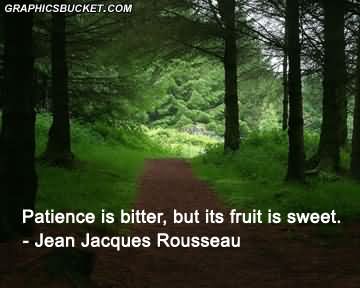
There’s an ancient proverb that says that patience can cook a stone. What this means is that the impossible is possible with patience. You cannot literally melt a stone down into a cooking pot unless you intend on waiting for a very very VERY long time. Waiting, it is the bitter taste of patience. Not only is it sometimes stressful to have to wait, but to remain diligent while you wait is often our greatest challenge. Writing and producing takes a lot of patience but people who possess persistence are capable of achieving great things because they took their time preparing for it. Sometimes we get an idea in our head that is not meant to be acted upon right now. Sometimes these ideas are just there until it is time for them to bloom into that sweet reward that comes from hard work. Creativity then is also wrapped up in patience because waiting for the right time often nourishes our ideas; helps to organize them into realistic goals.

That’s it for this week’s episode of Writer’s Quote Wednesday. Follow the links to see how you can read other amazing quotes from amazing bloggers.

Twenty years ago, a book followed a routine process: You poured your heart and soul into a manuscript, and when you finished it, you started calling agents and editors who most likely told you to send them a query letter.
The next step is the book proposal and a few sample chapters. Then the waiting game started, usually ending with disappointment.
On the other hand, the option to Self-Publish was there, but it had a certain stigma that, thankfully, has waned in this digital era. That stigma can be identified by statements such as, “Your book isn’t really published because you couldn’t get it accepted by a ‘real publisher.'”
However, being a Self-Publisher only means you are in charge of the direction of your book. The publisher (in this case, you) is the one who puts up the money. If you invest in your own printing, you are a Self-Publisher. If you begin to take in manuscripts, you are a small publisher. If you grow, you become a large publisher. Still, many Self-Publishers still wear this “badge of shame” for choosing not to go the traditional route, as if they were the scarlet woman or something.
This list can help clarify and simplify things for you.
• Ownership
Self-Publishing can be the road to your independence. Do you dream of being your own boss? Do you desire more personal freedom? You can turn that dream into a reality. You own all rights to your book as a self-publisher, whereas a traditional publisher would likely own the rights. If they lose interest in your book, you cannot print additional copies unless you purchase those rights. Traditional publishers often require you to purchase your book from them to do any promotion you choose to do for your book. As your own publisher, you print as many books as you need. Here is a dynamic, proven way to shape your own destiny.
• Timing
Traditional publishers work on a long production cycle. They often plan a year to a year and a half—or even longer—to get a book out. As a Self-Publisher, you can do it in a fraction of that time. It’s your material, your career move – you can take control of when you want to publish.
• Increased Income
Self-Publishing offers the potential for huge profits. When you use creativity, persistence, and sound business sense, money is there to be made. Most publishers require their authors to do their own promotion, but if you have to do your own promotion, why not Self-Publish it anyway and make more money? Even if you don’t make much, Self-Publishing allows you to get back what you put in. If you set a plan and work hard at it, you’ll be “making it rain” in no time. Or, you can work hard for some big-time publisher to tell you that you’re just not good enough.
• Control
Self-Publishing gives you the final say on the direction of your book. It reflects your vision and not someone else’s. You can personally guide every step or hire professionals to be on your team. You can choose the cover you like, the typeface, and the title you want. You maintain absolute control over your own book.
Whether you publish Traditionally or Self-Publish, completing a book is a great accomplishment. As to whether or not you’re making money from it, that’s up to you. So go ahead, finish that masterpiece, self-publish if that’s what you want to do, defy the stereotypes, and live happily ever after.
Crafting Compelling Stories from the Heart
Rest is Resistance
a collection of beautiful things
I am more than breath & bones. I am nectar in waiting.
virtually travel with us
Dr. Andrea Dinardo, Ph.D., Psychology
Supporting and Promoting Indie Authors
Adventures in Writing
Writer, Reviewer, Activist
The best Mommy advice on all things kids
Writing Advice from a YA Author Powered by Chocolate and Green Tea
Parenting Blogger, Poet & Storyteller, and Children's Book Author.
Changing the World one Article at a time
where all emotions are cared for!
Entertaining Stories and Motivational Quotes
Sweet As Honey Among The Pages.
press on to know the lord
Changing the world, one word at a time.
Featuring books written by authors of color.
Essays, art and poetry
Leaving it all on the page because we are all shattered mirrors looking to mend our images.
Casting Alerts. Podcast series and talent directory about Blacks in Hollywood
Let's Talk About Books
Always on the hunt for a good story

 The PBS Blog