The Stella Spring Giveaway Starts Today!

Today’s The Day! The Stella Spring Giveaway is Under Way!

But quickly, let’s review:

The Stella Spring Giveaway includes paperback signed copies of all 3 books in The Stella Trilogy PLUS matching Bookmarks. The Stella Trilogy is a 3 Part Standalone Series about one woman and her family’s struggle for identity and freedom. By standalone, I mean it was written to be read in any order as a standalone novella. Short, sweet, and to the point, start at Book Three and work your way down to Book One. Or, read in chronological order, you decide! Already have this series? Win it for someone else! Have teens? This Historical, Young Adult Series is perfect for getting their summer reading list off to a great start.

So now that we know what The Stella Trilogy Spring Giveaway is, I have a surprise. I told you we were starting this exciting Spring Giveaway and that there will be 3 winners. What I didn’t tell you is that I have thrown in another prize!

3d828633-ee4e-49ae-9078-d36dbb944e16

2nd and 3rd Place winners will receive The Stella Trilogy with matching bookmarks, as promised. BUT the first place winner will receive an extra gift!

$25 Amazon Gift Card

  • Gift Card is nested inside a specialty gift box!
  • Gift Card has no expiration date!
  • Gift Card is redeemable towards millions of items store-wide at Amazon.com!

Spread The Word

Don’t be shy! Share This Link on your blog or across your social media pages. Let your friends know of this unique opportunity to win.  All that is required is their email address! Each contestant can only enter once. BUT extra entries can be unlocked!
(If you have eBook versions, this is the perfect opportunity to get this series in paperback, signed and with my special seal!)

You can enter the contest HERE.

The contest begins Today! April 12, 2016 and ends Tuesday, April 26, 2016 so there’s plenty of time to enter:  ENTER HERE

***********

*See What The Readers Are Saying!*


Kathryn Reed on Between Slavery and Freedom (Stella, Book 1)

“Yecheilyah Ysrayl takes us on a colorful and thought provoking journey through the eyes of a mulatto slave woman Stella. Generations later, Stella’s descendant Cynthia May has no idea of Stella’s life as a slave, nor the true identity of their bloodline. Since Cynthia is a racist she is in for a rude awakening. Stella is reminiscent of a wonderfully written slave narrative, a story of history and pain, it is a brilliant opener of the Stella series.”

Colleen Chesebro on Beyond The Colored Line (Stella, Book 2)

“By the time the Great Depression eases, Stella and her family move to segregated Chicago, where life is not much better. Aunt Sara, a school teacher, struggles to wait for the school district to pay her. Sara has made the step into white society by dating an affluent doctor and encourages Stella to do the same. After a discussion with Aunt Sara, Stella decides to pass for white. Sidney McNair is born and enters a white society where she had the freedom to go where she chooses and to buy whatever she likes. Stella has crossed the colored line.

Christa Wojo. on The Road to Freedom (Stella, Book 3)

“The Road to Freedom – Joseph’s Story is something of a prequel to Beyond the Colored Line, and Stella’s son tells us about his own journey through turbulent times when South fights hard and dirty to stay segregated. Joseph and a group of his young, impassioned friends want to do something about it but don’t know exactly what. Like the first book, Ysrayl works her magic of putting the reader into her characters’ minds to witness history through their emotions and perspectives. At one point in the story, the friends are trapped in their vehicle as it’s mobbed by a pack of violent racists. My heart was literally pounding at this point. I was horrified that anyone had to experience such ugly cruelty.”
***********

#WQWWC: Writers Quote Wednesday– James Baldwin

Welcome back to another episode of Writer’s Quote Wednesday Writing Challenge. As you may notice, I have decided to go back to the traditional WQW for now. You can imagine my excitement when Colleen stated this was OK. If you can’t imagine it, below is my happy dance:

6548963-120875522_3-v1
Yecheilyah’s Happy Dance

OK, to the point.

My inspiration today comes from James Baldwin:

54d1a3fd89f65_-_esq-baldwin

“All art is a kind of confession, more or less oblique. All artists, if they are to survive, are forced, at last, to tell the whole story; to vomit the anguish up.”

― James Baldwin

I love Baldwin’s last line “Vomit the anguish Up”. At first I thought about struggle literally but then I thought about writing and combining the two. This got me thinking about the struggle of writing and struggles incorporated into writing. This lead me to Baldwin’s quote. It still has me pondering, but what I got out of it for now is how each artist, writer in this sense, have a responsibility to tell the truth and in so doing have the courage to speak whatever struggle that truth reveals. This struggle can be historical, personal, or emotional but at some point a writer has to dig deep. I think this is because good writing is about the struggle and how said struggle has been survived. It could be the villain’s survival, the heroes survival, or the writer him / herself. Why? Well, that’s real life. Struggle makes people strong. Where is the overcoming if not for the struggle?

About the Author (Click Here For Source)

james_baldwin_caro_page-bg_29956

“James Baldwin — the grandson of a slave — was born in Harlem in 1924. The oldest of nine children, he grew up in poverty, developing a troubled relationship with his strict, religious stepfather. As a child, he cast about for a way to escape his circumstances. As he recalls, “I knew I was black, of course, but I also knew I was smart. I didn’t know how I would use my mind, or even if I could, but that was the only thing I had to use.” By the time he was fourteen, Baldwin was spending much of his time in libraries and had found his passion for writing.

During this early part of his life, he followed in his stepfather’s footsteps and became a preacher. Of those teen years, Baldwin recalled, “Those three years in the pulpit – I didn’t realize it then – that is what turned me into a writer, really, dealing with all that anguish and that despair and that beauty.” Many have noted the strong influence of the language of the church, the language of the Bible, on Baldwin’s style: its cadences and tone. Eager to move on, Baldwin knew that if he left the pulpit he must also leave home, so at eighteen he took a job working for the New Jersey railroad.

After working for a short while with the railroad, Baldwin moved to Greenwich Village, where he worked for a number of years as a freelance writer, working primarily on book reviews. He caught the attention of the well-known novelist, Richard Wright – and though Baldwin had not yet finished a novel, Wright helped him secure a grant with which he could support himself as a writer. In 1948, at age 24, Baldwin left for Paris, where he hoped to find enough distance from the American society he grew up in to write about it.

After writing a number of pieces for various magazines, Baldwin went to a small village in Switzerland to finish his first novel. Go Tell It on the Mountain, published in 1953, was an autobiographical work about growing up in Harlem. The passion and depth with which he described the struggles of black Americans were unlike anything that had been written. Though not instantly recognized as such, Go Tell It on the Mountain has long been considered an American classic.”

************

That’s it for me. I hope you enjoyed this weeks Writer’s Quote Wednesday Segment. Until next week, yall be great.

030816_1826_writersquot1

Writing Addiction: Part 2

internet-addiction-400px

Are YOU addicted to writing?

Symptom #2: Writers Block Frightens you

As it happens, you’re actually thinking about writing. Your tummy feels nervous with excitement and your thoughts scatter ideas across your mind like Webster’s online dictionary. Now, everything is scatter brains and racing blood and completely unorganized but you do know that something’s there. Or at least you think you know. And then it happens. A title. A headline. A poem. A short story. A blog post. Wait? Which is it? You don’t know! Nonetheless, a theme, a topic, a spark of interest squeezes through the ziggly lines in your mind and makes it to the front. Your heart is beating loudly as you scramble for pieces of paper and an ink pen before throwing open the laptop. Yes, home sweet home! There they are: the letters you’ve been looking for! Here you are. You pick up that pen and notepad, that cell phone, that tablet, you wait patiently at the keyboard of the laptop. This is all so exciting! And then it happens. Silence. Nothing comes.

Not a word. You wait. And you continue to wait for an explanation. You stare angrily at the page and beat your fingers against the keys. You search for those ideas over and over again to try to convince yourself you have something. You close your eyes tight praying for a line, just a line! But nothing comes. And then alas, you close the program, shut down the computer, or simply throw the notebook at the wall. Yes, the whole thing. You crumble the paper into a ball, you throw that too before wiping away the tears. No, you’re not crying, you’ve just been at the computer too long and your eyes are all watery and tired as if you’ve done some work. That angers you. You got nothing done and you go to bed angry. This is when writers block has truly set in. Your husband / wife comes in, “Bae, what’s wrong?” You throw them a scowl. “What?” You snap back with attitude. “How dare he / she ask me what’s wrong!” You are out of control. Frightened. Scared. You need air. A relief. A pill. Do they have prescriptions for this?

Writing Addiction: Part 1

I once heard that “if you wake up in the morning and all you can think about is writing, then you’re a writer” (ok so that was actually Sister Act 2, but I did say this is what I HEARD).

picAre YOU addicted to writing?

Are you SURE about that?

Symptom #1: You Take Your Computer to The Movies

Now that is what I call OCD for writing, except this isn’t literal (I take that back, for some it just might be). With the technology these days, trees must be rejoicing from bark not shed for pencils….uh oh, I feel a poem coming on, but I’d stick to the topic here. Don’t wanna get stoned or nothing…you guys are tough.

So instead of walking around pen stuck to pad like we used to, there’s no way I’m gonna miss the opportunity to write a good story because of bad memory. So bye-bye eraser and hello backspace! From mini computers, Mac Books, Tablets, Notebooks, Lenovo’s, and even cell phones, all are getting in on the action. While many are not literally “taking their pcs to the movies”, today’s techno-nerds are practically glued to the cell phone. No matter where you turn you will not escape the hype; everyone has their fingers stuck to text messages and their eyes in one location: down. Every ten minutes we are scanning our fingers across tiny screens, updating social media post, scratching our heads for the next idea, and rolling our eyeballs at the slightest interruption. We spend hours researching, reading, revising, proofreading, and oh? That thing called eating? Not until this sentence is finished. Actually, this chapter. “Is that coffee?” We’ll take it!

Does this sound like you? If your husband/wife finds him/herself competing with you and the notepad on your smartphone, or you can’t stay away from the power switch and alphabet keys long enough to look up, I must say, you’re definitely showing signs of an addiction. Hey, c’mon now, don’t look at me like that. You do know the first step is admitting it….don’t you?

Black Slaves, Native Masters

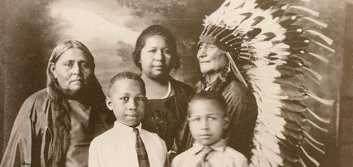
“I got Indian in my family.”

Is something I hear often among the black community. Even in my own family, my mom talks of how her dad was 100% Cherokee Indian and how our family were cow slaughters which explains my maiden last name which is Hereford, a kind of cow.

Black Slaves, Native Masters

However, while many black families are proud to proclaim their Native Heritage, what is rarely passed around our dinner tables is an important fact in American History. This fact being that even the 5 Civilized Indian Tribes held slaves. A lot of black people jump at the chance to proclaim the above statement because oppressed people typically wants to identify with other oppressed people but the truth is stranger than fiction. Native Americans were oppressed by Europeans but they both had black slaves. In fact, Native Americans knew the layout of the land better than anyone else and it was they who taught the Europeans how to track and to capture slaves. (This is why in last weeks Underground Episode the little boy asked the black slave, “You used to live with the Indians didn’t you? And you taught my daddy how to track.” He used to live with the Indians because he was their slave same as he is the slave to the little boys father. Underground is a very well written TV show).

“Though the harsh treatment of enslaved Africans largely paled in comparison to that of white slaveholders, Blacks still were treated as an underclass among Native Americas. The Five Civilized Tribes even established slave codes that protected owners’ property rights and restricted the rights of Blacks.”

(Barbara-Shae Jackson, The Atlanta Black Star)

What’s deep about my family history is this:

Cherokee is one of the tribes who took part in the Trans-Atlantic Slave Trade (along with Chickasaw and others). In addition, the term “Cow-Boy” is also derivative of slavery. The slave boys who handled the cows were called cow boys. So when you watch Quentin Tarantino’s Django the content is actually not out of context far as the cow boy theme is concerned and my maiden name is potentially much more deep than we know.

“Witness History First Hand” – Book Review of The Road to Freedom

That’s right, another 5 Star Review is in:

015-6x9-Book-Ereader-Mockup-COVERVAULT

I was very impressed with Yecheilyah Ysrayl’s Stella: Beyond the Colored Line, and her second book is just as compelling. The Road to Freedom – Joseph’s Story is something of a prequel to Beyond the Colored Line, and Stella’s son tells us about his own journey through turbulent times when South fights hard and dirty to stay segregated. Joseph and a group of his young, impassioned friends want to do something about it but don’t know exactly what.

Together they make a mix of blacks and whites, boys and girls, who inadvertently get what they wished for when they try to catch a bus to Atlanta. The youths are swept right into the action and end up being relentlessly chased by one side and becoming heroes to the other.

Like the first book, Ysrayl works her magic of putting the reader into her characters’ minds to witness history through their emotions and perspectives. At one point in the story, the friends are trapped in their vehicle as it’s mobbed by a pack of violent racists. My heart was literally pounding at this point. I was horrified that anyone had to experience such ugly cruelty. – C.J. Wojo.

Click Here to Finish Reading Christa’s Review

What Langston Hughes Taught Me About Writing

Langston Hughes
Langston Hughes, Google Images

What known historically famous writers, like Langston Hughes and Zora Neale Hurston, have taught me is that writing (far as fiction, / non-fiction, poetry, novelist type writing), is not about making money. Before you throw your stones at the computer screens listen carefully: You can surely make money, but writing is not about making money, if you can understand that. Though I write for a “living” I can honestly say, with my integrity intact, that I have written not one book and not one poem with the intent to make money. I don’t think any writer sits back and says, “Self, lets’ get this best seller on out the way shall we?” Personally, I write because I love doing it and I publish because I love sharing it. But, how did Langston Hughes help me to understand this?

For those of you who are not already familiar, Langston Hughes and Zora Neale Hurston are two of the biggest names in literary history. Just mention The Harlem Renaissance and their names are the first to come to mind. When you look into the lives that they lived however, you see two interesting facts: a). Both were very famous b). Both were very broke.

You wouldn’t know it from the looks of it. Not the way their names are plastered into history books. Not their quotes and faces and the people they’ve known. In fact, to the untrained eye one may come to think these people were rich. Yes, just like any “successful” Traditional or Self-Publisher always before the face of the people. The truth is that Langston Hughes had many side jobs throughout his career that made him money. This included many speaking engagements, teaching, traveling the world, and even working as a bus boy at the Wardman Park Hotel in Washington. Hughes attended Lincoln University but that was because he couldn’t raise the scholarship money to attend Howard. In addition, both Hughes and Zora worked closely under Charlotte Manson, their rich white patron (she was also a big racist but that’s another story) who paid them for the work they published (she also dictated the works they could / could not publish). They also worked closely, most especially Hughes, with Carl Van Vechten (infamous for his book “Nigger Heaven”) who got him lots of work.

I do not say this to discourage anyone from being an author. I say this to say that there is a passion and a drive to writing a book that has nothing to do with royalties and books sales. This is what the promotion and hard work is all about, or at least mine is.  Writing and promoting books that people want to read. There were times where Langston Hughes could barely pay his rent and yet he still managed to know pretty much everyone there was to know during the Harlem Renaissance and the era to which he lived in general. This is a man who was surrounded by millionaires and billionaires on a regular, not because he necessarily  made the same kind of money but because of the way that his work changed people who were drawn to his message. This is what it’s all about: Changing lives. This is also why the Traditional-Indie argument is so stupid right now. It doesn’t matter how you publish the book and whether or not you’re “making it rain”. What matters is whether or not your book has a voice. If it does, then the people will gather to hear you sing.