Writer’s Quote Wednesday – The War of Art

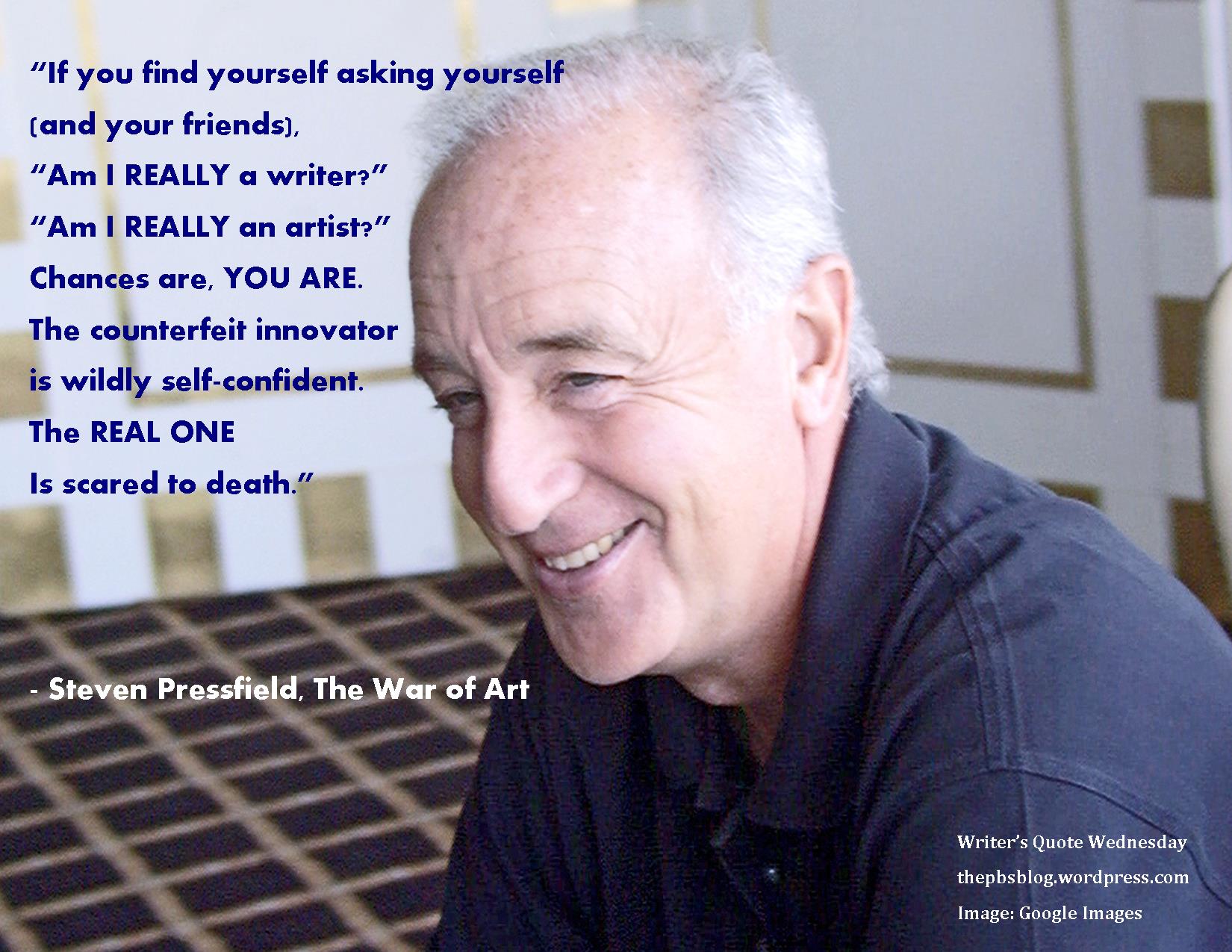
My choice for Writer’s Quote Wednesday this week is from Steven Pressfiled’s The War of Art:

WQW

Writers. People who second guess whether or not they have what it takes, and yet are still bold enough to go on. This quote reminds me of what it’s like to be nervous. We’ve all experienced it and we are all familiar with that feeling. Your heart beat races, your palms become sweaty and your body gets all jitterbug on you. Truth is you are scared to death of whatever it is you are about to do. It does not mean you have no confidence, it just means you are not so dependent on yourself that you forget about the big picture and you can’t stop thinking about the possibilities. You know that you can do it; you just don’t know whether or not it will succeed. But still you push forth and you show up at that place or do that thing. It is the war of art. You battle yourself until finally, you put pen to paper and you write. Writers. Sometimes fearful. Sometimes doubtful. Sometimes afraid. But always humble in confidence, and yet courageous in character.

About The Author: (from Wikipedia)

Steven Pressfield (September 1943— ) is an American author of historical fiction and non-fiction, and screenplays.

He was born in Port of Spain, Trinidad, in 1943, while his father was stationed there, in the Navy. He graduated from Duke University in 1965 and in 1966 joined the Marine Corps. In the years following, he worked as an advertising copywriter, schoolteacher, tractor-trailer driver, bartender, oilfield roustabout, attendant in a mental hospital, fruit-picker in Washington state, and screenwriter. His struggles to make a living as an author, including the period when he was homeless and living out of the back of his car, are detailed in his book The War of Art.

His first book, The Legend of Bagger Vance, was published in 1995, and made into a film of the same name, starring Will Smith, Charlize Theron, and Matt Damon, and directed by Robert Redford.

His second novel, Gates of Fire, is about the Spartans and the battle at Thermopylae. It is taught at the U.S. Military Academy, the United States Naval Academy, and the Marine Corps Basic School at Quantico.

In 2012, he launched the publishing house Black Irish Books with his agent Shawn Coyne.

******************

And that’s it for Writer’s Quote Wednesday. Click the pick to join the fun.

writers-quote-wednesday

http://silverthreading.com/2015/05/13/writers-quote-wednesday-sir-winston-churchill/

Race Doesn’t Exist

French physician Francois Bernier was the first to use the word “race” as a category for scientifically classifying humans in a 1684 essay titled “A New Division of the Earth, According to the Different Species or Races of Men Who Inhabit It”.


6a00d8341bf68b53ef0133ed28d33d970b-800wi

In addition, Johan Friedrich Blumenbach (1752-1840), a medical professor in Germany, argued that human beings fall into five races: Caucasian, Mongolian, Ethiopian, American, and Malay. He argued that Caucasians derived from the Caucasus Mountain region and embodied the ideal human from which the others degenerated. It was a popular belief that Caucasians were the ideal form based on a skull that had been found in the Caucasus Mountains, near the alleged location of Noah’s ark. What this classification achieved is the setting up of a color line. Blumenbach classified five chief races of mankind and by attributing psychological value and importance to race; this became what we know as racism.

Science has a lot to do with the usage of “race” to identify a people. Although there is uncertainty in the title about the correctness of the term “race” versus “species” to classify human variation, Bernier relied on categories based on outward physical characteristics such as skin color.

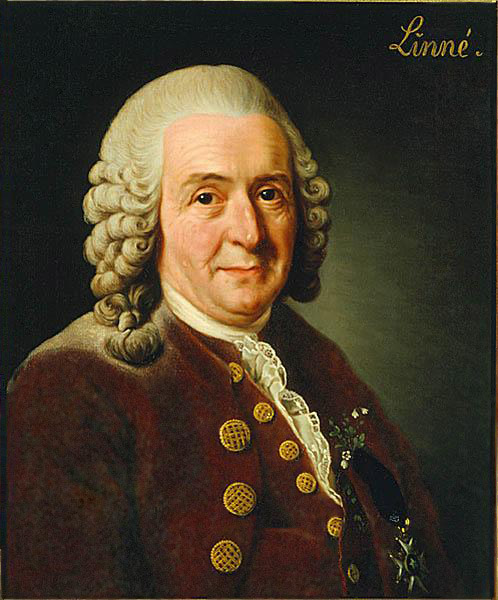
Carolus_Linnaeus_(cleaned_up_version)A prime example is Swedish botanist Carolus Linnaeus’ system of biological classifications in Systemae Naturae, published in 1735. Linnaean taxonomy is the system of scientific classification of plants and animals now widely used in the biological sciences. He formalized the distinction among the continental populations of the world and his work helped characterize the concept of race. In the tenth edition of Systemae Naturae, which was published in 1758, Linnaeus projected four subcategories of Homo sapiens: Americanus; Asiaticus; Africanus; and Europeanus. In short, the moral components of race–such as beliefs, values, etc., were not as prevalent where racial hierarchy was already established by slavery, but the word race was a general term that was used interchangeably with species, sort, type or variety. This is why there is no such thing as a race of people.

crayons-labThe concept of Race is a new ideology and has not always been with us. Genesis Chapter 10, known as The Table of Nations, gives an example of how people were split into nations and lands and language, not races. In fact, “definitions of who is black vary quite sharply from country to country, and for this reason people in other countries often express consternation about our definition.” (F. James Davis). What has happened then? How has a nation of people now become a race of people? They told you about a brown man, a black man, a yellow man, a red man, and a white man. It’s as if they took their crayons and painted us the colors of their expectations. After coloring they began the tasks of assigning these colors to class and certain geological locations in that they may properly identify them. Not necessarily so that these people may identify themselves, but so that racial superiority would reign supreme.

6a00d83420747353ef01a511c3312b970c-320wiThe U.S. Census Bureau defines race as “a social category recognized by the United States and does not attempt to define race biologically, anthropologically, or genetically”. The Census Bureau recognizes five categories of race: White (people with origins in Europe, the Middle East, or North Africa,) Black or African American (Africa), American Indian or Alaska Native, Asian, Native Hawaiian or Other Pacific Islander. The census also includes a Hispanic ethnic category. It is an ethnic category rather than a race category because the Latino community is said to include many races, such as White, Black, Native American, Asian, and mixed.

The truth is that every single person on the face of the earth belongs to a nation of people, as he was so divided since the beginning, and thus he falls into whatever family according to his nationality. Every people have a nation to which they belong, followed by a specific set of laws, customs, and traditions separated only by land and this is why race does not exist, because there’s no such thing as a race of people. Sure, we may use the term for understanding sake, one may say “my race is..” so that the person next to him gets it, but he does not really belong to a race, he belongs to a nation. Prejudices, Biases, and oppression of one people who feel superior over another people does exist, but race within the concept to which we’ve grown to know it, does not.

When Are You Done Succeeding?

I thought this was a great post by Shayla of Curiouser Editing:

1431185266819

As an entrepreneur, do you consider yourself successful? Or do you feel like you’re not quite there yet? Do you sometimes say, “I’ll be happy/successful when I get to this point”?

In the business world, we are engrained with the mentality that success is defined by numbers. We are told that it is something measurable. We are not successful until we get more followers, get more clients, get more engagement, get more subscribers, get more money, get a dream house, getgetgetgetget…

And it’s still not enough.

Because we keep going and we keep pushing ourselves to get better and be all of these things that our inner child would think were nuts.

So when is it enough? When do we get to say, “I did it. I’m successful”? When does that happen?

When are you done?

When you get 10,000 Facebook followers? When you make $8,000 a month? When you can hire your first employee? Second? Third? When you land an interview with a multimillionaire exec?

Speaking of interviews, I recently read one with a millionaire shop owner. She said, “We haven’t succeeded yet. We’re not at a point where we’ll all take a deep breath. I don’t know when we’ll ever stop.”

A millionaire said that.

To someone, that kind of dynamic attitude is contagious. It’s always been for me. But then when a friend asked me, “When are you done?” I began to rethink the definition of success.

Success means, “the fact of getting or achieving wealth, respect, or fame.”

I believe it’s time to change the definition of success. I believe we are more than the numbers on our Facebook page. I believe we are more than the amount of subscribers who read our blogs. I believe we are more than something that can be measured on Google analytics.

Here’s a thought: We already are successful. We were successful the day we put ourselves out there and hustled for our dreams. We were successful ages ago, but for some reason, we thought it wasn’t enough.

We have already succeeded. No amount of fans, followers, likes, subscribers, clients, or dollar signs can ever change that.

Here’s my new definition of success:

The act of waking up each day and being in love with what you do and who you are as a person.

It took me longer than I want to admit to realize what success truly means. It is not a number. It is being happy with who we are and who we strive to be every day.

So are you successful?

Appreciating Body Parts

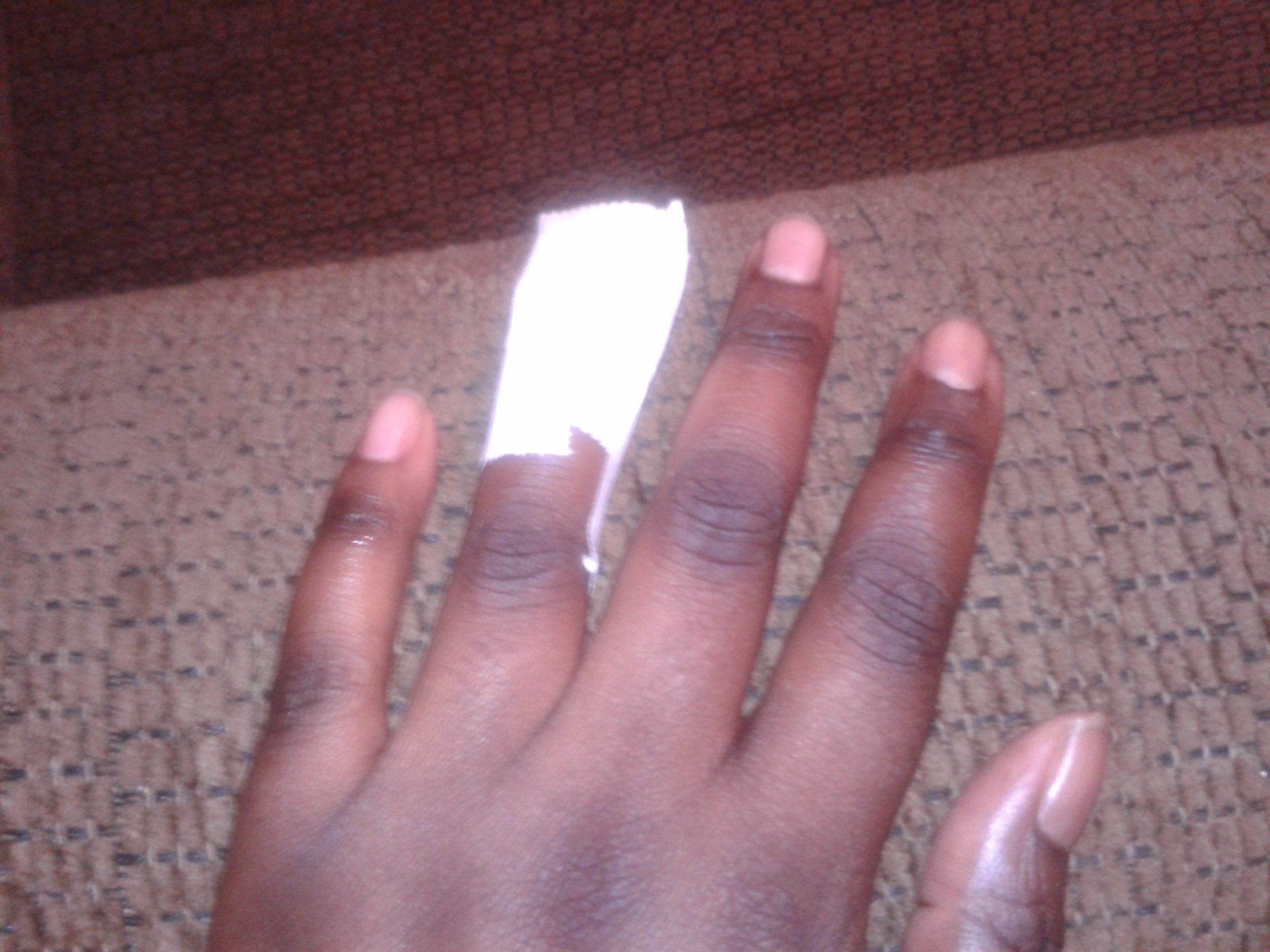
150510_0001I’m typing with nine fingers today. I do have ten fingers, but one of them happens to be out of commission today. Brilliant me slammed it in the car door last night. Now my wonderful husband can take care of his disabled wife. OK well, it’s really not that bad. It is in a bandage though so I really am typing with nine fingers. But this got me thinking: How often do we appreciate the value of the little things, such as a finger? Do you appreciate your body parts? You’d be surprised how important this small part is to the body. It’s a challenge not using this finger, but I know of a beautiful young woman who was not born with fingers. She has a rare disease that caused her to have webbed feet and no hands. This started me reminiscing on bits of my own history. What if I told you I don’t have a right leg? Well, technically it’s more like no femur bone. Your femur bone is the long bone in your thigh. It’s the only bone in the thigh in fact. It is both the longest and the strongest bone in the human body, extending from the hip to the knee. But I don’t have one. Instead, I have a steel plate. You see, it all started about eighteen years ago:

120831_0001

The day was beautiful. The sun danced in the streets and illuminated the green grass. There was an abundance of little ones running around, riding bikes, roller blading, and playing tag. One of the many things I always loved about the neighborhood was the pouring of children who came out to play in the summer time. (I don’t know what’s up with this new generation where everybody stay in the house and play video games. Staying in the house was punishment for us. We loved to play outside).  It was 1997, and school was just letting out. 8023 South Paulina is an address I would never forget. It’s the first apartment complex we lived in after moving out of the projects and today, Auntie Roslyn had rewarded us for passing on to the 5th grade. That’s back when a $1 was golden. We spent most of the time hustling for quarters to buy candy, but dollars? We were rich now.

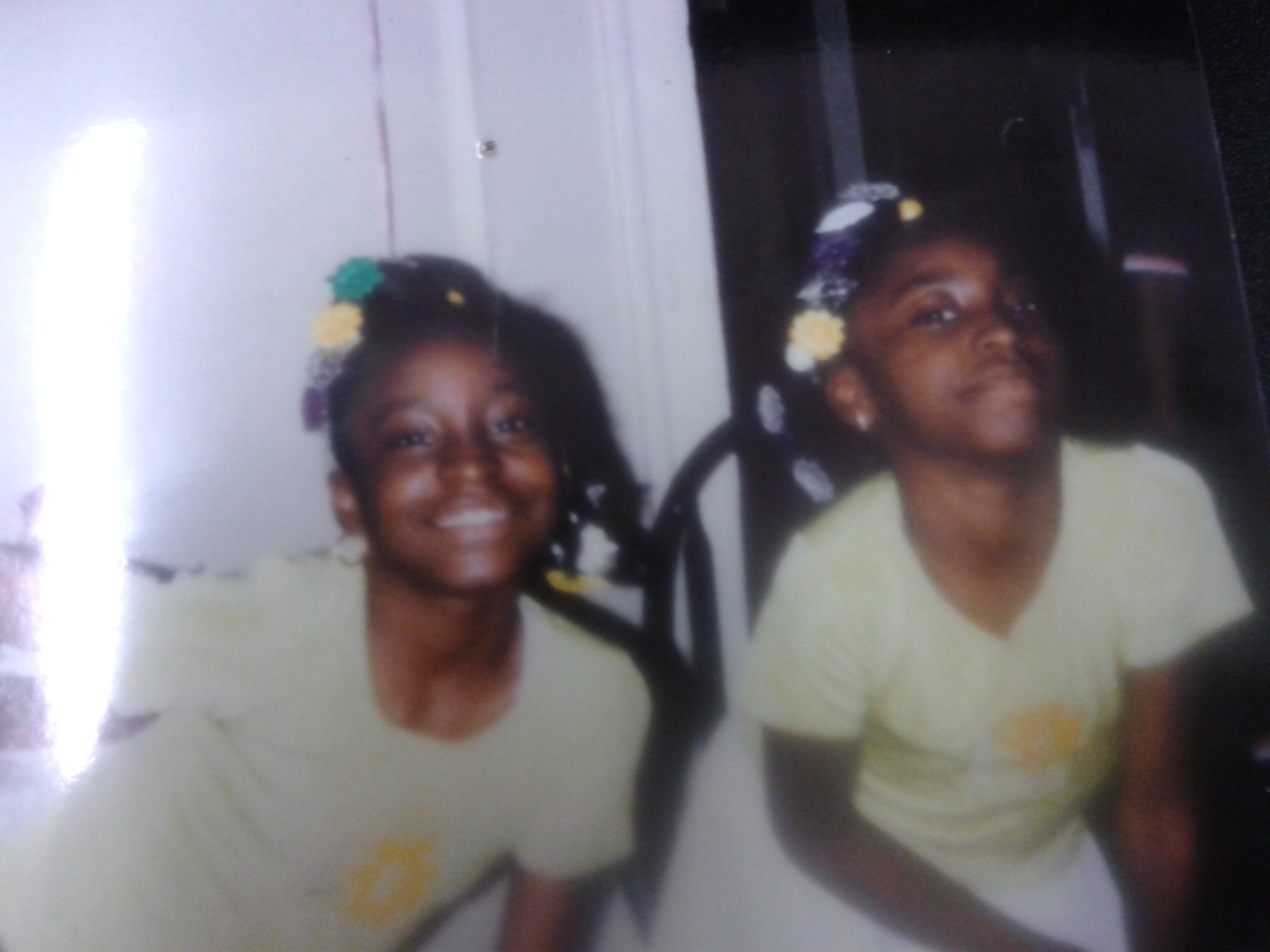
My twin sister and I decided this was the perfect day to visit a friend. And this meant bringing every toy in the house with us. We were excited and that meant that we would invite everyone to the festivities: Barbie, Ken, their car and the whole gang. This wasn’t unusual for the twins; these are the same little people who baked cakes in their easy bake oven and sold them to the kids in the neighborhood at a quarter each.

“Time to come in the house!” Boomed my mother’s voice. She actually called our names though. This was when parents still stood in the middle of the street and called your whole government to attention because the street lights were on and you were not at home. The day had gone smoothly. Our friend didn’t give us a reason to argue our ten year old genius about why she shouldn’t do this and that and for the most part we all played nicely. But as the sun began to set and the street lights crawled to attention, it was time for us to leave our dear friend down the street to come on back in the house.

This is when the story gets interesting. Cradling toys in our arms, my ears caught wind of the music before the ice cream truck floated down the street and a smile crept on my face. You see, I’d been scheming on how to spend this dollar since earlier that day. It was a precious gift and I wanted to make sure that I used it on something really good. I suppose now is the best time to remind you that my most favorite desert is ice cream. So, when the jolly jingle of something that sounded like, “pop goes the weasel”, sang down the street with its bright lights and large display of choices, I knew then and there what I wanted.

“Hold my stuff,” I instructed my twin sister. I was after all the oldest and back then five minutes was like five years, and let’s just say I wielded my authority proudly.

“But mama said to come in the house,” she whined.

Why must she do this now? I hated when twin started whining and complaining. It always brought attention to the seriousness of the situation. Why can’t she just get with the flow? The annoyance of her pleas etched into my face. I smacked my lips as I ignored her common sense.

“Just hold my stuff,” I said.

Before she could protest any more I decided to take a quick dash across the street. The ice cream truck was on the other side serving the people on the other side of the street. This should have been my warning that tonight was not the night for ice cream. However, I was stubborn so this logic didn’t occur to me. I wanted ice cream and I wanted it now.

I looked both ways before speeding across the street. I saw a white car and it all went black.

When I came to, I was rolling off the hood of this stranger’s car and onto the concrete. Twin and I were premature babies, only 3 and 4 lbs. each. And so we had always been small coming up. We were ten but we looked more like we were five. It is only now that I understand weight gain, but all throughout elementary and High School I never had to be concerned about my weight. When I graduated from High School I was 100 lbs. and could fit into size 1-2 jeans.

Needless to say that car tossed my small body around like a rag doll. When it was finished I lay on the cold concrete praying no one moved me. I had no knowledge of the medical field or any of that stuff at ten, and yet I knew enough to know I didn’t want anyone to touch me. Somehow, I knew that if I was touched it would not be good. But despite my pleas to be left alone, my mouth didn’t move and my voice shut down. No one heard my cries because it was all in my head. I was in shock and though I wanted to scream my mouth didn’t move. As a result, someone scooped me into their arms and not only could I not speak; now I could not breathe.

The person laid me in the grass and my breath returned to me. There was no pain as I lay there surrounded by the neighborhood. Everyone had come out to see the kid who got hit by a car. Either by walking by or peeking heads out of windows. I scanned the crowd until I realized my hand was being squeezed. To my left was the woman who hit me and her tears soaked her face. She pleaded and pleaded her apologies over and over again.

“Get over yourself,” I thought.

I wasn’t being mean; it’s just that I forgave her already. I still had not felt any pain and only prayed now that I would live. I forgave her over and over again while simultaneously praying I wasn’t going to die. But I was talking in my head again. The lady had not heard me and my mouth still had not moved. It wasn’t until I looked down at my right thigh that the pain came and my mouth opened. The thigh (it couldn’t have been mine) was twice the size of my real one and the pain was excruciating. To make a long story short my leg (or more precisely my femur bone) was broken. I had to get a steel plate put in and twenty-four surgical staples. I came home from the hospital with a walker which I thought really sucked. Here I am with a broken leg and all I was concerned with was why they couldn’t have given me crutches. Truth is I was fitted for them, but they couldn’t find two of the same height for tiny ole me.

“Aww man”, I thought, “I love those.” Yea, I was the kid who played on other people’s crutches. But the one time I needed them I was given an ugly brown walker instead. It didn’t help that they tied balloons around the thing. Yea, it really looks good now.

I was spoiled rotten of course when I came home, though the wrapping and unwrapping of my bandage and going back and forth to the hospital was no fun. Today you would never know the difference, though I still do have the scar which starts a little above my knee and stretches to right below my hip. It’s basically the whole thigh. Trace your finger from above your knee till it stops at the end of the thigh, that’s the length of my scar. The only side effects are the weather. When the weather changes dramatically, like from warm to cold, I get aches similar to that of arthritis. And sometimes I know when it’s about to rain (my leg tells me).But other than that I’m fine. I learned a valuable lesson though:

Obey your mother and father AND appreciate your body parts! Someone somewhere does not have what you have. And just think, I broke my femur, the strongest bone in the body, how ironic.

The Short Story

short-story“The short story….. wakes the reader up. Not only that, it answers the primitive craving for art, the wit, paradox and beauty of shape, the longing to see a dramatic pattern and significance in our experience.”

–V. S. Pritchett

“I have always enjoyed short stories and have now found them to be an added joy. They are easy to read and digest, quick to review and……….. a great introduction to an author’s work. They act as an appetizer if you like, tempting you to tackle the meatier course of someone’s novel where you need to commit serious time.”

– Georgia Rose Books

“The particular problem of the short story writer is how to make the action he describes reveal as much of the mystery of existence as possible…The type of mind that can understand [the short story] is the kind that is willing to have its sense of mystery deepened by contact with reality, and its sense of reality deepened by contact with mystery.”

–Flannery O’Connor

“…the short story is a natural form for the presentation of a moment whose intensity makes it seem outside the ordinary stream of time, or the significance is outside the ordinary range of experience.”

—Wendell Harris

Butterfly, My First Writing Love

150508_0002

Where do I trace the birth of this longing? I have not photographic memory as many do, nor do I remember the exact moment I said, “I want to be a writer”. And as I ponder this history of mine, the thunder growls and the winds roar. The skies darken this very moment and hover around this building; leaning its body against my windowsill and making my living room look like evening time. I like it like this really. To hear the thunder roar in the midst of the quiet and the skies darken. It has a calming effect on me. The appearance of lightening is a chance to see pure light, and the sound of horns is a reminder of great power. But I digress. Really I just think they must be excited, just as anxious to discover this mystery. A collection of horns and quarter notes gather from beyond the clouds and deep inside the galaxy, shouting melodiously. The floor beneath me pulsates and sends shivers up my spine. Meanwhile, raindrops tap dance against the roof. Perhaps the scream of heaven is prompting me to remember. I do remember the first time I had the material to organize my writing. I do remember my first journal. I do remember my first writing love.

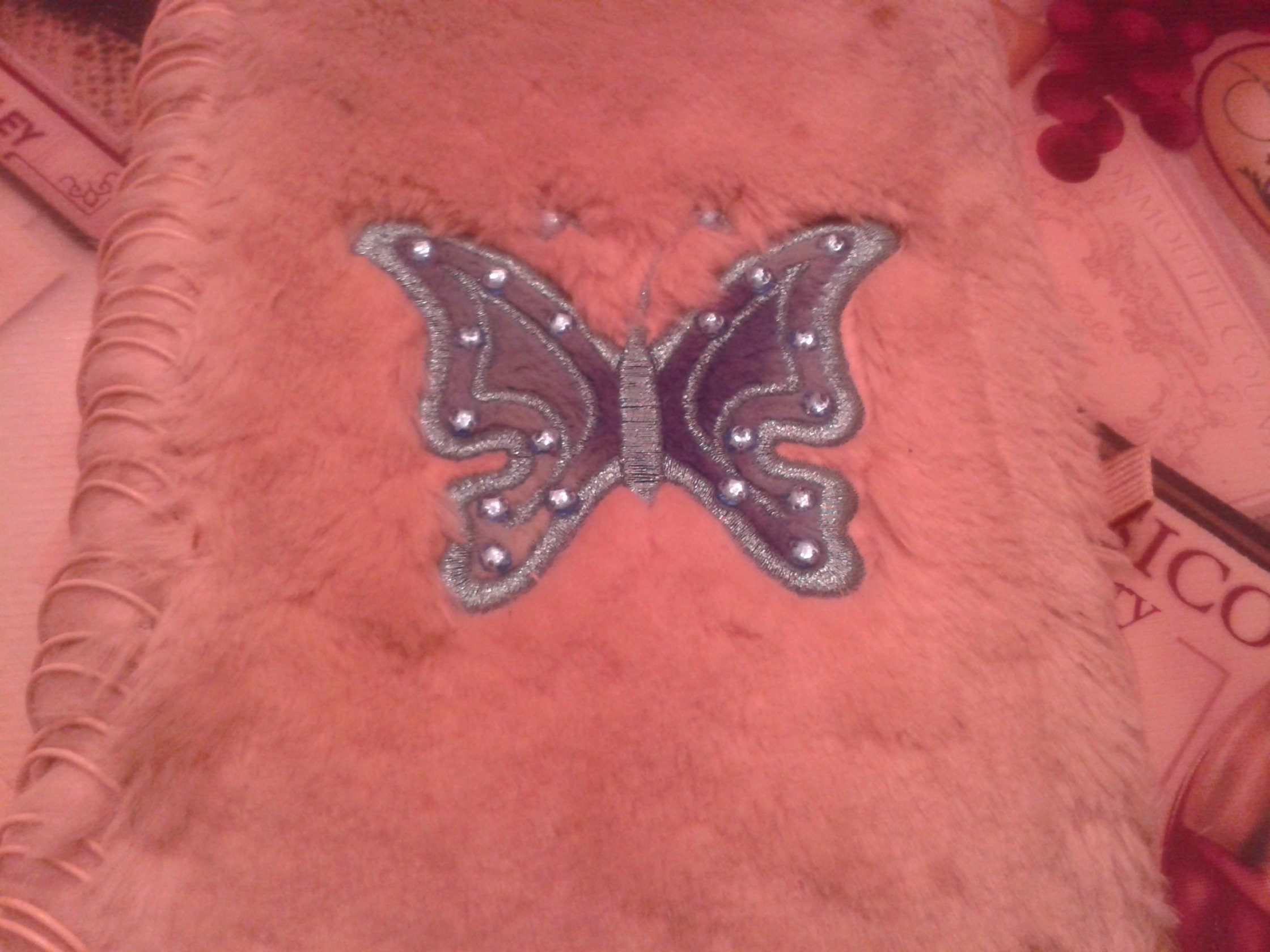
I was just about to turn fifteen, and though by then I’ve been writing for some time, I had not the care of keeping things organized. I wrote at will and on whatever pieces of paper I could find. But the close of eighth grade presented me an opportunity to confide in that pretty pink booklet with the blue sparkling butterfly on the front. I purchased it in Cincinnati Ohio during our eighth grade school trip. I spotted it at Claire’s, a store at the mall, over in the corner and it was a unique version of many of the journals I had seen in Chicago or anywhere. Somehow I didn’t think I would find it anywhere else in the world. As my peers busied themselves in appropriate teenage endeavors, my pupils danced in delight. Immediately upon seeing it I had to take it home. And I must say it dressed up well for our first date. The pink was fluffy and soft; my fingers found comfort when they slept on top the cotton. The butterfly on top shone bright like the dye was squeezed from fresh blueberries, and to top it off there were little diamonds imbedded in its wings. It wasn’t a diary so there was no lock and key. Nor did I use it as such, but it holds some of my early poems. In fact, I pretty much just used it for poetry, and maybe a journal entry or two here and there. When it opened, the euphoria of opportunity greeted me with the smell of fresh ink, and elegantly curved lines. It wouldn’t be long after this that I would begin my collection of journals and notebooks, but none of them would compare to the first. Butterfly was that first real writing love. The rest were merely copies. And as you can see, I still have it, though it is obviously not as beautiful as it once was. I think I’ll give it to my daughter one day. Maybe. OK well, let me just flip through it first.

Beyond The Colored Line – Final Sneak Peek

Book2Week three-four:

My apologies for the delay on this; I have recently come back to town and this week has been busy trying to get back on schedule. But, as promised, here are the final sneak peeks of Beyond The Colored Line:

Note: This excerpt is part of a book written by Yecheilyah Ysrayl. No part of this publication may be reproduced, or stolen in a retrieval system, or transmitted in any form or by any means without written permission of the publisher. The exception would be in the case of brief quotations embodied in the critical articles and reviews and pages where permission is specifically granted by Yecheilyah Ysrayl.

*******************

1932
Age 16
**************************

“Never limit yourself sweetheart.”

Aunt Sara was sitting at the vanity table applying red lipstick to lips that I didn’t think could get any redder. Aunt Sara was a thin but shapely woman, filling out the beautiful dark red dress that went down to her ankles, but held snug at the waist with a petite black belt. She wore black heels, and her red hat sat on the bed next to me as I sat watching her perfectly apply more make-up. She was in the middle of another lecture.

“We got the whole world just waiting for us and the least we can do is oblige. Besides, it’s not like you’re betraying anyone or denying anything. You have just as much a right to this life as anybody.”

It was Tuesday night and Aunt Sara was going out again. She tilted her head this way and that in the mirror and smiled her approval.

Mama lost the house. She tried to do the best she could with the visitors and such, but the depression didn’t allow for people to want to travel much. And the taxes came to be too much for a laundry woman’s salary. We moved to Chicago where things weren’t much better. The Great Depression was particularly severe here because of the city’s reliance on manufacturing, the hardest hit area nationally. Only 50 percent of the Chicagoans who had worked in the manufacturing sector in 1927 were still working by the time we arrived, especially Negroes. By now, 40 to 50 percent of Negro workers in Chicago were unemployed, including Aunt Sara. She was a school teacher, but wasn’t making any money. By the end of the year, the city would owe teachers more than eight months’ pay. But Chicago’s population grew enormously because of the mass lynching’s taking place in The South. Negroes escaped Mississippi as if running from a plague. And for just $11.10 they were brought by train to a new world. Everything was still segregated. In fact, Chicago is the most segregated place I’d ever seen. But you could hold your head up in Chicago. So to us, it still offered a freedom that didn’t exist in in The South. It was the land of milk and honey. And the crisis didn’t seem to affect Aunt Sara as it did Mama anyway. She didn’t particularly like being a part of the life Sara lived and she was depressed over our situation.

“Speaking of the whole world, what is it with you and that Timmy boy?” Sara puckered her lips for a final review as she spoke.

“Tommy Aunty, his name is Tommy,” I said.

Tommy and I had become rather close as we got older, though I couldn’t decide if we were dating or not. Aunt Sara clasped her hands together as she stood and sat next to me on the bed, “Oh, my memory these days.”

“Tommy’s a good friend, nothing special.” I lied.

“That’s my girl,” said Sara, grabbing her hat and putting it on, admiring herself again in the mirror as she spoke.

“I don’t think it’s a good idea for you two to see each other no how. There’s not much room for opportunity with such men. You must learn to play the game sweetheart.”

“Are we so different?” I asked.

Sara turned to face me, “You can drink your coffee black all you wanna, but I’d prefer a little cream to taste. I swear I don’t know what’s gotten into your Mother, teaching you to hate yourself is what she doing. There’s nothing wrong with embracing who you are, you remember that.”

I sunk down in my seat, embarrassed. I knew where she was going with this. Every day was Saturday for Aunt Sara. Uncle Bob, as we were instructed to call him (though marriage didn’t exist between them) was Sara’s new man, a wealthy doctor on Chicago’s North side. The problems of the Great Depression affected every group of Americans, but no group was harder hit than Negroes living in the cities trying to live like rich white folk. In some Northern cities, whites called for Negroes to be fired from any jobs as long as there were whites out of work. Otherwise, the depression meant nothing to Negroes who had been depressed in America for nearly 400 years. For this reason, we were Aunt Sara’s little secret hidden securely inside Uncle Bob’s pocket. She didn’t just pass for white, Aunt Sara was white. And coming from a white mother and half white father no one second guessed us, not even Bob.

“I tell you what, the ladies and I are attending a small gathering this evening, and you should come along.”

“But I’m only sixteen,” I said.

Sara smiled, “And? Who’s asking questions? Today you’re sixteen years old sitting in a house wasting your life away. But tonight, tonight you are the most beautiful twenty-one year old they’d ever lay their eyes on. The most beautiful white woman they’d ever seen.”

One Year Later

I laughed as Tommy and I strolled down the Negro area of town, arm linked in arm. We had decided to stop fooling ourselves and had begun dating. I must say, being with Tommy was one of the most refreshing parts of my life: smart, colored, and hilariously funny. His presence alone gave me a sense of relaxation I didn’t feel at home. I didn’t have to pretend or fear discovery. It was a relief being with him, and a lot of fun too. Indeed, the love I had for that man could never be mistaken and could never be traded. He was my first love and I love him still.

Tommy held open the door to The Shack, a mom and pop restaurant owned by Negroes. As I entered the restaurant, however, my foot stopped mid-air over the threshold.

“Sidney?”

It was Annie, one of the first friends I’d met in Aunt Sara’s circle. I had begun living a double life. It was easier than I’d expected. I had, after all, enjoyed the private education, the fine dresses, and the parties. I found myself looking forward to the freedom of going where I wanted and buying what I needed. We were one of the few European families doing well during the depression and loved by everyone. Aunt Sara and Bob got closer. We were invited to his inner circle of friends and family, which meant standing on top the highest hill and waving. Even Mama began to lighten up just a bit. Things were going well, until now.

“Annie, what a surprise!” I said as Annie and I hugged each other, planting dainty kisses on each other’s cheeks, fake grins all over the place. Annie looked Tommy up and down, while he held onto the door, as if she had just spotted a piece of trash on the ground that must be disposed of quickly.

“You must be the servant. I’m Anne, how do you do?”

Tommy let the door slip from his hands, closing quietly as Annie held out her hand; covered in a crisp white glove made of finer cotton than spread across his kitchen table. Tommy’s family were sharecroppers. Silently he wondered how many barrels of cotton it took to make it glow in the darkness. He looked at Stella, staring deeply into the green eyes he once adored, and the reality of the present situation lit a fire inside of his chest. He hoped he wouldn’t fall down dead from a heart attack. It would be a shame for his dad to find out his son died cause of a thing as a woman’s glove.

Tommy said nothing, just kept his eyes fixed on mine. I didn’t want to look away, but I couldn’t help but to feel them shooting little prickly darts into my skin, and it was beginning to burn. I had to think of something. Quick. I pleaded with his eyes.

“Why of course, where are my manners? Thomas, this is a friend of mine Annie. Annie this is Thomas, the new driver.”

I hopelessly tried to catch sight of his eyes. I wanted to plead mercy, but Thomas’ eyes searched instead for something on the ground. I turned my attention back to Annie.

“Why of course,” said Annie. “I was just telling Daddy about how difficult it is to find one these days. Why we just replaced a cook last week. Poor Mama was devastated,” we laughed, only hers was real.

“I told her we’d just have to get Miss Pearl to do it, but you know Daddy couldn’t stand for that. A housekeeper cooking? Why the next ball would be simply atrocious,” we laughed again as I silently prayed for a miracle.

“Anywho,” continued Annie, “I am off, but do come by tomorrow. The women and I are having tea, you know Mama’s dying to show off the furniture.”

“Of course,” I said as we hugged and kissed again.

As I waved goodbye to Annie, I turned to plead my case to Tommy, who was already halfway down the street. And just like that, our friendship had ended.

***********************

I’m so grateful you’ve taken the time to read this far, I hope it means you are enjoying the story. If you’d like to continue reading and find out what happens next, you can get the book from Kindle for just $2.99 when it releases this summer and less than $10 in paperback.

I plan on writing another book in this series later this year, and with your permissions I’ll let you know when that’s available and send you some more free chapters. Until then, if you want to know what I’m up to, you can follow me on Twitter @: https://twitter.com/ahouseofpoetry.