

Book Launch! Beyond The Colored Line is Available Now!
Tag: short stories
Writer’s Quote Wednesday – The Short Story
My Writer’s Quote Wednesday for this week is in honor of the Short Story. Wendell Harris says:
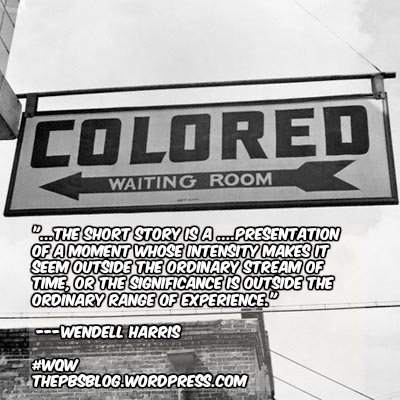
“…the short story is a ….presentation of a moment whose intensity makes it seem outside the ordinary stream of time, or the significance is outside the ordinary range of experience.” —Wendell Harris
I really like how Harris spoke about, “the presentation of a moment” because it is what I think about when I think of short stories. It’s like a sampling of the authors writing, pulling as much life from the story as is possible and then storing it into as few pages as possible, which is my goal for my current short story trilogy. To fit as much information as possible in just a few pages, while simultaneously providing for that bit of mystery that I think is important for the short story. I think Stella relates to this quote because it is the presentation of a single moment in history. It tackles the ongoing racial intensity of the past and brings it into our present day so that we are experiencing, in a unique way, the co-existing of past, present, and future.
I wanted to include an Author Bio from the quote but I read this as part of a list of short story quotes and saved them to my drive awhile back so I’m not sure who this particular Wendell Harris is, but what a great quote!
***************
And that’s it for this week’s episode of Writer’s Quote Wednesday, as hosted by Colleen of Silver Threading.

Queen

We are south of Senegal, maybe Guinea, maybe Ghana, or maybe as far east as the Congo. In any event, there is a woman and she’s smiling; putting her body and her hands to work to the multitasking of the rhythm of hips, rolling shoulders and the calming beat of the sounds that influence them. You must not however get distracted by her dancing as if of some stereotypical performance the Africans must put on, for her tribes have always been comprised of dancers and musicians. After a wedding, and even after battle, the men assemble their drums and the women their bodies to tap into a spiritual formation of triumphant celebration. So, the woman is dancing, and showcasing the bright red and blue colors against her skin; the dyed cloths her mothers have handmade from fresh berries. Her hair is braided in plaits; it is strength like strong rope. The woman is gorgeous and the men stare as her chocolate skin glistens in the sun, soft and smooth like silk. He nods, returning her smile. She blushes, rolling back and forth to the appreciation of his hands, slamming with authority against djembe drums, a rope-tuned skin-covered goblet drum, as if massaging against her skin. The year is 1619, and she has just turned seventeen. Waiting this day to which he would smile at her since childhood.
Abba looks her way, it is what she calls Papa Joe, forcing her to turn off seductive eyes and transform into his innocent little girl giggling away in mama’s arms. Placing her index finger on mama’s lips she hopes she has gained enough trust in her to keep silent for daddy must not ever find out about her secret love. If so he may begin to think she no longer belongs to him, for in her village it is custom that when a woman found a man her father gives up his reign, and it now belongs to her husband. And this she can’t bring herself to fathom, that one of those fine strong men will take her away from King Joe. The one who have always protected her and was known for treating mama like a queen, yet it is what she wishes for, to be queen. For a chance to wear golden nose rings and flaring dresses— yes, to be queen is what she wants. The sounds of the village men still heard in the background of her thoughts; slamming strong hands into drums in time for her body to move in that way.
The night has come, and Papa prepares the tent for sleep, driving the stakes into the ground. The roof is thatched with reeds, the walls and floors covered with mats. She lays awake, this woman. No, better yet this princess. Her eyes wander from the plantain from which her bed is made, to the mats three feet below her. Her eyes cannot stop to think of morning when the village men will approach each tent in that they may search out their future wife. This was done every year to service the anxious seventeen year olds, young women who’d prepared for this day since infancy. Seventeen because the number seven is symbolic of perfection, and it is their belief that seventeen years represented the completeness of their womanhood, perfectly fit to become someone’s wife. For this reason alone she cannot sleep, there is just too much excitement! She would never be seen as a child again, for on this day she would officially become a woman. A man would soon leave his father and mother to cling onto her. And she would serve her husband like mama does Papa Joe and her children she would raise to be the most upright of all her country. If only upon the awakening of the sun it will rest on the heart of him, to choose her.
Yet the night is not complete. Mama screams, obliterating her thoughts into pieces of confusion as storms of men with pale faces invade the village. She cannot catch herself before falling, ropes that smell like death have embraced her space and blood creeps in from outside the tent; and then there was darkness. Pitch black darkness as if the moon, that usually sent pieces of light tapping against each tent, had suddenly run away from the men with pale faces and yellow teeth. Baby girl had never seen them before. They could have been men or they could have been monsters, she didn’t know, and had nothing else to do but wait. This woman or better yet, this princess. This semi-woman waiting in the darkness to become queen.
Story Time…
… with EC 🙂

So, Stella has gone through her first stage of editing and I am now in the rewriting stage, so I thought I’d have some fun and engage in a little reading. Speaking of which, I’ve thought about an audio book. Well, more like a passing thought in which I’ve lingered slightly, but what if? As a reader, do you find audio books helpful or harmful? Would you’d rather listen or read? Hmmm, perhaps I’ll do another post about just that. Until then, I hope you enjoy my acting skills….
The Short Story
 “The short story….. wakes the reader up. Not only that, it answers the primitive craving for art, the wit, paradox and beauty of shape, the longing to see a dramatic pattern and significance in our experience.”
–V. S. Pritchett
“I have always enjoyed short stories and have now found them to be an added joy. They are easy to read and digest, quick to review and……….. a great introduction to an author’s work. They act as an appetizer if you like, tempting you to tackle the meatier course of someone’s novel where you need to commit serious time.”
– Georgia Rose Books
“The particular problem of the short story writer is how to make the action he describes reveal as much of the mystery of existence as possible…The type of mind that can understand [the short story] is the kind that is willing to have its sense of mystery deepened by contact with reality, and its sense of reality deepened by contact with mystery.”
–Flannery O’Connor
“…the short story is a natural form for the presentation of a moment whose intensity makes it seem outside the ordinary stream of time, or the significance is outside the ordinary range of experience.”
—Wendell Harris
Beyond The Colored Line – Part 2 of Book 2
 ****************************
Disclaimer: The following post is excerpted from a book written by Yecheilyah Ysrayl and is property of Yecheilyah Ysrayl. No part of this publication may be reproduced, or stolen. Permission is only given to re-blog, social media sharing for promotional purposes and the case of brief quotations embodied in the critical articles and reviews and pages where permission is specifically granted by Yecheilyah Ysrayl. (For permission write to: ahouseofpoetry@gmail.com) Copyright © 2015, All Rights Reserved.
*************************************
Part 2
_________________________________________________
1928
5 Years Later
Age 12
*******************************
Daddy run off to who knows where on account of his life. Some racist whites had seen him and Mama together and threatened to lynch him if found. So he run off to nobody knows where. The community gossip is that his brothers know, but they won’t say. We weren’t alone though, Mama and me. Seems like Mama filled the hole where Papa should have been with our whole family. The house always stayed filled with guests: my people, and peoples of my people. My granddaddy was a colored man, and so owned this land. My name sake, his mama Stella, was a slave and was given this house by her owner. As the story goes, after Grandma died, I was born. Since Mama was the closest, she named me after her. We got stories going all the way back to her girlhood, and stories of Grandpa Solomon too. I heard the stories mostly on Sundays, since all the family come down. My aunts would gather around the table with my mom and they laugh and cry most of the night about they girlhood. I don’t have any uncles except from my daddy side, but they don’t come around much cause of my aunties. Uncle Roy say Mama acts different around her sisters and that they too uppity, especially Aunt Sara. She’s the youngest of my aunties and the most spoiled. She’s the one who convinced Mama to send me to a private school to escape all the worry, and boy were my uncles hot! They said we were breaking the law – that a Negro had no business in a white school. But Aunt Sara said I had all the right in the world since I was technically half white after all.
“But does the school know she colored?” one of my uncles would ask.
“That’s none of the school’s business now is it?” Aunt Sara would say and they’d just go back and forth until Mama break it up.
That’s the story of my life: Was I white? Was I Negro? Race wars always concerned these two groups of people, and there ain’t seemed to be much place for a mulatto. Speaking of race, not all talks were good talks. Not all round table discussions were filled with laughter and jolly drinking. I used to sit up until my eyes were red with fatigue to hear Mama and my uncles talk about all the killings that were taking place around the country, and especially in the south.
“That’s what I say,” said the voice of Uncle Keith. “Up there in Minnesota.”
“That close?” Mama gasped. I could just picture her now with her hand over her chest. Mama had a thing for the dramatics.
“Yea that close. What, woman you living under a rock? They just had one on over in DeKalb last month,” said Uncle Roy.
“It’s a crying out loud shame,” continued Keith. “Say they dragged the boys from the cell and a whole mob of ‘em lynched ‘em. Say it was bout least a thousand of ‘em.”
“My my,” said Aunt Rebecca.
“Well you know what I say, if you can’t beat ‘em, join ‘em,” said Sara.
“Where did you come from?” said Deborah, annoyed.
“From betwee–,“ began Sara.
“Please, spare us,” said Mama.
“I didn’t ask the question,” said Aunt Sara, smacking her lips.
But there were times, of course, I witnessed for myself evidence of the events rocking the country. One day, Mama and I went to visit Cousin Mary in Texas, and drove the truck up to a general store. We walked in, and being only about five at the time, I picked up a post card hanging on one of the shelves. It was of a man hanging on a tree that supported an iron chain that lifted him above fire. The man didn’t seem to have much of a body left. His fingers were cut off, his ears and his body burned to a crisp. On the back of the postcard read:
“This is the barbeque we had last night. My picture is to the left with a cross over it. Your son, Joe.”
I learned later the picture was of a 17-year old mentally ill boy named Johnny, who had agreed to having raped a white woman. And everybody at home still talked of the Cairo circus of 1909, the public lynching that took place here in Illinois. I asked Mama once if we could go to a circus like that, and she told me to never ask her of such things again. I couldn’t understand what had Mama so upset till I found out what kind of circus it was. It was events such as this that caused my aunts not to want much to do with the land or the house. They say it’s too close to slavery. So when Granddaddy died, Mama took on the burden of keeping it, and keeping it full too. I got kinfolk I see every weekend, and some I never met before. And some I don’t think are kinfolk at all; they just come for a hot meal and a bed. But that was alright with Mama. She didn’t care none about being taken advantage of. She just wanted to be around people she could feed and clothe. Her heart was just full of love like that. Sometimes they spend the night, but other times they just come and go. Sundays were the biggest days. Mama cook a feast of a dinner: fried chicken, yams, macaroni and cheese, fried brim and crappy, greens, pies, cakes. You name it, it was on our table. Everything except pork. Mama say Granddaddy was always talking about his Hebrew Heritage and teaching them about it too. Said he didn’t like being called Negro and African, and they weren’t allowed to call him that either, or themselves for that matter. Granddaddy say with his face all proud, “There are two things in the world I would never be: Christian and a Hog Head.”
Then he’ll light his pipe and go on rocking in his favorite chair, like the conversation was supposed to be over, even though folk mouths hung open. That’s another reason my uncles say we uppity:
“Everybody due for a lil fat back every now and again. Everybody Negro that is,” Uncle Roy would say, cutting his eyes over at Mama.
“Good thing we ain’t Negro then huh?” Deborah would shoot back.
Deborah, named after my great great great grandmother, fit right into her biblical name and was the most like Daddy, taking her Israelite Heritage seriously and practicing the laws of the Old and New Testament. Most of the family thought she was crazy. That didn’t stop her from speaking her mind though. But good eating and conversation was just the half of it. There was music, dancing, drinking, smoking, and gambling too. Cousin Walter would bring over some of his hooch and the grown-ups forget all about the children, which was just the way we liked it. I had a lot of cousins and friends, but no one was as close to me as Thomas. Tommy’s mom died off when he was just a baby, and his dad come across the road looking for direction one day when me and Mama come walking along. Come to find out they didn’t really need direction so much as a bed to sleep in. Mama let them stay with us for a while until Luther, Tommy’s dad, got off his feet. But that didn’t stop them from coming around. Luther and Mama became good friends and Tommy was over every weekend. My aunties used to think there was something going on between Mama and Luther till she shut up the gossip with news of Luther’s lady friend, who also became friends with Mama. So naturally Tommy and I were good friends, but we were also enemies and partners in crime. Tommy was dark as charcoal with big lips, nappy hair, and a wide nose. And I envied him for being so obviously Negro. It’s the same reason I liked him too.
“How you get so dark?”
“I don’t know,” said Tommy. “Just lucky I guess.”
“Lucky? What you got to be so proud for? Ain’t no girls liking no skin that dark.”
“Shut up white girl,” said Tommy.
“Shut up big head,” I say.
That’s usually when he punches me in the arm and I’d have to hunt the rest of him throughout the house.
We weren’t much of a church going family; party going is more like it. Except when Mama wanted to show off a new dress or hat, when somebody died or needed saving, and on Holidays and such. Folk would come from all over southern Illinois to hang out with “Cousin Judy”, as Mama was often called. Sunday’s sure were fun, my second favorite day of the week.
Saturdays was my favorite day of the week. It was the day for shopping and that only meant one thing: Chicago. First, Mama would wake me to the smell of biscuits or pancakes. This was to keep me full enough throughout the day so she didn’t have to worry none about food buying. Then, I was commanded to bathe down real good, paint my arms and legs with oil, untie my curls from the night previous, and we’d both put on our Sunday’s best and be two of the most beautiful women you’d ever seen. I was a young lady now and shopping was the best thing to a young lady next to boys (but you couldn’t like them in public). You could like shopping though. I loved going from store to store in search of the finest. Skipping along while Mama scanned the insides of magazines for stuff she only saw on TV. We would squeeze our way through crowds of people, just bumping into each other. They weren’t dressed as professional today. Instead, they wore their weekend wear, bought ice cream for their children and went inside movie theatres, and so did Mama and I. We could buy candy or jewelry, or perhaps a new hat or two with the money Mama made from the laundry. We drank from water fountains without label, and spent money without prejudice. Everything was so easy on Saturdays, life itself was better. We had us a good time on Saturdays because on Saturday, no one knew we were colored.
– Stella M.
**********************************************
What did you think about the second part? I hope it held your interest and you’re ready for chapter three. I am leaving you with a surprise part from Book 1 below. For the prologue to Book #1, see last week’s post. If you like this story so far, would you do me the favor of sharing this post with your friends who might enjoy reading it also? Re-blog or share on your social networks. Thanks a lot! And I’ll see you next week for Part 3.
Beyond The Colored Line – Part 1
Today is the debut release of Part 1 of Book #2, “Beyond The Colored Line” in the Stella Series.Below is a reminder of what this book series is all about:
Stella is a work of Historical fiction, and is distinctive in its focus on one woman’s road to self-discovery against the backdrop of the African American fight for justice, racial equality, and freedom. The 3-Part series focuses on the history of one family in their struggle for racial identity. Discover in this Trilogy how 3 individuals living in separate time periods strive to overcome the same struggle, carefully knit together by one blood.
Log-Line for Book 2:
“Determined to be accepted by society, a black woman desperately seeks to hide her true identity when a prevailing conversation with her aunt provokes her to pass for white.”
Find out in this Stella Sequel what’s truly Beyond The Colored Line.
*****************************************************
Disclaimer: The following post is excerpted from a book written by Yecheilyah Ysrayl and is property of Yecheilyah Ysrayl. No part of this publication may be reproduced, or stolen. Permission is only given to re-blog, social media sharing for promotional purposes and the case of brief quotations embodied in the critical articles and reviews and pages where permission is specifically granted by Yecheilyah Ysrayl.
Copyright © 2015, All Rights Reserved.
Part 1
___________________________________________
September 4, 1923
“You’s white.”
Margaret and Josephine had their hands on their hips again, Josephine taking the lead role as always. The soft wind swayed the handmade dress in all directions, hovering well below her long skinny legs. Her hair was pulled up into a collage of pony tails with twists that never really wanted to stay together. Stella got lost for a minute, slightly envious. She wished her hair was that thick. But instead she was given a sandy blonde that could never keep a braid. School had just started at Crestwood Elementary of Belvedere City, just south of Boone County, Illinois. And already Stella could see this would not be a good year, same as the others.
“I’m not white; I’m Negro, same as you,” said Stella.
Josephine rolled her eyes, “You look white. You sound white. I thinks you white.”
The girls laughed. Meanwhile, Stella’s blood boiled, the blush of anger showing quickly in the space of her cheeks and around her ears.
“You’s white cause we say you’s white,” said Margaret.
“That’s right,” co-signed Josephine, “What kind of name is Stella anyway? What you some kinda slave?”
“Naw,” said Margaret, “she ain’t no slave, naw, she massa.”
Josephine turned her head slightly, laughing hysterically in Margaret’s ear, who saw it coming out the side of her eye.
“Josephine!” yelled Margaret. But it was too late. Stella was already on top of Josephine, pulling at her neatly pressed hair and slamming her face into the dirt. Stella could hear the screams of the teachers nearby calling her name, but she just couldn’t stop.
“I’m not white! I’m not white! I’m the same as you!” Stella yelled.
Josephine was crying now, as Margaret tried to peel Stella off of her.
“I’m Negro the same as you!” she yelled.
Later That Day
Judith stood by the door tapping her feet impatiently against the hardwood, and burning a hole in the back of Stella’s head, who sat silently on the sofa with her head down.
“You’re going to have to learn to control yourself Stella.”
“But ma–“
“Did I ask you to say a word?” scolded Judith, answering the door at the same time. Expecting her guest, she opened the door before the bell rang and gracefully let in Mrs. Velma Conner, Stella’s teacher.
“Good afternoon”, said Judith. “I’d like to apologize again for what happened today. May I offer you some coffee?”
“Never mind that,” said Velma. “I don’t specs to be here long.”
“Well let me offer you to a seat then,” said Judith.
Judith sat beside Stella as Velma took the sofa across from them and cleared her throat.
“Stella seems to be having a very difficult time adjusting. Her temper is far too easily tickled, if you catch my meaning.”
“I do,” said Judith.
“We think perhaps she would be better off in a more comfortable environment, somewhere more of her liking, if you catch my meaning,” said Velma.
Judith straightened and looked Velma in her sparkling blue eyes, “Not exactly.”
“Well, Ms. May, the accusations from some of the children are hard to ignore.”
“What accusations?” Judith interrupted.
“Well, you know, children will be children,” Velma laughed slightly. “It’s just that they don’t take very well with our kind. Surely you’d prefer for Stella–.”
“Our kind?” Judith interrupted again.
“Why yes,” said Velma, shaking her head.
“You don’t have to say anything more, Mrs. Conner.”
Judith stood up, smoothed the apron hanging from her waist and approached the door.”
“Stella May?”
“Yes mama?”
“Go on upstairs so me and your teacher can talk.”
“Yes ma’am,” said Stella, hurrying off upstairs.
Velma remained seated, “Is there a problem?”
Judith smiled, “No, there’s no problem. But I do want you to leave my house.”
Velma stood, pointed her nose into the air and walked toward the door, clearly offended.
“By the way, the school has placed Stella under suspension, you understand why.”
“Oh, I do,” said Judith. “You see, defending ourselves, is what we’re taught.”
An expression of confusion spread across Velma’s face as she stared into the green eyes of the white woman in front of her, disgusted that she would stoop so low as to lay with one of them.
“What we’re taught? I’m not sure I’m following you,” said Velma.
“Oh yes,” said Judith, “It’s one of the first things my Negro father taught me, you know, our kind I guess.”
The pink rushed to the woman’s nose as she hurried out the door.
And that’s how things had been for us growing up. I couldn’t understand what made mama so strong. She loved daddy with every bone in her body, but they couldn’t be together. Society would never have of it. Mama was Negro sure enough as she was white, but Papa didn’t trust it. I thought about Papa that day and all the other days like it as I stood at the top of the stairs and watched as my mother waved goodbye to my racist teacher, with a smile on her face.
– Stella May
**************************************************
I really hope you enjoyed the first part of my book! The fun continues with Part 2 next Thursday. If your enjoying yourself so far, would you mind sharing this on your social networks? Thanks a lot! Also be sure to come back for the continuation next week. And that’s not all, for your convenience, I’ve provided the link to the prologue to Book #1. I love writing and learning and sharing what I’ve learned and I’m really excited to be sharing this journey with you.
 The PBS Blog