
 Very true. It is easier to teach others when they know that you have been where they are. Always remember the days when you didn’t know. Let each one, teach one. Have a wonderful weekend people. 🙂
Tag: pbs
The World Has Enough Women

“The world has enough women who know how to be smart. It needs women who are willing to be simple. The world has enough women who know how to be brilliant. It needs some who will be brave. The world has enough women who are popular. It needs more who are pure. We need women, and men, too, who would rather be morally right than socially correct.”
― Former U.S. Senate Chaplain Peter Marshall, 1940’s
MSN Reports: “These twins can teach us a lot about racial identity”
As many of you already know, I also happen to be a twin. So naturally, I was drawn to this story. Racial identity also happens to be the central theme of the short story series (Stella Trilogy) I’m writing, each part surrounding a person’s search for identity, knit together by the same blood. Book #1: Between Slavery & Freedom is available now on Amazon, B&N, Kobo, Lulu, iBookstore, etch. In the meantime, check out this article.

MSN News Article:
“There’s a set of biracial twins in the UK who are turning heads because one is black and the other is white.” That’s how the New York Post introduced a profile of Lucy and Maria Aylmer, 18-year-olds whose father identifies as white and whose mother is “half-Jamaican” (and, we’re to assume, thinks of herself as black).
It’s just the most recent story of fraternal twins born with such dramatic variations in complexion they’re seen by many — and even see themselves — as members of two different racial groups.
Each of these situations and their accompanying striking images, is a reminder of how fluid and subjective the racial categories we’re all familiar with are.
What “black and white twins” can teach us about race: it’s not real
Lucy and Maria’s story, and all the other sensational tales in the ” Black and White Twins: born a minute apart” vein are actually just overblown reports on siblings who, because of normal genetic variations that show up in more striking ways in their cases, have different complexions.
But they’re fascinating because they highlight just how flimsy and open to interpretation the racial categories we use in the US and around the world are.
Even the Post’s description of the Aylmer twins is clumsy, asserting that they’re each “biracial,” but stating in the very same sentence that one is white and the other is black.
And the fact that the two, despite having the same parents, see themselves as belonging to two different racial groups ( “I am white and Maria is black,” Lucy told the Post) proves that there’s a lot more than biology or heritage informing racial identity.
It’s a reminder that the racial categories we use are fickle, flexible, open to interpretation, and have just as many exceptions as they do rules when it comes to their criteria for membership— that’s why they have been described as “not real,” meaning:
- They’re not based on facts that people can even begin to agree on. (If we can’t even get a consensus that people with the same parents are the same race, where does that leave us?)
- They’re not permanent. (If Lucy decides one day, like many other people with similar backgrounds, that her Jamaican mother is black and therefore, so is she, who’s to stop her?)
- They’re not scientific. (There’s no blood test or medical assessment that will provide a “white” result for Lucy and a “black” one for Maria.)
- They’re not consistent (Other twins with the same respective looks and identical parentage as these twins, might both choose to call themselves black or biracial.)
“Not real” doesn’t mean not important
Of course, none of this changes the fact that the concept of race is hugely important in our lives, in the United States, in the UK where the twins live, and around the world.
There’s no question that the way people categorize Lucy and Maria, and the way they think of themselves, will affect their lives.
That’s because, even though race is highly subjective, racism and discrimination based on what people believe about race are very real. The racial categories to which we’re assigned, based on how we look to others or how we identify, can determine real-life experiences, inspire hate, drive political outcomes, and make the difference between life and death.
But it’s still important to remember that these consequences are a result of human-created racial categories that are based on shaky reasoning and shady motivations. This makes the borders of the various groups impossible to pin down — as the “black and white” twins demonstrate — and renders modern debates about how particular people should identify, futile.”
Know Your Worth

“As long as you look for someone else to validate who you are by seeking their approval, you are setting yourself up for disaster. You have to be whole and complete in yourself. No one can give you that. You have to know who you are – what others say is irrelevant.”
― Nic Sheff
Photography
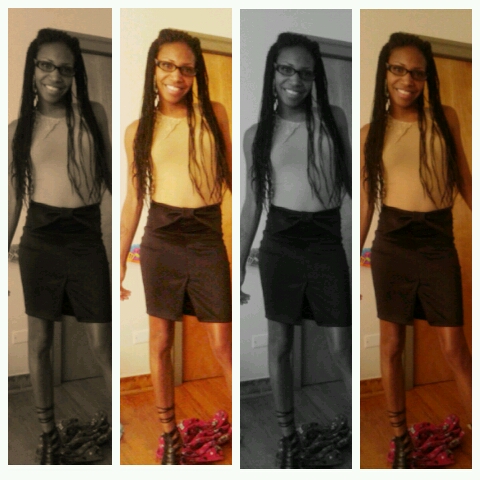
Honestly, I can’t teach your ways to anyone, nor do I know much about you. I don’t talk about you a lot either, or cough up revelations about how I came to enjoy the way your eyes capture and then freeze our lives. I do remember however our first real encounter. It was the 11th grade. Mrs. Luno coupled us for the school yearbook, and we walked the hallways of Harper High School like we had been together for years. You wrapped your arms around my neck and let my pupils kiss your face. Together we recorded, froze, and transformed time into memory. We followed Jesse Jackson and Arnie Duncan through interviews and meetings. You even let me choose what to see and hold you in my arms during assemblies, plays, and basketball games. Letting me control the way your body felt in my hands, and in seconds we created images both tangible and symbolic; both real and fantasy. It was the first time I came to appreciate this kind of relationship with technology. We had so much in common: Your shutter and my pupil, your film and my retina, and our capacity to record the past; your memory card, and my brain. I still don’t completely understand you, but goodness, don’t I love holding the camera!
Limitations

“If you live everyday, with the capacity to stretch yourself past limitation and structure, you will find boundless opportunity is all the places that once scared you.” ― Nikki Rowe
Guest Feature – Touched by an Angel

We, unaccustomed to courage
exiles from delight
live coiled in shells of loneliness
until love leaves its high holy temple
and comes into our sight
to liberate us into life.
Love arrives
and in its train come ecstasies
old memories of pleasure
ancient histories of pain.
Yet if we are bold,
love strikes away the chains of fear
from our souls.
We are weaned from our timidity
In the flush of love’s light
we dare be brave
And suddenly we see
that love costs all we are
and will ever be.
Yet it is only love
which sets us free.
Touched by an Angel – Maya Angelou
 The PBS Blog