Did you ever wonder what it was like to write about other people’s writing? That is the job of a book reviewer. I always wanted to be a freelance writer, and for me reviewing books is a perfect example of what a freelance writer does. I write book reviews as a public service to readers and authors alike, sharing my opinions of what I read.
Book reviewers are a valuable asset to all writers. I believe all serious writers should write reviews on other author’s books. The lessons learned are invaluable and will benefit your own writing. This process works for me. I see a marked improvement in my own writing skills since I began reading and sharing other writer’s work.
I follow a format designed to bring out the best aspects of any author’s work. The idea is to express my thoughts about a book in as honest a…
I was only two years old in 1989 so I obviously was not aware of these men when the story first broke. In 2002, when the man who committed the crime stepped forward and these men were officially declared innocent, you can still say that I was a baby being only 15 years old. As I think about my life and the things I was doing then, graduating Middle School and entering High School, I cannot help but to think about these men who, at 15, was on their way to jail.
You can say that they were doomed from the beginning. Let’s set the scene. In 1989, big cities like Chicago and New York City was overflowing with crack addiction within the black community.
“Crack popped up in Miami and Los Angeles in the 1970s. The Drug Enforcement Agency didn’t pay it much mind then. It was nothing more than a different version of cocaine, the agency figured. Crack arrived in New York City in the early 1980s before most of the public had heard anything about it. The department was understaffed. Budget cuts from the 1970s, when the city was almost bankrupt, had forced the NYPD to lay off nearly a third of its officers from 1975 to 1982. Meanwhile, crack began its spread across New York. It was cheaper than cocaine. Anybody could afford it, and anybody could sell it — anybody could buy a gram of coke, chop it up, cook it, and flip it for double the money. So now, all of a sudden, you have got a product that is saleable to a mass new audience,” Robert Strutman, a former New York city D.E.A. agent, told PBS Frontline in 2000. “And that is what the New York drug peddlers did. They mass-merchandized cocaine.” The media world first noticed crack in 1984, when the Los Angeles Times reported that “cocaine sales explode with $25 rocks.” According to a 1999 paper in Columbia University’s Souls journal, reporters began using the word “crack” in 1985. The earliest instance was a November 1985 story in the New York Times: “new form of cocaine, known as crack, was for sale in New York City.” By 1986, crack was available in 28 states. Newsweek called the drug’s impact a “national crisis.”
You can be sure that this was by no accident. The media practically advertised crack cocaine. Crack destroyed the Black community like no other weapon could. I speak not from a Google search or a spectator of the news, I speak from experience. I watched the drug take over the minds and bodies of those close to me. As a 90s kid, with crack being born in the 80’s, by the time I was growing up it was at its peak and those addicted were completely strung out. You see, it was cheaper than other drugs. This meant that everyone, including parents became junkies. No, not just parents, children.
This created gangs, drug dealers, and naturally, much violence. Because the victims of crack are African American in the majority, almost all crimes are presumed to be related, in some way, to blacks in the inner cities with an emphasis on males. So when a group of young men go to Central Park New York to hang out and witness numerous attacks that lead them to head home for curfew around the same time a young white woman (28yrs) is raped and beaten beyond recognition, it is no secret why police decide to bring these men in for questioning. Besides, it is a trend that has existed for centuries. Had this been 1929 instead of 1989, these men would not have had the “privilege” of an arrest, they would have just been hung from the nearest tree.
“Isa 42:22 But this is a people robbed and spoiled; they are all of them snared in holes, and they are hid in prison houses: they are for a prey, and none delivereth; for a spoil, and none saith, Restore.”
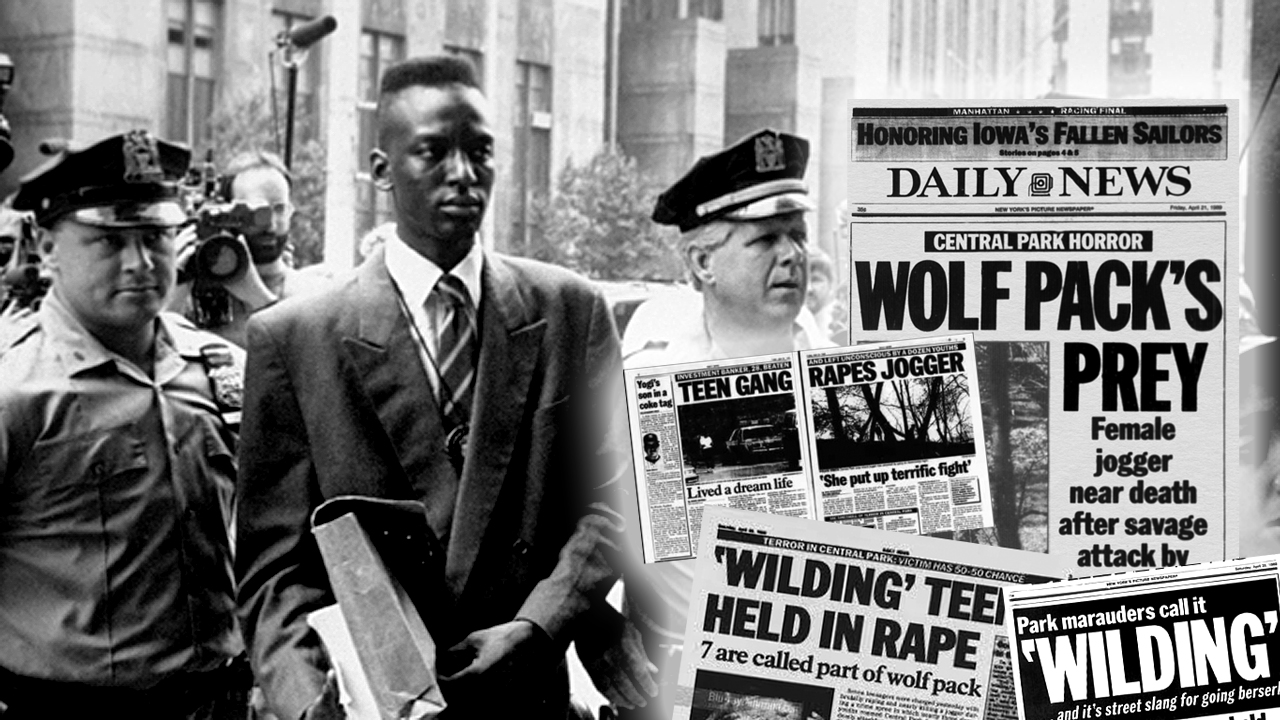
On April 19, 1989, five young men, ages 14 – 16 were recorded on video confessing to attacking, raping, and almost killing Central Park jogger Trisha Meili. In two separate trials, five young men were coerced into video taped and written confessions that sent them to prison. Still, after the confession, all of the young men pleaded not guilty and claimed that their videotaped confessions were concocted by the cops.
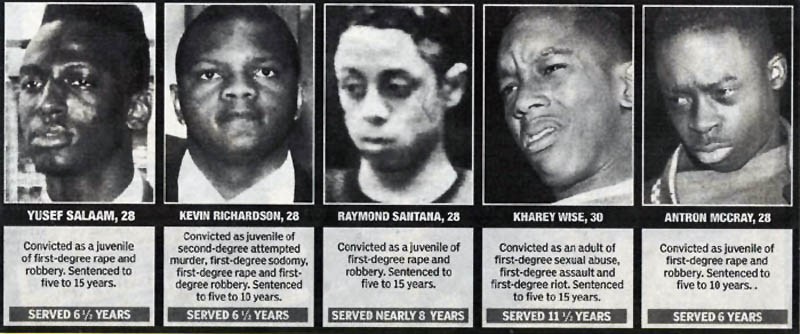
The story of the crime, as told by the police and prosecutors, was that a group of young people, were “wilding” through Central Park and after harassing a few other people, eventually led to the beating and sexual assault of the woman jogger. The story quickly exploded into the public eye, and I am sure those of you older than me remember the story. Because of the taped confessions, the jury ruled the young men guilt in two separate trials in 1990. Antron McCray, Kevin Richardson, Raymond Santana, Yusef Salaam, and Korey Wise served sentences ranging from five to thirteen years.
Korey, the oldest of the group, got the most time and was still enduring his sentence when he got into a confrontation with a man named Matias Reyes at the prison where they were both serving sentences. The confrontation was over something simple but Reyes apology had a far deeper meaning. Korey, presuming it was because of their jailhouse brawl, dismissed the man’s apology.
On August 12, 2001, just months after the only DNA collected at the crime scene, which was never tied to any of the accused, was matched, Korey got out of prison. Matias Reyes had committed to the crime that sent these young men to prison. In 2002, one year later, the young men were exonerated. However, their innocence did not ring as loudly as their assumed guilt.
The Central Park Five as Adults
In 2012, a documentary was premiered of this case titled “The Central Park Five”. For those of you on Netflix, you should find it there. Otherwise, I highly recommend you activate your Google skills and find it. It is a story far too familiar and is well worth the watch.
Some of us are just too close to the ground to see what the sky looks like and yet you, in your own way, have become the hanging crystal of inspiration. You stand unaffected among grand halls and ballrooms; of corporate offices and living rooms. I watch at the coming and going of guests. Some of them important, some not. They wrap themselves in fruitless conversation and rest their bottoms in chairs that hug the table beneath you. They shout with laughter and hold their noses in the air and yet they live on the ground. They have to look up to you and gasp in awe. So modest and rooted is this simple fixture in a room. I watch as your radiance pulls their mouths to the floor. Watch your occasional swing shift their eyes; watch your gracefulness stop their breaths. Softly and delicately, your crystals spark reflection like the conviction of a mirror, in which we are all forced to see ourselves. We try to move to a less luminous part of the room, but we are powerless to scorch your light. Voices rise to distract from your daintiness. The people scream and yell, come and go, but they are incapable of stealing your glory, let alone catch its shadow bouncing off the walls and chipping at the faces of guests. It is you oh Chandelier. You who remains steadfast and immovable, yet moving. Silent, and yet you sing. Fragile, and yet strong. Beautiful, and yet delicate. Modest, and yet shinning.
I don’t usually use an outline when writing my books but I found this really neat method I’d like to try. While I can’t say I’ll stick to it like glue, it looks like something that will help me to organize my thoughts without the confusion. For my next project I’ll be using The Snowflake Method. Click Here to check it out. After your reading, research, and daydreaming is done (when you have an idea of what the story is about), here is Step #1 from the article:
Step 1) Take an hour and write a one-sentence summary of your novel. Something like this: “A rogue physicist travels back in time to kill the apostle Paul.” (This is the summary for my first novel, Transgression.) The sentence will serve you forever as a ten-second selling tool. This is the big picture, the analog of that big starting triangle in the snowflake picture.
When you later write your book proposal, this sentence should appear very early in the proposal. It’s the hook that will sell your book to your editor, to your committee, to the sales force, to bookstore owners, and ultimately to readers. So make the best one you can!
Some hints on what makes a good sentence:
Shorter is better. Try for fewer than 15 words.
No character names, please! Better to say “a handicapped trapeze artist” than “Jane Doe”.
Tie together the big picture and the personal picture. Which character has the most to lose in this story? Now tell me what he or she wants to win.
Read the one-line blurbs on the New York Times Bestseller list to learn how to do this. Writing a one-sentence description is an art form.
Another important point: It doesn’t have to be perfect. The purpose of each step in the design process is to advance you to the next step. Keep your forward momentum! You can always come back later and fix it when you understand the story better. You will do this too, unless you’re a lot smarter than I am.
*******
Sounds exciting! There is also a book which you can find here. Are you writing a book? Share the method to your madness! How do you stay organized?
You may remember the review I wrote last year on Christa Wojo’s debut psychological suspense horror series SICK. In Book One, we peered into the life of Susan Branch, a woman struggling to take care of a very sick husband with a number of diseases plaguing his body. Well, I am happy to inform you that part two, SICKER is now available for pre-order! So, I am not ill but I did just preorder SICKER. The ending of SICK was so sick I cannot wait to continue reading. Click the book cover below to pre-order SICKER and welcome to the mind of John Branch.





 The PBS Blog