Do you write for therapy? Also known as Journal Therapy, Writing Therapy is the act of writing down thoughts and feelings to either come to a deeper understanding of self, or of the world, or just to provide a kind of healing to the stresses of abuse, insecurities, or everyday situations. It is a form of therapy that I am not sure that everyone who participates is even conscious of. Do writers who write recognize a form of healing from the process? Perhaps that is something we may explore in great depth at a later time. “What drives you to write? What makes you write? What kind of stain does having written a piece leave on you?” These are questions you may feel free to respond to at your own leisure; it will be interesting to see what our answers are to these questions.
In the 1980s many public school systems began formally using journals in English classes and across the curricula as well. These journals, often called “dialogue” or “response” journals, offered a way for students to develop independent thinking skills and gave teachers a method for responding directly to students with individual feedback. Although the intention for classroom journals was educational rather than therapeutic, teachers noticed that a simple assignment to reflect on an academic question or problem often revealed important information about the student’s emotional life. Students often reported feeling a relief of pressure and tension when they could write down troubling events or confusing thoughts or feelings.
Journal Therapy in Practice
Although there are many psychotherapists who incorporate journal therapy into their sessions by assigning written “homework,” there are relatively few who specialize in journal therapy. Therapists who utilize journal writing in a session often begin by asking the client to write a short “check-in” paragraph or two on “what’s going on” — how the client is feeling, what s/he wants to work on in the session, and what’s happening in her/his life that impacts the therapeutic work at hand. This writing is usually shared with the therapist, and an “agenda” for the session is set. The therapist then guides the client through a writing exercise designed to address the therapeutic issues or tasks that the client has brought forward in the check-in or warm-up write. This writing usually takes about 10 minutes, and the remainder of the session is spent with the client and therapist exploring the information revealed in the longer write. The session generally concludes with the therapist offering several suggestions for journal “homework” to be completed between sessions. Journal therapy is also very effective in groups, and it is common for group members to establish a sense of deep community as writings representing authentic expressions of self are shared.
Benefits of Journal Therapy
It is believed that by recording and describing the salient issues in one’s life, one can better understand these issues and eventually diagnose problems that stem from them. Journal therapy has been used effectively for grief and loss; coping with life-threatening or chronic illness; recovery from addictions, eating disorders and trauma; repairing troubled marriages and family relationships; increasing communication skills; developing healthier self-esteem; getting a better perspective on life; and clarifying life goals.
Sometimes you gotta realize that you are worth more than they way people treat you. And then you gotta realize the role you play in the way that people treat you. And finally, you gotta make the decision to stop letting people treat you that way.
This poem is based on a true story. A sista I know requested I write a poem based on her childhood. And after hearing her testimony, this is the result.
Silence lingers on every street corner of her heart
surrounded by the sounds of her own heartbeat
the only child
who knew that loneliness could be so loud?
Never remembering ever being a girl
womanhood emerging from her mother’s womb
responsibilities following her home wrapped in soft blankets and warm booties
yet infancy is kicked off too soon
removed
and replaced with scavenger instincts
tearing away at empty cupboards
hope falling asleep like heroine nods
quickly replaced with the tears of a three year old
silence tearing away at the soft eardrums of a toddler’s pride
never remembering ever being a girl
Quick paces of little feet turned nine
gotta get the cigarettes on time
crowded streets
little feet
unknown eyes that are watching me
(at least somebody’s watching me)
careful now these little feet
having never been a girl
Twelve times twelve,
twelve arrives
sadness in mommies cancer eyes
watch him do it and do it right
gotta give the medicine exactly right
the internal cries of that youthful voice (never really having been young)
somebody please tell me,
where is mommies tongue?
gotta carry cause mommies gone
will someone sing her daughters song?
The woman with the pink ribbons in her curls
the woman never having been a girl
Restaurants to wash myself
weed and drinks cause I watch myself
who cares for cute sinks when nothings left
seems like childhood just up and left
me sitting beside myself
empty benches now colored with the stench of my pain
smelly armpits reach out to beg for change
while relatives sit at home and count my change
whose willing to see this woman change?
Never having been a girl
Hustle proved its source of love
where does an instant woman find true love?
inside the arms of an abusive man she seeks her refuge from lazy hands
money giving light to dark places
apartment buildings giving substance to misplacement’s
where
where has it gone? My love? Where’s your part?
where oh where have you hidden my heart?
Numbers fade away like living water upon dirty dishes
this daughter of mine the result of these stitches
Entering the world as if she owns it!
Gotta hope another woman has not entered this world
praying my first child has the chance to at least,
just be
a girl.
Excellent Advice, stay true to yourself people, enjoy:
“Trying to write for your new audience (or trying to appeal to as many new readers as possible). Your readers relate to your voice. They care about what you have to say, and how you say it. Whatever you’re doing is already appealing to them; trying to be who you think we want to see mutes your natural voice, and trying to be all things to all readers leaves you with a diluted, perspective–less blog.”
I didn’t exactly intend on doing a book review, recommendation or whatever you wanna call it. But as I sat to contemplate what to write about today I thought back to this book and thought it would be a great recommendation for a nice historical read. After all, it is getting colder out and we all know what that means: winter time is reading time. 🙂
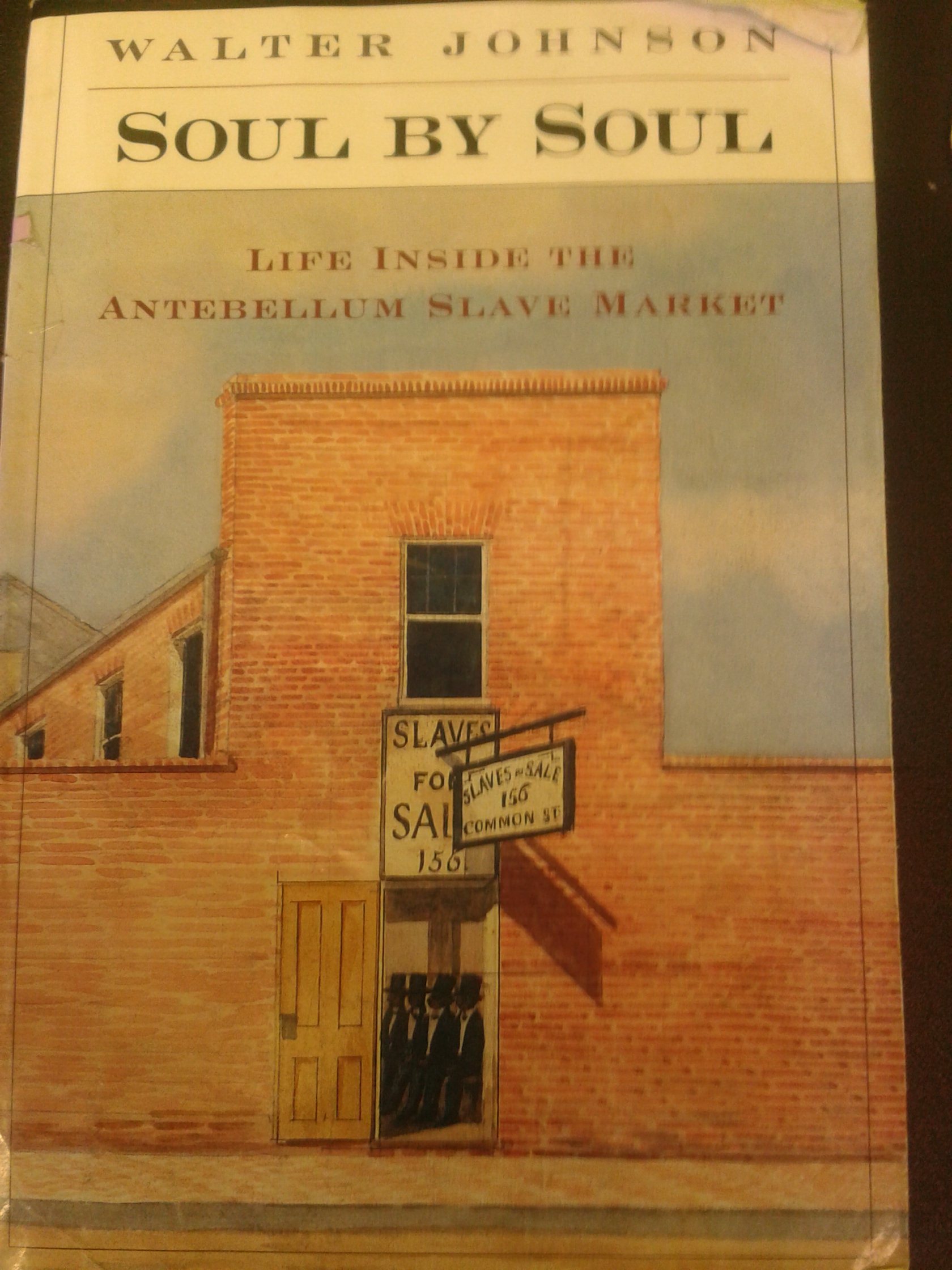
“Soul by Soul takes us inside the New Orleans slave market—the largest in the nation, where 100,000 men, women and children were packaged, priced, and sold. Walter Johnson transforms the statistics of this chilling trade into the human drama of traders, buyers, and slaves, negotiating slaves that would alter the life of each. He reveals not only the brutal economics of trading but the vast surprising interdependence among the actors involved, as well as the centrality of this “peculiar institution” in the lives of slaves and slaveholders alike.”
Let’s stop here.
What intrigued me about this book and what makes it, not necessarily better, but unique in lots of ways to other slavery books, is its 360 approach to the subject of the Trans-Atlantic Slave Trade. What do I mean 360 approach? I don’t think any of us would have such a complete understanding of chattel slavery on that face to face level like our ancestors, but I do think there are ways to understand it better. Many scholars, and lovers of Black History, limit themselves merely to that of slave narratives and African American Anthologies, though eye-opening, does not provide all of the details of the organization of this system. Many of us watch Roots and Amistad and thus conclude a valid understanding of this institution. I think taking the time to see this world through the eyes of a slave trader may in fact give some new and exciting insights into the system itself. If you are so “Pan African” that you cannot read literature that was written by a European, your perspective will always be limited. If you think the “white man” is the devil (foolishness), then your perspective will always be limited. Balance, as I speak about often, is key even in research.
So, getting back (*stepping off of soap box*), that’s what I like about this book. It’s not just about the history of this system through the eyes of the slave, but also through the eyes of the slave trader. When you understand it from that perspective it becomes a lot clearer as to what the slave represented. Not being of African American descent, the author takes on a business perspective when speaking about the trade in Louisiana. So instead of only focusing on the slaves experiences as a slave, the author actually takes us into the life of the trader. For it is he, the slave trader, who provides an overwhelming source of facts that justifies just how non-human the descendants of the ancient Israelites (Blacks) in fact were because you get to see how much of a business this was. His point of view, his mentality, his thought process as he went about his day to day business gives great insight into the market. I may caution you, when I use the term “non-human”, I do not mean people who were considered animals, I mean people who were considered less than animals, products: a bag of flour, a can of beans, a washing machine for example, is more equivalent to what the slaves were considered to be than an animal. For a slave slept on the floor, while the slave masters dog slept in his bed.
1 “And Yah shall bring you back to Egypt in ships, by a way of which I said to you, ‘You are never to see it again.’ And there you shall be sold to your enemies as male and female slaves, but no one to buy.”- Deut. 28:68
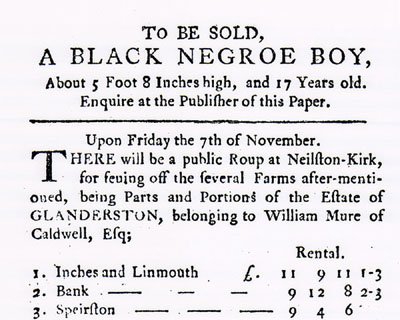
Since its inception, from the carrying of its cargo of Human’s, to its process of buy and sell, Blacks were less than human, and even given as gifts and pets to white children. Whenever a slave ship sailed into an American port, its arrival was announced by an advertisement in the local newspaper like a new product. Professional slave dealers would then come down to the docks to select their fresh batch of field hands and house nigga’s, who they would then sell to the slave masters on the street and on auction blocks. From birth, both slave masters and slaves themselves, came to view the slaves bodies as property, “their growth tacked against their value; outside the market as well as inside it, they were taught to see themselves as commodities.” Often slave owners would refuse an offer from other slave owners with the hope that in time their investment would increase, and an $800 slave would soon be worth $1,000. Big feet for example may indicate to a slave owner that his slave may be strong and stout one day, while his “skin and bones” appearance may bring down a hopeful price. “Through care and discipline, slaves’ bodies were physically incorporated with their owners’ standards of measure”. If a slave approached the auction block with two fingers cut off, both of which in a desperate attempt to escape chains, choosing rather to go about with eight fingers than to become a slave, the true manner of her disablement would have to be concealed for the time being. Her attempted escape would have to transform itself into one in which a doctor cut off one of her fingers due to illness and she, in an attempt to comply with the doctor’s orders, cut off the other one. In such case the slave is seen as so stupid and imitative that she would mutilate herself because it’s what the doctor did. For the auctioneer, this increased his chances of selling this slave. (This also shows how sometimes the slaves had the upper hand. At the same time, they could purposely lower their own prices and stop themselves from being sold to a particular master just by presenting themselves as disembodied or disobedient).
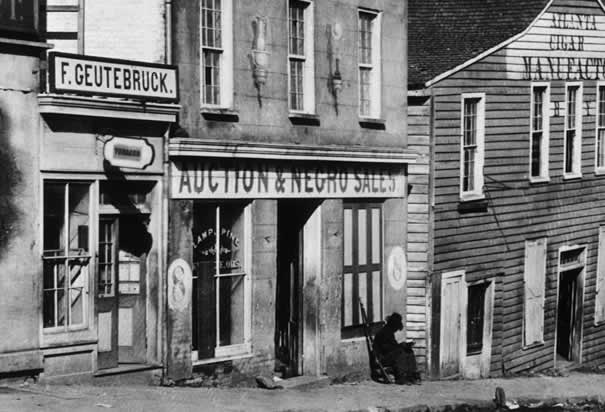
Andrew Joseph Russell (American, 1830-1902) Slave Pen, Alexandria, Virginia, 1863 Albumen silver print from glass negative
Because slavery itself was not some minute part of American society, there is no American business, whether small or great, that did not benefit from the institution of chattel slavery. After all, all slaves were the fabric that held the economic system together. But even at this point, in 2014, when this is a common fact, it’s still amazing how deeply this country’s economic system reflects upon the system of slavery. When I go to the mall and I stare dreamily into the windows of a cute outfit or browse by to catch a window peek at some fly shoes, my mind does not hearken back to slavery. However, even window shopping has its origin in this institution. It was during a time where slaves were not always sold on auction blocks and street corners, but they were also sold inside of what traders called Slave Pens. Traders would transport them to the designated slave pen, dress them up in the finest suits, grease them down so that they appear as clean cut as possible, and position them by the windows of the pens so that buyers could window shop. Slaves were, then, the first Mannequin.
Slaves were also used as collateral in credit transactions, and considered better than land, for these can be easily transported and traded for ready cash, similar to an Ace Cash Express, Currency Exchange, or Payday Loan. The business of the slave trade was constructed on the idea that “the bodies of human people had a measurable monetary value, whether they were actually sold or not”. Enslaved people meant so much to the economy of the United States that within the institution itself was the breaking of laws they themselves created to keep order. If we delve into the mind of a slave trader for just a moment, who builds his enterprise on the idea that Blacks can be bought and sold, within his company he has to also deal with men who cheat his very system by stealing slaves or selling dead ones. A slave trader who never traded before and has an illiterate understanding of the business may find himself being sold a dead slave and cheated out of his money. What slavery meant to the owner and the family of the owner is as simple as imagining a little white girl about the age of 8 during this time, staring out the window into a dim and rainy sky, she daydreams, “if only I had a slave who could stand out there, open his mouth and catch all the raindrops.” And if she’s lucky, her 9th birthday may grant her a special gift, called Toby.
Soul by Soul: Life Inside the Antebellum Slave Market
Available on Amazon.com now for as low as $7.75, search it and check it out.
the first time we met, I stood knee deep in lust
took advantage of your smile
never thought I would fall for it
too young to realize I’ve just never met a man before
dancing in your eyes
willing
to gamble my last just for a chance to see you again
your words,
so elegant that I thought deception wrapped its arms around my waist
tried
to convince me our love was nothing but child play
planned
to hold nothing in my heart but a piece of your gaze
and now
just maybe
you’ll let me kiss the anger from your voice
babysit your thoughts in my lap
let you feed on the wisdom of my breast
and we’ll dance neck up in peace & tranquility







 The PBS Blog