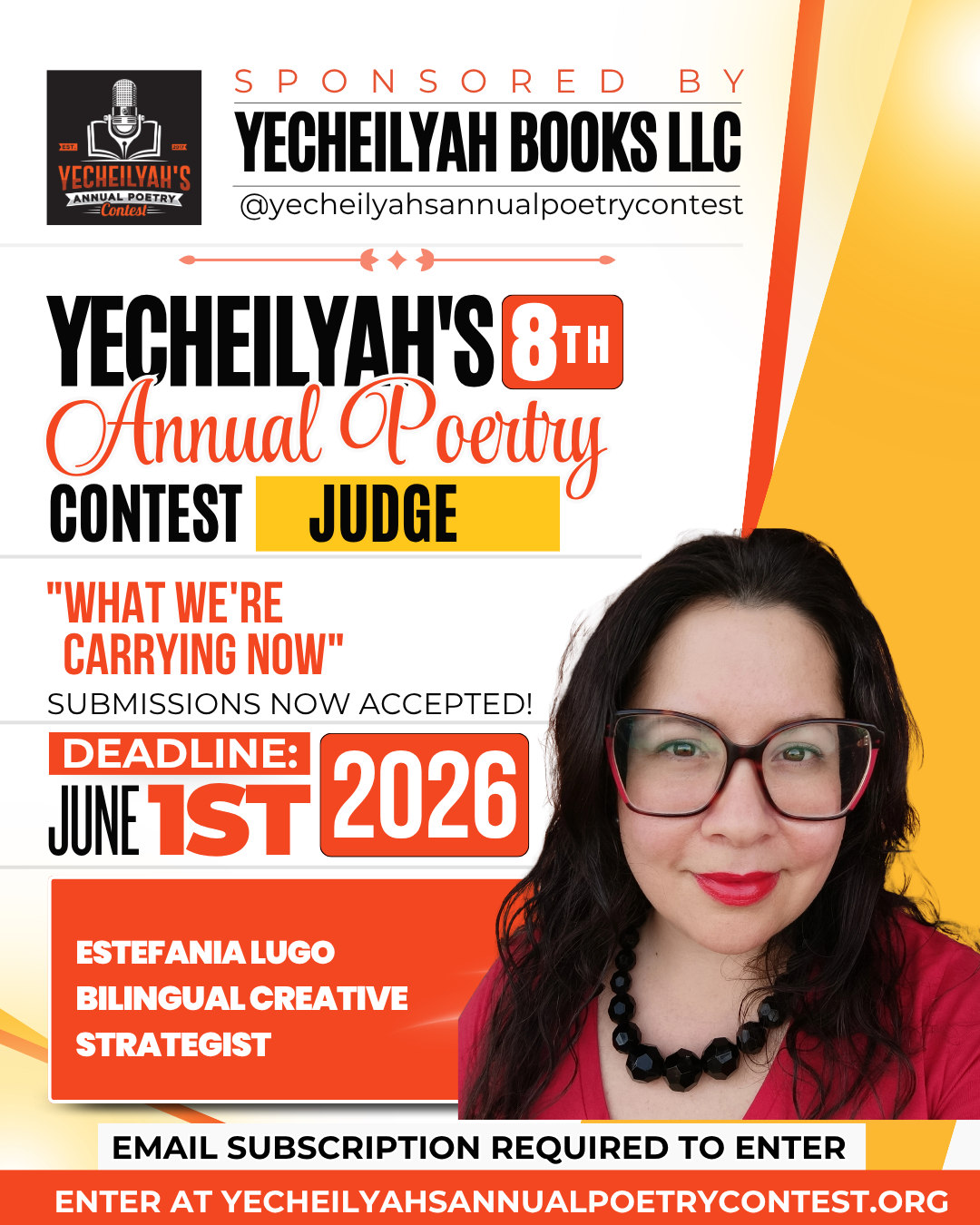
This week, we’ve been rolling out some of the amazing poets who are helping with this year’s contest. Up next is Estefania Lugo.
Estefanía Lugo is a brilliant bilingual creative strategist with a sharp eye for the written word.
She delights in exploring authors’ imaginations and celebrating the richness of their voices.
This contest is not just national but international, and we are honored to have Estefanía as part of the team!
If you are on Instagram, please head over to my page here and show her some love!
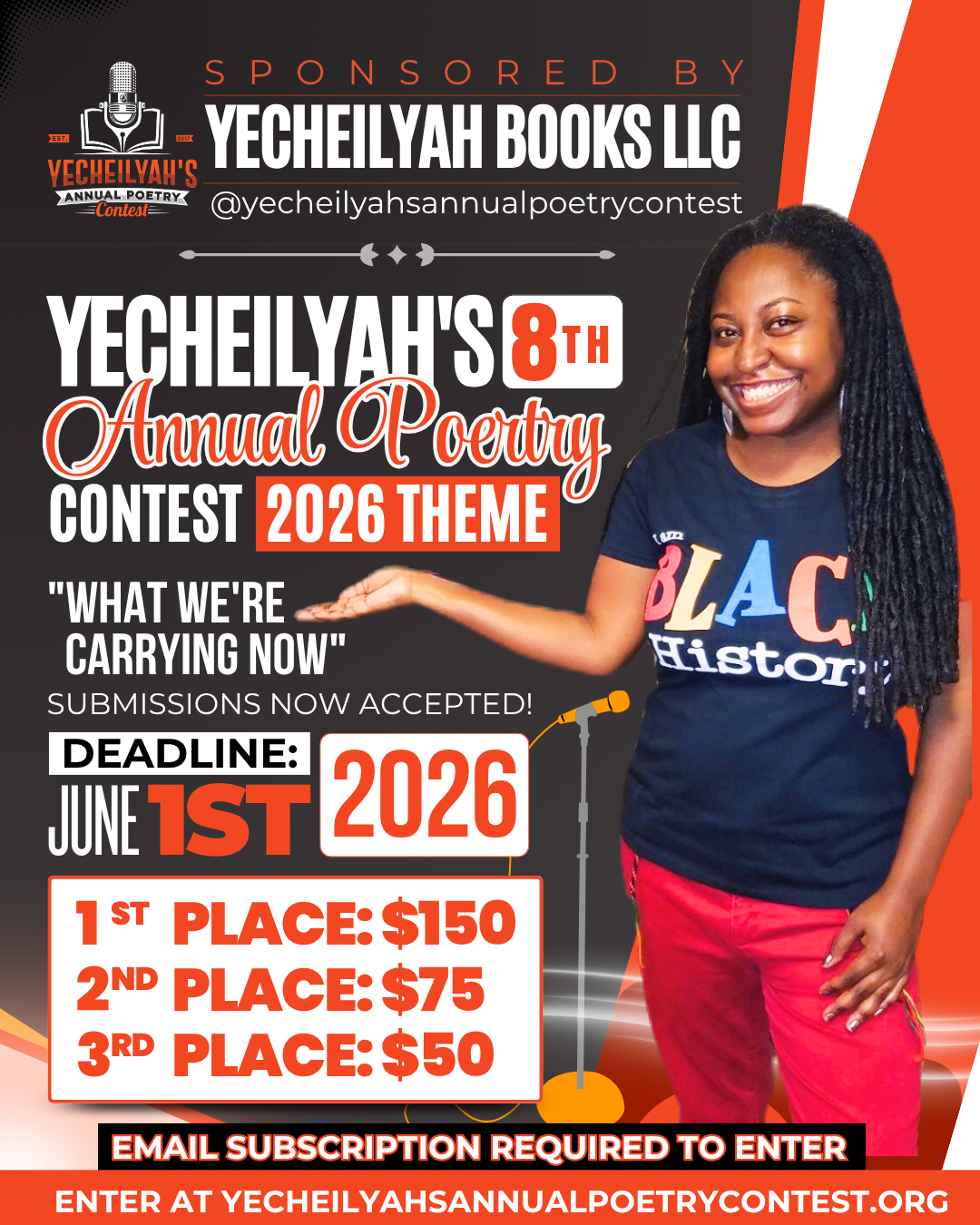
Reminder: This year’s poetry contest is accepting submissions from now to June 1st!
Theme: “What We’re Carrying Now.”
This theme explores personal loss, collective memory, survival, and the emotional weight of living in today’s world. Through this contest, we are not only uplifting poets, but we are also creating space for community storytelling, reflection, and connection through the arts.
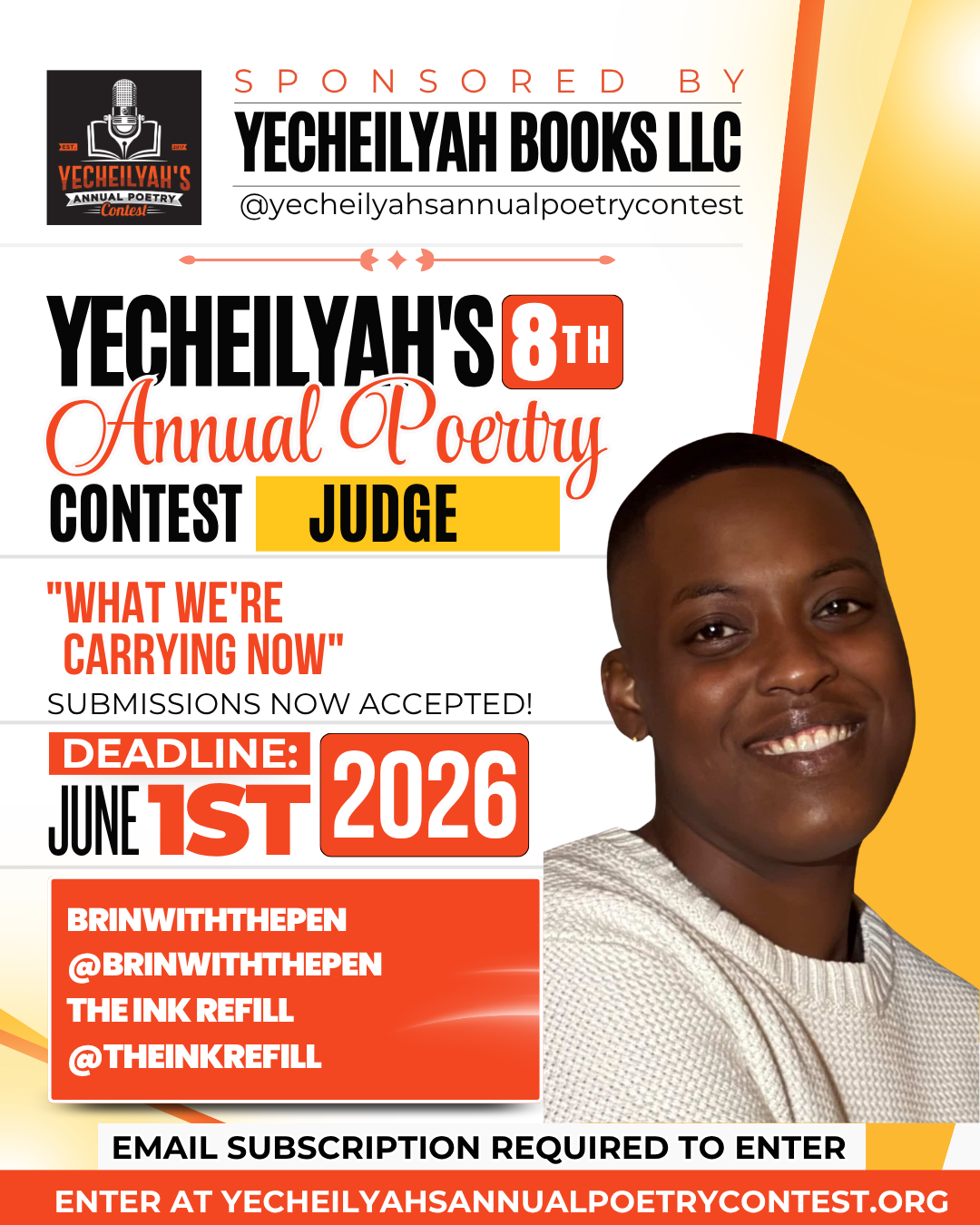
This week, we are rolling out some of the amazing poets who are helping with this year’s contest. Up next is BrinwiththePen.
Love-centered poet Brinwiththepen inspires safety and inclusion through her poetry and the workshops she facilitates.
Brin joined Atlanta’s poetry community in 2021 and pours into the intentional time and space of writing with The Ink Refill, a monthly poetry writing workshop.
I met her in 2024 when we were both poetry features at the same event. I also got to witness her brilliance at one of her workshops.
We are honored to have Brinwiththepen and her company as part of our judges’ panel for this year’s poetry contest!
Please help us welcome The Ink Refill to the team!
If you are on Instagram, please head over to @theinkrefill and show her some love!
We have more shout-outs to give. Stay glued.
Reminder: This year’s poetry contest is accepting submissions from now to June 1st!
Theme: “What We’re Carrying Now.”
This theme explores personal loss, collective memory, survival, and the emotional weight of living in today’s world. Through this contest, we are not only uplifting poets, but we are also creating space for community storytelling, reflection, and connection through the arts.
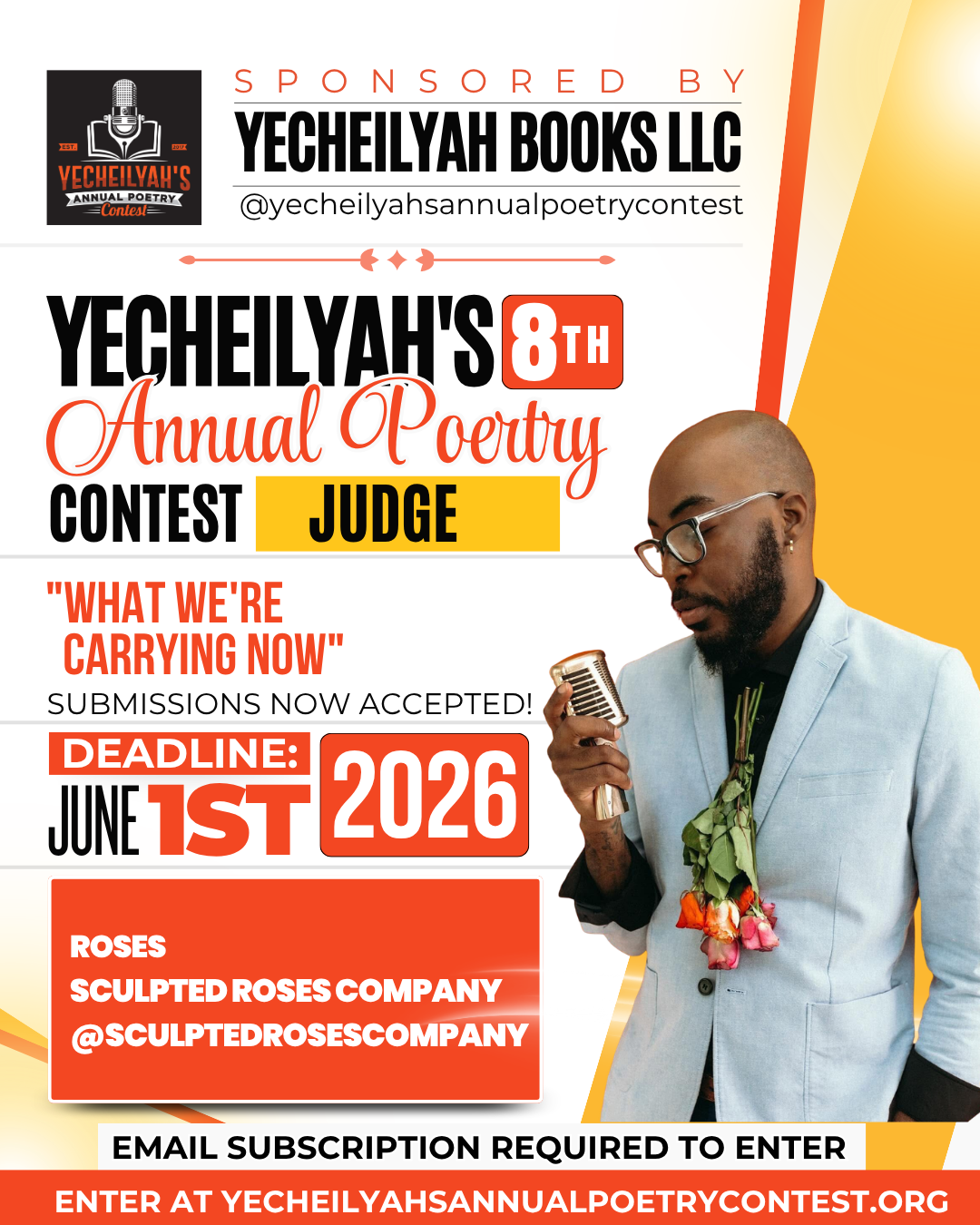
Today, we are rolling out some of the amazing poets who are helping with this year’s contest. Up first is Joshua Clark.
Joshua Clark, who goes by Roses, is a Dallas-based spoken word poet, creative specialist, and Texas Chapter Leader of the Poetry Business Network.
He is the CEO of Sculpted Roses Company (@sculptedrosescompany), where his team offers mental health and creative writing workshops, poetry sessions, and public speaking engagements.
We are proud to have Roses and his company as part of our judging panel for this year’s poetry contest!
Please help us welcome Sculpted Roses Company to the team!
If you are on Instagram, please head over to @sculptedrosescompany and show this brother some love!
We have more shout-outs to give. Stay glued.
Reminder: This year’s poetry contest is accepting submissions from now to June 1st!
Theme: “What We’re Carrying Now.”
This theme explores personal loss, collective memory, survival, and the emotional weight of living in today’s world. Through this contest, we are not only uplifting poets, but we are also creating space for community storytelling, reflection, and connection through the arts.
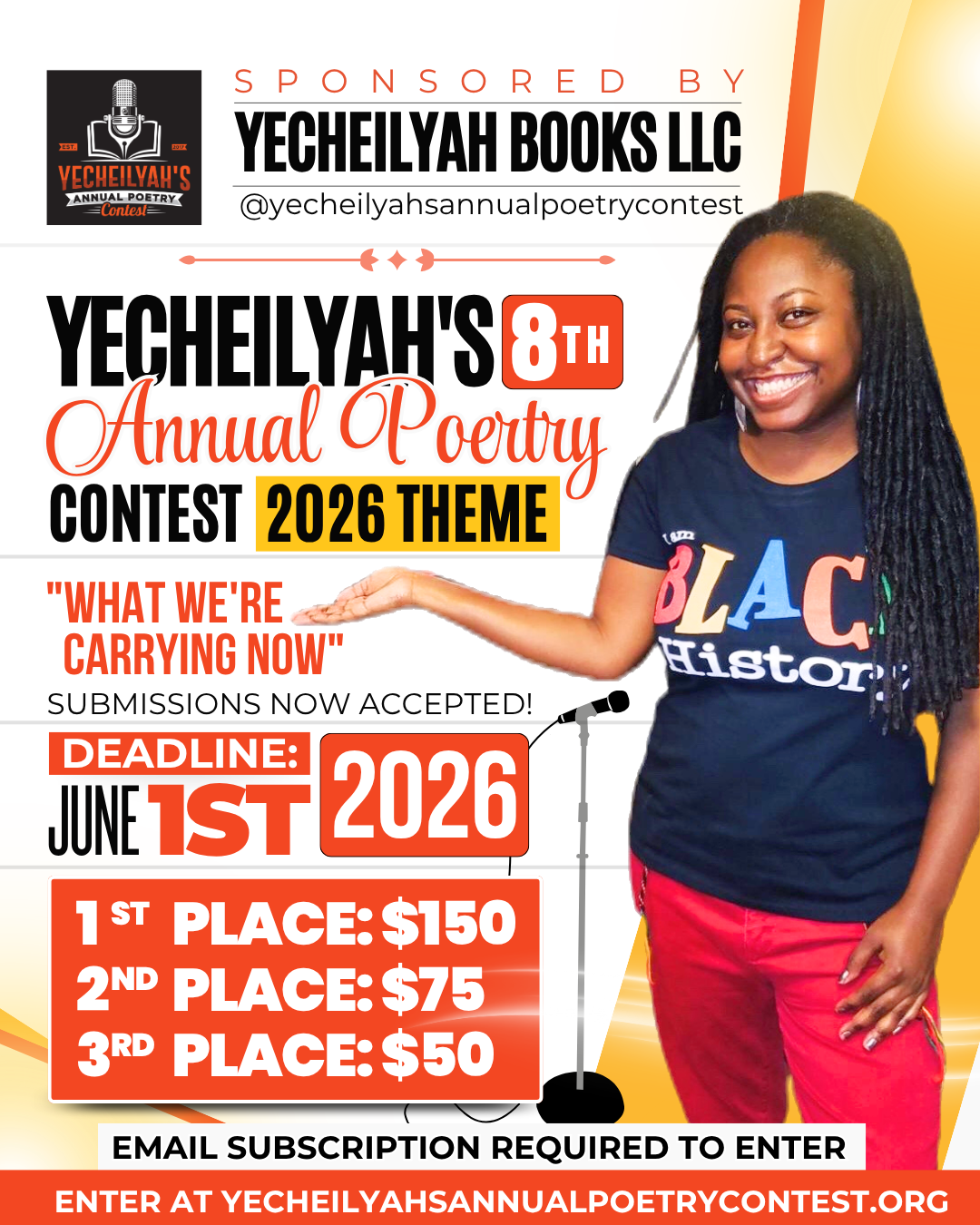
We are pleased to announce that this year’s poetry contest is now open! Submissions will remain open until June 1, 2026.
Entry: Email Subscription (Free)*
*If you are already subscribed, you can skip this step.
Theme: “What We’re Carrying Now.”
This year’s theme centers on personal loss, collective memory, survival, endurance, and/or the emotional weight of living in today’s social and political climate.
This year, we are asking poets to create a living archive of how they are processing, surviving, and making meaning in this moment in history.
What are you carrying this season? What are we carrying now?
We are living in an era where Black history is being erased every day, so I understand the excitement over discovering all the amazing things our people have done.
However, while I love me a good fun fact, I cannot help but notice that many of the Black history memes floating around social media are often grossly inaccurate or lacking context.
And some are flat-out wrong altogether.
And I am not talking about small pages either. Many of your favorite Black history accounts with millions of followers put out false information every day in the name of Black history.
Yes, this includes those on Substack… not really sure why ya’ll think this isn’t also a social media platform.
With a culture so rich and expansive as ours, we really do not need to embellish what we’ve done. The work is already powerful on its own.
Here are just a few things I wish we would explain more deeply. I am starting with this one because someone told me to “Shut up” on Instagram for pointing it out.
Mary Beatrice Kenner invented the maxi pad.
Context:
What Kenner invented was called the sanitary belt and moisture-resistant pocket, which is not exactly the same as our modern disposable menstrual pad.
Kenner’s patent eventually expired, leading people to take credit for her invention. A company also expressed interest but pulled back after learning she was Black.1
If Kenner had not been rejected, it is highly likely that she would have also invented the disposable pad, likely based on her original idea. However, what she invented was not the same as today’s adhesive pad, as many of these posts insinuate without proper context.
1880s–1890s: Early disposable pads were made of cotton and gauze, often marketed to women traveling by land or sea.
1896: Johnson & Johnson marketed “Lister’s Towels: Sanitary Towels for Ladies,” which were a notable early commercial attempt but failed due to social stigma.
1918–1921: Nurses in WWI used high-absorbency wood-pulp bandages, leading to the creation of Kotex, the first successfully marketed disposable pad.
1926: Johnson & Johnson introduced Modess Sanitary Napkins.
1956/1957: Mary Kenner patented an improved adjustable sanitary belt with a moisture-resistant pocket.
What I would change on this timeline, though, is that Kenner’s invention was in the 1920s, but because of racism, the sanitary belt did not come out until the late 1950s.
This is what I mean by adding context or looking deeper into what we read.
Let’s look at another one.
Claudette Colvin was the first to give up her seat before Rosa Parks.
There was also Aurelia S. Browder, who did it in April 1955, almost eight months before Rosa Parks’s arrest and a month after Claudette Colvin’s.
History is not the linear event we think it is. There is so much that happened, and so many people it happened to, we might never know about.
What Claudette Colvin and Rosa Parks represent is the culmination of many years of work and sacrifice by many different Black women.
And one more.
Lewis Howard Latimer invented the light bulb.
Context:
What Lewis Howard Latimer invented was an improved process for manufacturing carbon filaments for electric light bulbs.
In simpler terms, his invention made using light bulbs in homes and businesses more practical. His filaments could be heated to high temperatures without breaking, resulting in longer-lasting, more efficient, and affordable light bulbs.
These are a few easy ones I thought of because I see them a lot, but there are many more.
Before you sit in the Amen corner of anybody’s Black history post (including mine), make sure the information they are sharing is correct. Google (and Google Scholar) is right there.
Sluby, Patricia C. “BLACK WOMEN AND INVENTIONS.” Women’s History Network News, no. 37, 1993, pp. 4.. ↩︎
Lang, Martin. “Irene Morgan and her Impact on Freedom Riders.” ↩︎
Orr, Nicole. Famous Women in History: Ida B. Wells: Crusader for Justice. Curious Fox Books, 2025. ↩︎
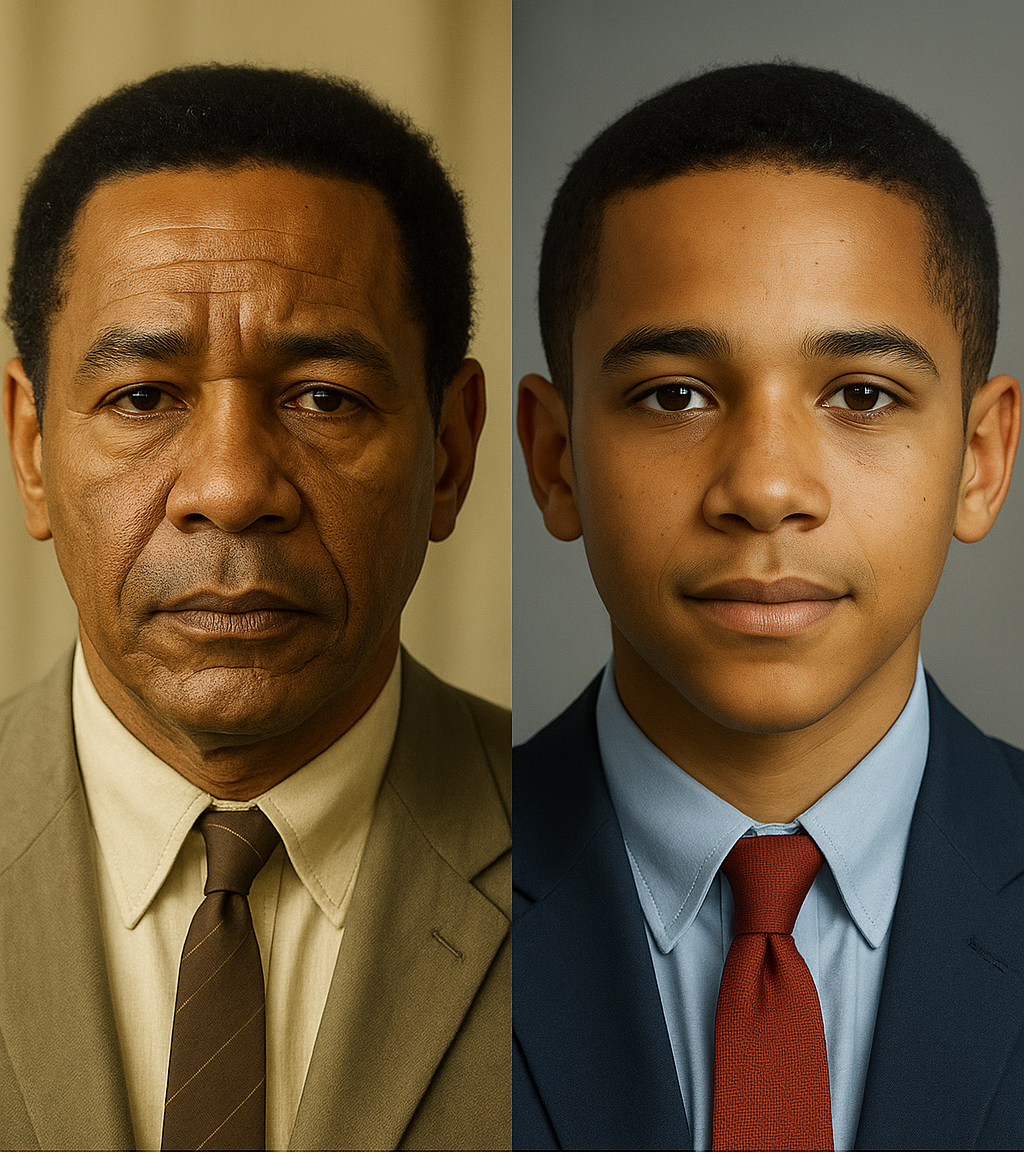
People knew his father and what he had contributed to the movement. They still spoke Joseph’s name with a kind of reverence, as though saying it might conjure the courage of another time. His photograph—creased at the corners, and yellowed with time, hung in barbershops and church foyers, beside posters for fish fries and gospel concerts.
Every February, Joseph’s face reappeared on classroom walls, a reminder of marches and megaphones, of a generation that refused to bow. For the community, Joseph was history come to life.
For Michael, he was just Dad.
Michael and his friends walked past the bulletin board in the school hallway. There it was again: his father’s face, eyes sharp, mouth set like a promise. Michael paused, thinking about his first days at Lindbloom.
“Ey, Mike! Mike!” a classmate had called. “Yo man, so how is it being famous? What was it like?”
Today, he would tell the person to go to hell, but back then, he just shook his head, a small, polite refusal that spoke louder than words.
Michael kept walking, shoulders tight, mind elsewhere, like the chess match he had lost last night. If he had not been hungover, his opponent would not have stood a chance. He didn’t particularly enjoy the taste of liquor, but it got his mind off thinking about walking in a legend’s shadow.
Tanya carried the legacy easily, quoting speeches and smiling at cameras as if born for the stage. But Michael kept to the edges. He wanted to be noticed for his own quiet triumphs—for the way his mind worked over a chessboard, or how the basketball arced perfectly from his fingertips.
Instead, people only ever asked about “The Movement,” their eyes expectant, as if he held some sacred story he refused to tell.
His father’s name was everywhere, in every conversation, every display, every “remember when” retold by people who seemed to think history lived only in him. Not in Michael. Not in the quiet hours he spent imagining, planning, thinking. They acted like he was Martin Luther King’s son.
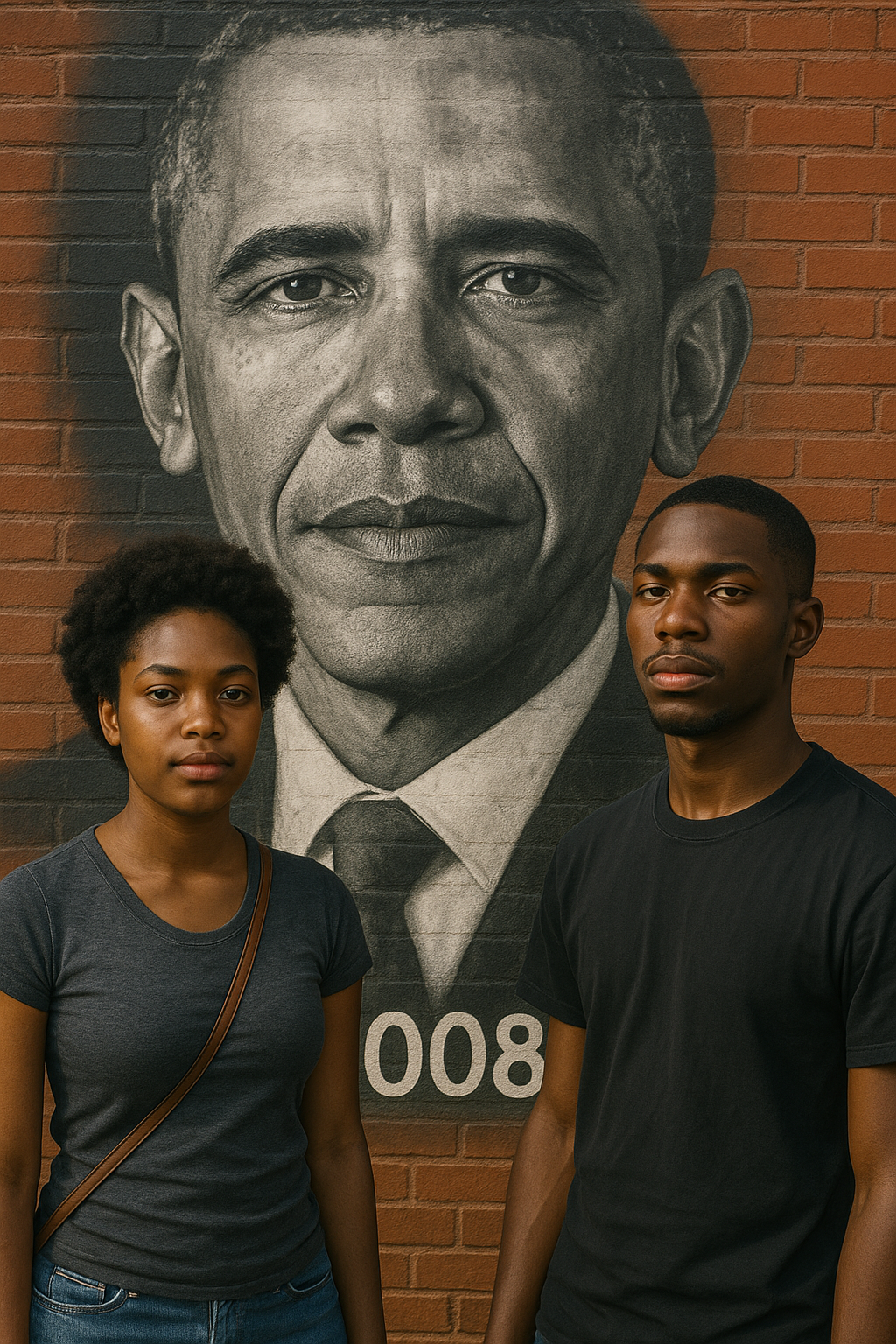
So what, his father took part in the Freedom Rides? What did that have to do with him? Michael didn’t care about no Barack Obama either. He wasn’t his Savior. He was just another politician. He swallowed hard, tasting the bitterness of being overlooked for the wrong reasons.
History had chosen him without asking, which is why he couldn’t admit to his friends or himself that he had a crush on a white girl.
Tanya McNair, dressed in her favorite navy-blue blouse, which bore a faint trace of glitter from the campaign rally a month ago, moved from group to group of the crowded apartment. Her living room was alive with chatter, laughter, and the occasional burst of applause from friends and neighbors whenever a commentator announced another state leaning toward Obama. Tanya looked fondly at the old TV set sitting on the floor beneath the big, flat-screen they were all watching.
The floor model television belonged to her grandmother, Sidney McNair—Mama Sidney to everyone who knew her. Uncle Eddy had bought it after great-grandma Judith passed, back when he and his sisters decided to remain in Chicago a while longer. That was also around the time her father, Joseph, disappeared into what he later called a revolution of self-discovery, also known as abandoning the family until he found himself.
The television had been there through it all.
It was the same set where great-grandma Judith—daughter of the great Solomon, son of the first Stella—watched the Black Panthers march down the street in their berets and rifles, demanding the freedom of Huey Newton.
The same screen that flickered quietly in the corner the day Aunt Karen’s boyfriend, Noah, stormed into their lives. Years later, she would name their first and only son after him.
For Tanya, it wasn’t just a piece of furniture but a sacred repository for memories, a portal to her family’s history.
Tanya frowned at the stacks of books on top of it, wondering if she was disrespecting her grandmother by using her TV as a table.
A cheer erupted from the room as the phone rang. Tanya’s heart raced as she ran to answer it without taking her eyes off the flatscreen. So far, Obama was winning.
“Sisss,” sang her little brother.
Tanya raised her eyebrows, “Are you drunk already, Mike?”
“Nah. I’m good. What’s the word?”
Tanya sighed, “Michael, you are not good. I can smell the Hennessy through the phone.”
Mike burst into laughter, and Tanya pulled the phone from her ear. That boy was gonna make her go deaf. “Where are you anyway?”
“I’m handling some business. Why, what’s good?”
“The business you were supposed to be handling is here. What happened to you helping me with the party?”
“The election party? You know I don’t get into alla that,” he said, slurring his words.
“Well, you need to get into it. History is being made. Have you talked with Dad?”
“History? Yea okay. Nah. I ain’t spoke to him today.”
“He was supposed to be coming over.”
“Coming over where?”
“Over here, to the apartment.”
“Not today, he ain’t. He told me he was working on the Malibu.”
“That beat-up old thing?” Tanya sighed. “And I thought you ain’t talk to him?”
“Look, pops don’t wanna hurt yo feelings, but you know the old man don’t vote.”
It didn’t make sense to her. Joseph McNair was born in 1945 and grew up in the ’60s at the height of the Civil Rights Movement. He had heard Dr. King speak, fought segregation with his friends through protest, and was even beaten for trying to integrate at a bus station during the Freedom Rides.
Finding out he really was a mixed Black man and not the white boy he grew up believing himself to be is a history lesson all its own.
And now, as the country waited with bated breath to see if the United States really would elect its first Black President, her father, the revolutionary of the family, didn’t participate in politics?
Joseph McNair was politics!
“Yo T, you there?”
Michael’s voice startled Tanya back to the present, her heart beating a million miles per minute as her guests sat on their hands, quietly waiting on the biggest announcement of their time, the walls echoing with hope.



 The PBS Blog