I stood in observation as my husband passed the cashier the card to complete the purchase. It was nice and warm out yesterday and the Little Caesar’s boomed with life. The bright orange and yellows of the colors blended perfectly with the chipper atmosphere that always accompanies warm weather. The young woman in front of us bounced around, smiling and joking as she completed the purchase, buzzing around the restaurant to finish other things, like what the young man behind her (slightly older, I round him off to be eighteen) was pulling up on the laptop. Yes, the laptop. Maybe it too wanted to take part in whatever it was going on up front, eager to be cradled in the arms of its owner. As my nose preoccupied itself with fresh dough and pizza sauce, I let my eyes roam the rest of the store. The warm ovens and counter-top blocked my direct view, however the bodies spilling over the sidelines and walking back and forth did not allow for much obscurity. Plus, the cooking area that I could not see wasn’t very concealed, resounding like the halls of a high school, the chit chatter of non business conversation floated into the air. An older woman sat waiting for the remake of an order as if she’d rather be watching the news, and a young man with three small boys came in behind us. The itty bitty’s could not have been more adorable, though they looked like three little men. Two of which sported white t-shirts and blue jeans, Jordan’s, light complexion, and a head full of what we used to call bee-bees (when the naps let you know it’s time for another haircut). These boys looked to be no older than a year and appeared to be twins. The other boy was darker in complexion and a couple years older with softer hair outlining a Mohawk. He was, by far, more outspoken if you will and decided it was time to climb on top the counter and see what all the commotion was about. He even decided he’ll stand up and had plans of jumping until his father caught wind of his body in his arms. Whew, that was close.
A couple more customers came in, two young women. The sun was out and so were they. I smiled at my husband who preoccupied his eyes with his cell phone. I’ll tease him about all the booty standing in his way later. Let’s just say there were enough thighs to go around. They were there to see if such and such had come into work today and discussed this with their friends, emptying conversation over the tops of counters and over the people’s heads.
As I sat back and watched this scene play out before me, feeling more and more like this was my kitchen and my children had invited their friends to dinner, I began to wonder: “It would be nice if the same black people who worked this store could also own it”. They are so content right now, making the hourly wage that could support Jordan and cell phone habits. But, what if we taught young people to look at their 9-5s as potential businesses? Often we ask ourselves, “What do I want to be when I grow up?” But our interest never completely change as we transition into adulthood. They are just better developed but they never completely change. So instead of the ancient “What do you wanna be when you grow up?” Is it possible to start asking the question: “What do you enjoy doing?” And, “in what way can you turn that into a business idea?'” If you work part time at a restaurant, why not see what it takes to own one like it one day? If you like doing hair, why not set out to have your own shop and list of clientele? Housekeeping at a hospital? What does it take for you to become licensed and contract yourself out to hospital chains and apartment complexes?
I could go on and on about why I think Black Entrepreneurship is important, but it is best that we look at the facts together:
“Koreans own the beauty supplies and nail shops; Arabs and Mexicans own the fast food restaurants and liquor stores; Jews / Europeans own the banks, pawn shops, and other lending institutions, and east Indians own the gas stations. The so called African American owns little to no businesses in his own community.”
African Americans are the biggest consumers and yet they own no businesses within their own communities. To be a consumer means you are not an investor, you are not an owner, you are instead a spender. Before the collapse of one of the most prominent African American communities in the nation, the dollar in the greenwood community of Northeast Tulsa Oklahoma rotated 36-100 times before it left the community. This means, the people in that community spent money at the local stores before going outside that community. For instance: Clothes bought at Elliot & Hooker’s clothing at 124 N. Greenwood could be fitted across the street at H.L. Byars tailor shop at 105 N Greenwood, and then cleaned around the corner at Hope Watson’s cleaners at 322 E. Archer. Today, the dollar leaves the black community in less than 15mins.
The Daily Post gave an exciting blog prompt yesterday on giving the book blurb to a book you want to write:
“Write the blurb for the book jacket of the book you’d write, if only you had the time and inclination.”
I wasn’t going to take part in this prompt initially, but since I have written a book (available soon), I decided this was the perfect time to give the book blurb to my upcoming book: “Beyond The Colored Line“:
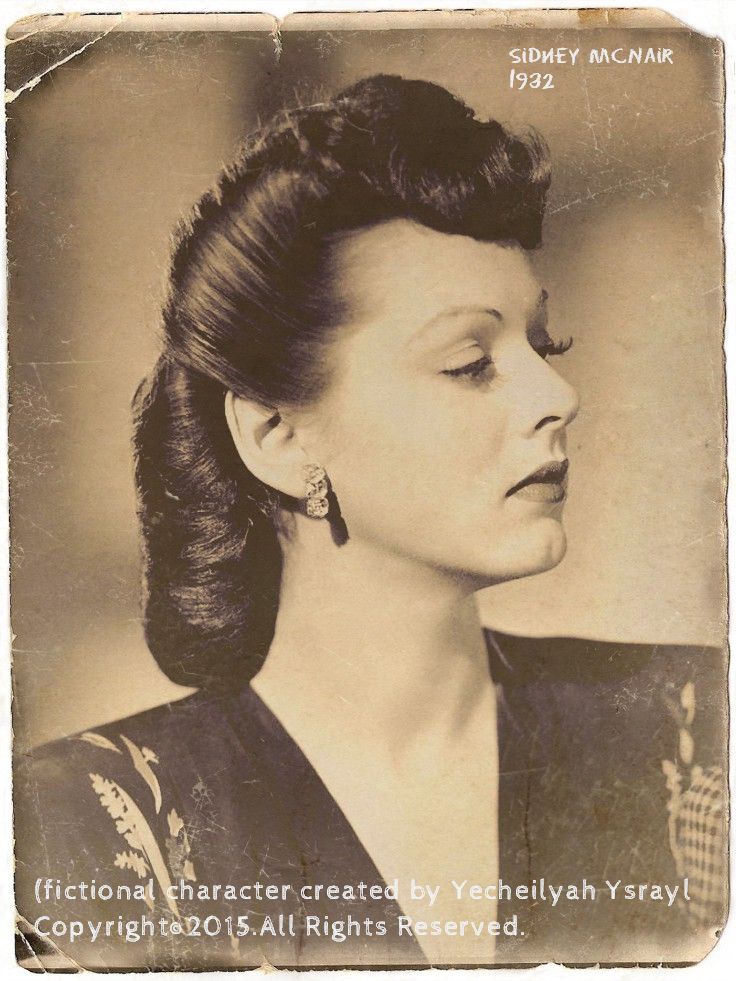
“Growing up has not been easy for Stella. Just a few generations from slavery, Stella is the daughter of Judith May. Mother and daughter share the blood of a black woman and her white slave owner. Unable to cope with the teasing and bullying from both the white and black kids, Stella struggles with identity and a place to belong. She does not feel she can find her rightful place among the blacks and neither among the whites. That is except on Saturdays. Stella loves Saturdays! Where her and mother take occasional walks on the town and enjoy all of the privileges that come with a light skin tone. Years later, after a discussion with Aunt Sara persuades her to pass, Stella decides to live her life as Sidney McNair, a white woman. But living Saturdays isn’t as easy as visiting them.
How will Stella deal with the new challenges that come with her new life? Will she ever find the courage to face the truth concerning herself? How far is too far?
Part 2
_________________________________________________
1928
5 Years Later
Age 12
*******************************
Daddy run off to who knows where on account of his life. Some racist whites had seen him and Mama together and threatened to lynch him if found. So he run off to nobody knows where. The community gossip is that his brothers know, but they won’t say. We weren’t alone though, Mama and me. Seems like Mama filled the hole where Papa should have been with our whole family. The house always stayed filled with guests: my people, and peoples of my people. My granddaddy was a colored man, and so owned this land. My name sake, his mama Stella, was a slave and was given this house by her owner. As the story goes, after Grandma died, I was born. Since Mama was the closest, she named me after her. We got stories going all the way back to her girlhood, and stories of Grandpa Solomon too. I heard the stories mostly on Sundays, since all the family come down. My aunts would gather around the table with my mom and they laugh and cry most of the night about they girlhood. I don’t have any uncles except from my daddy side, but they don’t come around much cause of my aunties. Uncle Roy say Mama acts different around her sisters and that they too uppity, especially Aunt Sara. She’s the youngest of my aunties and the most spoiled. She’s the one who convinced Mama to send me to a private school to escape all the worry, and boy were my uncles hot! They said we were breaking the law – that a Negro had no business in a white school. But Aunt Sara said I had all the right in the world since I was technically half white after all.
“But does the school know she colored?” one of my uncles would ask.
“That’s none of the school’s business now is it?” Aunt Sara would say and they’d just go back and forth until Mama break it up.
That’s the story of my life: Was I white? Was I Negro? Race wars always concerned these two groups of people, and there ain’t seemed to be much place for a mulatto. Speaking of race, not all talks were good talks. Not all round table discussions were filled with laughter and jolly drinking. I used to sit up until my eyes were red with fatigue to hear Mama and my uncles talk about all the killings that were taking place around the country, and especially in the south.
“That’s what I say,” said the voice of Uncle Keith. “Up there in Minnesota.”
“That close?” Mama gasped. I could just picture her now with her hand over her chest. Mama had a thing for the dramatics.
“Yea that close. What, woman you living under a rock? They just had one on over in DeKalb last month,” said Uncle Roy.
“It’s a crying out loud shame,” continued Keith. “Say they dragged the boys from the cell and a whole mob of ‘em lynched ‘em. Say it was bout least a thousand of ‘em.”
“My my,” said Aunt Rebecca.
“Well you know what I say, if you can’t beat ‘em, join ‘em,” said Sara.
“Where did you come from?” said Deborah, annoyed.
“From betwee–,“ began Sara.
“Please, spare us,” said Mama.
“I didn’t ask the question,” said Aunt Sara, smacking her lips.
But there were times, of course, I witnessed for myself evidence of the events rocking the country. One day, Mama and I went to visit Cousin Mary in Texas, and drove the truck up to a general store. We walked in, and being only about five at the time, I picked up a post card hanging on one of the shelves. It was of a man hanging on a tree that supported an iron chain that lifted him above fire. The man didn’t seem to have much of a body left. His fingers were cut off, his ears and his body burned to a crisp. On the back of the postcard read:
“This is the barbeque we had last night. My picture is to the left with a cross over it. Your son, Joe.”
I learned later the picture was of a 17-year old mentally ill boy named Johnny, who had agreed to having raped a white woman. And everybody at home still talked of the Cairo circus of 1909, the public lynching that took place here in Illinois. I asked Mama once if we could go to a circus like that, and she told me to never ask her of such things again. I couldn’t understand what had Mama so upset till I found out what kind of circus it was. It was events such as this that caused my aunts not to want much to do with the land or the house. They say it’s too close to slavery. So when Granddaddy died, Mama took on the burden of keeping it, and keeping it full too. I got kinfolk I see every weekend, and some I never met before. And some I don’t think are kinfolk at all; they just come for a hot meal and a bed. But that was alright with Mama. She didn’t care none about being taken advantage of. She just wanted to be around people she could feed and clothe. Her heart was just full of love like that. Sometimes they spend the night, but other times they just come and go. Sundays were the biggest days. Mama cook a feast of a dinner: fried chicken, yams, macaroni and cheese, fried brim and crappy, greens, pies, cakes. You name it, it was on our table. Everything except pork. Mama say Granddaddy was always talking about his Hebrew Heritage and teaching them about it too. Said he didn’t like being called Negro and African, and they weren’t allowed to call him that either, or themselves for that matter. Granddaddy say with his face all proud, “There are two things in the world I would never be: Christian and a Hog Head.”
Then he’ll light his pipe and go on rocking in his favorite chair, like the conversation was supposed to be over, even though folk mouths hung open. That’s another reason my uncles say we uppity:
“Everybody due for a lil fat back every now and again. Everybody Negro that is,” Uncle Roy would say, cutting his eyes over at Mama.
“Good thing we ain’t Negro then huh?” Deborah would shoot back.
Deborah, named after my great great great grandmother, fit right into her biblical name and was the most like Daddy, taking her Israelite Heritage seriously and practicing the laws of the Old and New Testament. Most of the family thought she was crazy. That didn’t stop her from speaking her mind though. But good eating and conversation was just the half of it. There was music, dancing, drinking, smoking, and gambling too. Cousin Walter would bring over some of his hooch and the grown-ups forget all about the children, which was just the way we liked it. I had a lot of cousins and friends, but no one was as close to me as Thomas. Tommy’s mom died off when he was just a baby, and his dad come across the road looking for direction one day when me and Mama come walking along. Come to find out they didn’t really need direction so much as a bed to sleep in. Mama let them stay with us for a while until Luther, Tommy’s dad, got off his feet. But that didn’t stop them from coming around. Luther and Mama became good friends and Tommy was over every weekend. My aunties used to think there was something going on between Mama and Luther till she shut up the gossip with news of Luther’s lady friend, who also became friends with Mama. So naturally Tommy and I were good friends, but we were also enemies and partners in crime. Tommy was dark as charcoal with big lips, nappy hair, and a wide nose. And I envied him for being so obviously Negro. It’s the same reason I liked him too.
“How you get so dark?”
“I don’t know,” said Tommy. “Just lucky I guess.”
“Lucky? What you got to be so proud for? Ain’t no girls liking no skin that dark.”
“Shut up white girl,” said Tommy.
“Shut up big head,” I say.
That’s usually when he punches me in the arm and I’d have to hunt the rest of him throughout the house.
We weren’t much of a church going family; party going is more like it. Except when Mama wanted to show off a new dress or hat, when somebody died or needed saving, and on Holidays and such. Folk would come from all over southern Illinois to hang out with “Cousin Judy”, as Mama was often called. Sunday’s sure were fun, my second favorite day of the week.
Saturdays was my favorite day of the week. It was the day for shopping and that only meant one thing: Chicago. First, Mama would wake me to the smell of biscuits or pancakes. This was to keep me full enough throughout the day so she didn’t have to worry none about food buying. Then, I was commanded to bathe down real good, paint my arms and legs with oil, untie my curls from the night previous, and we’d both put on our Sunday’s best and be two of the most beautiful women you’d ever seen. I was a young lady now and shopping was the best thing to a young lady next to boys (but you couldn’t like them in public). You could like shopping though. I loved going from store to store in search of the finest. Skipping along while Mama scanned the insides of magazines for stuff she only saw on TV. We would squeeze our way through crowds of people, just bumping into each other. They weren’t dressed as professional today. Instead, they wore their weekend wear, bought ice cream for their children and went inside movie theatres, and so did Mama and I. We could buy candy or jewelry, or perhaps a new hat or two with the money Mama made from the laundry. We drank from water fountains without label, and spent money without prejudice. Everything was so easy on Saturdays, life itself was better. We had us a good time on Saturdays because on Saturday, no one knew we were colored.
– Stella M.
**********************************************
What did you think about the second part? I hope it held your interest and you’re ready for chapter three. I am leaving you with a surprise part from Book 1 below. For the prologue to Book #1, see last week’s post. If you like this story so far, would you do me the favor of sharing this post with your friends who might enjoy reading it also? Re-blog or share on your social networks. Thanks a lot! And I’ll see you next week for Part 3.
This post is a reminder of the continuation of the sneak peek series into my upcoming book “Beyond The Colored Line”. Tomorrow, we will be reading through Part 2.
“Beyond The Colored Line” is Book #2 in a short story series I’m writing called Stella. Stella is a work of Historical fiction, and is distinctive in its focus on one woman’s road to self-discovery against the backdrop of the African American fight for justice, racial equality, and freedom. The 3-Part series focuses on the history of one family in their struggle for racial identity. Discover in this Trilogy how 3 individuals living in separate time periods strive to overcome the same struggle, carefully knit together by one blood.
The first 4 parts to Book #2 is being released right here on this blog every Thursday; they started last week and will go on until May 7th. I’m giving these parts away for free because one of the things I enjoy about blogging is the direct feedback available to us. I think it is an awesome way to network, to build relationships with other authors, and to enhance our writing skills so I’m taking advantage. I am also seeking to broaden my platform and make it easier to connect with readers.
In case you missed it, below is the link to last week’s story, Part 1 of Book #2. I hope it captures your attention, and I look forward to the revealing of Part 2 of Book 2 early tomorrow morning:
I would like to present first Philips Wheatley because as I embark on publishing my third collection of poetry, I cannot help but wonder what it must have been like for her to be the first. Phillis Wheatley was the first black poet in America to publish a book. She was born on May 8, 1753 in West Africa and brought to New England in 1761, where John Wheatley of Boston purchased her as a gift for his wife. Like many of her time, Phillis was taught to read by her owners and could read and write English by the age of nine.
Many people are under the impression that slaves were of pure ignorance; that they muttered broken English because they were imbecile. This is not truth. Slaves were only ignorant so far as the English language is concerned, at which they could not read, write, and could barely speak. They were strangers in a foreign land and introduced to ways to which neither they nor their fathers had known. Put me in the middle of a street in China and see how dumb I will be.
Nonetheless, Wheatley also became familiar with Latin, Greek, the Bible, and selected classics at an early age. She began writing poetry at thirteen (around the same time I started writing), modeling her work on the English poets of the time, particularly John Milton, Thomas Gray, and Alexander Pope. Her poem “On the Death of the Rev. Mr. George Whitefield” was published as a broadside in cities such as Boston, New York, and Philadelphia and garnered Wheatley national acclaim. This poem was also printed in London.
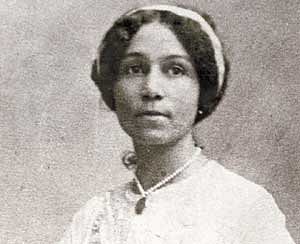
Anne Spencer
1882–1975
Anne has too many names for me to keep up with so we’ll stick with Anne Spencer. Anne was born in Virginia in 1882. She was the daughter of a former slave and her mother enrolled her in school for the first time when she was eleven years old. She graduated seven years later as valedictorian. Known as a “Harlem Renaissance Poet”, Anne was good friends with many Harlem Renaissance writers, including James Weldon Johnson, Langston Hughes, and W.E.B. Du Bois. Spencer’s poetry engages themes of religion, race, and the natural world. Thirty of her poems were published during her lifetime, in such anthologies as The Book of American Negro Poetry (1922) and Caroling Dusk (1927) and was the first African American woman poet to be featured in the Norton Anthology of Modern Poetry (1973).
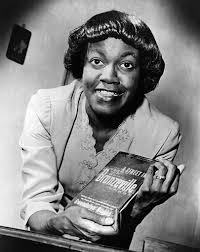
Gwendolyn Brooks
1917–2000
For some reason, whenever I say this woman’s name I think of Books. Seems like it should be Gwendolyn Books, but anyway, Brooks and I do actually have something in common: we are both from Chicago. Brooks was born in Topeka, Kansas, but her family moved to Chicago when she was young. Her father was a janitor who had hoped to become a doctor; her mother was a schoolteacher and trained pianist. They were supportive of their daughter’s passion for reading and writing. Brooks was thirteen (again around the same age I was when I began writing) when her first published poem, “Eventide,” appeared in American Childhood; by the time she was seventeen she was publishing poems frequently in the Chicago Defender, a newspaper serving Chicago’s black population. After such formative experiences as attending junior college and working for the NAACP, she developed her craft in poetry workshops and began writing the poems, focusing on urban blacks, that would be published in her first collection, “A Street in Bronzeville”.
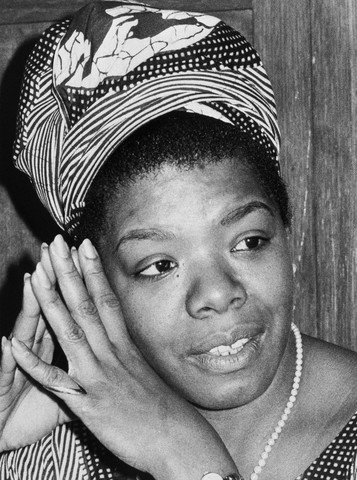
Maya Angelou
1928-2014
I could probably leave this part blank and many of you would still know who this woman was. The poet and award-winning author known for her acclaimed memoir “I Know Why the Caged Bird Sings” and her numerous poetry and essay collections. Born on April 4, 1928, in St. Louis, Missouri, writer and civil rights activist Maya Angelou is known for her 1969 memoir, I Know Why the Caged Bird Sings, which made literary history as the first nonfiction best-seller by an African-American woman. In 1971, Angelou published the Pulitzer Prize-nominated poetry collection “Just Give Me a Cool Drink of Water ‘Fore I Die”. She later wrote the poem “On the Pulse of Morning“—one of her most famous works—which she recited at Bill Clinton’s inauguration in 1993. Angelou received several honors throughout her career, including two NAACP Image Awards in the outstanding literary work (nonfiction) category, in 2005 and 2009. She died two days after my 27th birthday on May 28, 2014.
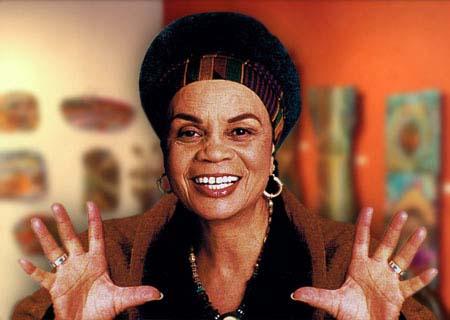
Sonia Sanchez
1934
Sonia is another poet whose name rings with such prominence that I could leave her bio blank too and many of you would still know who she is. Born Wilsonia Benita Driver, on September 9, 1934, in Birmingham, Alabama Sanchez lived with her paternal grandmother and other relatives for several years after her mother died in childbirth a year later. In 1943, she moved to Harlem with her sister to live with their father and his third wife. Sonia married and divorced Albert Sanchez, a Puerto Rican immigrant whose surname she kept.
In the 1950s, Sanchez formed a poets’ group, the Broadside Quartet. Sanchez began teaching in the San Francisco area in 1965 and was a pioneer in developing black studies courses at what is now San Francisco State University, where she was an instructor from 1968 to 1969. Sanchez is the author of more than a dozen books of poetry, including “Morning Haiku” (Beacon Press, 2010); “Shake Loose My Skin: New and Selected Poems” (Beacon Press, 1999); “Does your house have lions?” (Beacon Press, 1995), which was nominated for both the NAACP Image and National Book Critics Circle Award; “Homegirls & Handgrenades” (White Pine Press, 1984), which won an American Book Award from the Before Columbus Foundation. From the 1970s through the ’90s, she wrote poetry, plays and kids’ books. She retired from her Laura Carnell chair in English in 1999.
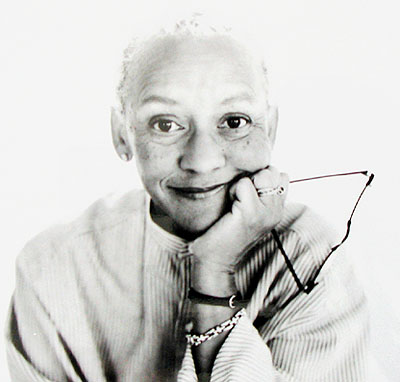
Nikki Giovanni
1943-
Giovanni’s collections, like the women before her, focused on African American identity. Born Yolanda Cornelia, Nikki Giovanni was born in Knoxville, Tennessee on June 7, 1943 and raised in Cincinnati Ohio, a place I got the chance to visit for our 8th Grade school trip. On July 28, 2000, when I was thirteen years old, I lost my Dad to cancer. In December of 2014, I lost my Aunt to the same disease. In some way or another I can sympathize with Giovanni, who is not only a poet but a Lung Cancer survivor and has contributed an introduction to the anthology Breaking the Silence: Inspirational Stories of Black Cancer Survivors (Hilton Publishing, 2005). Giovanni has been awarded The Langston Hughes award for Distinguished Contributions to Arts and Letters in 1996, as well as more than twenty honorary degrees from national colleges and universities. She has been given keys to more than a dozen cities, including New York, Los Angeles, Dallas, Miami, and New Orleans. She has served as poetry judge for the National Book Awards and was a finalist for a Grammy Award in the category of Spoken Word.
She is currently professor of English and Gloria D. Smith Professor of Black Studies at Virginia Tech, where she has taught since 1987.
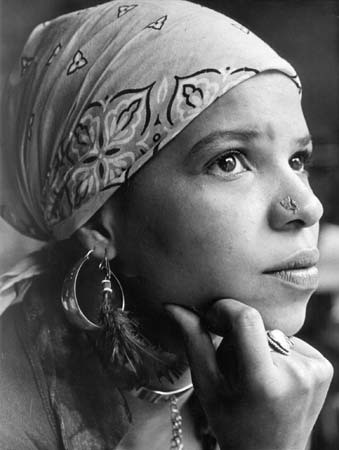
Ntozake Shange
1948-
I fell in love with Shange’s poems almost instantly. I really enjoy the raw truth of experience embodied in the words and the style in which they occupy the page is hard to ignore. I like how she allows the words to be written just how they are spoken, how they ignore the “professionalism” of the edit. (though poetry does tend to allow for this kind of freedom).
Born Paulette Williams, Ntozake Shange was born into an upper middle-class African-American family. Her father was an Air Force surgeon and her mother a psychiatric social worker. Cultural icons like Dizzie Gillepsie, Miles Davis and W.E.B. DuBois were regular guests in the Williams home. Shange attended Barnard College and UCLA, earning both a bachelors and master degree in American Studies. But Shange is most famous for her play For Colored Girls Who Have Considered Suicide/When the Rainbow Is Enuf (1975) which is how I was introduced to her. A unique blend of poetry, music, dance and drama called a “choreopoem,” it “took the theater world by storm” said Jacqueline Trescott in the Washington Post, as it “became an electrifying Broadway hit and provoked heated exchanges about the relationships between black men and women…Its form—seven women on the stage dramatizing poetry—was a refreshing slap at the traditional, one-two-three-act structures.” The play uses female dancers to dramatize poems that recall encounters with their classmates, lovers, rapists, and abortionists. The women survive abuse and disappointment and come to recognize in each other the promise of a better future.
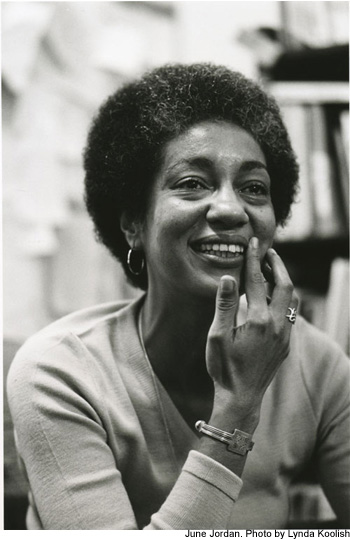
June Jordan
1936-2002
June Jordan is the author of children’s books, plays, a novel, and Poetry for the People: A Blueprint for the Revolution (1995), a guide to writing, teaching and publishing poetry. Her collections of political essays include Affirmative Acts: Political Essays (1998) and Technical Difficulties (1994). Basic Books published her memoir, Soldier: A Poet’s Childhood, in 2000.
Born in New York City on July 9, 1936, June Jordan attended Barnard College. She received the National Association of Black Journalists Award, and fellowships from the Massachusetts Council on the Arts, the National Endowment for the Arts, and the New York Foundation for the Arts.
Her numerous books of poetry include Directed by Desire: The Collected Poems (Copper Canyon Press, 2007), Haruko/Love Poems (1994), Passion (1980), and Things That I Do in the Dark (1977), among many others. She taught at the University of California, Berkeley, where she founded Poetry for the People. June Jordan died of breast cancer on June 14, 2002, in Berkeley, California.
Rita Dove
1952-
Rita Dove is the first African-American woman to be named Poet Laureate of the United States, and only the second to win a Pulitzer Prize for poetry (Thomas and Beulah, 1987), Rita Dove has achieved a great deal in her career. Her multi-layered poems dramatize the stories of individuals both living and dead against the backdrop of larger historical forces (I really like “Reverie in Open Air”). Rita was born in Akron, Ohio on August 28, 1952. Her books of poetry include (but are not limited to) Sonata Mulattica (W. W. Norton, 2009); American Smooth (W. W. Norton, 2004); On the Bus with Rosa Parks (W. W. Norton, 1999), which was named a New York Times Notable Book of the Year and was a finalist for the National Book Critics Circle Award. In addition to poetry, Dove has published a book of short stories, Fifth Sunday (University of Kentucky Press, 1985), the novel Through the Ivory Gate (Pantheon, 1992), essays in The Poet’s World and the verse drama The Darker Face of the Earth (Story Line Press, 1994). She also edited The Best American Poetry 2000 and The Penguin Anthology of Twentieth-Century American Poetry (Penguin, 2011).
Dove is Commonwealth Professor of English at the University of Virginia, where she has been teaching since 1989.
********************************************
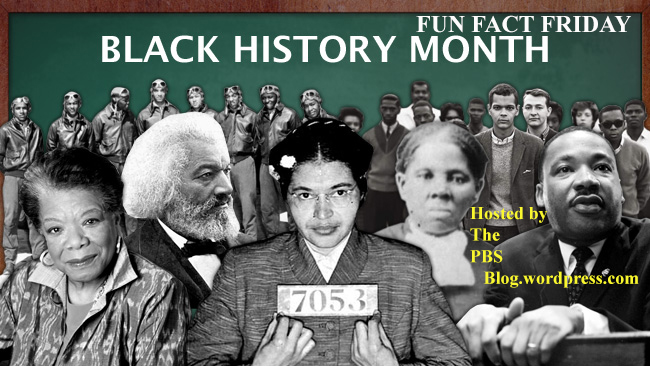
And that’s it for this week’s episode of Black History Fun Facts. Don’t forget to check out last week’s episode, in case you missed it:
I believe life tends to happen in stages. There are certain bridges that we have crossed as stepping stones to get to where we are; a small portion of the bigger picture to lead us on. And even where we are today is of itself a mere foundation for where we will be tomorrow. As I think about this, I am recalled to Lucille’s quote and I am reminded of the compassion and the respect that we should have for one another because you never know what’s beyond those eyes. What they have seen, what they see, or what they have endured. And even our idea of what seems difficult or simple can play a different role in the life of someone else. I may have known homelessness but the man who lost his mother to cancer may experience a struggle that would have broken me, whereas my homelessness could have broken him. Makes me think about what each person has endured and how it has contributed to their strength. No matter how seemingly small it was something that we ourselves probably could not have faced if given the chance to do so.
About the Author:
Lucille Clifton 1936–2010
What I noticed right away about Lucille is that she puts the sweet in “short and sweet”. Her poems are often not very long-winded, but they are short, almost speeding like, but not tasteless. Clifton is noted for saying much with few words. In a review of her work, Peggy Rosenthal commented, “The first thing that strikes us about Lucille Clifton’s poetry is what is missing: capitalization, punctuation, long and plentiful lines. We see a poetry so pared down that its spaces take on substance, become a shaping presence as much as the words themselves.”
In an American Poetry Review article about Clifton’s work, Robin Becker commented on Clifton’s lean style: “Clifton’s poetics of understatement—no capitalization, few strong stresses per line, many poems totaling fewer than twenty lines, the sharp rhetorical question—includes the essential only.”
In addition, Lucille Clifton’s work hinges largely on life, emphasizing endurance and strength with a focus particularly on the African American experience and family life. It is another reason I enjoy her poetry. In 2007, Clifton was awarded the Ruth Lilly Poetry Prize in which the judges remarked,
“One always feels the looming humaneness around Lucille Clifton’s poems—it is a moral quality that some poets have and some don’t.”
In addition to the Ruth Lilly prize, Clifton was the first author to have two books of poetry chosen as finalists for the Pulitzer Prize, Good Woman: Poems and a Memoir, 1969-1980 and Next: New Poems (1987).
An additional plus is that Lucille was not just a poet, but she was also an author of children’s books, designed to help them to understand the world and enable an understanding of black heritage specifically.
In books like “All Us Come Cross the Water “(1973), Clifton raises awareness of African-American history and heritage. Her most famous creation, though, was Everett Anderson, an African-American boy living in a big city; an eight title series that won the Coretta Scott King Award. Connecting Clifton’s work as a children’s author to her poetry, Jocelyn K. Moody in the Oxford Companion to African American Literature wrote: “Like her poetry, Clifton’s short fiction extols the human capacity for love, rejuvenation, and transcendence over weakness and malevolence even as it exposes the myth of the American dream.”
And that’s it for this weeks episode of Writers Quote Wednesday!
Be sure to checkout Silver Threading to see how you can join the fun.
So, I wanted to present music in general for you this morning. But the African American contribution to music is too far reaching to cover ever genre in one post. Black people have had influence on almost every kind of music there is, for example: Born in the South, the blues is an African American-derived music form that highlighted the pain of lost love and injustice and gave expression to the victory of outlasting a broken heart and facing down adversity. The blues evolved from hymns, and work songs.
Blues is the foundation of jazz as well as the prime source of rhythm and blues, rock ‘n’ roll, and country music.
JAZZ
Duke Ellington: Master Composer
“One of the most significant figures in music history, Edward Kennedy “Duke” Ellington was born on April 29, 1899, in Washington, D.C. He began studying the piano at the age of seven. He started playing jazz as a teenager, and moved to New York City to become a bandleader. As a pianist, composer, and bandleader, Ellington was one of the creators of the big band sound, which fueled the “swing” era. He continued leading and composing for his jazz orchestra until his death in 1974. “Ellington plays the piano, but his real instrument is his band. Each member of his band is to him a distinctive tone color and set of emotions, which he mixes with others equally distinctive to produce a third thing, which I like to call the ‘Ellington Effect.'”
—Billy Strayhorn, composer and arranger
1900s New Orleans: The Melting Pot of Sound
“New Orleans had a great tradition of celebration. Opera, military marching bands, folk music, the blues, ragtime, echoes of traditional African drumming, and all of the dance styles that went with this music could be heard and seen throughout the city. When all of these kinds of music blended into one, jazz was born.” —Wynton Marsalis
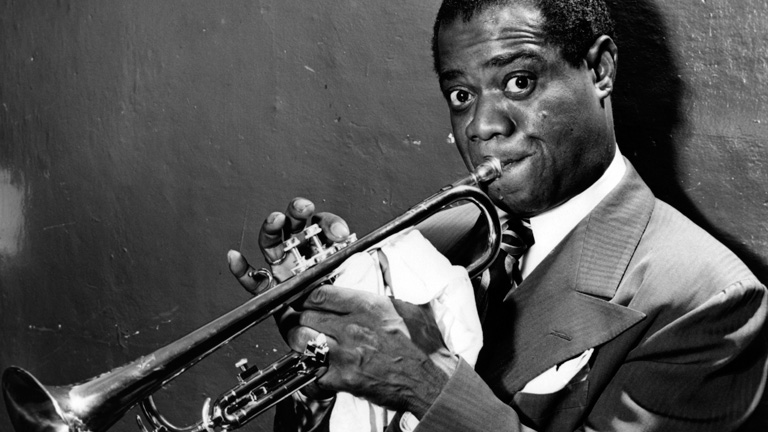
1901 Louis Armstrong is born: The Jazz Original
“Through his clear, warm sound, unbelievable sense of swing, perfect grasp of harmony, and supremely intelligent and melodic improvisations, he taught us all to play jazz.” —Wynton Marsalis
Louis Armstrong was one of the most influential artists in the history of music. Born in New Orleans, Louisiana, on August 4, 1901, he began playing the cornet at the age of 13. Armstrong perfected the improvised jazz solo as we know it. Before Armstrong, Dixieland was the style of jazz that everyone was playing. This was a style that featured collective improvisation where everyone soloed at once. Armstrong developed the idea of musicians playing during breaks that expanded into musicians playing individual solos. This became the norm. Affectionately known as “Pops” and “Satchmo,” Louis was loved and admired throughout the world. He died in New York City on July 6, 1971. – Louis Armstrong House Museum
Dizzy Gillespie: A Jazz Visionary
“The first time you hear Dizzy Gillespie play the trumpet, you may think that the tape was recorded at the wrong speed. He played so high, so fast, so correctly.” —Wynton Marsalis
Trumpeter, bandleader, and composer John Birks “Dizzy” Gillespie was born on October 21, 1917, in Cheraw, South Carolina. He got his first music lesson from his father and took off from there. He moved to New York City in 1937 and met musicians such as Thelonious Monk and Charlie Parker. Together they experimented with jazz and came up with the bebop sound. Dizzy also helped to introduce Latin American rhythms to modern jazz through his collaborations with artists such as Machito and Chano Pozo. His bold trumpet playing, unique style of improvisation, and inspired teachings had a major influence, not only on other trumpet players, but on all jazz musicians in the years to come. He died in Englewood, New Jersey, on January 6, 1993.
– Dizzy Gillespie Biography
1940s Bebop: The Summit of Sound “If you really understand the meaning of bebop, you understand the meaning of freedom.” —Thelonious Monk, pianist and composer
In the early 1940s, jazz musicians were looking for new directions to explore. A new style of jazz was born, called bebop, had fast tempos, intricate melodies, and complex harmonies. Bebop was considered jazz for intellectuals. No longer were there huge big bands, but smaller groups that did not play for dancing audiences but for listening audiences.
1950s Latin and Afro-Cuban Jazz: Beyond the Borders
“Afro-Cuban jazz celebrates a collective musical history. Through its percussive beat, it unites ragtime, blues, swing, and the various grooves of Cuban music. It proclaims our shared musical heritage.” —Wynton Marsalis
The combination of African, Spanish, and native cultures in Latin America created a unique body of music and dance. Jazz musicians from Jelly Roll Morton to Duke Ellington to Dizzy Gillespie combined their music with this Latin sound to create a powerful blend. In the 1940s and 50s, when musicians from Cuba began to play with jazz musicians in New York, the circle was complete. Gillespie and Chano Pozo, a Cuban musician, created a new form of Latin jazz called CuBop.
*****************************
And that’s it for today’s segment of Black History Fun Facts. February is over and done but the fun never stops. To mark our 10th Fun Fact Week, I am introducing a new Fun Fact Badge. I will be using it to represent Black History Fun Facts for now on:
Be sure to check out last weeks Episode below, in case you missed it:



![sneak-peek2[1]](https://thepbsblog.com/wp-content/uploads/2015/04/sneak-peek21.jpg)







 The PBS Blog