
Guest Blog Post. I’m on Rachel’s Blog today. Come on over!
Tag: african american
Black History Fun Fact Friday – Seneca Village

Got a short fun fact article for you today.
I love finding the hidden treasure of black communities that existed and thrived that we’ll never know about (until we look). I’ve mentioned several of such communities on this blog in the past and here’s another one.
Seneca Village was settled in the 1820s on the eve of Emancipation in New York. The only community of black property in the city at the time, it was located between 82nd and 87th Street east of what is Central Park today.

The Village was a thriving community of blacks (two-thirds) and whites started to settle there as well. The community had its own school and a population of over 250 people. Houses were also built on the land, some of them elaborate two-story with barns and others a bit more modest. This was an achievement because New York, like the rest of the country, was a place of slave-ownership. Contrary to what you’ll learn in school, the South was not the only place to find blacks who were enslaved but many northern cities did as well. In 1703, more than 42 percent of New York City households held slaves and slavery was a key institution in the development of New York. According to The New York Historical Society:
“As many as 20 percent of colonial New Yorkers were enslaved Africans. First Dutch and then English merchants built the city’s local economy largely around supplying ships for the trade in slaves and in what slaves produced – sugar, tobacco, indigo, coffee, chocolate, and ultimately, cotton. New York ship captains and merchants bought and sold slaves along the coast of Africa and in the taverns of their own city. Almost every businessman in 18th-century New York had a stake, at one time or another, in the traffic in human beings. During the colonial period, 41 percent of the city’s households had slaves, compared to 6 percent in Philadelphia and 2 percent in Boston. Only Charleston, South Carolina, rivaled New York in the extent to which slavery penetrated everyday life. To be sure, each slaveholding New Yorker usually owned only one or two persons.”
The only difference between Southern and Northern slavery was that instead of plantations, slaves in the North slept in cellars and attics or above farmhouse kitchens in the country. Nonetheless, the enslaved population of the city was emancipated in 1827 and many of these freedmen comprised the residents of Seneca Village.
The Village’s demise came with the building of what is now Central Park. The government claimed the land under the right of eminent domain and evicted the residents. Since then, Seneca Village has been pretty much forgotten in history. Well, until now.
_____________________________
Don’t forget, you can find all the Black History Fun Fact Articles
under the Black History Fun Fact page in the sidebar.
We are already 17 weeks in since the re-launch of this segment last October. Wow!
Black History Fun Fact Friday – Meta Vaux Warrick Fuller

Welcome back to Black History Fun Fact Friday.
Today I introduce to you Meta Vaux Warrick Fuller, the first black woman to receive a federal commission for her art. Fuller’s artwork became the precursor to the resurgence of African themes in art seen during the Harlem Renaissance Movement. Not only a time of Jazz, Literature, and Flapper women, this explosion of black artistic culture also included artwork which is not discussed as much as let’s say the literature and the music.

Born in Philadelphia in 1877, Fuller was the youngest of three children born to William and Emma Warrick. Prominent hair stylists who owned a flourishing Philadelphia store, Fuller’s father was a prosperous barber and the owner of several shops. Her mother was a hairdresser with wealthy white clients who were served in the family’s shop. The family also took vacations to the same places as did their upper-class white Philadelphian clients and lived in a three-story house. Why is it then that Fuller’s name is different from her parents?
Meta was named after one of these clients, Meta Vaux, the daughter of a Senator Richard Vaux. It makes me think about many blacks during the time and whether or not we felt we needed to assimilate into white society in order to fit into the culture of America. For instance, both W.E.B. Dubois and Meta (who was close with Dubois) felt that blacks were capable of the highest achievements but also that this meant to be educated as whites were educated. In addition, despite eventually producing “African” themed art, Meta rejected DuBois initial suggestion that she concentrate on African-American themes when they first met in Europe.
While Meta was successful and is highlighted here as an unfamiliar face, a precursor if you will to The Harlem Renaissance, the movement itself was not all rainbows and whistles. While the artistic explosion is something I love (being a poet and all) I hate that some blacks (as talented as we are) felt at the time that they needed to fit in with White America in order to make it, a truth not everyone is willing to acknowledge but this is Black History Fun Fact Friday so we must keep it real. As Carl Van Vechten titled his book, for many blacks Harlem was, at the time, “Nigger Heaven”.

Nonetheless, in October of 1889, Fuller arrived in Paris where for the next three years she would study with prominent French sculptors which would have a major impact on her work. While in Europe this is where she would encounter Dubois for the second time and it was the beginning of a friendship that continued for many years. Dubois and Thomas Calloway was organizing a Negro exhibit for the Paris Exposition and visited Meta’s studio to her surprise.
When Meta returned to the States, she established a studio in Philadelphia where art organizations flourished and in the early 1900s through the twenties she continued to do well. In 1928, she was selected to show her work at The Pennsylvania Academy of Fine Arts.
In 1909 she did a 15-piece work for The Jamestown Tercentennial Exposition illustrating black’s progress in America since the Jamestown settlement. Fuller also received a gold medal for “The Jamestown Tableau,” and this established her reputation as an artist and began a long and committed career. Despite my personal feelings, it is refreshing to study the faces of some of the unknown artists of this most important time in history.
Black History Fun Fact Friday – Black Land Ownership

Welcome back to Black History Fun Fact Friday where Black History Month is never over! BHFFF is coming to you every Friday where I strive to introduce to you lesser known faces and lesser known facts. Today, we are talking Black Land Ownership, the most underrated , least discussed black business yet.
Land ownership has always been important to African Americans, although we own less than 1% of rural land in the United States today, it has not always been this way.
At one point, Black Land Ownership was at its peak (the 1910s – 20s) and helped to start such communities as The Mound Bayou in Mississippi, Rosewood in Florida, Blackdom in Albuquerque New Mexico, and, Black Wall Street in Oklahoma and many, many more. (See 7 Black Communities that Prospered) “In the 50 years following the Emancipation Proclamation, African Americans held over 15 million acres of land. Today, African Americans own less than 7 million acres of land. In 1920, African Americans owned 14% of all farms. Today, African Americans own less than 1% of all farms.” (Vivian M. Lucas, Barren: The Decline of African American Land Ownership from 15 million to 7million acres).
In Roll of Thunder Hear My Cry, the book that opened me up to the world of Black Literature as a child, Mildred D. Taylor starts a slew of books centered around the Logan family and their fight to keep their land. Land, always that place families could come back to, where gatherings could be held and where communities could root themselves. In Forty-Acres, Phyllis R. Dixon centers her story around black landownership. Rising from a sharecropper’s son to the largest Black Landowner in Dwight Count, Arkansas, C.W. Washington’s stroke forces him to retire from farming and he must decide what happens to the land. And finally, In Queen Sugar, by Natalie Baszile, now a TV show executive produced by Oprah, it again brings to light the subject of black landownership when Charley Bordelon inherits her father’s eight hundred acres of sugarcane land.
Unlike today, where paper money is valued above anything else, land ownership had always been praised as a vital contributor to financial and economic stability for the African American community. Landowners could build houses on the land, raise animals on land and grow food. We sold food we grew, bartered among neighbors, had bountiful dinners and when The Great Depression hit, many southern black land-owners didn’t notice until years in. Land ownership was something cherished, something we could call our own, and something to which we could be proud of.
What happened to families like the ones we read about and have grown to love? Where did Big Mama go and the land with her? What happen to Black Land Ownership and why was it so important to the people who came before us?
“Comparing the U.S. Agriculture Census data on African-American farmland ownership for 1910 and 1997, it shows a drastic decline from its peak of 15 million acres in 1910 to 2.4 million acres in 1997. A recent study estimated that in the early 20th century, rural landownership among African-American farmers and non-farmers was between 16 and 19 million acres (Gilbert, J., 2002). The 1999 Agricultural Economics and Land Ownership Survey (AELOS), which assessed private rural landownership across race and use (i.e. farming, forestry, etc.), found that there are currently 68,000 African-American rural landowners and they own a total of approximately 7.7 million acres of land, less than 1% of all privately owned rural land in the United States. (AELOS, 1999). Sixty percent (60%) of which is owned by non-farmers. (AELOS, 1999). However, this acreage is valued at $14 billion. (AELOS, 1999).”
-Miessha Thomas, Jerry Pennick & Heather Gray, Federation/LAF staff, 2004
There are many factors that play into why land has lost its prominence among blacks today:
- Discrimination of Black Farmers
- Little political and technical understanding of the business of farming on behalf of the farmers themselves
- Poor land management
- Movement of blacks from the South to the North, in which case many sold their land
- Heir Property passed down to heirs who don’t really care about the land
- Underappreciated of the business of farming by young people who equate it to slave labor
- Landowners dying off without leaving Wills
When my husband and I lived on our cousins’ 40 acres, we loved it. The land I mean. The house wasn’t much to speak of, but oh the land! We lived there for five years of our lives and as a couple who is interested in acquiring land of our own we learned a lot.
Not only did many families leave their wealth (land) for better financial opportunities in the North (which many of them did not find), many blacks also did not leave Wills to their children and grandchildren. Known legally as Estate Planning, this is the process of arranging for the distribution and management of your estate after you die which, sadly, many black families fail to do. The generation just a few steps out of slavery more than likely cared very much about the land but if the children who will keep the land going do not care, then the land is lost. In most families, when the older generation dies off (and did not leave Wills to indicate who the land passed down to), the land then falls into the hands of the State who then controls who owns the land and how much of land they own. In the case, there was estate planning, the land may also become heir property.
Heir property is when the land is passed down to heirs according to the state or blood relative successors who are in place to inherit the land. The problem with this in the Black Community is that the land was typically passed down to family members who are not as interested in the land, who does not live in the state where the land is, who is only interested in the oil rights of the land (royalties given to landowners who have had their land drilled on for oil by the oil companies, which, taints the purity of the soil so many of these lands are no longer good for growing food), and who could care less about the land’s upkeep. Heirs also comprised of relatives who may not have known each other and will probably never know that the land exists.
Gary Grant, National President of the Black Farmers and Agriculturalist Association, a nonprofit organization created to respond to the issues and concerns of African American farmers in the U.S. and abroad, addresses the continued loss of African American farms:
“We are losing land and wealth that our parents, grandparents, and great-grandparents worked, fought, and died to acquire for us,” he says. “We owe our ancestral warriors a debt– We must help ourselves by ensuring that the next generation is ready to control the land.”
During our time on the land, from which we acquired dogs, chickens, a horse, and started two gardens, my husband and I had long petitioned our elderly cousins on what it will take for us to buy some of the lands. After all, this was family. However, the land is heir property that must first be passed down to certain individuals. Individuals who do not live near the land, rarely check up on the land, and who do not have a connection to the land in a way that would compel them to live on the property. This is not unusual. Many landowners, especially young ones, are more interested in living in the city and in brick houses. Thus, the land becomes abandoned since lack of land management can quickly get out of hand and little by little, the land is lost.
Still, land ownership is still a big deal in the African American community. There are still many blacks who own land and much more who are stepping out there in the quest to secure acres of their own. Whether it’s an acre, five acres, or forty, I encourage the reestablishing of Black Land ownership, the education of farming and the motivation of our young people to truly understand what land has meant to us as a people—long before slavery we were a farming people—and what it means to us today.
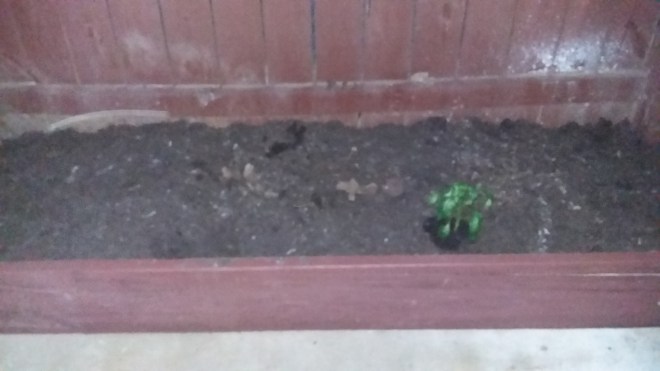
My husband and I are starting by growing our garden in the backyard. We may not have our acres yet but its a start! We’re growing Spinach, Onions, Tomatoes, Lettuce, Basil, Thyme, Rosemary, and Oregano.


Four Months to Go: The Nora White Story
Hi guys,
Before the week ends, I wanted to share this with you.
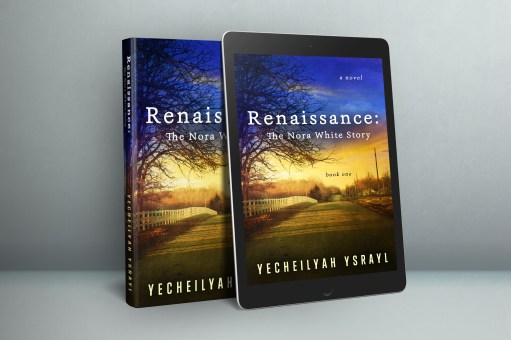
Next month, March, we will be four months out from the release of Book One in The Nora White Story. To prepare for this, I’ve put together a Book Launch Schedule to help all of you to stay updated on this project.
To view the Launch Schedule and to stay updated, I have put together a temporary website dedicated to The Nora White Story exclusively.
You can help me spread the word by sharing and checking out the site HERE.
I’d also appreciate any shares of the site with those who you know are interested in this kind of story.
As the time draws near, I will give more information about the special events leading up to the release for that particular month. As you can see, yes, there will be a blog party! But I’m not giving out any details right now. I will real soon and your patience is most appreciated.

You Are the One
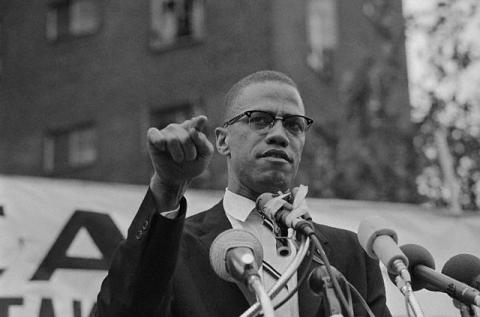
“The picture of the dry bones in the Valley, is talking about you. You are Lazarus. You are the dry bones. You are the prodigal son. You are the lost sheep. You are the people about whom the bible is speaking. Who will stand up in the last days when the trumpet is sounded. Black people are waking up. Black people are standing up. Black people are rising up.” – Malcolm X
Let’s Talk Education
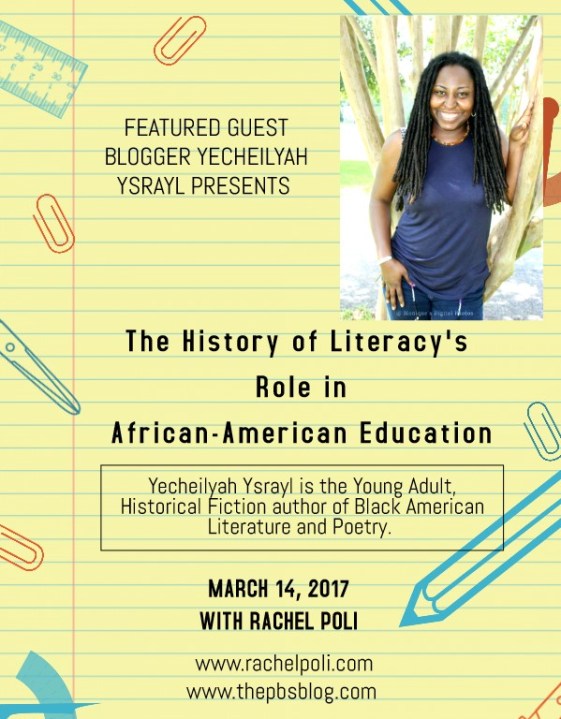
That’s right, Rachel is giving me the keys to the house (I hope she has coffee??!). My topic of discussion is on the education of blacks in America and how reading and literature came to be such an important part of the learning process in the transition from slavery to freedom.
When: Tuesday, March 14, 2017
Where: Rachel Poli’s Blog @ http://www.rachelpoli.com
 The PBS Blog