The Short Story

short-story“The short story….. wakes the reader up. Not only that, it answers the primitive craving for art, the wit, paradox and beauty of shape, the longing to see a dramatic pattern and significance in our experience.”

–V. S. Pritchett

“I have always enjoyed short stories and have now found them to be an added joy. They are easy to read and digest, quick to review and……….. a great introduction to an author’s work. They act as an appetizer if you like, tempting you to tackle the meatier course of someone’s novel where you need to commit serious time.”

– Georgia Rose Books

“The particular problem of the short story writer is how to make the action he describes reveal as much of the mystery of existence as possible…The type of mind that can understand [the short story] is the kind that is willing to have its sense of mystery deepened by contact with reality, and its sense of reality deepened by contact with mystery.”

–Flannery O’Connor

“…the short story is a natural form for the presentation of a moment whose intensity makes it seem outside the ordinary stream of time, or the significance is outside the ordinary range of experience.”

—Wendell Harris

Butterfly, My First Writing Love

150508_0002

Where do I trace the birth of this longing? I have not photographic memory as many do, nor do I remember the exact moment I said, “I want to be a writer”. And as I ponder this history of mine, the thunder growls and the winds roar. The skies darken this very moment and hover around this building; leaning its body against my windowsill and making my living room look like evening time. I like it like this really. To hear the thunder roar in the midst of the quiet and the skies darken. It has a calming effect on me. The appearance of lightening is a chance to see pure light, and the sound of horns is a reminder of great power. But I digress. Really I just think they must be excited, just as anxious to discover this mystery. A collection of horns and quarter notes gather from beyond the clouds and deep inside the galaxy, shouting melodiously. The floor beneath me pulsates and sends shivers up my spine. Meanwhile, raindrops tap dance against the roof. Perhaps the scream of heaven is prompting me to remember. I do remember the first time I had the material to organize my writing. I do remember my first journal. I do remember my first writing love.

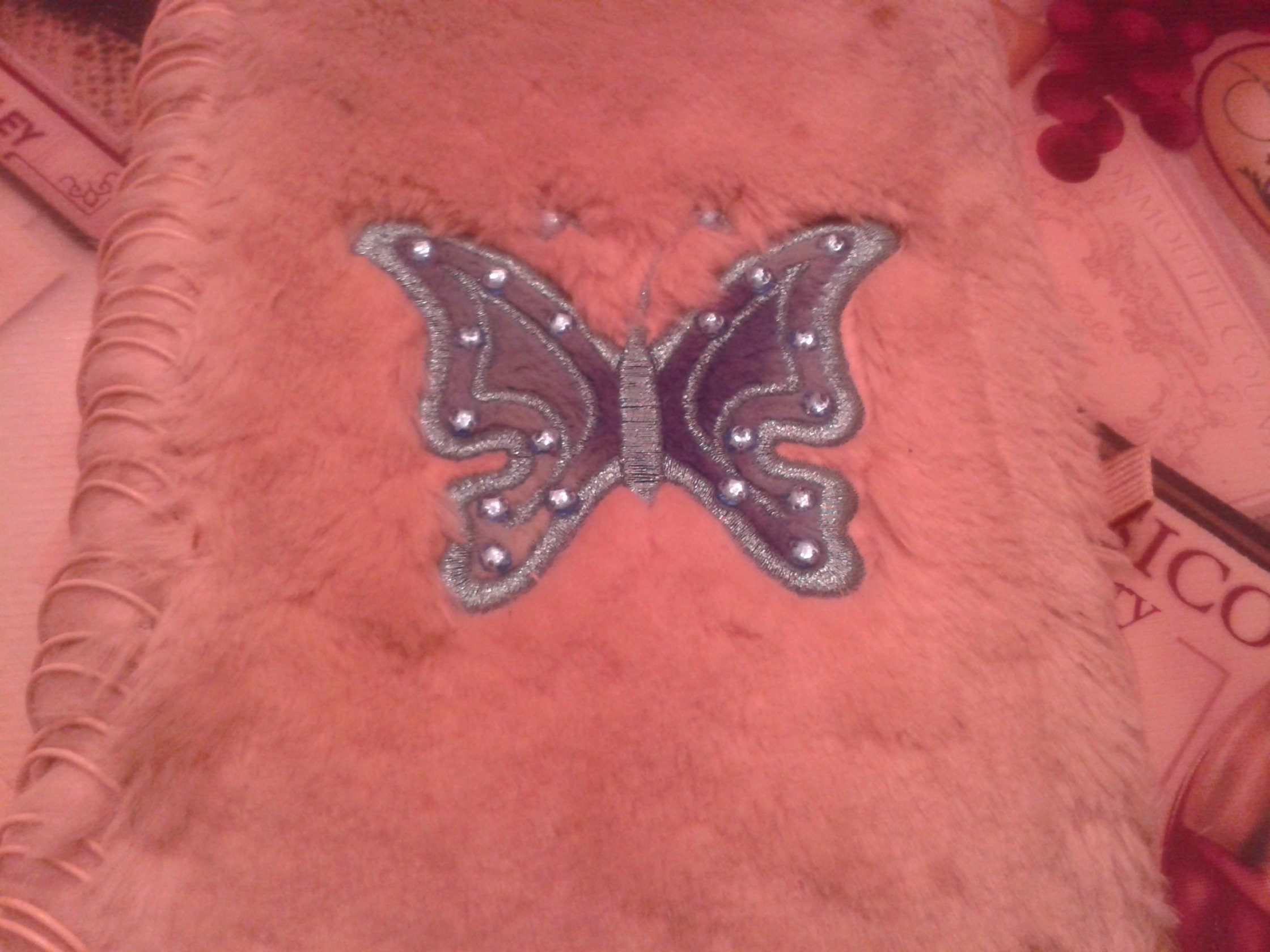
I was just about to turn fifteen, and though by then I’ve been writing for some time, I had not the care of keeping things organized. I wrote at will and on whatever pieces of paper I could find. But the close of eighth grade presented me an opportunity to confide in that pretty pink booklet with the blue sparkling butterfly on the front. I purchased it in Cincinnati Ohio during our eighth grade school trip. I spotted it at Claire’s, a store at the mall, over in the corner and it was a unique version of many of the journals I had seen in Chicago or anywhere. Somehow I didn’t think I would find it anywhere else in the world. As my peers busied themselves in appropriate teenage endeavors, my pupils danced in delight. Immediately upon seeing it I had to take it home. And I must say it dressed up well for our first date. The pink was fluffy and soft; my fingers found comfort when they slept on top the cotton. The butterfly on top shone bright like the dye was squeezed from fresh blueberries, and to top it off there were little diamonds imbedded in its wings. It wasn’t a diary so there was no lock and key. Nor did I use it as such, but it holds some of my early poems. In fact, I pretty much just used it for poetry, and maybe a journal entry or two here and there. When it opened, the euphoria of opportunity greeted me with the smell of fresh ink, and elegantly curved lines. It wouldn’t be long after this that I would begin my collection of journals and notebooks, but none of them would compare to the first. Butterfly was that first real writing love. The rest were merely copies. And as you can see, I still have it, though it is obviously not as beautiful as it once was. I think I’ll give it to my daughter one day. Maybe. OK well, let me just flip through it first.

Beyond The Colored Line – Final Sneak Peek

Book2Week three-four:

My apologies for the delay on this; I have recently come back to town and this week has been busy trying to get back on schedule. But, as promised, here are the final sneak peeks of Beyond The Colored Line:

Note: This excerpt is part of a book written by Yecheilyah Ysrayl. No part of this publication may be reproduced, or stolen in a retrieval system, or transmitted in any form or by any means without written permission of the publisher. The exception would be in the case of brief quotations embodied in the critical articles and reviews and pages where permission is specifically granted by Yecheilyah Ysrayl.

*******************

1932
Age 16
**************************

“Never limit yourself sweetheart.”

Aunt Sara was sitting at the vanity table applying red lipstick to lips that I didn’t think could get any redder. Aunt Sara was a thin but shapely woman, filling out the beautiful dark red dress that went down to her ankles, but held snug at the waist with a petite black belt. She wore black heels, and her red hat sat on the bed next to me as I sat watching her perfectly apply more make-up. She was in the middle of another lecture.

“We got the whole world just waiting for us and the least we can do is oblige. Besides, it’s not like you’re betraying anyone or denying anything. You have just as much a right to this life as anybody.”

It was Tuesday night and Aunt Sara was going out again. She tilted her head this way and that in the mirror and smiled her approval.

Mama lost the house. She tried to do the best she could with the visitors and such, but the depression didn’t allow for people to want to travel much. And the taxes came to be too much for a laundry woman’s salary. We moved to Chicago where things weren’t much better. The Great Depression was particularly severe here because of the city’s reliance on manufacturing, the hardest hit area nationally. Only 50 percent of the Chicagoans who had worked in the manufacturing sector in 1927 were still working by the time we arrived, especially Negroes. By now, 40 to 50 percent of Negro workers in Chicago were unemployed, including Aunt Sara. She was a school teacher, but wasn’t making any money. By the end of the year, the city would owe teachers more than eight months’ pay. But Chicago’s population grew enormously because of the mass lynching’s taking place in The South. Negroes escaped Mississippi as if running from a plague. And for just $11.10 they were brought by train to a new world. Everything was still segregated. In fact, Chicago is the most segregated place I’d ever seen. But you could hold your head up in Chicago. So to us, it still offered a freedom that didn’t exist in in The South. It was the land of milk and honey. And the crisis didn’t seem to affect Aunt Sara as it did Mama anyway. She didn’t particularly like being a part of the life Sara lived and she was depressed over our situation.

“Speaking of the whole world, what is it with you and that Timmy boy?” Sara puckered her lips for a final review as she spoke.

“Tommy Aunty, his name is Tommy,” I said.

Tommy and I had become rather close as we got older, though I couldn’t decide if we were dating or not. Aunt Sara clasped her hands together as she stood and sat next to me on the bed, “Oh, my memory these days.”

“Tommy’s a good friend, nothing special.” I lied.

“That’s my girl,” said Sara, grabbing her hat and putting it on, admiring herself again in the mirror as she spoke.

“I don’t think it’s a good idea for you two to see each other no how. There’s not much room for opportunity with such men. You must learn to play the game sweetheart.”

“Are we so different?” I asked.

Sara turned to face me, “You can drink your coffee black all you wanna, but I’d prefer a little cream to taste. I swear I don’t know what’s gotten into your Mother, teaching you to hate yourself is what she doing. There’s nothing wrong with embracing who you are, you remember that.”

I sunk down in my seat, embarrassed. I knew where she was going with this. Every day was Saturday for Aunt Sara. Uncle Bob, as we were instructed to call him (though marriage didn’t exist between them) was Sara’s new man, a wealthy doctor on Chicago’s North side. The problems of the Great Depression affected every group of Americans, but no group was harder hit than Negroes living in the cities trying to live like rich white folk. In some Northern cities, whites called for Negroes to be fired from any jobs as long as there were whites out of work. Otherwise, the depression meant nothing to Negroes who had been depressed in America for nearly 400 years. For this reason, we were Aunt Sara’s little secret hidden securely inside Uncle Bob’s pocket. She didn’t just pass for white, Aunt Sara was white. And coming from a white mother and half white father no one second guessed us, not even Bob.

“I tell you what, the ladies and I are attending a small gathering this evening, and you should come along.”

“But I’m only sixteen,” I said.

Sara smiled, “And? Who’s asking questions? Today you’re sixteen years old sitting in a house wasting your life away. But tonight, tonight you are the most beautiful twenty-one year old they’d ever lay their eyes on. The most beautiful white woman they’d ever seen.”

One Year Later

I laughed as Tommy and I strolled down the Negro area of town, arm linked in arm. We had decided to stop fooling ourselves and had begun dating. I must say, being with Tommy was one of the most refreshing parts of my life: smart, colored, and hilariously funny. His presence alone gave me a sense of relaxation I didn’t feel at home. I didn’t have to pretend or fear discovery. It was a relief being with him, and a lot of fun too. Indeed, the love I had for that man could never be mistaken and could never be traded. He was my first love and I love him still.

Tommy held open the door to The Shack, a mom and pop restaurant owned by Negroes. As I entered the restaurant, however, my foot stopped mid-air over the threshold.

“Sidney?”

It was Annie, one of the first friends I’d met in Aunt Sara’s circle. I had begun living a double life. It was easier than I’d expected. I had, after all, enjoyed the private education, the fine dresses, and the parties. I found myself looking forward to the freedom of going where I wanted and buying what I needed. We were one of the few European families doing well during the depression and loved by everyone. Aunt Sara and Bob got closer. We were invited to his inner circle of friends and family, which meant standing on top the highest hill and waving. Even Mama began to lighten up just a bit. Things were going well, until now.

“Annie, what a surprise!” I said as Annie and I hugged each other, planting dainty kisses on each other’s cheeks, fake grins all over the place. Annie looked Tommy up and down, while he held onto the door, as if she had just spotted a piece of trash on the ground that must be disposed of quickly.

“You must be the servant. I’m Anne, how do you do?”

Tommy let the door slip from his hands, closing quietly as Annie held out her hand; covered in a crisp white glove made of finer cotton than spread across his kitchen table. Tommy’s family were sharecroppers. Silently he wondered how many barrels of cotton it took to make it glow in the darkness. He looked at Stella, staring deeply into the green eyes he once adored, and the reality of the present situation lit a fire inside of his chest. He hoped he wouldn’t fall down dead from a heart attack. It would be a shame for his dad to find out his son died cause of a thing as a woman’s glove.

Tommy said nothing, just kept his eyes fixed on mine. I didn’t want to look away, but I couldn’t help but to feel them shooting little prickly darts into my skin, and it was beginning to burn. I had to think of something. Quick. I pleaded with his eyes.

“Why of course, where are my manners? Thomas, this is a friend of mine Annie. Annie this is Thomas, the new driver.”

I hopelessly tried to catch sight of his eyes. I wanted to plead mercy, but Thomas’ eyes searched instead for something on the ground. I turned my attention back to Annie.

“Why of course,” said Annie. “I was just telling Daddy about how difficult it is to find one these days. Why we just replaced a cook last week. Poor Mama was devastated,” we laughed, only hers was real.

“I told her we’d just have to get Miss Pearl to do it, but you know Daddy couldn’t stand for that. A housekeeper cooking? Why the next ball would be simply atrocious,” we laughed again as I silently prayed for a miracle.

“Anywho,” continued Annie, “I am off, but do come by tomorrow. The women and I are having tea, you know Mama’s dying to show off the furniture.”

“Of course,” I said as we hugged and kissed again.

As I waved goodbye to Annie, I turned to plead my case to Tommy, who was already halfway down the street. And just like that, our friendship had ended.

***********************

I’m so grateful you’ve taken the time to read this far, I hope it means you are enjoying the story. If you’d like to continue reading and find out what happens next, you can get the book from Kindle for just $2.99 when it releases this summer and less than $10 in paperback.

I plan on writing another book in this series later this year, and with your permissions I’ll let you know when that’s available and send you some more free chapters. Until then, if you want to know what I’m up to, you can follow me on Twitter @: https://twitter.com/ahouseofpoetry.


She’s Not Human

monster_paintingI saw this episode once on Tales From The Hood. This little boy came to school with bruises on his body and he said a monster did it. This perplexed his teachers because surely this couldn’t be an actual monster. But the little boy proceeded to insist it was a monster. He drew pictures of this giant green entity with razor sharp teeth and big hands. In the end, we discovered the monster was really his mother’s boyfriend who beat him from time to time. But the little boy never drew him as a person, just as a monster; interesting the perspective of children, the innocence and fragility of their minds. I imagine this is how they see her, a monster. Even though her face looks gentle, her blonde hair pushed back into a pony tail and her petite figure causing no stirs among the neighbors. Then again, I don’t know what it’s like to wake up to a growl like they do. Even if I did, it’s different when you’re a kid and just the slightest increase in tempo rattles your entire body. At best all you need is a look and you are frozen in mother’s authority and your mind is prepared to listen. But a growl? I don’t want to wonder what that’s like. That’s what I wake up to most mornings. At first, I didn’t think the woman had any children. I thought maybe she was cursing out her man. A slew of profanity escaped her mouth like I hadn’t heard since I banished it from my very own vocabulary. I envisioned her entire presence overtook the house. I’d be willing to bet she grows claws and turns green in her spare time. Only to shapeshift back into the harmless little lady we see walking to the bus stop. I don’t understand people who abuse children; it is a most cowardly act. When I discovered my neighbor was ripping the heads off her own children it disgusts me. But it did not disgust me more than actually seeing the babies. I wanted to just cry. They did not have little bruise marks on their bodies like the little boy in the movie. It’s just that they are small children. I would not have guessed someone was speaking this way to children all under ten years old. And then one day, I saw that one of them is in a wheelchair. So you have two very small children and one is disabled. I don’t understand the logic that goes into this kind of behavior. This is why self-love is so important. How can you mistreat what came from your own body, except you have no love for yourself. Without self-love, nothing can be accomplished. We cannot love ourselves, we cannot love our neighbors, and we cannot love those around us. More frightening than our inability to love, we cannot be loved. Self-hatred illuminates. It surrounds you like a plague and can be smelled from a distance. It causes you to act out of character and abuse anyone who tries their hand at loving you. Because you have not given it to yourself, you are unwilling to accept it from anyone else nor are you willing to give it. Be careful the way that you treat your children, they are a reflection of you and they have no shame in keeping it real. If their mouth does not reveal who you are their actions will. It’s funny, I can always tell the true intentions of a person just by looking at the behavior of their children and interestingly enough, the parents never seem to notice. Be careful how you treat your children, whether you notice it or not, their actions reveal who you truly are.

Don’t BeStressed, #BeWoW – My BeWoW Post

be-wow-blogger

My submission for this week
episode of Ron’s BeWoW Blogshare is on mental strength and stability.
We often attempt to plan every second of our lives. As a result, our
minds are clouded by a conglomerate of possible and maybes that did not
turn out the way we intended. While preparation is good, over analyzing
and planning increases stress. You cannot relax long enough for things
to work themselves out smoothly because you’re too busy planning ahead.
You have no time for the present moment because you’re always thinking
about the next. Time then passes you by and before you know it today is a
memory. The question is now: what did we make of it? It is important to
work hard, and to fill each day with some kind of task but do not
forget to breathe. Don’t forget to smile. Don’t forget to hug the person
next to you or do something for someone else for a change. Let things
run their course as they were intended to. I understand this is easier
said than done and it may even require you to give up certain pleasures
for the sake of peace in your mind. This is important because the mind
is where it all begins, it is higher than the physical and where the
spiritual dwells. A lot of times we think we are weak in certain areas
when we’re not. The weakness instead is in the mind. It is clouded by
unnecessary burdens we place on ourselves. Plan, organize, and structure,
but go with the flow too. Don’t continue to allow yourself to
BeStressed because life is too short. Instead, clear your mind. It may
be hard to find, but try to discover the reasons why and let things
happen as they will without factoring your genius in the equation.

**************

And that’s my BeWoW for today. Yall be great.

– EC

Writer’s Quote Wednesday – If You Don’t Define Yourself

Yayy I’m back :). Time to get back into the swing of things. What better way to start than with Writer’s Quote Wednesday. This week, I take my inspiration from Audre Lorde. And since I just came back from a Stage Play, I thought it’d be fun to use the picture of me on the set in my costume right before going onstage lol.

Besty Mae

“If you don’t define yourself for yourself, you’d be crunched into other people’s fantasies of you and eaten alive.” – Audre Lorde

When it comes to writing, and also to life, what sets one person apart from another are those individual qualities that are specific to that person. There is uniqueness about each of us and our style of writing that defines our work and defines also who we are as individuals. It is a kind of branding that does not have to be created, it already exists. We just have to discover it. There is a lot of good advice out there and a lot of good living examples to follow, but if you do not yet know who you are as a person and as a writer; if you do not yet know what sets you apart from the rest; if you have yet to define yourself, it is easy to get lost in all the opinions and philosophies and false images of who everyone perceives or desires you to be. Many invoke what others are expected to see. As a result, they lose sight of a definition of self. They cannot find the voice that is exclusive to them because they are trying to be a mirror reflective of someone or something else.

While I disagree with many of Audre’s views, I enjoy this quote because it is a constant reminder, for both my personal as well as my writing life, to be true to myself no matter what. I also chose this particular quote because my next book deals with mixed ancestry and it is noted that Audre Lorde’s mother could pass for white, while her father was darker than the family would have liked. Lorde is therefore among many African Americans to have experienced in some way the question of the colored line.

About the Author:

220px-Audre_LordeLorde was born in New York City to Caribbean immigrants from Barbados and Carriacou, Frederick Byron Lorde and Linda Gertrude Belmar Lorde, who settled in Harlem. Lorde’s mother was of mixed ancestry but could pass for white, a source of pride for her family. Lorde’s father was darker than the Belmar family liked and only allowed the couple to marry because of Byron Lorde’s charm, ambition, and persistence. Nearsighted to the point of being legally blind, and the youngest of three daughters, Audre Lorde grew up hearing her mother’s stories about the West Indies. She learned to talk while she learned to read, at the age of four, and her mother taught her to write at around the same time. She wrote her first poem when she was in eighth grade.

Audre Lorde was a Caribbean-American writer, poet, essayist, etc. and her poetry was published very regularly during the 1960s — in Langston Hughes’ 1962 New Negro Poets, USA; in several foreign anthologies; and in black literary magazines. Her first volume of poetry, The First Cities (1968), was published by the Poet’s Press. She died in 1992 at the age of 58.

****************************

That’s it for this week’s episode of Writer’s Quote Wednesday. Be sure to check out Silver Threading to join in on the fun. Just click on the pic below!

writers-quote-wednesday

http://silverthreading.com/2015/05/06/writers-quote-wednesday-the-buddha/