Writer’s Quote Wednesday – The War of Art

My choice for Writer’s Quote Wednesday this week is from Steven Pressfiled’s The War of Art:
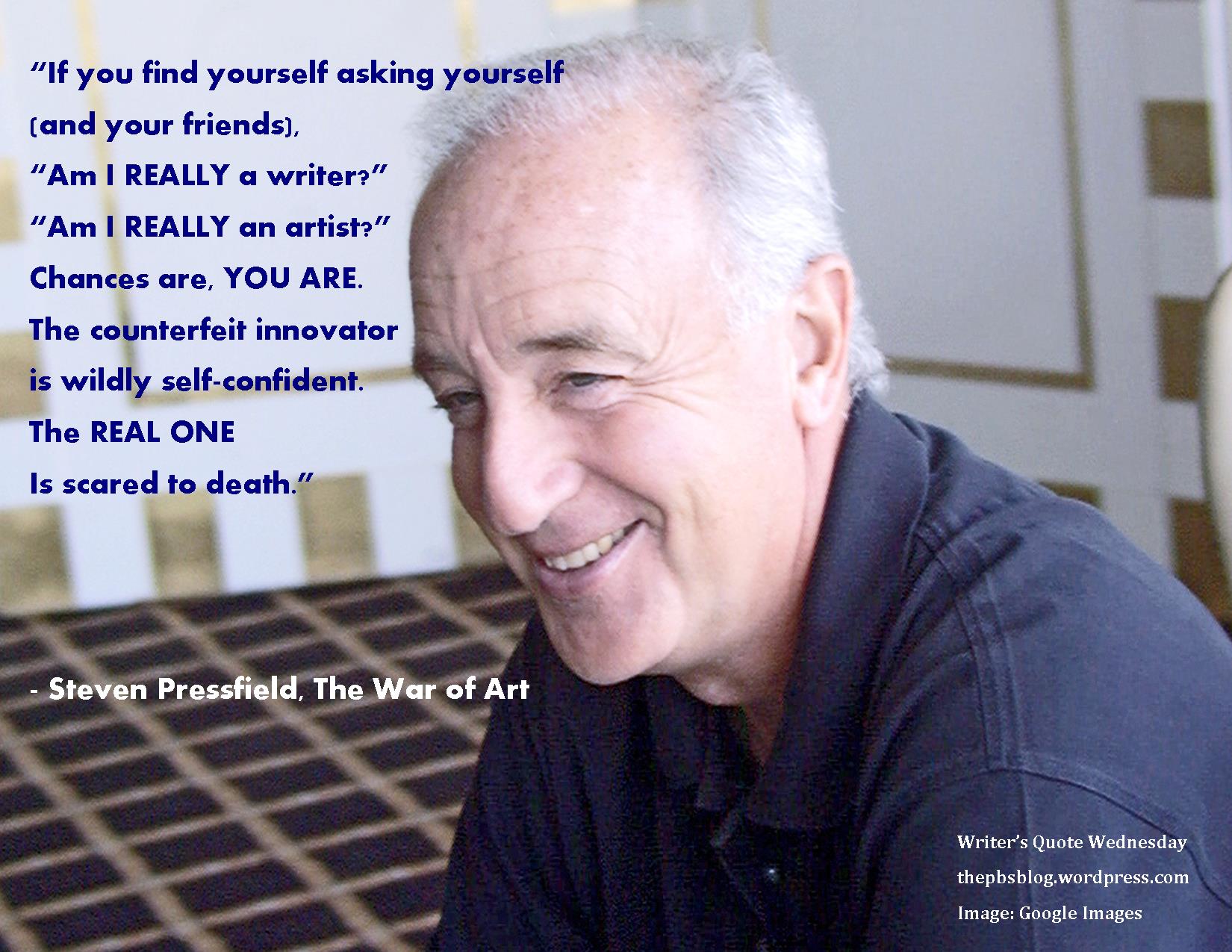
WQW

Writers. People who second guess whether or not they have what it takes, and yet are still bold enough to go on. This quote reminds me of what it’s like to be nervous. We’ve all experienced it and we are all familiar with that feeling. Your heart beat races, your palms become sweaty and your body gets all jitterbug on you. Truth is you are scared to death of whatever it is you are about to do. It does not mean you have no confidence, it just means you are not so dependent on yourself that you forget about the big picture and you can’t stop thinking about the possibilities. You know that you can do it; you just don’t know whether or not it will succeed. But still you push forth and you show up at that place or do that thing. It is the war of art. You battle yourself until finally, you put pen to paper and you write. Writers. Sometimes fearful. Sometimes doubtful. Sometimes afraid. But always humble in confidence, and yet courageous in character.

About The Author: (from Wikipedia)

Steven Pressfield (September 1943— ) is an American author of historical fiction and non-fiction, and screenplays.

He was born in Port of Spain, Trinidad, in 1943, while his father was stationed there, in the Navy. He graduated from Duke University in 1965 and in 1966 joined the Marine Corps. In the years following, he worked as an advertising copywriter, schoolteacher, tractor-trailer driver, bartender, oilfield roustabout, attendant in a mental hospital, fruit-picker in Washington state, and screenwriter. His struggles to make a living as an author, including the period when he was homeless and living out of the back of his car, are detailed in his book The War of Art.

His first book, The Legend of Bagger Vance, was published in 1995, and made into a film of the same name, starring Will Smith, Charlize Theron, and Matt Damon, and directed by Robert Redford.

His second novel, Gates of Fire, is about the Spartans and the battle at Thermopylae. It is taught at the U.S. Military Academy, the United States Naval Academy, and the Marine Corps Basic School at Quantico.

In 2012, he launched the publishing house Black Irish Books with his agent Shawn Coyne.

******************

And that’s it for Writer’s Quote Wednesday. Click the pick to join the fun.

writers-quote-wednesday

http://silverthreading.com/2015/05/13/writers-quote-wednesday-sir-winston-churchill/

Writer’s Quote Wednesday – If You Don’t Define Yourself

Yayy I’m back :). Time to get back into the swing of things. What better way to start than with Writer’s Quote Wednesday. This week, I take my inspiration from Audre Lorde. And since I just came back from a Stage Play, I thought it’d be fun to use the picture of me on the set in my costume right before going onstage lol.

Besty Mae

“If you don’t define yourself for yourself, you’d be crunched into other people’s fantasies of you and eaten alive.” – Audre Lorde

When it comes to writing, and also to life, what sets one person apart from another are those individual qualities that are specific to that person. There is uniqueness about each of us and our style of writing that defines our work and defines also who we are as individuals. It is a kind of branding that does not have to be created, it already exists. We just have to discover it. There is a lot of good advice out there and a lot of good living examples to follow, but if you do not yet know who you are as a person and as a writer; if you do not yet know what sets you apart from the rest; if you have yet to define yourself, it is easy to get lost in all the opinions and philosophies and false images of who everyone perceives or desires you to be. Many invoke what others are expected to see. As a result, they lose sight of a definition of self. They cannot find the voice that is exclusive to them because they are trying to be a mirror reflective of someone or something else.

While I disagree with many of Audre’s views, I enjoy this quote because it is a constant reminder, for both my personal as well as my writing life, to be true to myself no matter what. I also chose this particular quote because my next book deals with mixed ancestry and it is noted that Audre Lorde’s mother could pass for white, while her father was darker than the family would have liked. Lorde is therefore among many African Americans to have experienced in some way the question of the colored line.

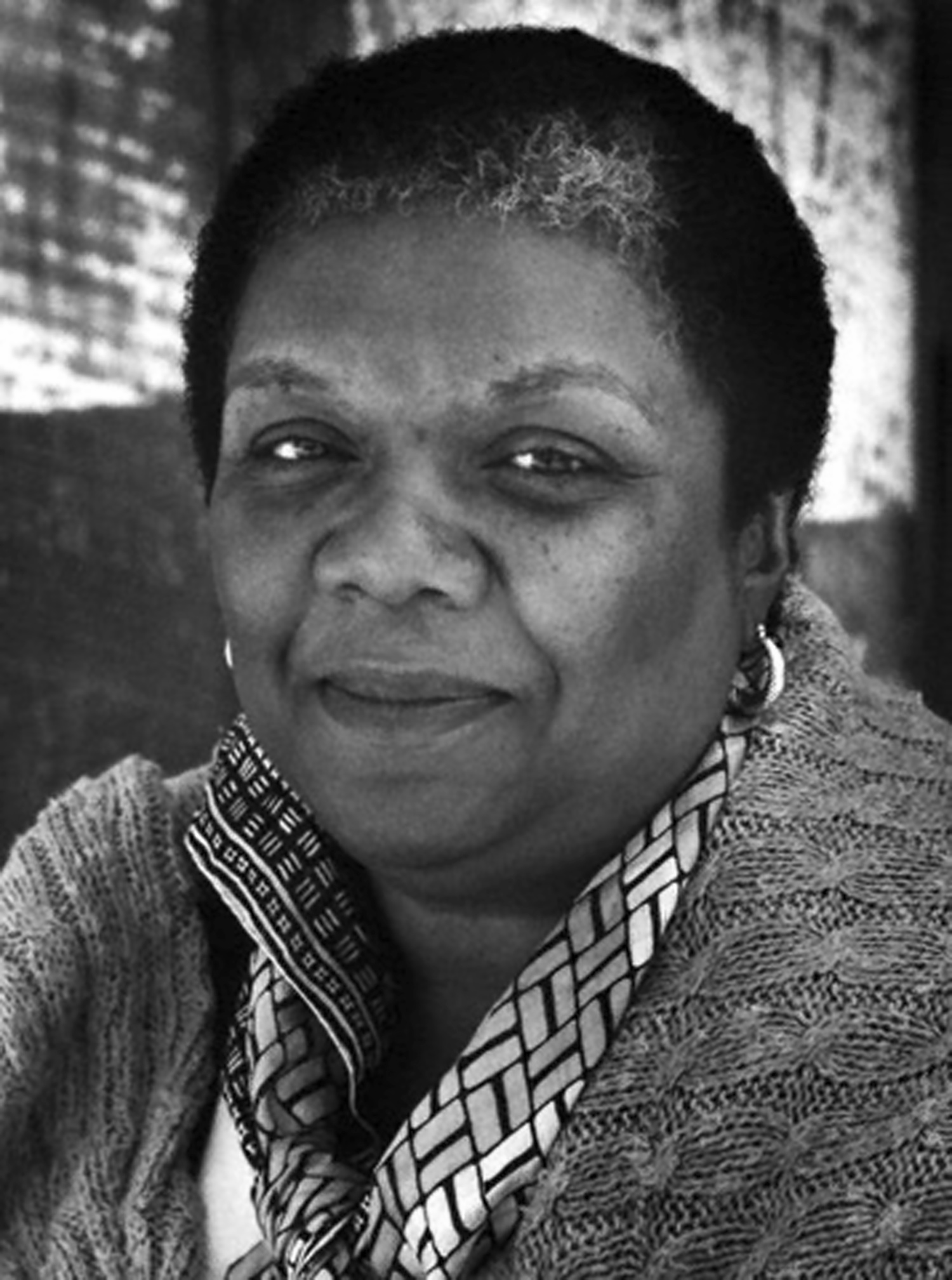
About the Author:

220px-Audre_LordeLorde was born in New York City to Caribbean immigrants from Barbados and Carriacou, Frederick Byron Lorde and Linda Gertrude Belmar Lorde, who settled in Harlem. Lorde’s mother was of mixed ancestry but could pass for white, a source of pride for her family. Lorde’s father was darker than the Belmar family liked and only allowed the couple to marry because of Byron Lorde’s charm, ambition, and persistence. Nearsighted to the point of being legally blind, and the youngest of three daughters, Audre Lorde grew up hearing her mother’s stories about the West Indies. She learned to talk while she learned to read, at the age of four, and her mother taught her to write at around the same time. She wrote her first poem when she was in eighth grade.

Audre Lorde was a Caribbean-American writer, poet, essayist, etc. and her poetry was published very regularly during the 1960s — in Langston Hughes’ 1962 New Negro Poets, USA; in several foreign anthologies; and in black literary magazines. Her first volume of poetry, The First Cities (1968), was published by the Poet’s Press. She died in 1992 at the age of 58.

****************************

That’s it for this week’s episode of Writer’s Quote Wednesday. Be sure to check out Silver Threading to join in on the fun. Just click on the pic below!

writers-quote-wednesday

http://silverthreading.com/2015/05/06/writers-quote-wednesday-the-buddha/

Writer’s Quote Wednesday – Crippled

I wasn’t sure what I wanted to present for this week’s episode of Writer’s Quote Wednesday, hosted by Colleen of Silver Threading. Even on into the night I still had no idea what to post. But, as my husband and I settled into the night and popped in a movie I found the answer. Right there in the eyes of Ray Charles mother in the movie Ray, I stopped. “That’s it!” That’s my writer’s quote for this week:

Ray

I felt extremely connected to these words in that moment. The movie faded away in the background and this woman’s words resonated against my consciousness. I started to think about all of the ways in which we, mankind, allow the world at large to cripple us. I began to ponder all of what this crippling can embody. There are so many levels to this that it would be impossible to complete in one post. But here’s what I gathered for today:

Sometimes our weaknesses becomes a crutch; something to lean on whenever a convenient excuse is not available. Eventually, it rots our desire to move forward or creates more baggage to lean on when the going gets tough. The cant’s and wish’s pile up until they reach the heavens but we ourselves never get there, only our excuses do. Someone somewhere told you something is impossible or that you will never be able to do something. If you take that advice to heart and you sit on your hands because of it, you have allowed that person and those circumstances to weaken you. In truth, it is not the struggles, people, or places that weaken us; it is we who weaken ourselves. Whatever you allow to hinder your ability to love, and to seek righteousness, and all that is good, only cripples your ability to function. But like the lady said,

“don’t let nothing or nobody turn you into no cripple…”

****************************************

And that’s it for Writer’s Quote Wednesday. be sure to check out Silver Threading to see how you can join the fun!

http://silverthreading.com/2015/04/22/writers-quote-wednesday-emily-bronte/
writers-quote-wednesday

Writer’s Quote Wednesday – The Closeness of Poetry

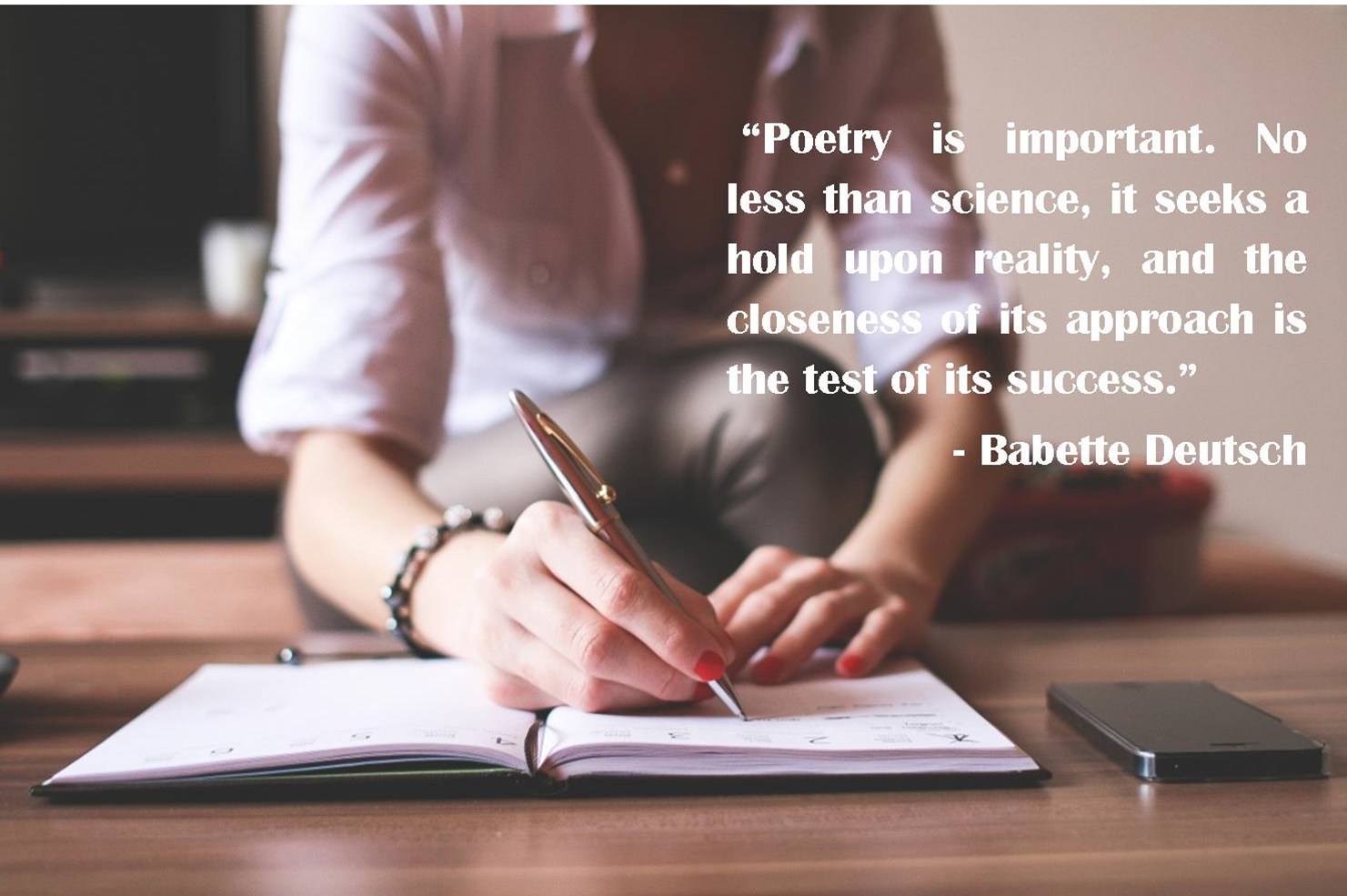
My contribution to this week’s episode of   Writer’s Quote Wednesday is from Babette Deutch:

Poetry

“Poetry is important. No less than science, it seeks a hold upon reality, and the closeness of its approach is the test of its success.” Babette Deutsch

I had a different poetry quote in mind for today, but of the two I chose this one because it reminds me how powerful good poetry can be and the impact of its gift on the world. The result of words that live combined with a strong voice to deliver them has the capacity to change lives. I’m sure there’s so much more that can be said about this powerful quote, but that is all I have for you this afternoon.

About the Author:

Deutsch was a Poet, novelist, and editor. She was born and lived much of her life in New York City and began to publish poems in journals such as the New Republic while a student at Barnard College, where she earned a BA. Two years after her graduation, she published her first poetry collection, Banners. What is interesting about Babette is that she was part of what is called the Imagist Movement. Now I didn’t know what that was so I Googled it:

Imagism was a movement in early 20th-century Anglo-American poetry that favored precision of imagery and clear, sharp language. It has been described as the most influential movement in English poetry. A characteristic feature of Imagism is its attempt to isolate a single image to reveal its essence.

Aligned with the Imagist movement, Deutsch typically composed compact, lyrical pieces using crisp visual imagery. Many of her poems are responses to paintings or other pieces of visual art. Deutsch is the author of 10 collections of poetry, two of which are self-selected volumes of her collected work: Collected Poems 1919–1962 (1963) and The Collected Poems of Babette Deutsch (1969). She is was also the author of four novels and six children’s books. Babette died in November of 1982.

***********************************

And that’s it for Writer’s Quote Wednesday! Be sure to check out Silver Threading to see how you can join the fun!

writers-quote-wednesday

http://silverthreading.com/2015/04/15/writers-quote-wednesday-3/

Writer’s Quote Wednesday – Derek Walcott

Today’s quote for Writer’s Quote Wednesday is from Poet and Playwright Derek Walcott:

Bucknell University. (Photos by Timothy D. and Nicole M. Sofranko)

“… the truest writers are those who see language not as a linguistic process but as a living element….” – Derek Walcott

I think this is such a great motivational quote for writers. It has a way about it that can be explained in much more detail than what I can give but in short, it reminds me of the living attribute of words. Just the power of words and how breathing language is. I think that when we seek to create vision for the reader it’s much more than the language aspect in the literal form. It is not merely collaborating strings of words together for English sake, but it is feeling. Experiencing the moment and then putting that moment into words. Personally, I think some of my best writing has occurred during times where I did not purposely set out to write, but the language itself was so moving, and so feeling, that I simply had to.

About the Author (from Poets.org)

derek-walcott-3-sized

“The recipient of the 1992 Nobel Prize in Literature, Derek Walcott was born in Castries, Saint Lucia, the West Indies, on January 23, 1930. His first published poem, “1944” appeared in The Voice of St. Lucia when he was fourteen years old, and consisted of 44 lines of blank verse. By the age of nineteen, Walcott had self published two volumes, 25 Poems (1948) and Epitaph for the Young: XII Cantos (1949), exhibiting a wide range of influences, including William Shakespeare, T. S. Eliot, and Ezra Pound.

He later attended the University of the West Indies, having received a Colonial Development and Welfare scholarship, and in 1951 published the volume Poems.

The founder of the Trinidad Theater Workshop, Walcott has also written several plays produced throughout the United States, The Odyssey: A Stage Version (1992); The Isle is Full of Noises (1982); Remembrance and Pantomime (1980); The Joker of Seville and O Babylon! (1978); Dream on Monkey Mountain and Other Plays (1970); Three Plays: The Last Carnival; Beef, No Chicken; and A Branch of the Blue Nile (1969). His play Dream on Monkey Mountain won the Obie Award for distinguished foreign play of 1971. He founded Boston Playwrights’ Theater at Boston University in 1981.

About his work, the poet Joseph Brodsky said, “For almost forty years his throbbing and relentless lines kept arriving in the English language like tidal waves, coagulating into an archipelago of poems without which the map of modern literature would effectively match wallpaper. He gives us more than himself or ‘a world’; he gives us a sense of infinity embodied in the language.”

He currently divides his time between his home in St. Lucia and New York City.

 ***************************

And that’s it for Writer’s Quote Wednesday!

writers-quote-wednesday

Don’t forget to check out Colleen on Silver Threading to see how you can join the fun.

http://silverthreading.com/category/writers-quote-wednesday/

Writer’s Quote Wednesday – Lucille Clifton

My pick for today’s Writer’s Quote Wednesday is from poet Lucille Clifton:

Lucille C

I believe life tends to happen in stages. There are certain bridges that we have crossed as stepping stones to get to where we are; a small portion of the bigger picture to lead us on. And even where we are today is of itself a mere foundation for where we will be tomorrow. As I think about this, I am recalled to Lucille’s quote and I am reminded of the compassion and the respect that we should have for one another because you never know what’s beyond those eyes. What they have seen, what they see, or what they have endured. And even our idea of what seems difficult or simple can play a different role in the life of someone else. I may have known homelessness but the man who lost his mother to cancer may experience a struggle that would have broken me, whereas my homelessness could have broken him. Makes me think about what each person has endured and how it has contributed to their strength. No matter how seemingly small it was something that we ourselves probably could not have faced if given the chance to do so.

About the Author:

20070309clifton
Lucille Clifton 1936–2010

What I noticed right away about Lucille is that she puts the sweet in “short and sweet”. Her poems are often not very long-winded, but they are short, almost speeding like, but not tasteless. Clifton is noted for saying much with few words. In a review of her work, Peggy Rosenthal commented, “The first thing that strikes us about Lucille Clifton’s poetry is what is missing: capitalization, punctuation, long and plentiful lines. We see a poetry so pared down that its spaces take on substance, become a shaping presence as much as the words themselves.”

In an American Poetry Review article about Clifton’s work, Robin Becker commented on Clifton’s lean style: “Clifton’s poetics of understatement—no capitalization, few strong stresses per line, many poems totaling fewer than twenty lines, the sharp rhetorical question—includes the essential only.”

In addition, Lucille Clifton’s work hinges largely on life, emphasizing endurance and strength with a focus particularly on the African American experience and family life. It is another reason I enjoy her poetry. In 2007, Clifton was awarded the Ruth Lilly Poetry Prize in which the judges remarked,

One always feels the looming humaneness around Lucille Clifton’s poems—it is a moral quality that some poets have and some don’t.”

In addition to the Ruth Lilly prize, Clifton was the first author to have two books of poetry chosen as finalists for the Pulitzer Prize, Good Woman: Poems and a Memoir, 1969-1980 and Next: New Poems (1987).

mQxHuV_bFdPyDQqbcdTWmTgAn additional plus is that Lucille was not just a poet, but she was also an author of children’s books, designed to help them to understand the world and enable an understanding of black heritage specifically.

In books like “All Us Come Cross the Water “(1973), Clifton raises awareness of African-American history and heritage. Her most famous creation, though, was Everett Anderson, an African-American boy living in a big city; an eight title series that won the Coretta Scott King Award. Connecting Clifton’s work as a children’s author to her poetry, Jocelyn K. Moody in the Oxford Companion to African American Literature wrote: “Like her poetry, Clifton’s short fiction extols the human capacity for love, rejuvenation, and transcendence over weakness and malevolence even as it exposes the myth of the American dream.”

And that’s it for this weeks episode of Writers Quote Wednesday!

writers-quote-wednesday

Be sure to checkout Silver Threading to see how you can join the fun.

http://silverthreading.com/2015/03/25/writers-quote-wednesdaykatherine-neville/

Writer’s Quote Wednesday – Appreciation

Welcome back to another episode of Writer’s Quote Wednesday, hosted by Silver Threading. Today’s Quote is from Epicurus:

cc980d13cb0a14076f045706c9a5e810

“Do not spoil what you have by desiring what you have not…”

There is nothing more arrogant than not accepting or appreciating what we have in the moment in which we have it. In a world of instant gratification we are always looking for the next big thing. Even the small things. Did you pay your rent or mortgage this month? Good, enjoy your home. Why worry about next month when that moment has not yet arrived? And who said you will live to see it? At one point you could only dream of owning a home or renting one this beautiful, don’t ruin it by desiring something that is not yet in your reach, or in your time to possess.

People and situations, no matter how exciting or distraught, come into our lives for a reason. Everyone you meet and everything you encounter has something to teach you. Sometimes we forget to take things as they are. An ugly situation must be accepted for what it is before we can properly act on it, and to navigate that situation. An ugly person even has to be accepted for who they are, for in the twisted way of things, even they have something to teach us.

About the Author:

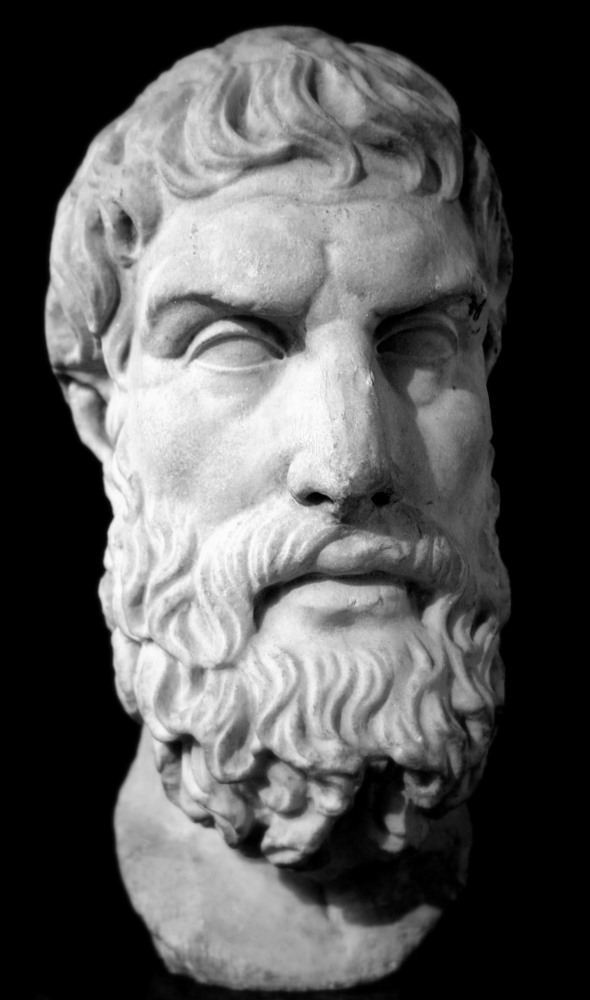
Epicurus_bust2Today’s quote is a new one for me because I don’t really get into the whole philosophy thing. But Epicurus was an ancient Greek philosopher as well as the founder of the school of philosophy called Epicureanism. Only a few fragments and letters of Epicurus’s 300 written works remain. I chose this quote not for its author but for the quote itself. I don’t know much about Epicurus nor am I a fan of his but that fact became, unintentionally, symbolic in and of itself. For example: According to Wikipedia:

Epicurus is a key figure in the development of science and scientific methodology because of his insistence that nothing should be believed, except that which was tested through direct observation and logical deduction.”

While I absolutely disagree, I was still able to learn something from the quote itself and apply it to my personal walk in a way that is relevant to me without sacrificing my understanding or being redirected.

writers-quote-wednesday

Thanks for joining us for another episode of Writer’s Quote Wednesday! Be sure to run on over to Silver Threading to see what the fun is all about.

http://silverthreading.com/2015/03/18/writers-quote-wednesdayoscar-wilde/