Wk#4: #Rebirth Weekly Love Challenge – You Can’t Leave

Wow, this month is over already. This is my final Love poem submission for Lisa’s Weekly Loooovveee Challenge for the month of April. loveu1

made_for_each_other

You can’t leave me
not now
not ever
not while my kiss is in your bloodstream
and not when your tongue has danced on the insides of my mouth
not when your teeth have carved “I luv u’s”
on my heart like hieroglyphic images
to remember when were far apart from each other
like
long standing memories
And if I 4get to say I love you just use the seal of my kiss and put them in parenthesis
but not for a Greek tragedy
so you see
there ain’t no leaving me
Not unless you wanna leave you
and then our bystanders can tell stories of those days back when life made sense
back when you were already a man of pride
and serious eyes were already making love to the tears of my innocence
Not unless you want them to weep at our footprints
But if your heart continues to cry my tears
And my heart continues to cry your tears
Then it will be impossible for you to leave me
Because our hearts will be tongue tied for years.

************

Special thanks to Lisa for hosting this months Love Challenge, it was fun! Whoop! 🙂

Writer’s Quote Wednesday – The Closeness of Poetry

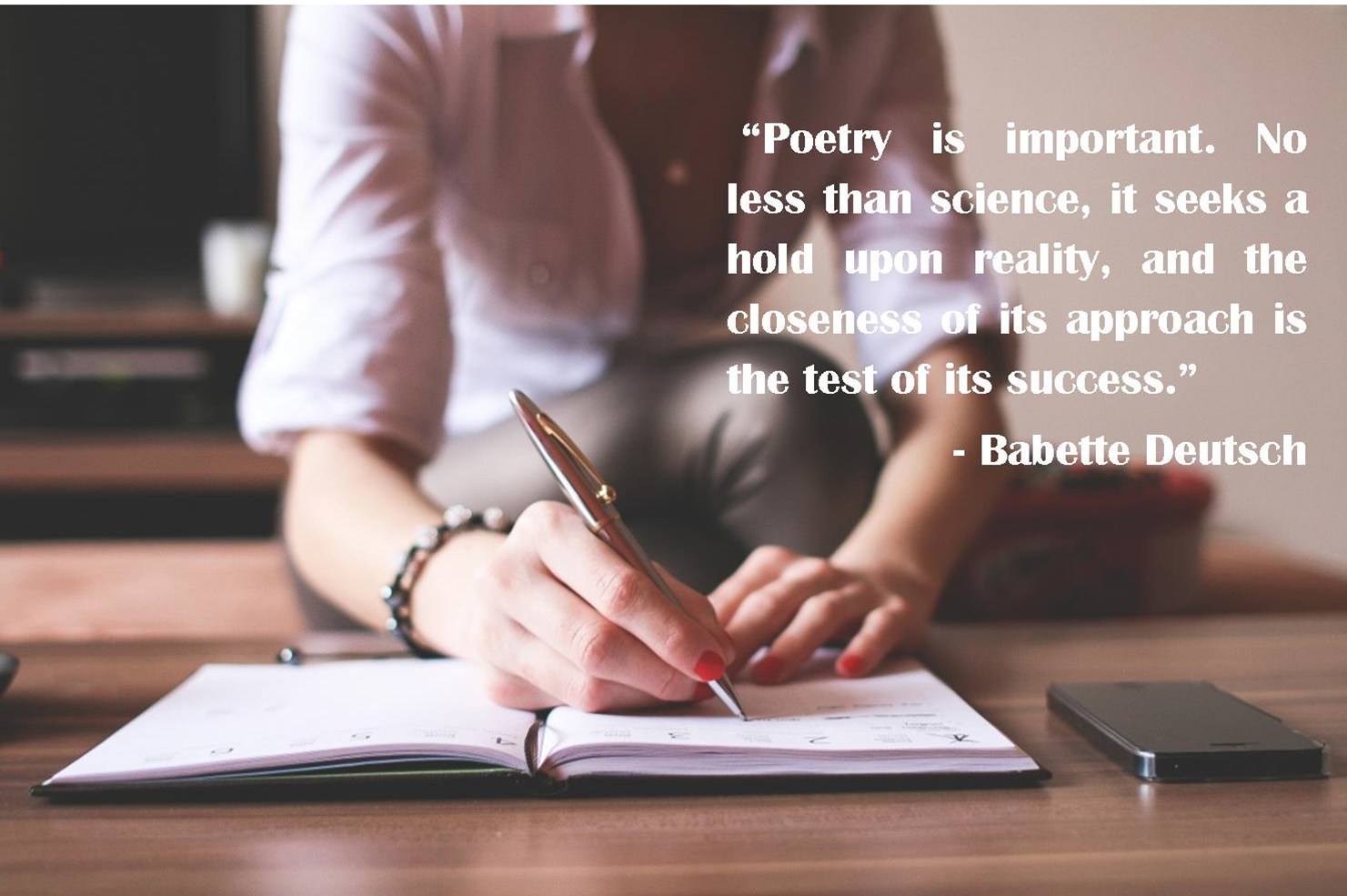
My contribution to this week’s episode of   Writer’s Quote Wednesday is from Babette Deutch:

Poetry

“Poetry is important. No less than science, it seeks a hold upon reality, and the closeness of its approach is the test of its success.” Babette Deutsch

I had a different poetry quote in mind for today, but of the two I chose this one because it reminds me how powerful good poetry can be and the impact of its gift on the world. The result of words that live combined with a strong voice to deliver them has the capacity to change lives. I’m sure there’s so much more that can be said about this powerful quote, but that is all I have for you this afternoon.

About the Author:

Deutsch was a Poet, novelist, and editor. She was born and lived much of her life in New York City and began to publish poems in journals such as the New Republic while a student at Barnard College, where she earned a BA. Two years after her graduation, she published her first poetry collection, Banners. What is interesting about Babette is that she was part of what is called the Imagist Movement. Now I didn’t know what that was so I Googled it:

Imagism was a movement in early 20th-century Anglo-American poetry that favored precision of imagery and clear, sharp language. It has been described as the most influential movement in English poetry. A characteristic feature of Imagism is its attempt to isolate a single image to reveal its essence.

Aligned with the Imagist movement, Deutsch typically composed compact, lyrical pieces using crisp visual imagery. Many of her poems are responses to paintings or other pieces of visual art. Deutsch is the author of 10 collections of poetry, two of which are self-selected volumes of her collected work: Collected Poems 1919–1962 (1963) and The Collected Poems of Babette Deutsch (1969). She is was also the author of four novels and six children’s books. Babette died in November of 1982.

***********************************

And that’s it for Writer’s Quote Wednesday! Be sure to check out Silver Threading to see how you can join the fun!

writers-quote-wednesday

http://silverthreading.com/2015/04/15/writers-quote-wednesday-3/

Writing Poetry

7716writerSo I was thinking about poetry a lot this week. I’m in the midst of this like wondering moment if you will; a pondering of thoughts concerning poetry. I noticed that the inspiration I have to write poetry is different than the inspiration to write in general. It’s not like just sitting down and just writing but more like a wanting to express myself in a deeper way I suppose. To be more detailed, and filled with expression. For me writing poetry specifically cannot be forced. I don’t know if I could be asked and then write on the spot. It doesn’t come to me that way. For me it has to flow naturally, almost like breathing, it has to be inside of me and then I can let the words exhale from within me. Not to just write but to do so creatively, metaphorically, symbolically, lyrically. When I started writing poetry it was for reasons many start to write. I wrote what I could not speak, and what I could not speak I wrote down. Finding compassion and solace in the spaces between the words. And often going back to read what I felt and to see if I could still relate to those feelings or if I’d grown some.

Does the writing of poetry for you involve a similar process as writing in general or is there a different method involved?

Words Are Worth It

LondonBridgez03

Corroded behavior reveals the unpolished stains left dangling from the heart
Brimming from the mind and falling from the mouth
A surge of power tap dancing in the air and building meaning on the ground
A melting pot of consonant sounds and vowels finding way to my skin
Seeking to build homes in the goosebumps on my arms
Making noise
Unnecessary sounds like the mimic of my own voice
But you do not live here
Have not walked on top the coals that once found residence between my toes
to know what this ground taste like
a skin black leather like strength
I was not born among glass
and will not break easily
I doubt then that this impression will go successful
Sneaky words
Empty tongues
Idle existence
a reverberation of shame creaking against emotion is your birthplace
dare you seek to give of me a world of illusion
a day dream of fairy-tale hopscotching around in my mouth
an elusive sleep walk
a collection of letters too light to gravity the ground
too corroded to fly
bouncing off the walls of thought
dare you pretend the taste of burnt ash that fell from mouth and consumed a life
did not first have a home in heart
all these bodies collecting black and bruise
bruise and black
and bone and stitch
I am no fool
Dear Words
I choose to choose you carefully
To examine your wings before deciding that they should take flight
To taste your essence one syllable at a time
Seasoning as needed
You see words,
I’m on to you
I know how powerful you really are.

Guest Feature – Top Five Reasons You Should Be Reading Poetry

by Nickole Brown

(Found this on BookPage, excellent piece on Poetry)

nickolebrown

5. Because it’s unnecessary.

Yes, unnecessary, absolutely so, but only in the way that beauty and truth are unnecessary. Like an elegant armful of cut tulips brought home dripping from the store among all your pragmatic sundries, like my grandmother’s false lashes glued on every morning to her come-sit-your-handsome-ass-down-here wink, like that baked-bread smell of a newborn’s crown.

Poetry may bear witness, but it is rarely the hardy mule carrying news or facts. No, its burden is unquantifiable, and similar to a penny tossed into a fountain, its worth is in the wishing. As William Carlos William wrote, “It is difficult / to get the news from poems / yet men die miserably every day / for lack / of what is found there.” Put another way, C.S. Lewis said, “Friendship is unnecessary, like philosophy, like art. . . . It has no survival value; rather it is one of those things which give value to survival.”

4. Because it’s a throat full of word music.

 
For the poet Patricia Smith, the word was anemone. She was nine years old when her fourth-grade teacher asked her to pronounce it. She writes that she “took a stab and caught it, and / and that one word was uncanny butter on my new tongue.” For the poet Laure-Anne Bosselaar, she loves it when plethora, indolence, damask, or lasciviousness work, in her words, “to stain my tongue, / thicken my saliva.” For me, some days, it’s the word fricative. Other days, it’s ardor, aubade, hydrangea; I’ve held each of those words like a private little bubble of air popping around inside my mouth. Donald Hall calls this “milktongue” and names it as the “deep and primitive pleasure of vowels in the mouth, of assonance and of holds on adjacent long vowels; of consonance, mmmm, and alliteration.”

3. Because it fosters community.

 
Robert Pinsky knew this when he started the Favorite Poem Project when he was U.S. Poet Laureate—people love to share poems that speak to them. And not just poets, either, but postal workers and dental technicians and racecar enthusiasts, too. Almost everyone carries a poem with them, even if only a scratch of a line or two deep in memory, and reading poetry can place you squarely in the chorus of people hungry to share those lines. Consider, for example, a casual late-night post I made on Facebook last February, making a request of the Internet for poems of joy and happiness. Within hours, over sixty comments magically arrived in my feed, recommending poem after poem. . . poems by Naomi Shihab Nye and William Loran Smith and Robert Hass, among many others. I read them all, and suddenly, I was much less alone; my dreary winter was flooded bright.

2. Because it welcomes what’s inexpressible.

 
I’ll confess: it was fiction I studied in graduate school. But when I finished my program, I found the cohesiveness required of a novel to be false and hardly conducive to the fragmented, often discontinuous memories I carried. When I wrote my first book, Sister, I needed the white space between poems to hold the silence between the remaining shards of my childhood. With Fanny Says, I needed a form that would allow me to mosaic together a portrait of my grandmother with only the miscellaneous bits of truth I had without having to fudge the connective tissue between them. You see, poetry doesn’t demand explanations. In fact, most poems avoid them, often reaching for questions over answers. Now, this doesn’t mean poetry is necessarily difficult to understand, no. It means that it simply makes room for things that are difficult to understand. John Keats called this negative capability, as poetry is “capable of being in uncertainties, mysteries, doubts, without any irritable reaching after fact and reason.” To me, this acceptance of what cannot be explained is one of the best reasons to read poetry.

1. Because it calls for a life of awareness.

 
People often assume poetry exists in the realm of thought, lost in philosophical inquiry and romantic meanderings. And most early attempts at writing poetry fail because of this, or worse, because beginning writers travel those easy, hard-wired paths in the brain geared towards survival, which are inundated with years of advertisements, televised plots, and habitual speech. But poetry demands awareness, a raw, muscular devotion to paying attention. You have to live in your body, you have to listen hard to the quiet ticking of both your life and those around you. Like an anthropologist, you have to take down good notes. Poems require a writer to write from all the senses. As Eudora Welty said, “Children, like animals, use all their senses to discover the world. Then artists come along and discover it the same way, all over again.” To me, poetry can make even the most quotidian of things—a tomato on the counter, a housefly batting against the window, your bent reflection in a steel mixing bowl—something extraordinary. Poetry notices things. It scrubs your life free of clichés and easy answers, and the best poems make everyday life strange and new. Poetry requires you to be awake to write it, and reading effective poetry is a second kind of awakening.

Wk 2: Love Poems Challenge: A Love Like Music

loveu1

Welcome back everyone for another week of Looooveee with Lisa Tetting’s Love Poem Challenge brought to you every Friday. This one is a re-post, an oldie but goodie. Enjoy.

A Love Like Music…

the instant birth of calm
and racing anxiety slowed,
and slick,
and subtle
like splashes of sunlight chipping at our faces
warm and comforting
like tapping footsteps
love me
like drumming fingers
like dancing
bobbing heads and bodies contorted
into the full figure of violin
and singing like half notes
like puzzles brought together and connecting to the sky
we love like wireless
find us anywhere
find us weak and fractured
our experiences tugging against the others existence like tendons and muscles
our faces pulled back like nostalgia
an orgasmic melody of words to virgin ears
potent, and suspect, and anxious
like balls of flesh torn into stuttering syllables, and time signatures
and melodies and pianos
we play poetry like pianos
like fingers are feathers
every nerve tickled by the slightest touch
a Katrina of waves pleasurable and strong
like euphoria
brushing against the shores of truth
love me into music
like base that split atoms into frequencies that scrape the sky
that loves like stringed instruments
this is a love that sounds
like music

************************************

And that’s it for my contribution to Lisa’s Love Poems Challenge. Click the pic (or the link below) to see how you can join the fun!

poetry-2

New Challenge for National Poetry Month!

Writer’s Quote Wednesday – Derek Walcott

Today’s quote for Writer’s Quote Wednesday is from Poet and Playwright Derek Walcott:

Bucknell University. (Photos by Timothy D. and Nicole M. Sofranko)

“… the truest writers are those who see language not as a linguistic process but as a living element….” – Derek Walcott

I think this is such a great motivational quote for writers. It has a way about it that can be explained in much more detail than what I can give but in short, it reminds me of the living attribute of words. Just the power of words and how breathing language is. I think that when we seek to create vision for the reader it’s much more than the language aspect in the literal form. It is not merely collaborating strings of words together for English sake, but it is feeling. Experiencing the moment and then putting that moment into words. Personally, I think some of my best writing has occurred during times where I did not purposely set out to write, but the language itself was so moving, and so feeling, that I simply had to.

About the Author (from Poets.org)

derek-walcott-3-sized

“The recipient of the 1992 Nobel Prize in Literature, Derek Walcott was born in Castries, Saint Lucia, the West Indies, on January 23, 1930. His first published poem, “1944” appeared in The Voice of St. Lucia when he was fourteen years old, and consisted of 44 lines of blank verse. By the age of nineteen, Walcott had self published two volumes, 25 Poems (1948) and Epitaph for the Young: XII Cantos (1949), exhibiting a wide range of influences, including William Shakespeare, T. S. Eliot, and Ezra Pound.

He later attended the University of the West Indies, having received a Colonial Development and Welfare scholarship, and in 1951 published the volume Poems.

The founder of the Trinidad Theater Workshop, Walcott has also written several plays produced throughout the United States, The Odyssey: A Stage Version (1992); The Isle is Full of Noises (1982); Remembrance and Pantomime (1980); The Joker of Seville and O Babylon! (1978); Dream on Monkey Mountain and Other Plays (1970); Three Plays: The Last Carnival; Beef, No Chicken; and A Branch of the Blue Nile (1969). His play Dream on Monkey Mountain won the Obie Award for distinguished foreign play of 1971. He founded Boston Playwrights’ Theater at Boston University in 1981.

About his work, the poet Joseph Brodsky said, “For almost forty years his throbbing and relentless lines kept arriving in the English language like tidal waves, coagulating into an archipelago of poems without which the map of modern literature would effectively match wallpaper. He gives us more than himself or ‘a world’; he gives us a sense of infinity embodied in the language.”

He currently divides his time between his home in St. Lucia and New York City.

 ***************************

And that’s it for Writer’s Quote Wednesday!

writers-quote-wednesday

Don’t forget to check out Colleen on Silver Threading to see how you can join the fun.

http://silverthreading.com/category/writers-quote-wednesday/