Unfamiliar Faces – Lost to History: Afro Puerto-Ricans, Cubans, Jamaicans, Haitians

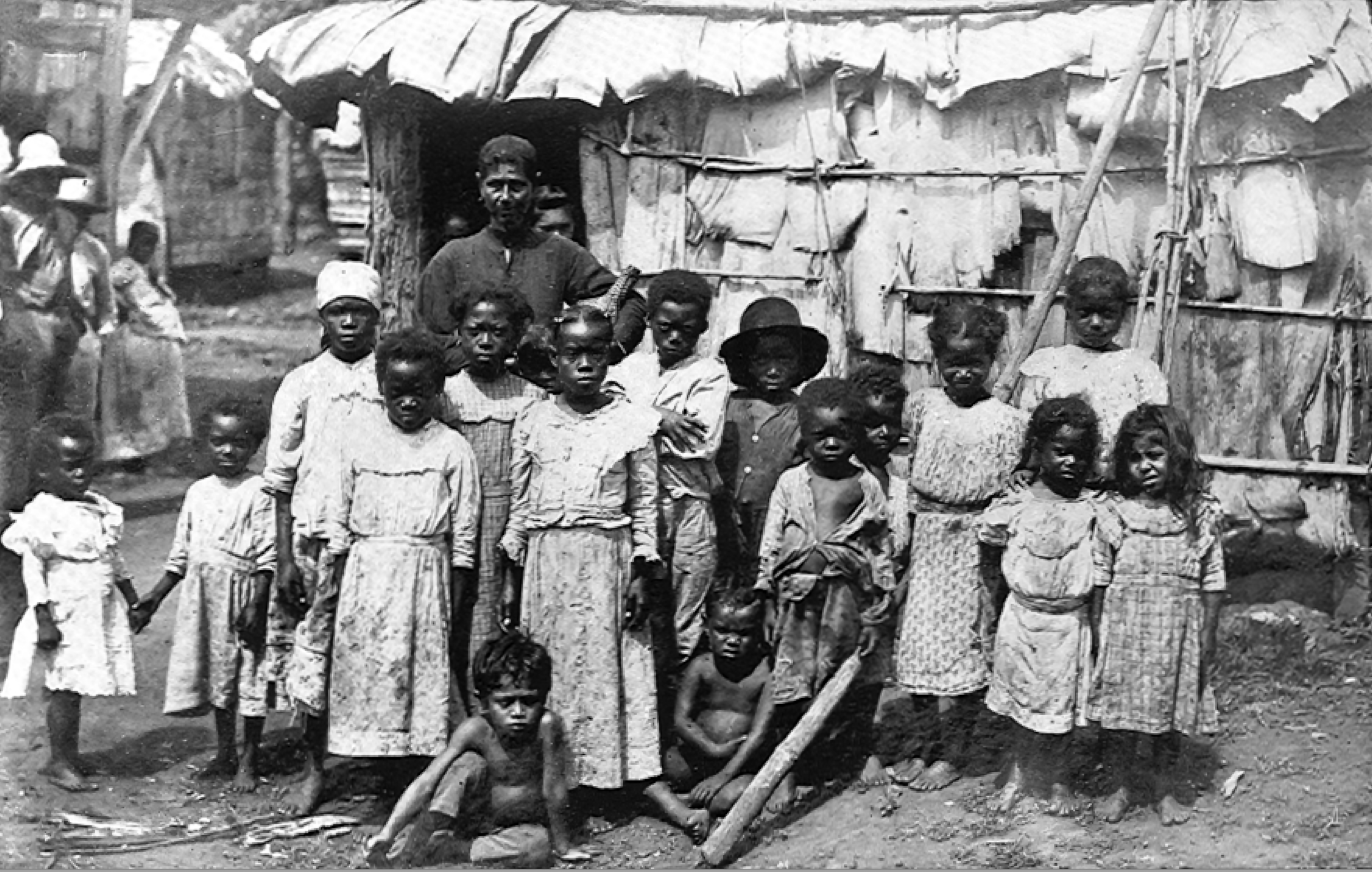
porto_rican_peones_puerto_rican_peons-_children
Enslaved Afro Puerto Rican children

Though many students will learn about slavery in the U.S. at some point, our teachings are usually narrow in that we only learn about the European Slave Trade and the wrongs that Europeans have done. We won’t be told that we weren’t just dropped off in America. We won’t be told that every people, from Jews to the Five Civilized Native American Tribes, held us as slaves. We won’t be told of the difference between the Africans themselves who had slaves and those who were enslaved, and we won’t be told of the many different tribes and nations of black people that occupy the continent.

Contrary to popular belief, mostly brought on by television and movies, slave traders did not go into the interior of Africa to pick up any “African” but they were looking for a specific people. However, since the continent has been lumped up into one big mass, all blacks are assumed to be the same people and as a result, many ancient practices and truths faded from memory.

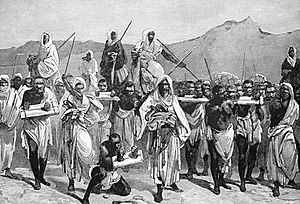
Engraving of Arab slave-trading caravan transporting African slaves across the Sahara.

The trade of slaves across the Sahara has a long history. Dr. John Alembellah Azumah in his 2001 book, The Legacy of Arab-Islam in Africa estimates that over 80 million black people died en route to the Islamic world. Having enslaved blacks about one thousand years before the Europeans, the Arabs had already identified the people of the book. That is the people of the covenant. The people of scripture. The chosen and the prophecies surrounding their captivity.

Indeed, they were not after just any African, but the ones who held principles that were distinct from the other tribes. Differing by way of culture and spirituality, these blacks could easily be spotted by way of their traditions. Olaudah Equiano, known as Gustavus Vassa, captured, enslaved, and then freed, told in his book, The Interesting Narrative of the Life of Olaudah Equiano, of his life in Africa before the abduction.

Born among the Ibo people in the kingdom of Benin, along the Niger River, Olaudah recounts in his narrative of how they still held many Hebrew customs and traditions, such as the circumcision, the division of the tribes by twelve, and the marrying of their brother’s wife after death just to name a few. What is not recounted is that not only did Olaudah’s family uphold such traditions but so did many so-called African tribes.

That said, many of the slaves who came to Puerto Rico were from Congo, the Ashanti, Yoruba, Igbo and Bantu tribes. In all, 31 known African tribes were brought to the island from Central and West Africa through the slave trade but they weren’t the only ones.

Not only was Afro-Puerto Ricans largely made up of these Hebrew tribes, but so were the Jamaicans, Dominicans, Cubans, and so-called African Americans of today. Though we see each other as separate, the truth is that many of us (even if we’ve mixed) are all the same people and were all part of the dispersion.

Today’s lost to history segment focuses not on one individual but a group of individuals who have gone on to war within themselves due to the lost historical fact that we are not a different people but the same. Having been separated by land, we were taken from the same areas because we are descendent of the same people. The only difference is that we were dropped off in different places. Some to Jamaica, some to Haiti, some to Puerto Rico, and so on. As a result, some of us speak English, some of us speak Spanish, and some of us speak French.

Why I Speak

Why I Speak

“We often forget that the current state of Black Americans is directly related to history.”

Black Then Staff

It is clear that we live in a system that is unfair and a civilization that is not just. I speak of these things not because I want to focus on the negative experience of blacks in America only. I speak of these things not because I’m a dark person who just wanna keep bringing up bad stuff. I speak of these things because we’ve become comfortable here in this land. We have been blinded from the truth as a people. We’ve forgotten that the constitution did not include us and that civilization for us is outside of this system. We’ve been tricked into believing that we are citizens in this land and that we have some kind of rights here. We’ve forgotten that when “All men were created equal” that didn’t include us. For what to the slave is the 4th of July?

You see we’ve forgotten where we’ve come from and as a result have no idea where we’re going. How can a slave pursue freedom when he thinks that he is already free? You see the black man does not exist. Black is a color, not a nation of people. Where is African American land? It does not exist. Africa and America are the combinings of two continents. There are over 50 countries in Africa, how then can “African” properly define a people? Which country in Africa are we talking about? African American is also therefore not a nation of people.

I speak because our roots stretch deeper than colors, bywords, proverbs, and mockeries that conceal true identities.  I speak because we forget that we were never part of this constitution. To amend. It means to alter, modify, and to revise. This document had to be revised, altered, and modified just to include you. No justice no peace, my people. It means that there’s no justice for you here and there’s no peace here either. This is the world we live in. We condemn the Confederate flag and we praise the American flag because we’ve been blinded to think there’s a difference between the two. They both drip with the blood of the saints.

We continue to march and to protest because we believe it will change things. How is it that we’ve gone from fighting for freedom to settling for Civil Rights? What is a civil right? What about human rights? So yes, I speak. I speak because we think we know slavery and we know nothing. I speak because we think we know freedom and we know nothing. I speak because we think we have rights and we have nothing. I speak because we think we know justice in a land that is anything but just.  Don’t matter who becomes president. It is the system that is broken and it is my responsibility to speak.

Lost to History – Unfamiliar Faces: Francis E.W. Harper

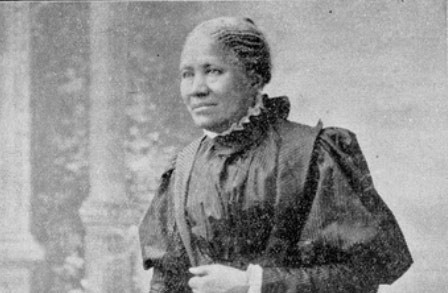
frances-ellen-watkins-harper-448

Maya Angelou, Toni Morrison, Richard Wright, and Zora Neale Hurston are among many peoples list of powerful writer influences. Throw in Ralph Ellison, James Baldwin, Alice Walker, Octavia Butler, and Langston Hughes and you have a dream team of the world’s most quoted, most copied, and most talked about black writer contributors of all time. A name you won’t hear is Francis Ellen Watkins Harper, poet, author, and abolitionist.

“My home is where eternal snow Round threat’ning craters sleep, Where streamlets murmur soft and low And playful cascades leap. Tis where glad scenes shall meet My weary, longing eye; Where rocks and Alpine forests greet The bright cerulean sky.” – Forest Leaves, Yearnings for Home by Frances E.W. Harper

Frances was a writer and poet born free to free parents in Baltimore and attended a school for blacks that was ran by her Uncle. Frances wrote poems and went on to publish her first collection in 1845, Forest Leaves. Years later, Frances taught domestic duties at Union Seminary in Ohio which was run by John Brown, the devout abolitionist who held strong opposing views of slavery. Brown, a white man, was a conductor of The Underground Railroad and The League of Gileadites, an organization established to help runaway slaves escape to Canada. As a result, naturally Frances got involved in the abolitionist movement and The Underground Railroad becoming a lecturer who went on tours with such men as Frederick Douglas.

In 1854, Frances published Poems of Miscellaneous Subjects, which featured one of her most famous works, “Bury Me in a Free Land”, and in 1859 made literary history with “Two Offers” which made her the first African-American female writer to publish a short story.

Harper died of heart failure on February 22, 1911, in Philadelphia, Pennsylvania.

This Month in History – August

THis MonthIn BlackHistory

  • 1834 – Slavery was abolished throughout the British Empire – Slavery Abolition Act 1833 came into effect.
  • August 2, 1850 – The start of The Underground Railroad, a network of secret routes and safe houses used by 19th-century enslaved people in the United States in efforts to escape to free states and Canada. The Underground Railroad was neither underground nor a railroad. It got its name because its activities had to be carried out in secret, using darkness or disguise, and because railway terms were used by those involved with system to describe how it worked. Various routes were lines, stopping places were called stations, those who aided along the way were conductors and their charges were known as packages or freight.
  • August 2, 1924 – James Baldwin, author of Go Tell It On The Mountain, The Fire Next Time, and Another Country, is born.
  • August 3, 1800 – Gabriel Prosser, a literate enslaved blacksmith, planned a large slave rebellion in the Richmond  area in the summer of 1800. Information regarding the revolt was leaked prior to its execution, and he and twenty-five followers were taken captive and hanged in punishment.
  • August 4, 1901 – Jazz trumpet player Louis Armstrong was born in New Orleans, Louisiana. Known as “Satchmo,” he appeared in many films and is best known for his renditions of It’s a Wonderful Worldand, Hello, Dolly.Three young civil rights workers, James Chaney, Andrew Goodman and Michael Schwerner, were found murdered and buried in an earthen dam outside Philadelphia, Mississippi.
  • August 5, 1962 – Nelson Mandela imprisoned.
  • August 11, 1841– Frederick Douglass, an escaped slave, spoke before an audience in the North for the first time.
  • August 11, 1965 – Watts Riots: In Los Angeles, racial tension reaches a breaking point after two white policemen fight with a black motorist suspected of drunk driving. An angry crowd gather near the corner of Avalon Boulevard and 116th Street to watch the arrest and soon grew angry by what they believe to be another incident of racially motivated abuse by the police. A riot kicks off and lasts for five days (ending on the 16th) with 34 dead and 1,032 injured.
  • Roots author Alex Haley was born in Ithaca, New York. His Pulitzer Prize-winning novel, published in 1976, explored seven generations of his family from its origins in Africa through slavery in America and eventual hard-fought freedom. Roots was translated into 37 languages and also became an eight-part TV miniseries in 1977 which attracted a record American audience and raised awareness concerning the legacy of slavery. A remake of Roots aired in on May 30, 2016.
  • August 18, 1859 – Harriet Wilson’s Our Nig is first novel published by a black writer.
  • August 20, 1619 – 1st known African Americans (approx. 20) land at Jamestown Virginia aboard Dutch vessel then sold or traded into servitude for supplies.
  • August 21-22 1831 – In Southampton County, Virginia, on August 21-22, 1831, Nat Turner, led the first slave revolt of magnitude. The revolt was crushed, but only after Turner and his band had killed some sixty whites and threw the South into panic. After hiding out, Turner was captured on October 30, 1831, and hanged in Jerusalem, Virginia, on November 11th. Thirty other blacks were also implicated and executed. It was not until John Brown’s raid on Harpers Ferry, Virginia, in 1859 that another slave revolt became known.
  • August 21, 1971 – George Jackson assassinated by prison guards during a Black prison rebellion at San Quentin on August 21, 1971. Three prison guards were also killed during that rebellion and prison officials charged six Black and Latino prisoners with the death of those guards. These six brothers became known as the San Quentin Six.
  • August 23, 1926 – Carter Woodson, historian, author, inaugurated Negro History Week and later producer of the Negro History Bulletin. Negro History Week would later be known, as it is today, as Black History Month.
  • August 25, 1908 – National Association of Colored Nurses founded.
  • August 26, 1900: Hall Woodruff was born. He was a nationally known print-maker, draftsman and painter and a leading artist of the Harlem Renaissance. He died in 1980.
  • August 27, 1935 – Mary McLeod Bethune founds the National Council of Negro Women.
  • August 28, 1955 – While visiting family in Money, Mississippi, 14-year-old Emmett Till from Chicago, is brutally murdered for flirting with a white woman four days earlier. His assailants–the white woman’s husband and her brother–made Emmett carry a 75-pound cotton-gin fan to the bank of the Tallahatchie River and ordered him to take off his clothes. The two men then beat him nearly to death, gouged out his eye, shot him in the head, and then threw his body, tied to the cotton-gin fan with barbed wire, into the river. (Duet. 28:49-50)
  • August 28, 1888 – Granville T. Woods patents railway telegraphy.
  • August 29, 1920 – Saxophonist Charlie “Bird” Parker born
  • August 30, 1967 – Thurgood Marshall ~ became first Black Supreme Court Justice
  • August 30, 1838 – The first African American magazine, Mirror of Freedom, begins publication in New York City.
  • August 31, 1836 – Henry Blair patents cotton planter (also patented a corn planter), and became the second African American to hold a United States patent.

Lost to History – Unfamiliar Faces: Latasha Harlins and Deadwyler

Rodney King. It is a name that rings all too familiar in the history of Black America. Latasha Harlins however, is a not so familiar face.

Latasha Harlins

67053-full

Latasha Harlins died 13 days after the beating of Rodney King on March 16, 1991 at The Empire Liquor Market in South-Central Los Angeles with two dollars in her hand. After attempting to purchase a bottle of Orange Juice, Latasha and Korean Store Owner Ja Du got into a verbal and physical altercation. Du thought Latasha was trying to steal the $1.79 drink, which lead to a fight. Latasha struck Du and the two mouthed words before Harlins turned to walk out the door but it was too late. Ja Du pulled the handgun from behind the counter and shot the teen in the head. The entire ordeal was caught on tape and Latasha died instantly. She was 15 years old. November of that year, a judge sentenced Du to five years of probation, 400 hours of community service, and a $500 fine. Tupac’s “Keep Your Head Up” was dedicated to Latasha Harlins.

The Deadwyler Case

mM5qZAnzQZ3ylo4w-TiVo4A

Johnny Cochrane is another prominent name in the black community. Modeling his career from the inspiration of Thurgood Marshall, Cochrane was born in Shreveport LA and gained his fame after defending such big names as Micheal Jackson and O.J. Simpson. An unfamiliar face however lies in the name of a man whose death is responsible for launching Johnny’s reputation: Leonard Deadwyler. Deadwyler’s death galvanized protests and activism that lead to the Martin Luther King Jr. and the adjoining Charles R. Drew University of Medicine and Science. While speeding through several red lights, Leonard Deadwyler raced in an attempt to get his pregnant wife, now in labor, to the hospital. Due to the lack of a black hospital near by, the Deadwhyler’s had to attend a facility 20 miles away. On the way, Leonard was stopped by police and a confrontation erupted which resulted in the shooting death of Leonard who was shot and killed in front of his pregnant wife. Police said the ordeal was the result of a drunken Leonard to the debate of his wife who remembered no such account. Blacks in South Central protested that Deadwyler would not have been speeding, and thus not shot and killed if there was a hospital near by. Leonard’s wife sued with a young Johnny Cochrane as her lawyer who filed a Civil Suit on behalf of the Deadwyler family. They lost the case, but Cochrane had already set himself apart as a talented lawyer as it pertained to Civil Rights, police abuse cases.

Unfamiliar Faces – Lost to History: Before Parks

“They said they didn’t want to use a pregnant teenager because it would be controversial and the people would talk about the pregnancy more than the boycott,” Colvin says.

https://www.bbc.com/news/stories-43171799

Was Rosa Parks the only woman to refuse to give up her seat on a segregated bus? Below are a few of the women left out of the history books. 


Irene Morgan – We have all heard of Rosa Parks, but there were at least three women who refused to give up their seats on the bus in the Jim Crow south throughout history. Eleven years before Parks, Irene Morgan, later known as Irene Morgan Kirkaldy, a black woman, was arrested in Middlesex County, Virginia, in 1944 for refusing to give up her seat on an interstate bus according to a state law on segregation. The Irene Morgan Decision inspired the men and women of CORE to create a nationwide protest movement called “The Journey of Reconciliation” when groups of civil rights activists rode buses and trains across states in the South in 1947, a precursor to The Freedom Rides of 1961.

The Irene Morgan v. Commonwealth of Virginia, handed down a landmark decision on June 3, 1946, when they agreed that segregation violated the Constitution’s protection of interstate commerce. Irene Morgan v. Commonwealth catalyzed further court rulings and the Civil Rights movement. Eight years later, the Supreme Court decided in Brown v. Board of Education that segregation violated Equal Rights Protection.

Irene Morgan died on August 10, 2007.

maxresdefault1

Claudette Colvin – Born on September 5, 1939, in Montgomery, Alabama, Claudette Colvin refused to give up her seat to a white passenger months before Rosa Parks on March 2, 1955. Colvin was only 15 years old but she was poor. She didn’t have the NAACP or the connections Parks had. As a result, little is know of her. The NAACP considered using Claudette but they said she was too young. They also looked away because she was pregnant and they did not want to represent a young, unwed mother and bring about negative attention to the movement. They thought Colvin’s condition would make blacks look bad. Colvin went on to serve as a plaintiff in the landmark legal case Browder v. Gayle, which helped end the practice of segregation on Montgomery public buses. Today, Claudette Colvin is still not a name you hear very often concerning bus desegregation, even though she was there before Parks.

“Whenever people ask me: ‘Why didn’t you get up when the bus driver asked you?’ I say it felt as though Harriet Tubman’s hands were pushing me down on one shoulder and Sojourner Truth’s hands were pushing me down on the other shoulder. I felt inspired by these women because my teacher taught us about them in so much detail,” she says.

8634838_orig

Aurelia Browder – After Colvin, Aurelia Browder followed suit and was arrested on April 19, 1955, for refusing to give up her seat. Browder was born on January 29, 1919. She joined the NAACP, SCLC (Southern Christian Leadership Conference), the Women’s Political Council (WPC), and the Montgomery Improvement Association (MIA). Aurelia could join all the organizations she wanted but with six children and no husband, her refusal to give up her seat on a bus did not stick, even though she was before Parks.

Mary Louise Smith – Mary was born in 1937, in Montgomery, Alabama. She attended and graduated from St. Jude Educational Institute. On October 21, 1955, at the age of 18, Mary was returning home on the Montgomery city bus. At a stop after Mary had boarded and seated, a white passenger boarded. There was no place for the white passenger to sit and Mary was ordered to give up her seat. She refused. Mary was arrested and charged with failure to obey segregation orders and given a nine dollar fine, which her father paid.

Irene, Claudette, Aurelia, and Mary Louise was followed by Susie McDonald, and Jeanetta Reese, all had been arrested and charged with violating various policies regarding segregated seating on city buses.


Discover more Black History Fun Facts and Lost to History Facts HERE.

Tales of African American History Found in DNA

Very interesting article. Check it out:

“The history of African Americans poses special challenges for geneticists. During the slave trade, their ancestors were captured from genetically diverse populations across a portion of West Africa. Adding to the complexity is the fact that living African Americans also may trace some of their ancestry to Europeans and Native Americans.”