Writer’s Quote Wednesday – The Closeness of Poetry

My contribution to this week’s episode of   Writer’s Quote Wednesday is from Babette Deutch:

Poetry

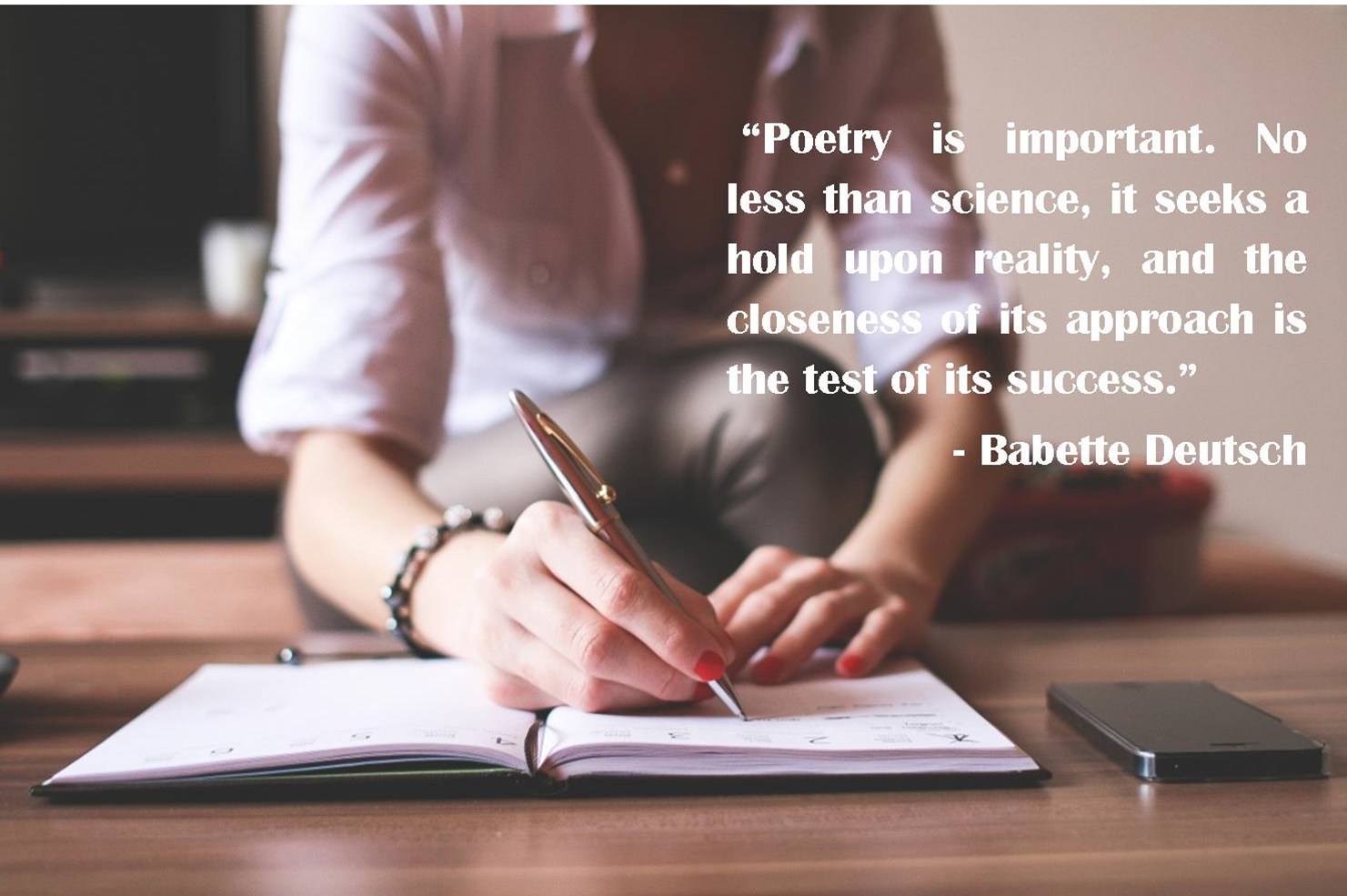
“Poetry is important. No less than science, it seeks a hold upon reality, and the closeness of its approach is the test of its success.” Babette Deutsch

I had a different poetry quote in mind for today, but of the two I chose this one because it reminds me how powerful good poetry can be and the impact of its gift on the world. The result of words that live combined with a strong voice to deliver them has the capacity to change lives. I’m sure there’s so much more that can be said about this powerful quote, but that is all I have for you this afternoon.

About the Author:

Deutsch was a Poet, novelist, and editor. She was born and lived much of her life in New York City and began to publish poems in journals such as the New Republic while a student at Barnard College, where she earned a BA. Two years after her graduation, she published her first poetry collection, Banners. What is interesting about Babette is that she was part of what is called the Imagist Movement. Now I didn’t know what that was so I Googled it:

Imagism was a movement in early 20th-century Anglo-American poetry that favored precision of imagery and clear, sharp language. It has been described as the most influential movement in English poetry. A characteristic feature of Imagism is its attempt to isolate a single image to reveal its essence.

Aligned with the Imagist movement, Deutsch typically composed compact, lyrical pieces using crisp visual imagery. Many of her poems are responses to paintings or other pieces of visual art. Deutsch is the author of 10 collections of poetry, two of which are self-selected volumes of her collected work: Collected Poems 1919–1962 (1963) and The Collected Poems of Babette Deutsch (1969). She is was also the author of four novels and six children’s books. Babette died in November of 1982.

***********************************

And that’s it for Writer’s Quote Wednesday! Be sure to check out Silver Threading to see how you can join the fun!

writers-quote-wednesday

http://silverthreading.com/2015/04/15/writers-quote-wednesday-3/

Writing Poetry

7716writerSo I was thinking about poetry a lot this week. I’m in the midst of this like wondering moment if you will; a pondering of thoughts concerning poetry. I noticed that the inspiration I have to write poetry is different than the inspiration to write in general. It’s not like just sitting down and just writing but more like a wanting to express myself in a deeper way I suppose. To be more detailed, and filled with expression. For me writing poetry specifically cannot be forced. I don’t know if I could be asked and then write on the spot. It doesn’t come to me that way. For me it has to flow naturally, almost like breathing, it has to be inside of me and then I can let the words exhale from within me. Not to just write but to do so creatively, metaphorically, symbolically, lyrically. When I started writing poetry it was for reasons many start to write. I wrote what I could not speak, and what I could not speak I wrote down. Finding compassion and solace in the spaces between the words. And often going back to read what I felt and to see if I could still relate to those feelings or if I’d grown some.

Does the writing of poetry for you involve a similar process as writing in general or is there a different method involved?

Words Are Worth It

LondonBridgez03

Corroded behavior reveals the unpolished stains left dangling from the heart
Brimming from the mind and falling from the mouth
A surge of power tap dancing in the air and building meaning on the ground
A melting pot of consonant sounds and vowels finding way to my skin
Seeking to build homes in the goosebumps on my arms
Making noise
Unnecessary sounds like the mimic of my own voice
But you do not live here
Have not walked on top the coals that once found residence between my toes
to know what this ground taste like
a skin black leather like strength
I was not born among glass
and will not break easily
I doubt then that this impression will go successful
Sneaky words
Empty tongues
Idle existence
a reverberation of shame creaking against emotion is your birthplace
dare you seek to give of me a world of illusion
a day dream of fairy-tale hopscotching around in my mouth
an elusive sleep walk
a collection of letters too light to gravity the ground
too corroded to fly
bouncing off the walls of thought
dare you pretend the taste of burnt ash that fell from mouth and consumed a life
did not first have a home in heart
all these bodies collecting black and bruise
bruise and black
and bone and stitch
I am no fool
Dear Words
I choose to choose you carefully
To examine your wings before deciding that they should take flight
To taste your essence one syllable at a time
Seasoning as needed
You see words,
I’m on to you
I know how powerful you really are.

Guest Feature – Top Five Reasons You Should Be Reading Poetry

by Nickole Brown

(Found this on BookPage, excellent piece on Poetry)
nickolebrown

5. Because it’s unnecessary.

Yes, unnecessary, absolutely so, but only in the way that beauty and truth are unnecessary. Like an elegant armful of cut tulips brought home dripping from the store among all your pragmatic sundries, like my grandmother’s false lashes glued on every morning to her come-sit-your-handsome-ass-down-here wink, like that baked-bread smell of a newborn’s crown.

Poetry may bear witness, but it is rarely the hardy mule carrying news or facts. No, its burden is unquantifiable, and similar to a penny tossed into a fountain, its worth is in the wishing. As William Carlos William wrote, “It is difficult / to get the news from poems / yet men die miserably every day / for lack / of what is found there.” Put another way, C.S. Lewis said, “Friendship is unnecessary, like philosophy, like art. . . . It has no survival value; rather it is one of those things which give value to survival.”

4. Because it’s a throat full of word music.

 
For the poet Patricia Smith, the word was anemone. She was nine years old when her fourth-grade teacher asked her to pronounce it. She writes that she “took a stab and caught it, and / and that one word was uncanny butter on my new tongue.” For the poet Laure-Anne Bosselaar, she loves it when plethora, indolence, damask, or lasciviousness work, in her words, “to stain my tongue, / thicken my saliva.” For me, some days, it’s the word fricative. Other days, it’s ardor, aubade, hydrangea; I’ve held each of those words like a private little bubble of air popping around inside my mouth. Donald Hall calls this “milktongue” and names it as the “deep and primitive pleasure of vowels in the mouth, of assonance and of holds on adjacent long vowels; of consonance, mmmm, and alliteration.”

3. Because it fosters community.

 
Robert Pinsky knew this when he started the Favorite Poem Project when he was U.S. Poet Laureate—people love to share poems that speak to them. And not just poets, either, but postal workers and dental technicians and racecar enthusiasts, too. Almost everyone carries a poem with them, even if only a scratch of a line or two deep in memory, and reading poetry can place you squarely in the chorus of people hungry to share those lines. Consider, for example, a casual late-night post I made on Facebook last February, making a request of the Internet for poems of joy and happiness. Within hours, over sixty comments magically arrived in my feed, recommending poem after poem. . . poems by Naomi Shihab Nye and William Loran Smith and Robert Hass, among many others. I read them all, and suddenly, I was much less alone; my dreary winter was flooded bright.

2. Because it welcomes what’s inexpressible.

 
I’ll confess: it was fiction I studied in graduate school. But when I finished my program, I found the cohesiveness required of a novel to be false and hardly conducive to the fragmented, often discontinuous memories I carried. When I wrote my first book, Sister, I needed the white space between poems to hold the silence between the remaining shards of my childhood. With Fanny Says, I needed a form that would allow me to mosaic together a portrait of my grandmother with only the miscellaneous bits of truth I had without having to fudge the connective tissue between them. You see, poetry doesn’t demand explanations. In fact, most poems avoid them, often reaching for questions over answers. Now, this doesn’t mean poetry is necessarily difficult to understand, no. It means that it simply makes room for things that are difficult to understand. John Keats called this negative capability, as poetry is “capable of being in uncertainties, mysteries, doubts, without any irritable reaching after fact and reason.” To me, this acceptance of what cannot be explained is one of the best reasons to read poetry.

1. Because it calls for a life of awareness.

 
People often assume poetry exists in the realm of thought, lost in philosophical inquiry and romantic meanderings. And most early attempts at writing poetry fail because of this, or worse, because beginning writers travel those easy, hard-wired paths in the brain geared towards survival, which are inundated with years of advertisements, televised plots, and habitual speech. But poetry demands awareness, a raw, muscular devotion to paying attention. You have to live in your body, you have to listen hard to the quiet ticking of both your life and those around you. Like an anthropologist, you have to take down good notes. Poems require a writer to write from all the senses. As Eudora Welty said, “Children, like animals, use all their senses to discover the world. Then artists come along and discover it the same way, all over again.” To me, poetry can make even the most quotidian of things—a tomato on the counter, a housefly batting against the window, your bent reflection in a steel mixing bowl—something extraordinary. Poetry notices things. It scrubs your life free of clichés and easy answers, and the best poems make everyday life strange and new. Poetry requires you to be awake to write it, and reading effective poetry is a second kind of awakening.

To Schedule or Not to Schedule Posts

duratimezone_600px_animation

OK, I just did something really awkward. The post that just came through was supposed to be for tomorrow (Friday). But it appears that WordPress timing is on accord with original time. That is, a new day begins when the sun sets. This is historical fact. In the beginning, people did not always have clocks and time zones. They did however have the sun, the moon, and the stars. But I am noticing a trend with WordPress that mimics this same thing in my Stats section. Have anyone else noticed this? If you go into your dashboard when the sun goes down on any given day, you’ll already begin to see the views come in under the next days date in your stats. For instance: The views you are all getting now will fall under April 10th although according to our current measurement of time, April 10th is not here yet (I’m writing this at 8:40pm CST on Apr 9th). I decided to schedule tomorrows post (today for those of you reading in the future hee hee, funny)because I know I will not have the time to manually log on so I scheduled that last post for April 10th. I thought I was being smart by using military time just in case WordPress isn’t on my time zone and so scheduled it for 0:00 hours to reflect 12am. The jokes on me though because I’m seeing likes from a post that’s supposed to come through tomorrow!

lol…

Oh well, maybe I’m just exhibiting my amateur blogging skills and the rest of you are having a good laugh. At least those of you in other countries are enjoying the post on time huh? I would appreciate however some wisdom from some of you blogging veterans though. I plan to schedule posts a lot more in the future and this is just not going to work. Are there any adjustments I need to make in the settings? Right now every thing pretty much falls under my time zone (USA, Central Standard Time). Thanks in advance for anyone who can offer assistance.

Dear Young People, how NOT to use Twitter

File photo of a Twitter logo in this photo illustration taken in the central Bosnian town of Zenica

Today in Indie Author News, I found some great Twitter Tips. There are tons of Social Media outlets to use for your Self-Publishing business (or any business) but that doesn’t mean all of them will prove effective for you. For some Facebook is more effective, for some Instagram and for others maybe its YouTube. Despite your chosen outlet, we are all seeking to enhance our social media skills to be of service to the online community. So for all of my twitter people out there, I have the perfect link filled with all of the twitter tips you need to get started, but first I have a tip of my own for Young Twitter Users venturing to build businesses:

Tip: Create a separate business account for your business

twitter-mistakes

Throughout our life we will learn new lessons, take part in new things, and overall become gradually different people. The older we get the more wisdom we will acquire (some of us). Experience will show us far more than words ever could and pain will become a great teacher in our lives. Needless to say, today we may not be the same person we were yesterday. Sure at 18 you probably loved to party and hang out with the home girls (or guys). But the truth is that you won’t always be that person. After turning 25 and witnessing some things you may in fact decide that the party life is just not for you anymore. Perhaps now you’ll desire to start your own business. If so, here’s the thing with social media:

If you’re going to use the same Twitter account for your new business as you used when you were rambling about your drunk friend at the club, I’m not here to judge. It’s just that you should probably take down some of the tweets that are not associated with the business itself. You are using Twitter obviously so that you can make new connections and to network with professionals and non-professionals alike. As a result, you want to project a certain professional image. Of course you have to be yourself, but you also want to be a proper representation of the new direction in your life as well.

It’s not that you want to necessarily be the physical manifestation of the business itself, (then you’ll just be boring. People will feel like they’re talking to a computer), you want to allow people the opportunity to see who you are as a person so you should definitely be yourself (as specified in one of the tips). For example, one thing that I’ve come to learn is this: People often want to feel themselves a part of something. They want to see that what you have to offer is of substance, and that it will be of benefit to their lives in some way. They want to see that you are offering more than just the product itself, or that the product itself offers more than a good price.

For this reason, it’s very important to build persona when networking online (this includes blogging). However, that persona should be a reflection, not just of who you are personally, but also your business sense and skill set. You don’t want the owner of The Best Company Ever to see pictures of you doing something wild and then you lose that connection. This same thing can actually also apply to Facebook most especially. Social Media is not a small thing anymore, it is practically everything. Employers and professionals alike do check out social media pages. I know many young people just don’t want to give the impression of being phony or fake, but that’s beside the point. It’s not about not being who you are, its about being of service to the people, and to therefore navigate both the online and offline community accordingly. You wouldn’t walk into a job interview wearing pajamas, so you probably shouldn’t portray the same nonchalant behavior online either.

Whatever you do, just keep it professional, and keep it you.

anigif_enhanced-15822-1408061717-2

Psst: Also, if you’re switching your personal account to a business account, please also change your Twitter name. SexyChick_5 just isn’t gonna work.

Check out more twitter tips here:
http://www.indieauthornews.com/2012/07/twitter-tips-for-authors.html