An Easy Way to Prepare Your Book’s Table of Contents for E-Book

sample e-book properly formatted (not just converted!)


One of the most challenging aspects of Self-Publishing for me, in the beginning, was preparing my book for e-book conversion for proper viewing as an e-book on electronic devices. Of course, formatting and conversion slightly differ (anyone can use the method I am about to show to make ePub and Mobi files, but unless you format the underlying HTML and CSS properly, the result will not look as professional as we all intend as authors like the image above. Often there will be blank lines between paragraphs, no indentations, no TOC (table of contents), links that don’t function, and everything left aligned including headings that were meant to be centered hence, the difference between conversion and actual formatting…. but that’s another post for another day).

So anyway, as I ventured on this Self-Publishing endeavor, I was practically pulling my locs out trying to prepare my manuscript to be accepted by retailers for electronic devices. As we are familiar, manuscripts that are prepared for an e-book has to be done in a way where the electronic device can easily navigate the book. The electronic device easily accomplishes this by utilizing the navigation functions built into an EPUB file to move around the e-book. This is done by properly creating a Table of Contents section or in technical terms, a Navigation Control File. Basically, because your device is not going to be printed like in the old days, it needs guidance on how to move around. Your Kindle or Mobile phone needs to know where each section begins and ends. It does this by looking for Header Styles in your document. While you can either pay someone else to do this or let your POD (Print on Demand) service do it for you, an easy way to learn to do it yourself is to format your manuscript using Heading Styles. Heading Styles are at the top of your Word Document and looks something like this:

styles MS Word

So Below I’ve listed how each section should be properly headed using these Heading Styles to create the TOC. To make this simple, I am only going to assume your book has a few main levels: Title Page, Copyright, Chapter, Sub-chapter, Preface, Body, Epilogue, and Sections:

1. Apply Heading 1 style to the Title and to each line containing a Section name (copyright, prologue, etc.) or section (Part 1, Section II, etc.). Heading 1 style will always appear at the top of the next page.

2. Apply Heading 2 style to each line containing a Chapter name or number

3. Apply Heading 3 style to each line containing a sub-chapter / subtitle or subsection.

That’s it! Pretty simple huh? I know most of you already know how to do this, but you never know who else may be pulling their hair out :). In most cases, your POD distributor will not reject your manuscript if you use this format.

(Don’t use additional Heading styles (Heading 4, Heading 5) to denote chapter or section breaks, as these will not generate most TOC *Table of Contents* entries. Most readers will not be able to navigate to these chapters resulting in retail distribution partners, such as Amazon Kindle and B&N, to reject your e-book).

4 Common Sense Reasons It Can Benefit You to Self-Publish

Crazy Woman Drinking Wine

Twenty years ago, a book followed a routine process: You poured your heart and soul into a manuscript, and when you finished it, you started calling agents and editors who most likely told you to send them a query letter. 

The next step is the book proposal and a few sample chapters. Then the waiting game started, usually ending with disappointment. 

On the other hand, the option to Self-Publish was there, but it had a certain stigma that, thankfully, has waned in this digital era. That stigma can be identified by statements such as, “Your book isn’t really published because you couldn’t get it accepted by a ‘real publisher.'”

However, being a Self-Publisher only means you are in charge of the direction of your book. The publisher (in this case, you) is the one who puts up the money. If you invest in your own printing, you are a Self-Publisher. If you begin to take in manuscripts, you are a small publisher. If you grow, you become a large publisher. Still, many Self-Publishers still wear this “badge of shame” for choosing not to go the traditional route, as if they were the scarlet woman or something.

This list can help clarify and simplify things for you.

4 Common Sense reasons it can benefit you to Self-Publish

• Ownership

Self-Publishing can be the road to your independence. Do you dream of being your own boss? Do you desire more personal freedom? You can turn that dream into a reality. You own all rights to your book as a self-publisher, whereas a traditional publisher would likely own the rights. If they lose interest in your book, you cannot print additional copies unless you purchase those rights. Traditional publishers often require you to purchase your book from them to do any promotion you choose to do for your book. As your own publisher, you print as many books as you need. Here is a dynamic, proven way to shape your own destiny.


• Timing

Traditional publishers work on a long production cycle. They often plan a year to a year and a half—or even longer—to get a book out. As a Self-Publisher, you can do it in a fraction of that time. It’s your material, your career move – you can take control of when you want to publish.


• Increased Income

Self-Publishing offers the potential for huge profits. When you use creativity, persistence, and sound business sense, money is there to be made. Most publishers require their authors to do their own promotion, but if you have to do your own promotion, why not Self-Publish it anyway and make more money? Even if you don’t make much, Self-Publishing allows you to get back what you put in. If you set a plan and work hard at it, you’ll be “making it rain” in no time. Or, you can work hard for some big-time publisher to tell you that you’re just not good enough.


• Control

Self-Publishing gives you the final say on the direction of your book. It reflects your vision and not someone else’s. You can personally guide every step or hire professionals to be on your team. You can choose the cover you like, the typeface, and the title you want. You maintain absolute control over your own book.

Whether you publish Traditionally or Self-Publish, completing a book is a great accomplishment. As to whether or not you’re making money from it, that’s up to you. So go ahead, finish that masterpiece, self-publish if that’s what you want to do, defy the stereotypes, and live happily ever after.

Being of Service

1792884

I’m no expert, but I do know that writing is a unique career. It’s the same as other businesses, and yet it is not the same. It requires the same level of dedication, professionalism, and hard work. However, it is also a lot different than lets say, selling your neighbor a bar of soap.

Reading takes a lot of time. It is on a level that is a lot more personal. Readers actually get very sensitive when it comes to buying a book that sucked than buying a bar of soap that also sucks. People are also easily bored these days, so as authors we have to constantly keep our ears to the ground, discovering what’s trending and what’s throwback. It is for this reason that readers tend to find an author they love and stick to him or her. If you’re that author, great, but the story does not always end this way. As I thought about this, I started to really think, not about selling books, but being of service. As I babysat these thoughts, I ran across some great advice from one of my subscription blogs:

“Don’t SELL to your readers, SERVE them. With the changing dynamic between readers and writers, authors need to listen, gather knowledge about readers, foster communications, collaborate, and build long-term relationships.”

We have to be realistic. Authors are constantly told not to sell. But full time authors, those who don’t hold secondary positions elsewhere or receive money from additional sources, have bills to pay, food to put on the table, and needs that require monetary investment. So we can’t just tell writers that they should not sell their books no more than we can tell bloggers not to get excited over new readers. Despite how we gloss it up, the reality is that an author’s end goal is to sell you this book. But here is where being of service comes in:

For me personally, anything that I bring into my space should teach me something. This just means it should advance me in some way. Will it make me laugh? Cry? Think? Discover? Will it inform me? Teach me? Show me? What does this book, more than any other book, do for me? This is the same way that I look at Blogging. I am more than likely to bond with blogs that have something to offer.

Now, back to soap:

51CEbS1BB7L._SY355_

When you’re selling soap, I want to know that it’s because the benefits of this particular soap outweigh Irish Springs; not just because you’re trying to make a quick buck. If you can convince me that your product is of some significance to my life and you can back this up, then I will be more than happy to become a dedicated supporter. I have enough sense to know that you have bills to pay, but I also see that your purpose is bigger than dead presidents on paper.  Why does this matter to authors?

Because people want to matter.

I believe this is true in everything that we do, and not just writing. But specifically, the first clue to readers that they matter, is the amount of hard work we put into the end product. Our professionalism, or lack thereof, speaks volumes far before these books hit the shelves. So I just want to encourage my writers out there to do the best you can, because it doesn’t get any better than your best. And I believe this is the difference between selling a product and being of service to the people. Readers (and bloggers) want to know that they are getting something out of the process. So I wouldn’t say don’t sell to your readers, instead I would just say to be of service to them.

Writer’s Quote Wednesday – George Orwell

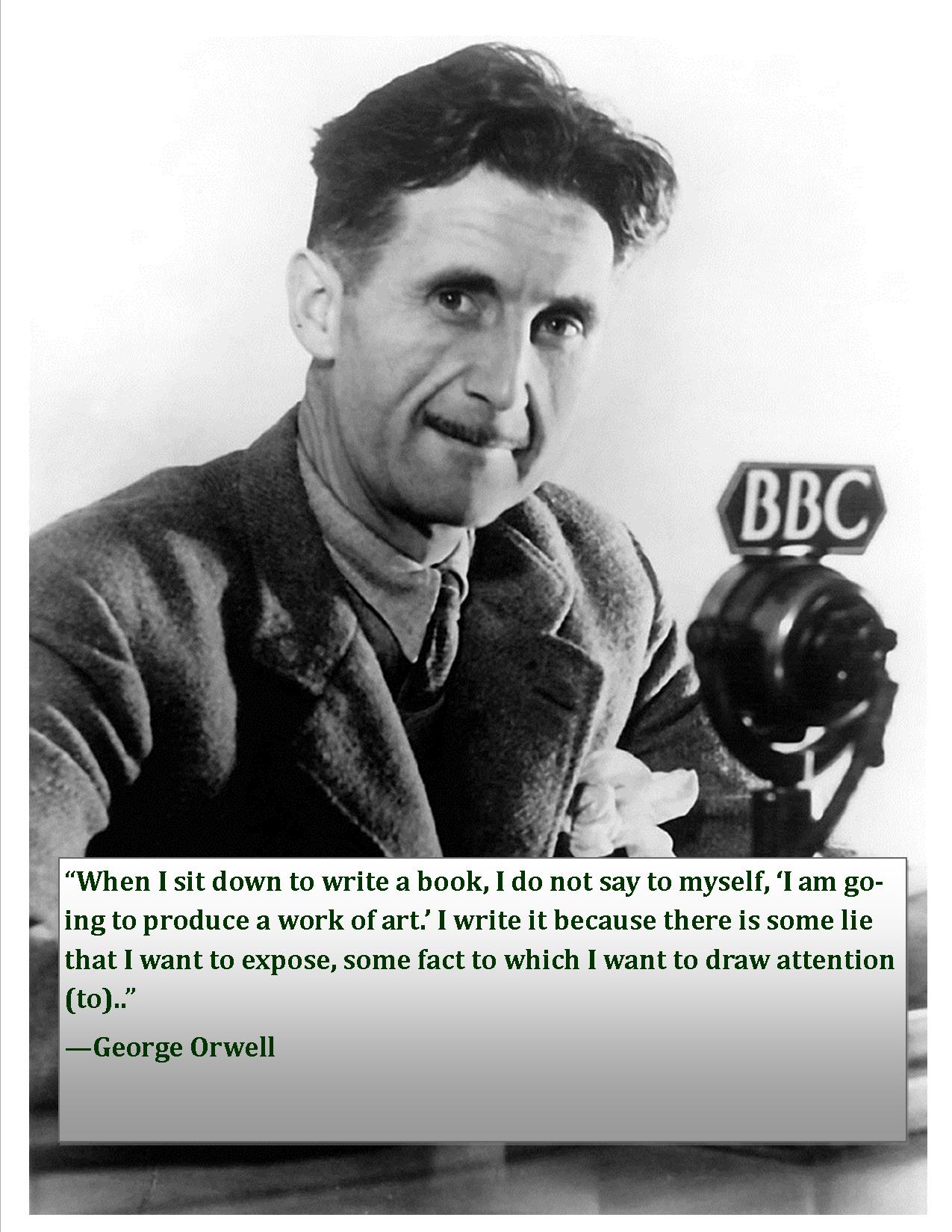
For today’s segment of Writer’s Quote Wednesday, I take inspiration from George Orwell:


GO

“When I sit down to write a book, I do not say to myself, ‘I am going to produce a work of art.’ I write it because there is some lie that I want to expose, some fact to which I want to draw attention (to)….” —George Orwell

I think this is a great way to sit down and write a book or article or poem. If you think more about your purpose for this particular piece, or you engage and have fun with the writing process in general, then I think you will unintentionally create something unique. Because you’ve put your all into it, you have the potential to create something really beautiful and powerful for readers. I do not believe the best songs were built under the notion that they will become hits, they were just written from the heart and that’s what makes them great. Anyone can write a book, poem, or sing a song, but when you can feel the passion, really feel it, and you know that it’s truly coming from the heart, that’s what makes it art.

About The Author:

I was first introduced to Orwell about seven or eight years ago when I read his book, 1984. I wouldn’t say he’s my favorite author but I did enjoy the book. At a time where I was just coming into a proper understanding of both myself and the world around me, it was an enlightening read.

Orwell was born June 25, 1903 in Bengal, India. His birth name was Eric Arthur Blair in Motihari, and he was a novelist, essayist and critic who went on to become best known for his novels Animal Farm and Nineteen Eighty-Four. Speaking of Nineteen Eighty-Four, the title sounds like a throwback to us, like something old but for Orwell it was the future. He wrote 1984 back in 1949. In short, it is a look into the future of the world which is divided into three nations. In the story, Orwell gives us a look into what would happen if the Government controlled every aspect of a person’s life, all the way down to his private thoughts. It was the first time, before Minority Report (the movie), that I had ever heard of something called thought crime.

************************************

And that’s it for my portion of Writer’s Quote Wednesday. As always, don’t forget to check out the links or the pic to see how you can join the fun. Don’t forget to also Like or Comment on the post of other participants. You get support by giving it :).

writers-quote-wednesday

Audio Books: Yay or Nay?

audio-book-Getty

I experiment with recording myself reading my own stories sometimes, (mostly for promotion of a new book) but I admit, I’ve never actually listened to a book. Seems kind of awkward for a book worm like me; I’d much rather read it. I have this image in my head that I may discover to be stereotypical in the future, but we’ll cross that bridge when we get there. You see in my mind, audio books (with the exception of poetry of course) are made up of mostly old people (no offense) who sit in rocking chairs narrating stories. But it’s not like the exciting person to person, face to face stories Grandma used to tell. Instead it’s long and drawn out. I don’t even know if there’s music involved, maybe. Makes me wonder: What components are necessary to make an audiobook something more desirable than reading the actual book? I do know that auditory learning, a learning style in which a person learns through listening, is one of the most effective teaching styles. Just look at music itself and how easily it is to learn something new just by adding a beat to it. From that end, I can see how audio books can help the auditory learner who depends on hearing and speaking as their main way of learning. I can also see how an audio book can come in handy for someone with an extremely busy schedule or for multitasking. I hear of some authors who offer an audio book version of their book in addition to the hard copies. With busy summers, I can see how this could be useful, even fun. But what if the story is super long and the reader’s voice is monotone! That’s scary. Listening to the book while reading it on the other hand, now that may prove an exciting experience I wouldn’t mind trying.

What are your thoughts? Would you offer an audio version of your book if given the chance?  Are you for plugging in or turning pages? Yay or Nay?