One of the features we have added to The PBS Blog’s list of reading material is our Guest Feature section. In this section, we strive to deliver quality poems or articles, usually written by an author outside of PBS, for your enjoyment. We would like to cover so many different topics but we can’t do it without your help. After all, who better to get your message out there but you? So, we are opening up to allow some of you to Submit a Poem of any subject to The PBS Blog to be posted in our Guest Feature section. This is not the same as a Guest blogger because you will not have access to this site. You will not be given a key in which to go into the inner rooms at this time, but I will be posting your poem to The PBS Blog for you. I will not edit your work and a link back to your blog (if you have one) will accompany your poem (further details are below). I have to make it clear that I do not have millions of followers. You will not be exposed to a grand audience and you will not be compensated for services rendered. However, you will get the opportunity to have your work exposed to some new faces and may even be able to make some new connections. I am also aware that there are many new bloggers in the blogosphere (like some of you just started yesterday, congrats! btw). If you are among one of these, this exercise is for you. I have seen an enormous increase in the follower or traffic or however you track your blog’s success, to someone’s blog when they were either featured or re blogged by someone else. That’s because in this vast techno-world, it’s not always easy to see everyone. Sure, your blog can be great, but it can also get lost in the clutter. So the re-blogs help to greatly generate attention to who you are. The Guest Blogs and Features do the same. So, for those of you who are still looking to do some connections and increase traffic to your blog, this is for you. One of the many purposes for this blog is inspiration. I enjoy inspiring and motivating people by way of poetry. I love being able to write about things that others can relate to, so being able to relate to others will be a key factor in the Guest Features I choose.
I will begin posting the Guest Features as soon as you can get them to me, but I will also like to space them out so if you don’t see your poem posted immediately it’ll probably post the next day (Poems are posted in the order to which they are received). Below is a basic guideline to follow:
– Only Poetry submissions are accepted at this time, Guest Featured Articles from Bloggers is coming soon.
– Poems can cover a variety of topics, except for these no no’s: 1. I will not accept material with an obscene use of profanity (guest or no guest, this blog is after all a reflection of me and that’s just not the kind of language I use) 2. religious agendas (this is not to say you can’t submit a poem with spiritualism, but please don’t send in a poem about how Jesus is Lord and that we all need to accept him as our personal lord and savior) 3. and poems that are just outright disrespectful (no example needed)
The idea is to try to relate to people across the board so try to berelatable. You have your own blog in which to push your own agendas.
– I will NEVER edit your post. All submissions will be posted AS IS.
– I will NEVER take credit for your work. All submissions include your first and last name along with any other credentials you’d like to send, such as: blog address, copyright information, etc. If you only send in your first and last name, this is what will accompany your post
– Limited promotions only. Please don’t send us a book about how great your business or talent is. Keep in mind that you are a guest in someone else’s home.
– If you’re familiar with The PBS Blog you know we like to use big colorful images to compliment each post. While images are not always used, if you would like to use them, please include them attached to your e-mail. I will arrange them in your post so that it looks nice (see posts for an idea). If no picture is attached to your e-mail we will not add pictures.
– If you’re a blogger, we encourage you to respond to the corresponding comments following your Guest Feature. If you are not a blogger, The PBS Blog will kindly thank those who comment on your poem. We can add an e-mail address or your personal website too if you include it in the e-mail. It’s up to you.
– You will know if I am interested in posting your poem simply because I will respond to your e-mail. Please give at least 1-2 business days before slamming your computer into the wall because you have not heard back from me. Bloggers actually have lives outside of cyber space, so give it a day or two.
That’s it, see ya soon 🙂
Please e-mail entries to: ahouseofpoetry@gmail.com
I’ve missed more than 9000 shots in my career. I’ve lost almost 300 games. 26 times I’ve been trusted to take the game winning shot and missed. I’ve failed over and over and over again in my life. And that is why I succeed. –Michael Jordan
I hope you’re not the kind of person to believe everything you watch on the news. At the same time, I hope you’re not the kind of person who thinks everything is a coincidence with no connection to your world. I really hope that you’re not the kind of person who lives in a box, where only certain things are capable of fitting. Everything else is, well, too far-fetched. It is too far removed from your four corners, too much on the crazy side, too fictitious. But as the subtitle states, truth is indeed stranger than fiction.
With the new season of The Walking Dead kicking off, I know that many of you anticipate being entertained. I know that you anxiously await your weekly fix. You wish nothing but to yell at Rick’s decisions. As for The Strain, your hoping the Stragoy hasn’t really gotten away. And with Halloween just around the corner, TWD is right on time. But in all seriousness these are not just TV shows. If you pay attention, very similar events are happening right here in your back yard. Unless of course you live under a rock, in which case you can stop reading now.
Otherwise, let’s start with the synopsis of each show:
The Walking Dead
Waking up in an empty hospital after weeks in a coma, County Sheriff Rick Grimes finds himself utterly alone. The world as he knows it is gone, ravaged by a zombie epidemic. The Walking Dead tells the story of the weeks and months that follow after the apocalypse. Based on Robert Kirkman’s hugely successful and popular comic book series, AMC’s The Walking Dead is an epic, edge-of-your-seat drama where personal struggles are magnified against a backdrop of moment-to-moment survival. A survivalist story at its core, the series explores how the living are changed by the overwhelming realization that those who survive can be far more dangerous than the mindless walkers roaming the earth. They themselves have become the walking dead.
The Strain
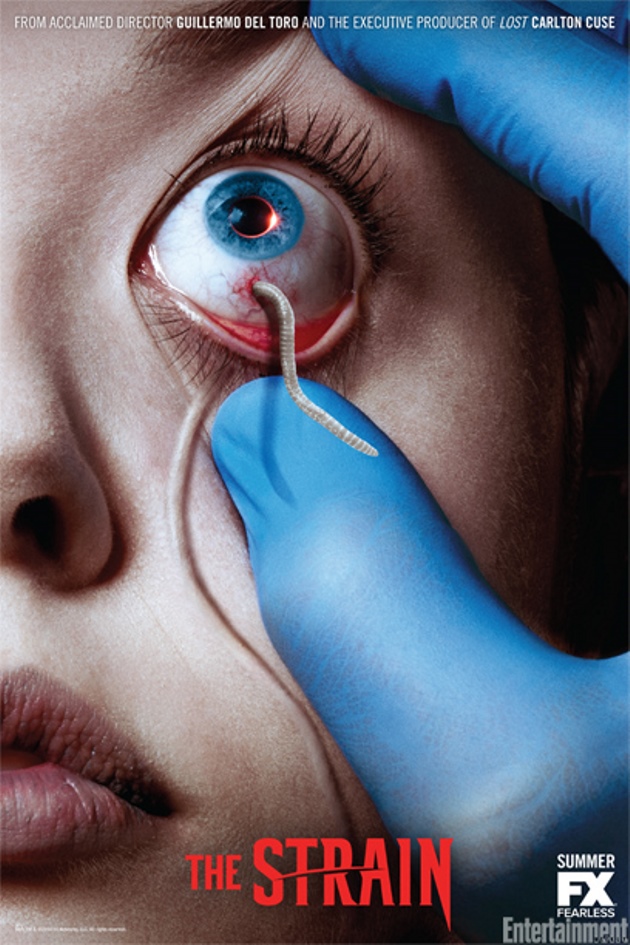
A Boeing 767 arrives at JFK and is on its way across the tarmac, when it suddenly stops dead. All window shades are pulled down. All lights are out. All communication channels have gone quiet. Crews on the ground are lost for answers, but an alert goes out to the CDC. Dr. Ephraim “Eph” Goodweather, head of their Canary project, a rapid-response team that investigates biological threats, gets the call and boards the plane. What he finds makes his blood run cold. In a pawnshop in Spanish Harlem, a former professor and survivor of the Holocaust named Abraham Setrakian knows something is happening. And he knows the time has come, that a war is brewing. So begins a battle of mammoth proportions as the vampiric virus that has infected New York begins to spill out into the streets. Eph, who is joined by Setrakian and a motley crew of fighters, must now find a way to stop the contagion and save his city – a city that includes his wife and son – before it is too late.
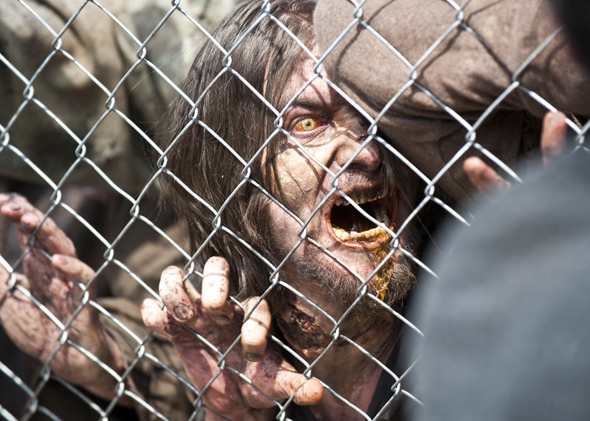
In both TV shows, the CDC (Centers For Disease Control) has knowledge of a zombie like virus that eventually ensues and becomes an enemy of mankind, turning them into Zombies (or Vampires). The process usually begins with a virus that produces flu-like symptoms, such as fevers, ending in death with the eventual reanimation of the corpse.
“Are you prepared for the impending zombie invasion?”
The Centers for Disease Control posed this question back in 2011 as part of an emergency preparedness program:
“There are all kinds of emergencies out there that we can prepare for,” the posting reads. “Take a zombie apocalypse for example. That’s right, I said z-o-m-b-i-e a-p-o-c-a-l-y-p-s-e. You may laugh now, but when it happens you’ll be happy you read this, and hey, maybe you’ll even learn a thing or two about how to prepare for a real emergency.”
The post, written by Assistant Surgeon General Ali Khan, instructs readers how to prepare for “flesh-eating zombies” much like how they appeared in Hollywood hits like “Night of the Living Dead” and video games like Resident Evil. Perhaps surprisingly, the same steps you’d take in preparation for an onslaught of ravenous monsters are similar to those suggested in advance of a hurricane or pandemic.
While the tone is friendly, and suggests “Zombie Apocalypse” is used as a gimmick to tap into an audience already obsessed with them on TV, it would however become one of many warnings put out by The CDC over the span of a few years. The following year, 2012, The CDC and Homeland Security brought the Zombie Apocalypse back to life:
“The Homeland Security Department warned citizens on Thursday that the “zombies are coming,” and urged them to be ready for a walking-dead apocalypse, The Associated Press reported.The zombie “warning” is part of a public health campaign calling for citizens to be ready for disaster — to know to stock up on food, batteries and water, and to keep extra changes of clothes and medication on hand.”
Again, the tone is humorous and the article warns that Zombie Apocalypse is actually used as part of an emergency preparedness program to help people to be ready for any disaster. It is understood to be a metaphor for emergency preparedness while capitalizing on AMC’s The Walking Dead. But, is this true? I would certainly think so, however I also believe there is much more taking place than CDC warnings of a Zombie Apocalypse. There has also been Zombie-Like activity running alongside these warnings:
Naked Man Chews Other Guy’s Face, Shot Dead by Cops
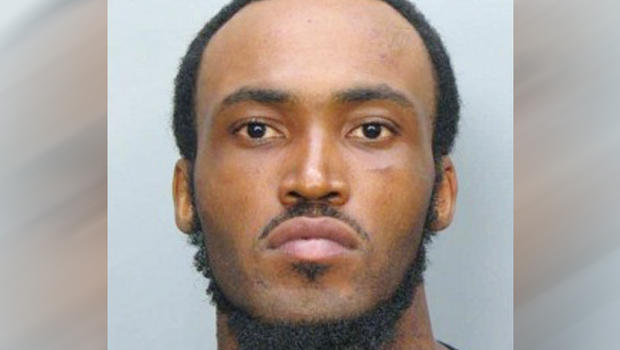
In May of 2012, a Miami man chewed another man’s face off:
“In a grisly attack that resembled something out of a horror movie, a naked man was discovered in downtown Miami on Saturday, May 26, in the process of chewing off the face of another man. The attacker, who had already devoured the victim’s eyes, nose and ears, growled at a police officer, who shot him several times after numerous orders to desist. The victim was left fighting for his life, with 75% of his face missing. “The guy was like tearing him to pieces with his mouth, so I told him, ‘Get off!’ ” the cyclist, Larry Vega, told Miami’s WSVN 7 News. “The guy just kept eating the other guy away, like ripping his skin.”
Two Zombie Attacks in Texas In Two Days, Zombie Plague Spreads
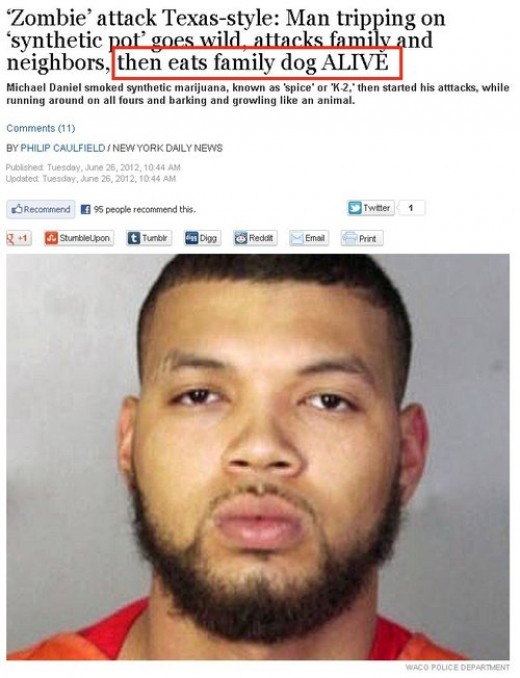
“On Saturday June 22, 2013 a man who’s friends said he was high on synthetic pot went wild and crazy. He stripped off his clothes and ran around the house on his all fours like an animal growling and screaming. At one point one of his friends locked the back glass screen door when the man went outside and the man screamed and then leaped through the locked screen door through the glass in the upper part of the door. He cut his chest and legs badly and was bleeding badly. He was scooping up his own blood with his hands and pushing it into his own mouth eating it. His friends terrier dog came into the kitchen and the screaming man beat the dog down with his fists and then tore it apart and ate it hair and all. Before the police and paramedics arrived on the scene the man had consumed most of the little terrier dog.”
Strangely enough, this exact scenario was played out for you on the world stage when an episode of The Strain depicted a man, overtaken by the Zombie virus, had eaten parts of his dog.
Second Zombie Attack Sunday June 23 , 2013, Houston Texas
“Police were called to a house on the south side of Houston Texas early on Sunday morning and they found a scene right out of a horror movie. The first officers on the scene said that Otty Sanchez a Mexican Female and a citizen of Mexico was setting on the couch with her throat slashed and bad cuts to her hands and arms. She was screaming and when they finally figured it out she was saying she had killed and eaten part of her 18 month old little boy. A search of the bedroom confirmed this. Police were also able to figure out that the knife wounds on the woman were self inflicted and that some of them were really bad knife wounds.”
But this is just another coincidence. Maybe The CDC is using the Zombie Apocalypse as a metaphor for emergency preparedness. Or maybe not:
Face Eating Attack In China: ‘Dong,’ Drunken Bus Driver, Allegedly Bites Woman ‘Du’s’ Nose, Lips
A woman has been hospitalized in China after a drunken bus driver allegedly attacked her and began gnawing on her face.
The woman, identified as “Du,” was driving near a bus station in Wenzhou on Tuesday when a man ran into the street, blocking her car. The man, a bus driver identified as “Dong,” allegedly climbed onto the hood of Du’s car and began hitting the windshield, according to the Malaysia Chronicle.
Du got out of the car, and allegedly Dong tackled her to the ground, where he began chewing on her face, according to Shanghai Daily. Witnesses say they attempted to pull Dong off of her, but were unable to do so.
Lollapalooza reveller bitten in ‘zombie like’ attack by stranger at Arctic Monkeys gig
“A man has been bitten in a ‘zombie like’ attack during an Arctic Monkeys gig. Ben Lenet was bitten in what police claim is a vicious and unprovoked attack on the first night of the annual Chicago music festival Lollapalooza, which drew crowds of 100,000 people. The music fan is now receiving treatment to ward off infection and HIV. In scenes similar to those on The Walking Dead, Lenet and his friends were watching the band as they were attacked as a group by the ‘zombie’ in question. In efforts to restrain the attacker, who had started choking a member of their group, Lenet put his arm on the man only for him to bite back. He turns around and clamps his teeth into my left forearm,” he told the Chicago Tribune. “He’s fully clamped, he’s coming at me. He’s ripping at me, he was trying to bite through my arm.” The 29-year-old has taken to Reddit to detail the attack and try and root out the assailant in order to try and stop any further attacks saying “I don’t want him to do this to anyone else.”
The Virus
In the TV series The Walking Dead, the characters live in a world overrun by zombies—specifically, zombies caused by a mysterious virus that has apparently infected everyone in the population. The living carries the virus, but when someone dies—whether quickly after being bitten by a “walker”, a human or more slowly due to natural causes—the result is the same: After death, everyone is reanimated as a bloodthirsty zombie.That’s because, as is revealed, the virus is airborne.
The principle that all living people are already infected with the zombie virus was introduced in Season 2 during an adventure to the Centers for Disease Control and Prevention, where the only remaining CDC scientist—Edwin Jenner—informed Rick of this fact. To date, this revelation has been the central plot point in every Zombie movie / TV show since then in terms of Public Health. “Coincidentally”, The CDC is always at the forefront of combating a virus that starts by giving people flu-like symptoms before turning them into Zombies. We can go over and over again with article after article, news report after news report of people exhibiting Zombie-Like behavior in the real world. Even if you choose not to believe it, it is a fact that people are going around eating other people in strangely similar ways to the Zombies we see on TV, usually beginning from a Virus.
Ebola and The Strain
One of the most obvious examples of fiction and its depiction of real life is the current Ebola virus and the TV show that “conveniently” just ended, The Strain. As previously recounted The Strain, according to FX, tells the story of Dr. Ephraim Goodweather, the head of the Center for Disease Control Canary Team in New York City. He and his team are called upon to investigate a mysterious viral outbreak with hallmarks of an ancient and evil strain of vampirism. The people fall into a deep sleep, like they’re dead, and wake up as a new creature.
According to the World Health Organization (WHO), The Ebola virus causes an acute, serious illness which is often fatal if untreated. According to WHO, the Ebola virus disease (EVD) first appeared in 1976 in 2 simultaneous outbreaks, one in Nzara, Sudan, and the other in Yambuku, Democratic Republic of Congo. The latter occurred in a village near the Ebola River, from which the disease takes its name. It is a virus that gives people flu-like symptoms before killing them.
On September 24th, Monrovia, Liberia-based newspaper The New Dawn published an article regarding an unusual occurrence in Nimba County. According to the local news source, two deceased victims of Ebola had mysteriously come back to life just prior to their burials. The strange and sudden resurrection of two Ebola patients had naturally frightened local residents. The story has since then been debunked as false, however, is it really? Have any of us ever actually been over to Liberia since this happened? How do we know it’s false? Oh, I get it, it’s not American Certified. It comes from another country so surely it’s not real.
I began this article by expressing my hope that you are not someone who believes everything you see on the news. Likewise, I equally hope you are not living under a rock. There are many more people with this virus than they’re telling you there are and it is much more serious in Africa than they show you it is. In The Strain, the disease restructures the genetic make-up into that of a new creature; in other words it changes the genetic code. For this reason, the bodies cannot be buried the same way regular bodies are buried, they have to be burned and the head must be severed from the body because it is the strain disease that carries the virus. Likewise, Ebola patients cannot be buried normally, their bodies must be burned:
Ebola bodies must be cremated rather than buried, says Liberia government
“The bodies of Ebola victims must be cremated rather than buried, the government of Liberia has ordered.Hundreds of troops were sent to the capital Monrovia as fears rose over the killer virus being spread through touching the bodies – the local tradition at funerals.Fights broke out between health workers and residents trying to bury another 20 victims yesterday. A further 17 bodies have been found dumped on the streets.“
It is very possible that Ebola carries the Zombie-Like Virus and this is why the bodies must be cremated so that the bodies are not reanimated.
The Media
Of course the media is going to make every story attract a lot more attention for the sake of ratings, after all, this is a business. But that’s just surface information I’m sure we’re all familiar with by now. 9/11 has been proven to have deficiencies in relation to the motive behind it, the alleged “terroristattack” thing, but that doesn’t mean the deaths are fake. It doesn’t mean people did not lose their lives and that it didn’t have a dramatic effect on the life you live today. It just means the purpose behind their deaths is different than what is shown on the television as to why they died. Just because we know the TV shows and News broadcasts seek ratings doesn’t mean we shouldn’t pay close attention to what’s going on around us. I’m sure CNN profited off the Trayvon Martin Case (I’m sure his parents and Al Sharpton did as well), but that doesn’t mean a young man did not die. Nothing is actually irrelevant in this world. Sure, there are lots of distractions yes, but it is not irrelevant in the full scope of things.
Finally, the Ebola Virus looks strangely similar to The Strain virus. Or maybe this is just yet another major coincidence, I’m crazy, and the CDC’s issuing of Zombie-Apocalypse Preparedness tactics has absolutely nothing to do with the CDC’s overwhelming presence in almost every Zombie movie / TV show around today.
*************************************************
Flashback: CDC warned Americans in 2011 about brain-eating corpses and said ‘If you’re ready for a Zombie Apocalypse, you’re ready for any emergency’
CDC spent staff time organizing a ‘Zombie Preparedness’ website and creating a graphic novella
‘That’s right,’ a CDC website read. ‘I said z-o-m-b-i-e a-p-o-c-a-l-y-p-s-e. You may laugh now, but when it happens you’ll be happy you read this’
Tom Frieden, the embattled CDC director, helmed the agency in 2011 when the campaign went – ahem – viral
Frieden is the subject of several resignation demands since his agency fumbled the first three Ebola cases diagnosed on U.S. soil
Ok, it’s recipe Sunday again on the PBS Blog, so what are we making today? Yall know those ridiculously delicious biscuits at Red Lobster? Off the chain right? Well, did you know they are also ridiculously easy to mimic?
Now, some of yall are chefs so you can actually purchase the flour and literally make your biscuits from scratch. But, I am not a Chef so this is going to be a lot easier than you thought.
First, let’s go to the Grocery Store, you’re going to need:
Mix in the biscuit batter (the measuring is up to you depending on how many you’re making. Now I pretty much just estimated, let’s just say like 2 cups of batter), ½ Cup Cheese, and ¾ Cup Cold Water. Go ahead and mix this up but don’t make it too thick. The idea is to make these soft and fluffy so add more water to thin them out and throw a couple eggs in there too. Bake on greased baking sheet at 425 degrees until browned. (They come out better on the individual baking sheet you use for cupcakes as seen in my picture).
Now, here’s the secret that actually makes them taste like Red Lobster: Butter and Garlic Sauce.
While your biscuits are baking, take your butter and garlic and make a sauce. The recipe can be as tasty and creative as you want. After your biscuits are ready, smear the tops of them all with the butter and garlic sauce. Throw them back in the oven for about 10 seconds.
Take them out and eat them immediately. And there you have it, your very own version of Red Lobster’s Cheddar Bay Biscuits. If you don’t like this particular recipe, you can also just Google Cheddar bay Biscuits, but this is the easiest and most tasty way if I must say so myself (aside from the actual Cheddar Bay mixture Red Lobster sells in stores).
*Let me know how they come out! Mine were the bomb!*
I’m aware that not everyone who blogs writes. It sounds kind of contradictory since you’re obviously writing, but people have many different reasons for blogging so that’s probably none of my business.
When I browse the pages of various blogs, I sometimes see many writers complaining about writing. In many ways I am quite confused about this, but maybe that’s just because I’m in love with writing, and that’s what I would like to offer you. While Blogging is a topic in and of itself (as some of you are probably still trying to balance writing by way of theblogging medium), writing is the gift you would obviously like to offer to those in which you are blogging for so that’s what we’re going to talk about. That, if you could learn to fall in love with writing, it wouldn’t be a tedious process. OK, perhaps I’m being a bit selfish; it may not be that easy for you. After all, I am in love with writing.
What does it mean to be in love with writing? First of all, like I said, get the idea of blogging out of your head, we’re not talking about that right now. Being in love with writing doesn’t have much to do with how frequent or less frequent you blog. However, if you do love to write, it can help you to blog. I just wrote a post on “The Brilliantly Untalented”, in which we discussed how sometimes the most introverted “untalented” people (from the POV of self); make for the best artists especially as it relates to writing. These people are not so overwhelmed with fear that they cannot write, it’s just that these people love to write. They wake up writing, they go to bed writing, and all they can think about is writing and the message they want to put out into the world. Will the world want to hear it? Who cares! The point is that when you love something (orsomeone), you don’t have to make yourself be a part of it. So stop it! Blog Writers, stop trying to make yourself write and just write. Let it be as smooth as brushing your teeth in the morning; let it embrace your thoughts, and in the words of Mark Strand let your words bathe in the blank wake of your passion, and be kissed by white paper. I don’t have to force myself to lay next to my husband because I love him. You don’t have to remind yourself to make the children breakfast because you love them, it is instinctive. The same is actually true for writing. There are mistakes that are made in the process of course, but when you love to do something, whether you get paid or not, it is not a long drawn out and daunting process. The key is that you want to do it. You shouldn’t have to make yourself write. It’s not a punishment; it’s just what you do. In the end, after falling in complete love with what you do, the process will be deliciously enticing. You will find yourself looking for any excuse there is possible just to write. And as with any gift that you exercise and use on a regular basis, you’ll notice that you’ve become quite good at it too, after all, there is someone out there just dying to read your content. Yes, YOURS. You untalented ball of clogged up words, there’s even a reader out there for you.
I’ve had this book for awhile; loaned to me by another sister. I never completely finished reading it, and as I scrolled my library for a neat snack, it wasn’t too high on my priority list. But as I now found myself flipping through pages, Chapter 10 caught my attention:
“Writer’s are people who tolerate a high level of anxiety. We have a talent for holding up well under tension. Anyone can start writing. To keep on creating and to grow as a writer you also believe you suck. You question everything you write. I know writing students who really do seem to believe they are great, they love writing, they write a lot, they seem blandly cheerful….they spew out words. They have no doubt, they reveal no anxiety. I think that is great. But my students who are doing really fine work, really committing themselves to writing honestly, deeply, and truly—-they have anxiety. They doubt themselves all the time. Writing stuff that is going to affect other people intensely is walking a fine line between anxiety and pleasure—-its a vibe you ride.”
I actually love this advice. I find it present not just in writing but other forms of art as well. Some of the most nervous, most introverted people are the most talented: the “Brilliantly Untalented” and Undiscovered Geniuses. This is not to say you party goers out there should worry. Nor is this to say the introverted are overcome with intense fear, for fear and faith cannot coexist (one will rule out the other). But they have a kind of humility that seems to balance out the negative components of anxiety. They know that there is talent present, but they also believe that they suck. Is it contradictory? It may be, but yet this contradiction keeps them writing and keeps you reading. Every time I’m on stage to recite a poem my stomach turns into butterflies and it feels like everybody in the world is depending on me to deliver them from a crisis. It is a feeling of great pressure. Its an understanding that though I’ve been given a gift to bestow upon my audience, I am simultaneously aware that this gift is not mine; that it belongs to one greater than myself. Then I notice, that in such anxiety, I’ve tapped into a kind of depth people could really feel. I did not have to think too hard about it. Did not think so grand of myself that I would begin editing my soul I just spoke, hoping the butterflies won’t make it so far up my throat. My belief that I am nothing, that I suck, and that I am Brilliantly Untalented, has in the end seemed to always produce the greatest work.













 The PBS Blog