Notice the Breadcrumbs: A Reflection Activity

I’ve been writing poetry since I was twelve years old, but it wasn’t until I joined the UMOJA Spoken Word group in High School that I truly understood it and how to fuse the words on the page with my voice to bring them to life.

At the time, I didn’t know much about Kwanzaa or its meaning, let alone that UMOJA was the first principle. Lasting for seven days, Kwanzaa was initiated by Dr. Maulana Karenga in 1966, with each day representing a practice. Umoja, the first principle of the Nguzo Saba, focuses on unity on the first day, December 26th. According to Karenga, “during Kwanzaa, we practice the candle lighting ritual called ‘lifting up the light that lasts,’ based not only on the history of our people in practice but also on the sacred teachings of our ancestors.”1

Although I don’t celebrate holidays today, 2 I appreciate the breadcrumbs sprinkled throughout my life that helped me to later identify my purpose, which will always go back to restoring the forgotten heritage to the forgotten people. As one who does not believe in coincidences, I think it’s important, maybe even wise, to notice those tiny steppingstones throughout our lives that molded or mold us into the people we are today.

An example of breadcrumbs could be me joining the Umoja poetry group, meeting my husband in an African American studies class, and marrying him in February, Black History Month. We did not intend to do this as we did not have a wedding. We mutually decided to elope on what we thought was a random day during a random month.

I now know nothing is random. I do not believe that things just happen.

As we prepare to end another year and embrace a new one,3 I challenge you to think more deeply about the things that have happened in your past and that happen now and see if you can make connections between them and your purpose. Consider that there is more to those coincidences and Deja Vu moments we’ve been taught to toss to the wind. This is not only a fun reflection activity, but it can also be helpful for those who do not yet know their purpose or mission.

It takes a deep spiritual maturity to appreciate things we’ve experienced and see their connection to who we are now without condemnation of that thing or ourselves. Sure, you know what you know, but you didn’t always have that understanding. Once upon a time, you needed to be guided to where you are today. Those are the breadcrumbs.

Ten, twenty, maybe even thirty years from now, we will see hints given to us today that helped guide us to wherever we are in the future.

And in the future, we will smile and nod in recognition of those stepping stones we were too preoccupied with life to notice but that led us to where we are.


  1. “Celebrating Kwanzaa in Difficult and Demanding Times: Lifting Up the Light that Lasts.” Dr. Maulana Karenga. Los Angeles Sentinel, 12-26-24. ↩︎
  2. I appreciate and respect Kwanzaa for what it is, but I don’t participate in its associated rituals. ↩︎
  3. For the extra-woke people out there, yes, I know a new year technically does not begin in the dead of winter but in spring. However, we will still measure the time based on the Gregorian calendar’s two thousand and twenty-fifth year. You still have to report back to work, and your children will still return to school in January something 2025. Thus, I will use the measurement of time most familiar with today for clarity. Let’s not be Pharisees about this. ↩︎

Always There Are the Children

Something devastating is happening, a bone-chilling, frightening thing.

The children are dying.

In this year alone, I have learned of the deaths of four young people, three of them children under 25 years old. All of them were from people I know; they were firstborns, the first fruits of their mother’s wombs.

It has made me reflect deeply on how we foster future generations while remembering old ones. As a history buff, I understand how easy it is to dwell on the past. However, I’ve realized that the past, present, and future are inextricably linked; if we ignore one, we disregard the others.

I had the fortunate opportunity to speak with my husband’s great-aunts this past weekend as we mourned the death of their sister, our grandmother. They are all in their 70s and 80s, so I asked them what advice they have for the next generation. Almost everyone said to listen to the elderly. Essentially, you should obey your mother and father. Today, many may refer to this as honoring the ancestors. Whatever phrase you use, the broad consensus is to listen to those who came before you.

Growing up on a farm, where they grew and raised everything they ate, I got the impression they weren’t just saying this because they were elders but that it was a genuine conviction in which they truly believed.

Growing up, many of us heard the warning: “Honor your mother and father so your days are prolonged on the earth.”

I think about the depth of this as I watch the children perish.

One of my favorite poems from Nikki Giovanni is “Always There Are the Children.”

For me, it is a reminder that we do not live forever in these bodies. We will pass on one day, but there will always be children. What we pour into them while we live determines whether there will be more Nikki Giovannis and Maya Angelous.

Unfortunately, we live in a world obsessed with two things: appreciating people only once they’ve passed and only once they have become great. Rarely do we recognize the process and honor the in-between spaces. Seldom do we honor the becoming.

This robs the children.

And the children are not just minors in small bodies; we are the children, too. We are also daughters and sons, and I hope that we learn to nourish ourselves in the same way that those who came before us were nursed, and that we do so early on, rather than waiting until we are thought to have made it, because we are born worthy.

“We prepare the way with the solid
nourishment of self-actualization
we implore all the young to prepare for the young
because always there will be children.”

-Nikki Giovanni

Angels in Black Skin

Listen, yesterday started out annoying and frustrating for me.

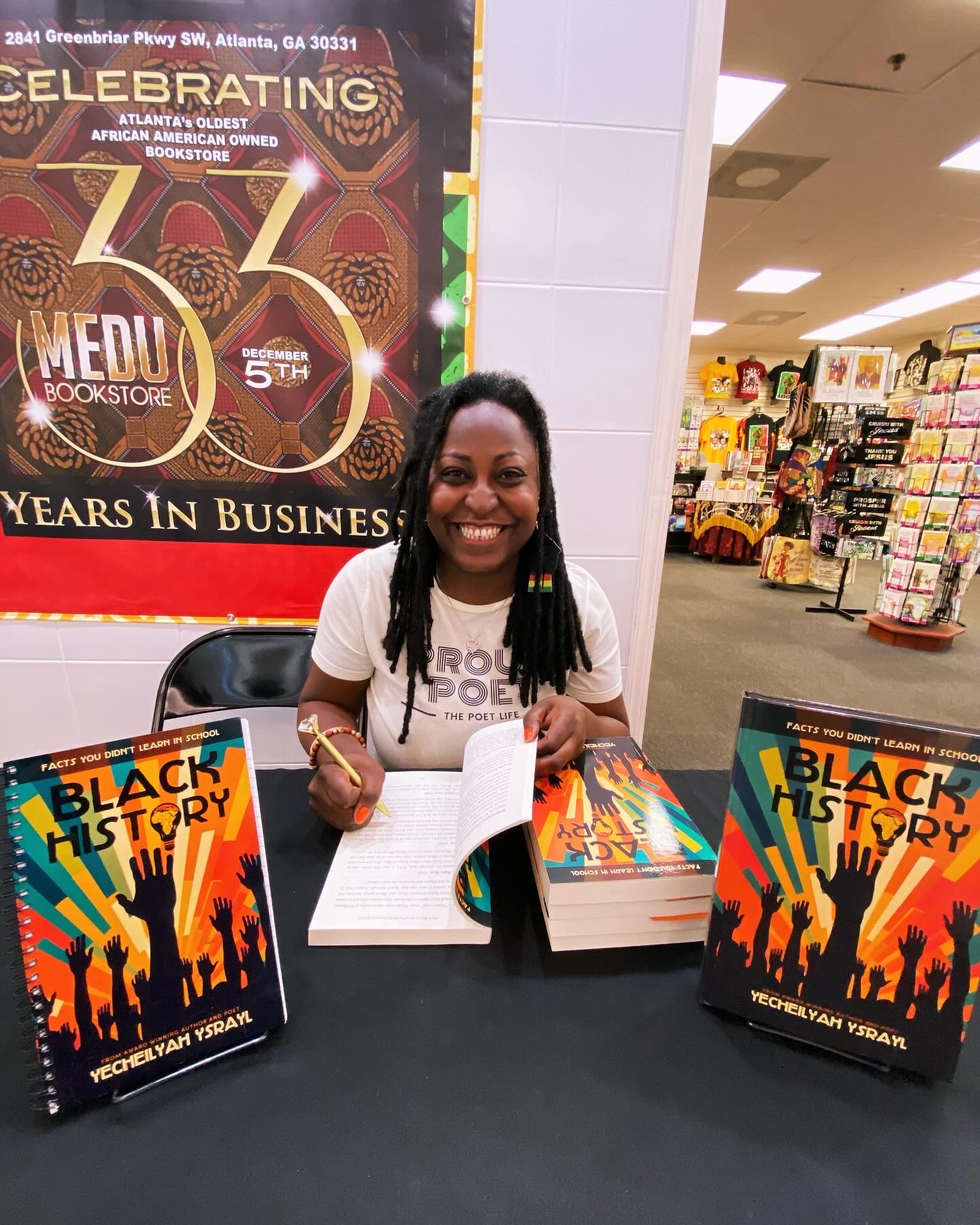
Watching all these Black people walk past my table and frown at the title of my book (Black History Facts You Didn’t Learn in School) was disheartening and sad.

It wasn’t about the money. It never is. It was about the sheer audacity of people to be offended.

I wanted to run to the bathroom and burst into tears at the arrogance of a people with no interest in their own history. There was even an interracial couple who walked by, him Black, her white.

Chile, do you know this man looked at his white friend/wife/woman and asked if she wanted the book while laughing as they walked on?

Trifling does not even begin to describe the moment.

But then…

There was an older Black man. He walked by my table and dropped a crinkled 20, whispering, “Keep doing what you are doing.”

You have to understand how he did it.

In African American families, elders (grandma’s, grandpa’s, aunts, uncles, etc.) will hug you and whisper in your ear, “How you?” While slipping cash into the palm of your hand.

There is no conversation about it and they are not interested in your explanations. It is simply an act of love wrapped tight in spiritual discernment. You need this even if you don’t think you do.

You could be struggling with bills.

You could be frustrated.

You could be facing any unforeseen tragedy, and this person who has lived long enough to know what love looks like in the flesh slips you with just enough money to cover whatever was bothering you.

Now, I was not in a financial catastrophe but a spiritual one. An emotional one. One that almost made me pack up my things and walk out the door.

There is something about not being appreciated that sends me boiling.

My tolerance is zero.

But then, here comes an angel, dressed casually, with a brimmed hat and gray beard wrapped in golden black skin.

He drops a 20 on my table like it was the sweaty palm of my hand and whispered words of confidence into my spirit without losing stride. He spoke while walking, always keeping sight of his mission.

This man’s simple act gave me everything I needed to keep going.

People took notice, stopping at my table suddenly, almost like they had been commanded to.

There is no moral to this story that you have not already read.


No. This is not the angel man, lol.

The Kindle Version of Black History Facts is 99c for a Limited Time! Click Here to Get Yours.

Want a signed paperback? Click here!

Legacy

Have you ever sat back to consider that the lives your parents, grandparents, aunts, and uncles lived is a form of history?

The world they grew up in is a different world than the one we are living in today. Even as recent as the 70s and 80s. That world no longer exists. I am fascinated by this. How did the world operate before I came to be? What were things like before I existed?

How often do we sit down to talk to our elders to glean wisdom from their lives?

Sitting at their feet and listening is the most accessible research we can do on our own personal history.

We learn more about the storyteller and ourselves as our lives are wrapped up in theirs.

Photo by By Toni Weschler

Coursing through your DNA is the experiences and the trauma of your ancestors. Wouldn’t it make sense to learn more about their story and, as a result, learn more about yourself?

I was not a fan of history in school. It didn’t intrigue me at all, and I found it boring. Passing was easy. All you had to do was read material that was never explained and memorize dates with no meaning.

blkhistorybook.com

I was in the second grade when I first learned about Emmett Till. His story stuck with me because it was the only form of Black history I had learned in school until High School, and even then, it all started with the Civil Rights Movement and Dr. King. It was as if our people didn’t exist before sit-ins.

It felt like we were still being enslaved, in a way, dehumanized through omission. A people forgotten, our legacies erased.

I only became curious when I learned more about my people. Black history intrigued me. The things we’ve invented, the struggles we’ve overcome, the way we just keep bouncing back.

When people can see themselves, something amazing happens. I didn’t care about history until I could see myself. My forefathers’ life piqued my interest, and out of that curiosity, I read.

The rest is, well, history.

You can still stream my interview episode on iDefineTV on Roku! Also, don’t forget to preorder your copy of Black History Facts You Didn’t Learn in School before January 24th to be part of the first shipment!

Unapologetically You

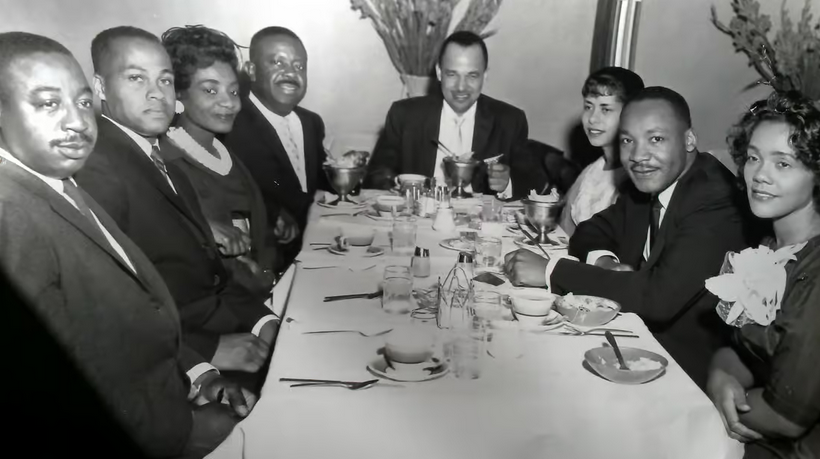
Rev. Fred Bennett, Mr. Isaac Farris, Sr., Mrs. Christine King Farris, Rev. Ralph D. Abernathy, Dr. Roy C. Bell, Mrs. Clarice Wyatt Bell, Dr. Martin Luther King, Jr., Mrs. Coretta Scott King; Pascal’s Restaurant, Hunter St., Atlanta, GA. ~1962 — Photo via Dr. Clarice Bell on Flickr

I am no longer doing anything uncomfortable to make others comfortable.

Yesterday, I turned 36, and you would think this is a lesson I’ve learned by now.

But Paschal’s restaurant was the straw that broke the camel’s back. It upset me for a number of reasons.

But first, a little history.

I chose Paschal’s because I heard about their fried chicken and soul food. Google also informed me that the area has a fantastic civil rights history, having served as the main gathering spot for movement leaders, such as Dr. Martin Luther King Jr., Andrew Young, Maynard Jackson, and others. It was founded in 1947 by two Black men, James and Robert Paschal.

I saw Dr. King’s and others’ images on the walls and was sold.

I didn’t look at any other spots after that. That was where I wanted to go. The prices were steep, but I didn’t care. I was told to pick out any place I wanted, and this is what I wanted.

Or so I thought.

The first red flag was the valet parking, which we paid for via cash app.

I frowned. Cash app? 

Now I’ve used cash app for many things, but a restaurant isn’t one of them.

But I didn’t want to be difficult so I said okay.

We walked in, and I felt like I was back in High School.

Call me bougie, but I was uncomfortable.

I am all for having a good time with my people, but this looked a lot different from the layout on the website.

I expected a fine dining experience with adults and a hint of black history and soul food.

And while the historical images were there, I got a room full of black people blasting Beyonce and standing around like they were at a club.

I was disappointed in what had become of the place. Although I’ve never been, I am sure it was a lot more refined when Dr. King ate here.

You can tell just by the picture above. See how they are carrying themselves? See the arrangement of the dishes? See the dignity?

The lack of decency and respect for our ancestors enough to take care of what they left us (because I am sure the Paschal’s would expect more) saddened me.

To make a long story short, we left.

It is not that I would never eat there. There is a time to kick back in that way. It is that I expect more. I expect more from my people just like I expect more from myself.

Take care of the legacy your ancestors leave behind.

Being Unapologetically Me

Thus, as my heart began to race and irritation blanked my face, I realized all the times I settled because I wanted others to be okay even if that meant I wasn’t. And I decided right then and there that I would no longer accept anything that made me uncomfortable just because I didn’t want to be “too much.”

am too much.

My standards are high, and from this point forward, I will walk unapologetically in this truth. 

I suppose the message here is, I hope you will too.

Be unapologetically YOU.


Update: 

We returned to Paschal’s months later and had a much better experience! The music was tasteful, it wasn’t crowded, and the fried chicken was divine. (The fried green tomatoes, not so much.) The first time, I didn’t consider graduation and Memorial Day weekend. I would recommend this place for sure. There is a grown and sexy vibe with the dimmed lights, bar, and jazz. Just ensure there aren’t any events happening that day and the children are still in school when you go.

Blood Line

Slavery-TodayMy nephew has my birthmark on his chest. My face has my mother’s nose, and my smile is etched with my father’s teeth. I interact with the world as if on my own. It never occurs to me that I swing my arms like my Aunt. Or that the decisions I make may have already been made before. They say there is nothing new under the sun. I cannot swim. But maybe that’s because the Great Flood has traumatized me. Can I still taste salt water seas on my tongue? Have you ever thought about the make-up of a blood line?

The possibility that maybe you inherited these ways only to gift them to someone else one day. I smile at the thought. What would a little girl look like with my eyes, my words and my hands on her hips? How do I know my favorite tree did not bleed with the stench of my ancestors? And have I ever fathomed why Hurricanes take the same route as the slave ships? Can it be that bodies still burn like melted ash upon the ocean floor? Its smoke mixed with the wind before marching out to the beat of Negro Spirituals I could have sworn I heard on the radio last night. Or maybe that’s just the Harriet in me. Perhaps I may gather poetry in my arms like the wind released of its chains. Is it possible that words can free those who do not know that they are slaves?