Some of the most common forms of protection for women during their cycles were grass, rabbit skins, sponges, rags, menstrual aprons, homemade knitted pads, or other absorbents. Usually, women used some form of cloth back in the day. These cloths are why “she’s on the rag” is a popular expression used to refer to menstruating women.
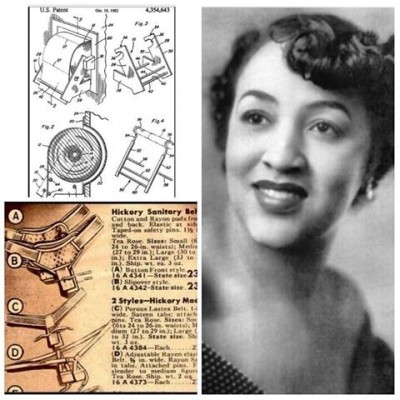
While she did not invent the modern version of the Maxi Pad, Mary Beatrice Davidson Kenner developed the sanitary belt, one of the first versions of the modern-day pad.
Mary was born in Monroe, North Carolina, on May 17, 1912, and came from a family of inventors. Her sister invented a children’s board game that explored family ties called “Family Treedition.” Mary’s father, Sidney Davidson, patented a pants presser in 1914. According to historian and former U.S. Patent Examiner Patricia Sluby, a maternal grandfather of the daughters was of German and Irish descent who invented a tricolor train light. It’s safe to say that developing things was in Mary’s blood, pun intended.
The sanitary belt was a belt used to hold pads in place before designing self-adhesive maxi pads.
Mary invented the sanitary belt with a moisture-proof napkin pocket, but the company that showed interest in the pads rejected the invention because Mary was a black woman. For this, the sanitary belt didn’t become widespread until 1956, thirty years after its design. Learning this has taught me the power of patience and how everything comes to be in its time. It may have seemed like a lifetime to Mary, but eventually, her invention saw the light of day. Mary received five patents for her invention between 1956 and 1987.
While mostly known for her invention of the sanitary belt, Mary had other groundbreaking designs like the toilet paper holder, and the mounted back scrubber and washer for showers. Mary has been an entrepreneur from the start, operating her own floral business in Washington, D.C., when she was not inventing things.
Adhesive Maxi Pads (a sticky side that stuck to the lining of a woman’s panties) were invented in the 1970s, so the sanitary belt did not last very long. But without the belt, someone would not have thought to make things easier by eliminating the belt and just going with the napkin.
If you are a young woman like me and have never used the belt, you can Google Sanitary Napkins (or talk to your mom or grandmother), and learn that the strap was uncomfortable and inconvenient. While tampons existed, using them for younger women was considered sexually improper. (A pretty good article to study up on the evolution of pads can be found HERE.)
Life happens in stages, and good things come to be because someone took a risk on something others may not have found useful. Mary’s invention helped women who didn’t want to use tampons to get by and paved the way for all of the pads currently on the market.
With the success of the Black Panther movie based on the super-hero comic, I am re-posting this Black History Fun Fact from two years ago based on real-life super-heroes for those of you new to this blog (or who missed it the first time around). To understand our present, we must understand our past so that in the future we do not make the same mistakes. The Black Panther Organization actually did more community-outreach than they did protest. The protest is what we saw the most on television however it is not the bulk of their work. They were not a hate group, they were not supremacists and they were not a “black only” group. The Panthers promoted ALL POWER to ALL PEOPLE with an organization comprised of many nationalities of people.
Has history been accurate in its portrayal of the group affectionately known as The Panthers?
In Whitewashing the Black Panthers, Michael Moynihan argues that PBS’s documentary The Black Panthers: Vanguard for The Revolution, tries to excuse a “murderous and totalitarian cult” saying, “Almost anything that reflects poorly on the Panthers is ignored or dismissed and no critics of the party are included. The story is told entirely through the testimony of former Panthers and sympathetic historians.”
(Umm, so is every European, Western focused story ever made, but we won’t go there).
Often portrayed as a militant, black supremacists hate group, it’s amazing to me that this group of people wrote a ten-point program outlining the details of their belief system and there are still misconceptions about who they were and what they stood for.
For the record, I did not set out to write about The Panthers based on Michael’s article (I came across it much later), or because of the documentary. After doing some reading I decided today’s Black History Fun Fact Friday will focus on three basic principles that everyone should by now, understand about The Panthers. But first, we must cover some additional facts.
The Freedom Movement has always been portrayed as a southern only movement on television and even in some books. Mississippi, Alabama, and Georgia are states where trees no doubt bore the remnants of strange fruit. We could see it on the news, the newspapers, and from the mouths of relatives who grew up there. If we didn’t see it, the whole world did when Chicago native Emmett Till went down south and never came back and the whole world saw the ugly face of America. At that time, I am sure, we all had the same consensus on our hearts (among other things): “If only he would have stayed home, this would not have happened.”
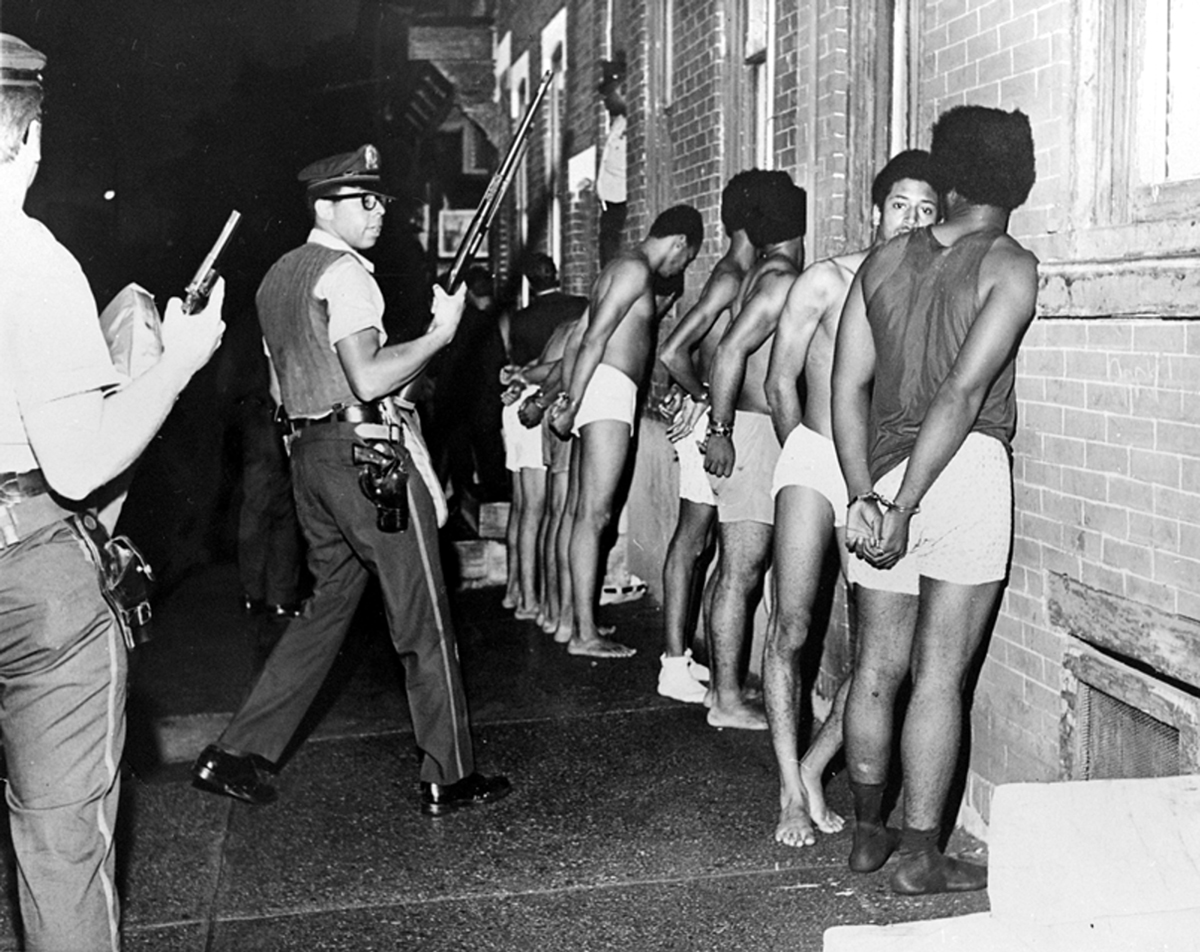
This is because seldom did we then, and even today, hear about the racism and discrimination that took place in Northern cities like New York, Chicago, and California. Many blacks, no doubt, escaped the southern states for better opportunities in the North. Still, even this part of history is only a half-truth as not all blacks left because they did not have.
There were many African American’s who, after slavery, suffered tremendously economically but not all of them. Not every black family had to sharecrop or endure poverty. On the contrary, many families started their own businesses, educated their own people, and founded their own communities. From the Mound Bayou in Mississippi, Blackdom of New Mexico, or the famed Black Wall Street in Tulsa it is clear, not all blacks were financially incapacitated. For this, it is only a half-truth that blacks escaped the south for a better financial and economic opportunity in the North and it is only a half-truth that they all left to escape Jim Crow. In truth, many of us sold what we did have to flee North because we were told (both by whites and black elites) that it was better. Many blacks were told that the North was the land of “Milk and Honey” so we sold our land, packed up our families, and left the Jim Crow South only to run into the police brutality of the North.
Martin Luther King, Jr., is hit in the head with a brick Marching in an all white Chicago neighborhood
It was Martin Luther King Jr., who said his trip to Chicago’s segregated Cicero was worse than Alabama and Mississippi. “I have never seen, even in Mississippi and Alabama, mobs as hateful as I’ve seen here in Chicago,” King told reporters. That statement is saying a lot considering what we know about the brutality of these states and had I not been born and raised in the city (Chicago), I’d doubt King’s words were true. But as I was born in Chicago and spent the first nine years of my life in the concentrated poverty-stricken projects of The Robert Taylor Homes on Federal Street, the most segregated and poorest urban city in the United States at the time, I can tell you that what King said was no exaggeration.
The truth is that while many segregationist laws were abolished in the South, poverty increased in the North. Black unemployment was higher in 1966 than in 1954, 32% of Black people were living below the poverty line, 71% of the poor living in metropolitan areas were Black, and by 1968, two-thirds of the Black population lived in ghettos, or impoverished communities, also known as slums. And so, it was for this hushed truth concerning the brutality of northern cities that two young men from Oakland California founded what would one day become the most hated black revolutionary organization of its time.
Founded in 1966 by Huey Newton and Bobby Seale in Oakland California, The Panthers took notice of the police brutality taking place in their own lives and the lives of members of the black community. They saw black men, and women, being beaten (some of them to their deaths) and nothing being done about it. They saw children who were malnourished because they didn’t have food at home and families denied access to proper medical care and education. Having met at The Meritt Junior College and is active in political movements there, Seale and Newton came together to form the Panthers. Following the passion of men like Malcolm X, and Stokely Carmichael, who were against the passive resistance movements of men like King, Newton, and Seale set out to be examples of what they saw was needed.
This leads me to three basic truths concerning why The Black Panthers were started and while I am not a black panther or black nationalist enthusiast (nor do I agree with their beliefs), I thought this would be a great way to re-introduce to you what this organization was initially built on and the things that they did that rarely made, and rarely make, the news:
Community Protection
One of the first reasons for the organizing of this group was to assist in the protection of members of the black community. Specifically, the Panthers wanted to protect blacks from police brutality, whether it was helping the elderly across the street, being human traffic signals, or standing between police and civilians to ensure the laws of California, of the time, were being adhered to. Being students of history and discipline, The Panthers were aware of the laws governing where they lived and they made sure both civilians and the police understood those laws and acted accordingly. Bobby Seale recounts, in Seize The Time: The Story of the Black Panther Party:
“He (Huey) defended himself in court and had beaten a petty theft case, and he was running it down how he got Olsen. Olsen was the dean of Merritt College. Dean Olsen had got up on the stand and testified to the fact that he had called the police in to have Huey P. Newton arrested, and had the police bring Huey to his office because some paddy boy over in the store had accused Huey of stealing a book. Huey explained to me that Olsen had asked him if those were his books. Huey said:
“Yes, this is my property.”
Olsen: “Well, I’ll just keep these books.”
Huey: “No, you won’t keep those books. That’s my property and I’ll keep them myself. You called me in the office for something. I don’t know what you want me for, but I’ll keep my property.” And Huey snatched the books back out of his hand and said, “If you want to arrest me, you’ll have to arrest me, but I’m not going to stand here talking.” And he walked right on out of the office. So, the same thing came up on the stand, and Huey asked Olsen on the stand, “Dean Olsen, why didn’t you have me placed under arrest if you thought I had stolen the books?”
Olsen: “Well, at that time, I just didn’t know my rights as to whether or not I had the right to arrest you.”
Huey: “Mr. Olsen, you’re a dean at a college; have a Ph.D. in education. Here I am a student in the college, learning my rights, and you’ve got a Ph.D., and you tell me you didn’t know your rights?”
(Caution. I post this excerpt as an example that The Panthers were aware of the laws of their state, not for anyone to mimic. With the number of black men gunned down for nothing, I do not advocate for anyone to try this at home. This was in 1966, this is 2016. I would not want anyone to be hurt for trying to mimic the actions of Huey as stated above. It’s important to obey the governing authorities, diffusing the situation if it is at all in your power to do so).
Free Breakfast Program and Medical Care
In 1966, students were not given free lunch as they are given today. Part of that revolution was due to the free breakfast program set in place by The Panthers where they fed children who would otherwise not have anything to eat. The Panthers had a lot to do with why the Public schools offer free lunches to students today. In addition, they implemented their own schools and system of medical care. The Panthers were, in short, of service to their community for no one knows the trouble we see and no one knows our sorrows. Preaching can only go so far, for if a man is hungry physically he won’t hear you spiritually. There must be physical action to accompany the spiritual and that is what The Panthers instilled in their communities: Physical and practical action.
All Power to All People
I do not want this article to be too long as I believe I’ve said enough, but I don’t want to leave without reiterating that despite all the black, The Panthers were not a black-only organization. Having recruited members of all nations they recounted repeatedly that they stood for restoring “All power, to all people”. In fact, they were separate from the black nationalist groups often associated with them and conflicted often with them. In his own words, Bobby Seale states:
“Cultural nationalists and Black Panthers are in conflict in many areas. Basically, cultural nationalism sees the white man as the oppressor and makes no distinction between racist whites and non-racist whites, as the Panthers do…Although the Black Panther Party believes in Black nationalism and Black culture, it does not believe that either will lead to Black liberation or the overthrow of the capitalist system and are therefore ineffective.”
– Bobby Seale
The truth is indeed stranger than fiction and for that most conscious grassroots organizations are deemed cults and militant to prevent, what Cointel pro deems, “the rise of a black messiah.” The Black Panthers were seeking to empower black people and that in itself is dangerous, for in the words of the poet Brook Yung, “They used to put to death people like me.”
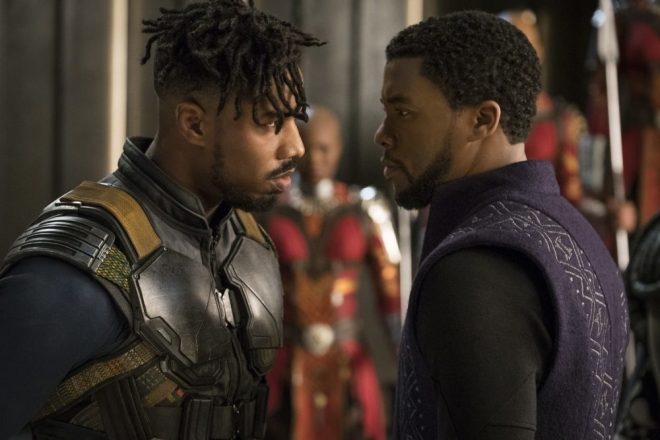
Because Eric Killmonger is a reflection of many Black American’s on a much deeper level than T’Challa. In fact, many Black American’s do not know T’Challa. They know Eric. This is why most Black Americans, more so than sympathize with him, empathize with him. They can put their lives into his shoes.
Saying this, I have only read two articles that brought up the real concerning the conflict between T’Challa and Killmonger (cited below). I liked that they put this conflict in the movie because (as I believe one of the actors pointed out) there is a private conversation among Black Americans concerning the relationship between those who have been taken captive and those who have not. As I’ve stated on this blog time and time again, Africa is a continent with over 50 countries and even more nationalities of people. That said it’s impossible for a people to be called African as nationality because it does not specifically point to a place of origin. Which country in Africa are we talking about? Where in Africa can you claim? Who in Africa would claim you? Herein lies the conflict between Eric and T’Challa.
Here’s the phrase that has captured our hearts:
Movie Quote: Eric Killmonger
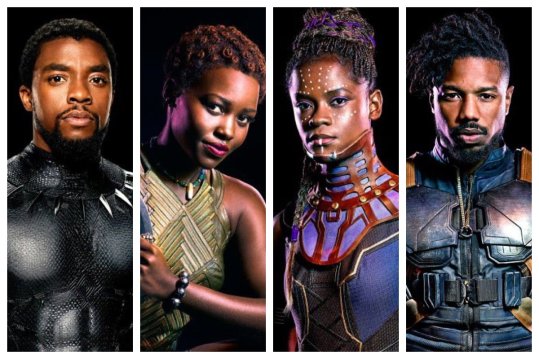
Killmonger was left behind, left out and rejected from among his people. He was locked out of the greatness of Wakanda and forced to grow up in the gritty streets of Oakland. His struggle and longing for a place of belonging and nationhood is the exact sentiment of the Black American. This statement (“…bury me in the ocean with my ancestors that jumped from the ships…”) is proof that he is a descendant of those who have been taken captive via The Transatlantic Slave Trade; a Wakandian by blood but rejected. Not privy to the knowledge and advancement of his homeland, Killmonger attended instead American Universities and studied his culture from a distance. Having grown up in America, not even Killmonger’s name is a reflection of his identity. His name is Eric which is not as exotic as T’Challa. It does not signify or denote any kind of place of origin. Eric also does not speak with an accent and uses language common to any Black American male growing up in the hood.
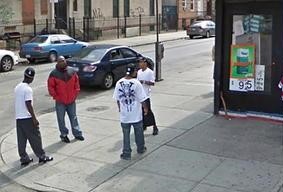
Eric is angry but rightfully so. He has had to watch his people suffer while Wakanda has thrived with resources that could have helped them. Eric wears his rage concerning the mistreatment of his people like a garment and does not understand how to direct that energy in a way that is less destructive. He reminds me of the young black men standing on the corners, full of rage, but without a way to release it in a way that is productive. Given the proper guidance, education, and resources, I believe these are some of the most powerful men the so-called Black community has. While many of us drive by them, shaking our heads and sighing, these boys are absolutely fearless and, like I said, given the proper direction can be the warriors they are descendant from.
While Killmonger’s temper gets the best of him, his desire to use the wealth of Wakanda as a way to help his people in America is a noble one (just don’t weaponize the vibranium by putting it into the hands of black people with no training in how to use it Killmonger. Train your people first lol.) For all of these reasons, and many more, I believe many Black Americans empathize and connect more so with Michael B. Jordan’s character than Boseman’s T’Challa. For many of us, Killmonger is the hero, choosing to die (symbolically and literally) with his people than to serve among those who have rejected him.
“Every time a Wakandan referred to Killmonger in the film, he was called an “outsider.” Even though he proved he was of Wakandan blood, he still wasn’t one of them. Killmonger grew up hearing stories about a home he’d never been to. He had knowledge of Wakanda’s wealth and culture but he had no access to it himself. While T’Challa was able to visit a lush, African landscape surrounded by his ancestors, Killmonger’s trip to his own ancestral plane led him back to an apartment complex, where he was mostly alone.”
“I refuse to see Killmonger as a super-villain. I see him as a super-victim of systemically oppressive forces, forces that forced him into a hyper-awareness of his dueled unwanted status in Wakanda and in America, due to having the blood of his mother, who was a descendant of black folks forced into the United States via the Trans Atlantic Slave Trade. This two-pronged othering serves as the source of his super-power. His super-power did not derive from radioactive spider bites like Spider Man, or mythological alien strength like that of Superman. Killmonger’s character harbors a super-power more potent than the fictive mineral Vibranium, housed exclusively in Wakanda: Killmonger is the possessor of un-tempered black rage….Killmonger’s black rage is my black reality, and I cannot see Erik Killmonger Stevens as a villain because it would mean seeing myself as a villain as well (and as a black man in America, I have been vilified enough.)
T’Challa and Huey next to Yoruba Tribal ruler in West Nigeria sitting on throne surrounded by elephant tusks.
Personally, I liked both T’Challa and Killmonger for different reasons and enjoyed the Martin Luther King Jr. and Malcolm X undertones embodied in the characters. Marvel’s Black Panther came out around the same time Huey Newton and Bobby Seale founded The Black Panther Party for Self-Defense and it is believed that X-Men is based on The Civil Rights Movement. Created in 1963, fans allege that Stan Lee wanted to create a comic that showed bigotry and racism via fantasy and that Magneto and Professor X are direct correlations of Martin and Malcolm. In Black Panther, T’Challa and Killmonger also seem to have the same correlation. Those who were fans of Malcolm will definitely be a fan of Killmonger.
Furthermore, prior to Stan Lee’s comic and the organizing of The Black Panther Party, the term “Black Panther” existed already. The 761st Tank Battalion was an independent tank battalion of the United States Army during World War II. The 761st was made up primarily of African-American soldiers, who by federal law were not permitted to serve alongside white troops. They were known as the “Black Panthers” after their unit’s distinctive insignia; their motto was “Come out fighting.”
I know we are all still on a high from The Black Panther movie. It’s a great film. While we are in this space–this feeling of pride and empowerment– I’d like those who choose to do so to not let something else go over our heads. If you think about it, it is easy to miss. There’s so much happening around Black Panther, no one has said anything about the misrepresentation of ourselves (Blacks) happening right before our eyes. The misrepresentation I am referring to is The Samson Movie.
If you don’t believe in the bible you may exit now. I don’t expect this to have any significance to you. If you believe in the bible however then there is one thing we must realize about two things that have taken place before our eyes, overshadowed by the excitement surrounding Wakanda and T’Challa.
Both Samson and Nefertiti have been misrepresented. They have both been portrayed as Europeans when this is not the case.
On February 16, 2018, The Samson movie came out. I don’t believe in coincidences so it’s no coincidence to me that this movie came out on the same day that Panther came out. Naturally, Black people will be excited about seeing themselves represented, for once, on screen. Naturally, we would support Black Panther over The Samson Movie. Naturally, we are tired of seeing white heroes. Naturally, we would miss this. I am asking you not to miss it. I am asking you to pay attention. Now, I am not asking you to go see Samson. Do not misunderstand me. I am asking you to realize that Samson was one of our heroes and he is being misrepresented in this movie. I am saying that Wakanda has got Blacks searching and talking about identity for once, which is great. Interestingly enough, Samson is our identity. The Israelites were black. The Philistines were black. The Egyptians were black.
As we are being represented in Black Panther, we are being misrepresented in Samson. Showing Israelites and Egyptians as Europeans is disrespectful. Do not lose sight of this. It is not a small matter. Samson was a very powerful man, a superhero with great strength. Black Panther is a great film with powerful symbolism and messages (that I hope to address soon. In the meantime, see my recent post on 6 Reasons Black Panther is Popular (and it’s not even out yet) I wrote before the movie released.) In short, Samson’s portrayal as a white man is just as offensive to me as Nefertiti being portrayed as a white woman and no one’s talking about it.
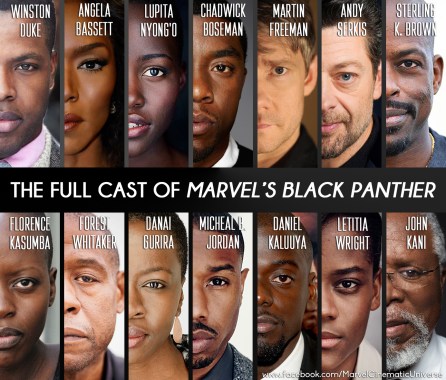
90% of the cast members are Black. This isn’t a racial thing. It’s just that people are tired of seeing movies where the heroes are white. Even biblical movies refuse to reflect the real identity of the people who lived in that time. The Samson movie is also about to come out but Samson was not white. It’s not about skin complexion it’s just a fact, the people of the Bible were Black.
Warriors, Not Slaves
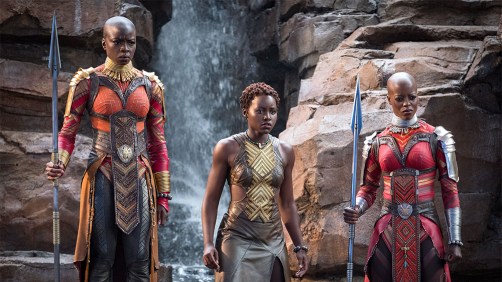
The Black people in the movie are not slaves, maids, housekeepers, and farmers (though there’s nothing wrong with farming, just saying). The Black people in this movie are warriors, Kings, and Queens.
Women Warriors
The Panther women go just as hard as the men without losing their femininity. They are supportive of their men, smart, fierce and they are fighters. Not to mention a showcase of the women’s natural beauty. I love how (far as the trailers go since the movie is not out yet) the movie shows them being beautiful while swinging those swords.
Historical
The Panther’s first appearance happened during the Civil Rights Movement of the 1960s, and I am sure the newscasts that showed Black Americans getting brutalized by police was a motivator for Marvel. This movie Black Panther comes at a sensitive time politically which further makes it reminiscent of revolutionary movements in Black History such as Huey Newton’s Black Panther Party For Self-Defense and Marcus Garvey’s Universal Negro Improvement Association, both of which promoted the freedom of the so-called Black people.
Educational
Speaking of history, Black Panther is educational for today’s youth, many of whom know nothing of the Black Panthers of the 60s, Marcus Garvey of the 20s or anyone of or before the era. The release of this movie at this time, therefore, makes it easier to start conversations about Black History (especially being it releases February) and inspires liberation among Black people in general. The men and women even have accents reflective of their “African” heritage. When you’ve spent nearly 400 years being afflicted and not seeing positive representations of yourself in textbooks, on television, in schools etc., it makes it difficult to have a positive image of yourself as an individual. My hope is that Black Panther delivers and helps to spark a resurgence of consciousness among Black youth.
Empowering
Wakanda is empowering and reminiscent of the Israelite nation (not a race of Blacks but a nation of people) and their position as rulers. It represents everything we could be if we embrace who we truly are. This movie, if done right, is not just a movie, it is a biblically powerful representation of Israel on the top and not the bottom for once. The birth of a nation and the rise of a people. It is our time.
About Black Panther
After the death of his father, T’Challa returns home to the African nation of Wakanda to take his rightful place as king. When a powerful enemy suddenly reappears, T’Challa’s mettle as king — and as Black Panther — gets tested when he’s drawn into a conflict that puts the fate of Wakanda and the entire world at risk. Faced with treachery and danger, the young king must rally his allies and release the full power of Black Panther to defeat his foes and secure the safety of his people.
Yecheilyah is an author, blogger and poet. Be sure to pick up your copy of I am Soul, her latest collection of poetry on Amazon.
Me at the Nubian Bookstore in South Atlanta where Renaissance has just been stocked on the shelves.
Those of you already following me on social media are already aware of this….but…
I hate to be so dramatic but I have news…
Yesterday it became official.
I’ve been doing some underground work and….
…on Saturday, December 30, 2017, one of my books made it to the shelves of a brick and mortar bookstore for the first time. Renaissance: The Nora White Story (Book One) is now available at The Nubian Bookstore in South Atlanta and I am organizing a book signing for Black History Month to help to promote the milestone.
Obviously, this is where the real work begins.
And, obviously, I am excited about this new endeavor.
I am looking forward to learning more about book publishing and networking more offline.
What a great way to end the year!
I’ll be away awhile but I wanted to give you the news for sure 🙂
See you around!
Ya’ll be great.
Peace and Hair Grease.
-EC
“Yecheilyah Ysrayl has crafted an outstanding novel that takes the reader on the migration that black elders have described all our lives. Nora has graduated from high school and run away from her Mississippi town to a northern city, Jacobsville, NY, just 45 minutes outside of Harlem. It’s Nora’s intent to pursue a career as a writer during the 1920’s and the height of the Harlem Renaissance. In Harlem, she rubs elbows with the talented elite or, as some would say, literary royalty.”
Deu 28:68 “And YAH shall bring you back to Egypt in ships, by a way of which I said to you, ‘You are never to see it again.’ And there you shall be sold to your enemies as male and female slaves, but no one to buy.
“The United Nations (UN) revealed on Wednesday that hundreds of migrants from Nigeria and other West African countries passing through Libya enroute Europe are being bought and sold in what it described as modern-day slave markets before being held for ransom, forced labour or sexual exploitation.”
I haven’t had the chance to sit down and share my thoughts on the slavery taking place in Libya. I usually take my time with such things. I don’t want to echo what everyone else is saying or jump on bandwagons. I want to be logical, spiritual, and develop my own thoughts about it so I’ll just keep this short until then.
If you are new to what’s going on, The Slave Trade has basically reopened and Israelites, so-called Blacks / Africans, are being taken back into captivity throughout Libya. You can catch up on what’s going on HERE and HERE.
Since I started this blog I’ve spoken about Slavery, the Enslaved and the horrors of this time. I talk a lot about The Civil Rights Movement, Jim Crow, Police Brutality, and the overall mistreatment of Blacks in America and the mistreatment of Blacks period. For three years now I’ve tried to give as much historical information as I am able to inform you of these things and in return, I get people who are tired of hearing about slavery. Tired of seeing movies and TV shows and reading books where slavery is present. We believe it is an eyesore that must be covered up and hidden underneath our beds. We want to forget about this time and sugar-coat the details. And when good men seek to help those who need it they are called dictators and thus removed from power.
Few people know that Khadafi tried to help Blacks in Libya before his death. He wanted to protect them and for this, he was called a dictator and killed while American’s cheered their ignorance in front of TV screens that told them lies. (Wag the Dog is a good movie on how TV often controls our perception of reality.)
If there is one thing we should know about slavery is this: At least we knew we were slaves and fought collectively for freedom. Today, we think we are free so we don’t fight anymore. It usually takes us to experience something as traumatic and tragic as this for us to understand and realize where we stand not just in America but all over the world.
While what’s going on in Libya is heartbreaking, I hope that finally, we can see why these stories are worth telling and why these reminders are still necessary. I keep saying there’s nothing new under the sun, that what has been done is what will be done, and that we should not be shocked but to pay close attention to what’s going on in the world. Our eyes may very well witness more tragedy and our hearts more pain.
(FYI: Black History Fun Fact Friday continues next week….been busy but I haven’t forgotten.)















 The PBS Blog