Welcome back to No Whining Wednesday, the only day of the week where you do not get to whine, complain, or criticize. Click Hereif you’re new to this segment for more on what this is about.
The No Whining Wednesday Badge
“If your daily life seems poor, do not blame it; blame yourself that you are not poet enough to call forth its riches..”
– Rainer Maria Rilke
Are you rich? Here’s a list to help you to find out. You’re rich if you:
Woke up this morning
Have a roof over your head
You ate today
You have someone who loves you
You love someone back
You have clean water
You have food in the refrigerator
You have someone who could give you food
You have a good heart
You wish good for others
Someone prayed for you today
You prayed for someone today
Someone cares for you
You have clean clothes
You have a washing matching to wash your clothes
You know how to wash your clothes on hand
You have a dream
You know how to read and write
You’re breathing right now
Understand and then appreciate your riches. Do that and you will never be disappointed. For the grateful, there is no poverty.
Timbuktu is a city in the West African nation of Mali, situated north of the River Niger on the southern edge of the Sahara Desert. Founded by nomads, it is most known as “The City of Gold.” While some scholars and proposed travelers attempt to debunk the “myth” (claiming to have reached the city where the homes are made of mud bricks), Timbuktu was one of the most important centers of trade and intellectual life in West Africa, flourishing through participation in long-distance trade networks directed north across the Sahara. The city is known as having traded goods that flowed through the center including salt, ivory, and gold. One of the reasons for Timbuktu’s wealth is the water supply. There are many wells containing sweet water in Timbuktu, where the Niger in flood canals delivers the water to the city. Grain and animals are abundant, so that much milk and butter is consumed.
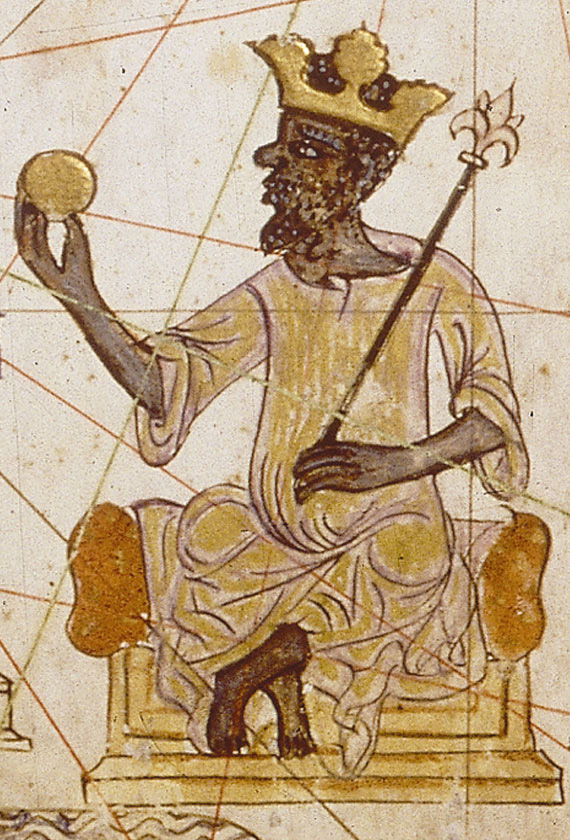
A picture from a medieval atlas, drawn in modern day Spain. It shows the King of Mali, Mansa Musa, who reigned between 1312 and 132, wearing a Gold Crown, Gold Ingot, and Gold Scepter.
During the fourteenth century, the story of Timbuktu as a rich cultural center spread throughout the world. The beginnings of which can be traced to 1324, when the Emperor of Mali made his pilgrimage to Mecca via Cairo. In Cairo, the merchants and traders were impressed by the amount of gold carried by the emperor, who stated that the gold was from Timbuktu. Furthermore, in 1354 the explorer Ibn Batuta wrote of his visit to Timbuktu and told of the wealth and gold of the region. Thus, Timbuktu became renowned as an African El Dorado, a city made of gold.
“Until comparatively recent times, knowledge that black Africa was the seat of highly evolved civilizations and cultures during a time when Europe stagnated was limited to a small group of scholars. That great empires, such as Ghana, and later, Mali flourished for centuries while Europe slept through its Dark Ages almost has been ignored by historians. Thousands of years before that, civilization began with the black races of Africa and Asia, including the Hebrews, who were jet black. Because of the scarce literature on the contributions of blacks to world civilization, most people today hold the erroneous opinion that the black races have little real history. It was not known, for instance, that the ancient Hebrews, Mesopotamians, Phoenicians, and Egyptians were black. Now, a growing body of literature is presenting the illustrious history of blacks and their enormous contributions.”
And that’s it for this week’s episode of Black History Fun Facts. Below is last weeks episode in case you missed it:
“Every job from the heart is, ultimately, of equal value. The nurse injects the syringe; the writer slides the pen; the farmer plows the dirt; the comedian draws the laughter. Monetary income is the perfect deceiver of a man’s true worth.” – Criss Jami





 The PBS Blog