
Mistakes Self-Publishers Make When Publishing Print Books (And How to Avoid Them)

We often talk about how attractive the book cover should be, and for good reason. Poor cover art is the #1 mistake Self-Published authors make when publishing print books.

But we know that already.

Let’s go inside of the book this time.

When preparing your manuscript for publishing in a print book, the formatting should be done in a way that is different from a college essay, research paper, or blog post.

Here are the top print book mistakes I see self-published authors make and how to avoid them.

Disclaimer. I am not a lawyer. Nothing beyond this point should be taken as legal advice.

No Copyright Page

The copyright page of a book is one page that lets people know who owns the rights to the book and that, generally, the author’s intellectual property cannot be copied without permission.

You do not need to register your book with the copyright office to add this page except if you want to. In this case, register the copyright at copyright.gov. You can do it after you publish the book to Amazon since it takes about 6-13 months (of this writing) to go through.

However, know your book is automatically under copyright when creating it.

The copyright page discourages theft, such as plagiarism, and announces you as the book’s owner. It is like a “No Trespassing” sign; every book should have one.

If you own a software program such as Atticus (PC) or Vellum (Mac), they have copyright templates already designed for you. If you don’t have these programs, creating one is easy. All you need is a copyright notice and a rights reserved.

© 2024. Yecheilyah Ysrayl. All rights reserved.

You may also add additional information. Below is an example of a basic, full copyright page.
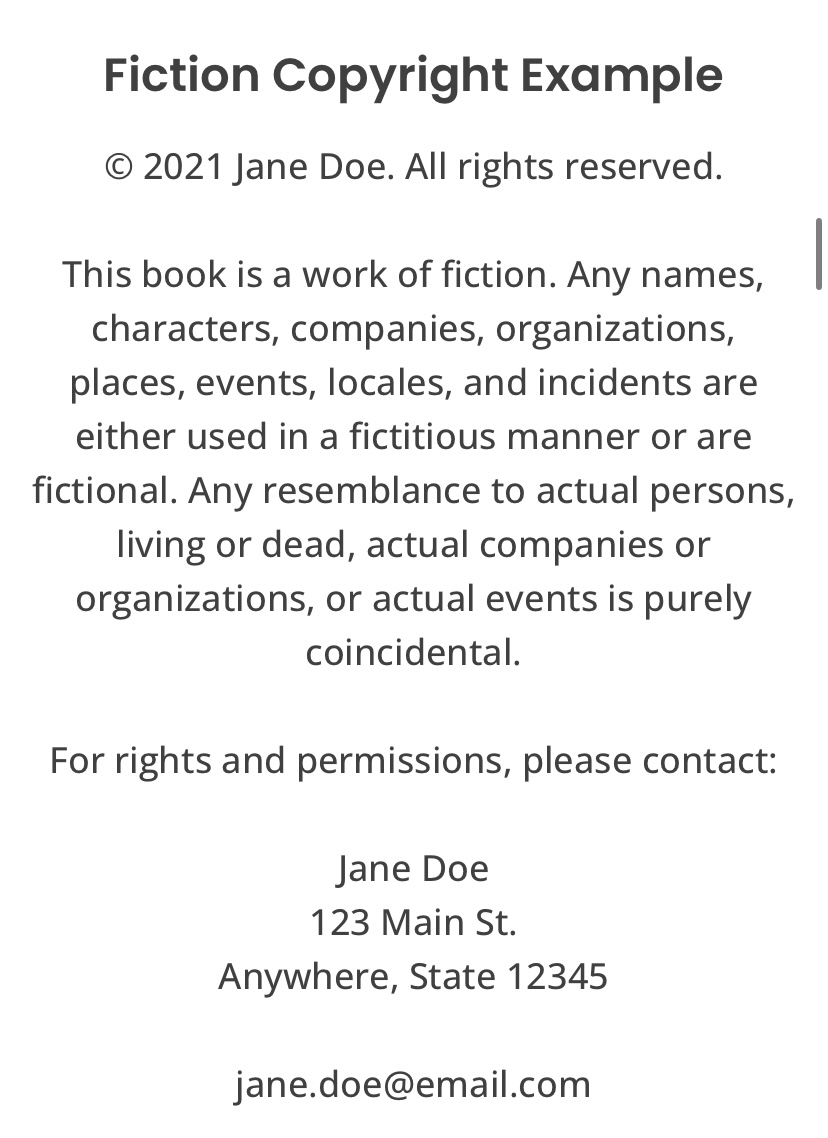
It should also include your ISBN. For more on ISBNs, click here and here.

This page should appear at the beginning of the book, also known as the book’s front matter, after the title page. The title page is one page that looks like the cover but without the artwork. It includes the book’s title and the author’s name. This title page may appear twice, depending on the publisher. Once at the book’s opening and once more before the opening chapters.

The Author’s Name and Title are Not on the Spine

This is easily avoidable with a professionally designed book cover, but let’s touch on it a bit.

Some books do not need a spine because they are too thin. Otherwise, you will want to have your author’s name and title on the spine of your print book.

The spine binds the front and back of the book and is also important for bookstores.

With the author’s name and title on the spine, a book is easier to find for someone skimming the titles on shelves. Since self-published books are already underestimated, a book without a spine can easily get lost, and the author misses out on sales.

The first thing a potential customer will see is the outward-facing spine, so if the book does not have a title or author name, readers won’t even notice the book.

No Chapter Headings

A chapter heading is how you organize your book so readers know when a section begins and ends. It is literally as simple as adding Chapter One….Chapter Two…Chapter Three.

Chapter headings can also have subtitles or names instead of numbers. In Black History Facts, I use chapter headings and subtitles.

Chapter One (Chapter Heading)

What You Didn’t Learn About Sundown Towns

(Subtitle)

The purpose of chapter headings and sections is to organize the book to make it easier to read and follow. Without it, readers might get confused about where they are in the story. Believe it or not, there are so many authors who make the mistake of not including chapters, making the book look more like an essay.

If you have a software program or professional who formats books, this is easily avoidable as they can add them for you.

Fancy Text

One of the most common mistakes of first-time self-published authors is using fancy text.

Times New Roman, Arial, Helvetica, Calibri, and Cambria are great fonts for books that make them easier to read!

Cursive writing and other fancy text, including colored fonts, make them harder to read.

Too Much Space and Not Enough Words…

Indie Authors who self-publish should also be aware of too much spacing, making the book look like it was written for children (unless it was). An adult-level book should not have so much space between it and the next section that you could write a short bio about your life in between.

Be sure to fill blank spaces with words or shorten the book’s length.


Plan to publish a print book? Don’t forget to add a copyright page, spine, chapter headings, text that is easy to read, and a book with enough words to fill it out.

Investing in professional cover design and interior formatting will help with all of this!
Click here for more Indie Author Basics to encourage you through the Self-Publishing / Indie Author Process!

Don’t Give Up on Your Book Too Soon

Sneaking out of the house to ship books during Covid 2020.

Time is one of the numerous advantages of self-publishing. Self-publishers set their own schedules, in contrast to traditional publishing, which enables them to release books fast and often.

And the better an author gets at publishing high-quality books, the more they publish in a shorter time. 

However, I caution authors not to rush their current book on the way to the next one.

Some authors only have one book out, but what they’ve been able to do with that book is more than some authors with ten or twenty.

From consulting and coaching to classes and workshops, these authors have turned that one book into a powerhouse of expertise and services, multiplying their income.

But they would not have been able to do this if they had given up too quickly.

They would not have been able to do this if they published the book on Amazon and then forgot about it on the road to the next one.

They would not have been able to do this if they worried about making the best sellers list. (Some authors are making good money selling their books consistently and have never been a Best Seller.)

They would not have been able to do this if they focused on what’s next instead of what already exists.

When we give in to shiny object syndrome, the continual distraction brought on by an ongoing belief that something new is worth pursuing, we miss the blessing right in front of us. 

The grass is not greener on the other side. It is greener where you water it. It is greener where you cut it. It is greener where you pluck out the weeds.

It is greener when you give it the time and attention it needs to thrive.

Sometimes, new ideas are not intended for us to act on immediately. Some thoughts need to be written and executed later. 

Give that book you worked so hard to produce the time and attention it deserves to grow and develop before moving on to the next best thing.

We believe publishing success is about quantity and hustle. That might work short-term, but the long-term victory is about quality and strategy.

You can spend a lot of time and energy hustling to break the Guinness World Record for the most published books, or you can be more strategic about turning that one book into a full-blown brand. This may require a long-term plan where you might not immediately see results.

Click here for more Indie Author Basics aimed at encouraging you through the Self-Publishing / Indie Author Process!

Help People Understand WHY They Should Buy Your Book

Supporting a fellow poetess at the Atlanta African American Book Festival, 2019.

In my years of consulting with authors and working with them on their books, I’ve discovered that the most difficult challenge for many is not writing the book (many of them have been writing their entire lives) but finding innovative ways to market and promote it.

With so many hats to wear, the last thing an Indie Author wants to do is strategize about how to promote their book day in and day out.

And you know what? We don’t have to!

Everything does not have to be part of some grand strategy that only a rocket scientist could understand. The secret to wisdom is often in its simplicity.

Considering it as relationship-building and connection-making rather than marketing and promotion could help you focus on the reasons behind your book. It involves thinking up creative ways to draw in and hold the interest of those who are already searching for solutions to the problems your books address. 

Not only can these connections help you meet new people who buy books, but you might also find a business partner or lifelong friend.

Since your identity as an author is heavily influenced by who you are personally, it might be beneficial to present your individuality and draw on real-world experiences to engage readers on a deeper level.

Dr. Jackie Walters does this well. 

Award-winning OB/GYN and star of the hit TV show Married to Medicine on Bravo, I reviewed her book a few years ago. The Queen V: Everything You Need to Know About Sex, Intimacy, and Down There Health Care goes into detail about our precious lady parts and all the ways to stay healthy. She has these videos where she reveals something informative about the vulva, sex, and intimacy. 

Here’s the important part: She only sometimes mentions her book in these videos! Sometimes, she’ll just have it sitting to the side, or it won’t be in the shot at all.

Dr. Jackie understands her expertise, and by educating her people and entertaining them with her props (she uses fruits and everything, chile), people are increasingly interested in her topic and her book without her mentioning it in every post.

She just shows up as herself.

In the end, we must show people why they should buy our book, not just that they should. This builds genuine connections and strong relationships that help our books to sell without stressing us out.

Click here for more Indie Author Basics aimed at encouraging you through the Self-Publishing / Indie Author Process!