Unfamiliar Faces – Lost to History: Afro Puerto-Ricans, Cubans, Jamaicans, Haitians

porto_rican_peones_puerto_rican_peons-_children
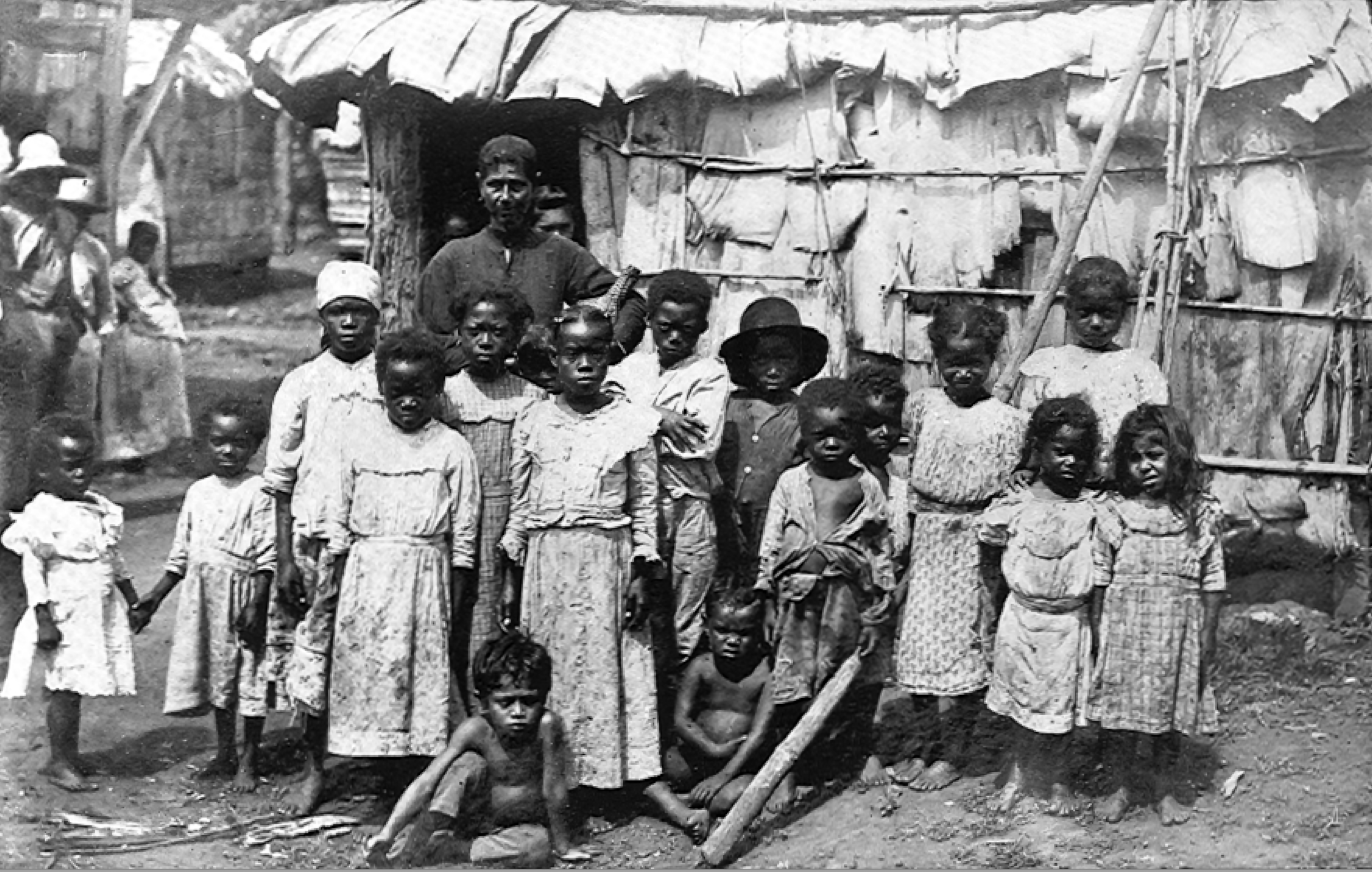
Enslaved Afro Puerto Rican children

Though many students will learn about slavery in the U.S. at some point, our teachings are usually narrow in that we only learn about the European Slave Trade and the wrongs that Europeans have done. We won’t be told that we weren’t just dropped off in America. We won’t be told that every people, from Jews to the Five Civilized Native American Tribes, held us as slaves. We won’t be told of the difference between the Africans themselves who had slaves and those who were enslaved, and we won’t be told of the many different tribes and nations of black people that occupy the continent.

Contrary to popular belief, mostly brought on by television and movies, slave traders did not go into the interior of Africa to pick up any “African” but they were looking for a specific people. However, since the continent has been lumped up into one big mass, all blacks are assumed to be the same people and as a result, many ancient practices and truths faded from memory.

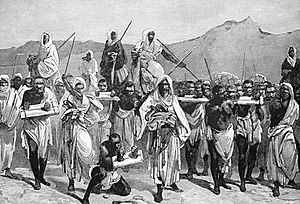
Engraving of Arab slave-trading caravan transporting African slaves across the Sahara.

The trade of slaves across the Sahara has a long history. Dr. John Alembellah Azumah in his 2001 book, The Legacy of Arab-Islam in Africa estimates that over 80 million black people died en route to the Islamic world. Having enslaved blacks about one thousand years before the Europeans, the Arabs had already identified the people of the book. That is the people of the covenant. The people of scripture. The chosen and the prophecies surrounding their captivity.

Indeed, they were not after just any African, but the ones who held principles that were distinct from the other tribes. Differing by way of culture and spirituality, these blacks could easily be spotted by way of their traditions. Olaudah Equiano, known as Gustavus Vassa, captured, enslaved, and then freed, told in his book, The Interesting Narrative of the Life of Olaudah Equiano, of his life in Africa before the abduction.

Born among the Ibo people in the kingdom of Benin, along the Niger River, Olaudah recounts in his narrative of how they still held many Hebrew customs and traditions, such as the circumcision, the division of the tribes by twelve, and the marrying of their brother’s wife after death just to name a few. What is not recounted is that not only did Olaudah’s family uphold such traditions but so did many so-called African tribes.

That said, many of the slaves who came to Puerto Rico were from Congo, the Ashanti, Yoruba, Igbo and Bantu tribes. In all, 31 known African tribes were brought to the island from Central and West Africa through the slave trade but they weren’t the only ones.

Not only was Afro-Puerto Ricans largely made up of these Hebrew tribes, but so were the Jamaicans, Dominicans, Cubans, and so-called African Americans of today. Though we see each other as separate, the truth is that many of us (even if we’ve mixed) are all the same people and were all part of the dispersion.

Today’s lost to history segment focuses not on one individual but a group of individuals who have gone on to war within themselves due to the lost historical fact that we are not a different people but the same. Having been separated by land, we were taken from the same areas because we are descendent of the same people. The only difference is that we were dropped off in different places. Some to Jamaica, some to Haiti, some to Puerto Rico, and so on. As a result, some of us speak English, some of us speak Spanish, and some of us speak French.

Why I Speak

Why I Speak

“We often forget that the current state of Black Americans is directly related to history.”

Black Then Staff

It is clear that we live in a system that is unfair and a civilization that is not just. I speak of these things not because I want to focus on the negative experience of blacks in America only. I speak of these things not because I’m a dark person who just wanna keep bringing up bad stuff. I speak of these things because we’ve become comfortable here in this land. We have been blinded from the truth as a people. We’ve forgotten that the constitution did not include us and that civilization for us is outside of this system. We’ve been tricked into believing that we are citizens in this land and that we have some kind of rights here. We’ve forgotten that when “All men were created equal” that didn’t include us. For what to the slave is the 4th of July?

You see we’ve forgotten where we’ve come from and as a result have no idea where we’re going. How can a slave pursue freedom when he thinks that he is already free? You see the black man does not exist. Black is a color, not a nation of people. Where is African American land? It does not exist. Africa and America are the combinings of two continents. There are over 50 countries in Africa, how then can “African” properly define a people? Which country in Africa are we talking about? African American is also therefore not a nation of people.

I speak because our roots stretch deeper than colors, bywords, proverbs, and mockeries that conceal true identities.  I speak because we forget that we were never part of this constitution. To amend. It means to alter, modify, and to revise. This document had to be revised, altered, and modified just to include you. No justice no peace, my people. It means that there’s no justice for you here and there’s no peace here either. This is the world we live in. We condemn the Confederate flag and we praise the American flag because we’ve been blinded to think there’s a difference between the two. They both drip with the blood of the saints.

We continue to march and to protest because we believe it will change things. How is it that we’ve gone from fighting for freedom to settling for Civil Rights? What is a civil right? What about human rights? So yes, I speak. I speak because we think we know slavery and we know nothing. I speak because we think we know freedom and we know nothing. I speak because we think we have rights and we have nothing. I speak because we think we know justice in a land that is anything but just.  Don’t matter who becomes president. It is the system that is broken and it is my responsibility to speak.

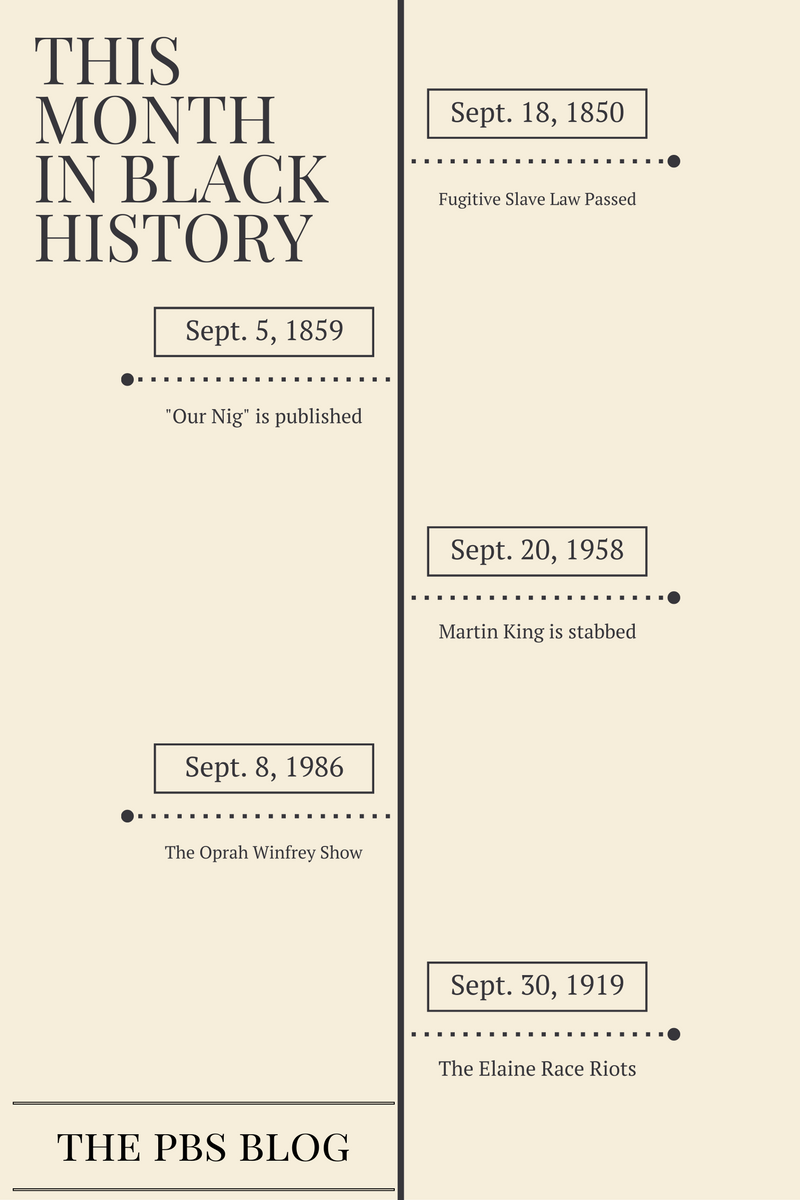
This Month in Black History – September

this-monthin-blackhistory

This month sped by so fast I almost missed this month’s history wrap up!

******

September 5, 1859 – Harriet Wilson’s novel Our Nig is published

September 8, 1965 – Dorothy Dandridge found dead

September 8, 1986 – The Oprah Winfrey Show debut

September 9, 1739 – The Stono Rebellion, the largest slave uprising in the British mainland colonies prior to the American Revolution, occurs in South Carolina

September 10, 1963 – Schools in Alabama desegregated

September 11, 1977 – Roots wins 9 Emmy Awards

September 12, 1905 – Master Horseman John Ware is killed when his horse trips, crushing him and breaking his neck

September 12, 1913 – Jessie Owens is born

September 12, 1947 – Jackie Robinson named rookie of the year

September 13, 1885 – Alain Locke of the Harlem Renaissance is born

September 15, 1963 – The 16th Street Baptist Church is bombed in Birmingham Alabama leaving 4 little girls dead and one blind in one eye

September 15, 1978 – Muhammad Ali becomes the WBA Champ

September 16, 1794– The French Abolish Slavery. (Slavery is reinstituted under Napoleon in 1802 along with the reinstitution of the “Code noir”, prohibiting Blacks from entering French colonial territory or intermarrying with whites).

September 17, 1858 – Dred Scott dies of Tuberculosis 17 months after emancipation

September 18, 1850 – The Fugitive Slave Law is passed by Congress

September 18, 1919 – Frederick Douglass “Fritz” Pollard is the first African American professional football player for a major team

September 18, 1970 – Jimi Hendrix dies in London (at the young age of 27)

September 20-24th 1830 – The First National Negro Convention met in Philadelphia

September 20, 1958 – Martin Luther King Jr. stabbed in the chest while signing copies of Stride Toward Freedom in Blumstein’s department store in Harlem

September 24, 1957 – Eisenhower orders the 101st Airborne Division to Little Rock Arkansas to force desegregation at Little Rock Central High School

September 24, 1935 – Joe Louis defeats Max Baer at Yankee Stadium, Bronx New York

September 26, 1967 – Riots erupt in Tampa, FL after police shoot Martin Chambers, an unarmed  black teen

September 28, 1991 – Miles Davis dies

September 30, 1919 – Oct 1 –  The Elaine Race Riots (also known as The Elaine Massacre) occurs in the Elaine town of Phillips County Arkansas

****

In Case You Missed It: This Month in History – August

Discover My Top 8 Historical Reads (That you’ve probably never read!) Get it Here.

Unfamiliar Faces – Lost to History: Before Parks

“They said they didn’t want to use a pregnant teenager because it would be controversial and the people would talk about the pregnancy more than the boycott,” Colvin says.

https://www.bbc.com/news/stories-43171799

Was Rosa Parks the only woman to refuse to give up her seat on a segregated bus? Below are a few of the women left out of the history books. 


Irene Morgan – We have all heard of Rosa Parks, but there were at least three women who refused to give up their seats on the bus in the Jim Crow south throughout history. Eleven years before Parks, Irene Morgan, later known as Irene Morgan Kirkaldy, a black woman, was arrested in Middlesex County, Virginia, in 1944 for refusing to give up her seat on an interstate bus according to a state law on segregation. The Irene Morgan Decision inspired the men and women of CORE to create a nationwide protest movement called “The Journey of Reconciliation” when groups of civil rights activists rode buses and trains across states in the South in 1947, a precursor to The Freedom Rides of 1961.

The Irene Morgan v. Commonwealth of Virginia, handed down a landmark decision on June 3, 1946, when they agreed that segregation violated the Constitution’s protection of interstate commerce. Irene Morgan v. Commonwealth catalyzed further court rulings and the Civil Rights movement. Eight years later, the Supreme Court decided in Brown v. Board of Education that segregation violated Equal Rights Protection.

Irene Morgan died on August 10, 2007.

maxresdefault1

Claudette Colvin – Born on September 5, 1939, in Montgomery, Alabama, Claudette Colvin refused to give up her seat to a white passenger months before Rosa Parks on March 2, 1955. Colvin was only 15 years old but she was poor. She didn’t have the NAACP or the connections Parks had. As a result, little is know of her. The NAACP considered using Claudette but they said she was too young. They also looked away because she was pregnant and they did not want to represent a young, unwed mother and bring about negative attention to the movement. They thought Colvin’s condition would make blacks look bad. Colvin went on to serve as a plaintiff in the landmark legal case Browder v. Gayle, which helped end the practice of segregation on Montgomery public buses. Today, Claudette Colvin is still not a name you hear very often concerning bus desegregation, even though she was there before Parks.

“Whenever people ask me: ‘Why didn’t you get up when the bus driver asked you?’ I say it felt as though Harriet Tubman’s hands were pushing me down on one shoulder and Sojourner Truth’s hands were pushing me down on the other shoulder. I felt inspired by these women because my teacher taught us about them in so much detail,” she says.

8634838_orig

Aurelia Browder – After Colvin, Aurelia Browder followed suit and was arrested on April 19, 1955, for refusing to give up her seat. Browder was born on January 29, 1919. She joined the NAACP, SCLC (Southern Christian Leadership Conference), the Women’s Political Council (WPC), and the Montgomery Improvement Association (MIA). Aurelia could join all the organizations she wanted but with six children and no husband, her refusal to give up her seat on a bus did not stick, even though she was before Parks.

Mary Louise Smith – Mary was born in 1937, in Montgomery, Alabama. She attended and graduated from St. Jude Educational Institute. On October 21, 1955, at the age of 18, Mary was returning home on the Montgomery city bus. At a stop after Mary had boarded and seated, a white passenger boarded. There was no place for the white passenger to sit and Mary was ordered to give up her seat. She refused. Mary was arrested and charged with failure to obey segregation orders and given a nine dollar fine, which her father paid.

Irene, Claudette, Aurelia, and Mary Louise was followed by Susie McDonald, and Jeanetta Reese, all had been arrested and charged with violating various policies regarding segregated seating on city buses.


Discover more Black History Fun Facts and Lost to History Facts HERE.

Black History Fun Fact Friday – Medical Apartheid

This Week’s episode of Black History Fun Fact Friday is the recommendation of Harriet Washington’s Groundbreaking book Medical Apartheid.

ec2d5b63c1c9fe0a8ec648f7f75c3fd1

Medical Apartheid is about the deliberate infection of people with deadly or debilitating diseases, exposure of people to biological and chemical weapons, human radiation experiments, injection of people with toxic and radioactive chemicals, surgical experiments, interrogation and torture experiments, tests involving mind-altering substances, and a wide variety of others. Medical experiments on children, the sick, mentally disabled individuals, and most especially Blacks, often under the guise of “medical treatment” go back for centuries.


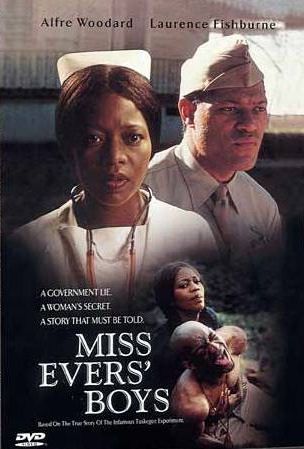
ea_d_38868_0_MissEversBoysOne well-known case of experimentation on Blacks is The Tuskegee Syphilis Experiment, a clinical study conducted between 1932 and 1972 by the U.S. Public Health Service to study the natural progression of untreated syphilis in rural African-American men in Alabama. Mrs. Evers Boys starring Alfred Woodard and Lawrence Fishburne is a movie modeled after this experiment. The men were told that they were receiving free health care from the U.S. government and for forty long years had to tackle the deadly side effects of a disease many of them didn’t know they had. Also, it must be stated that many of these men did not previously have the disease before the experiments began.

The Public Health Service started working on this study in 1932 during the Great Depression, in collaboration with the Tuskegee Institute, a historically black college in Alabama. Investigators enrolled in the study a total of 600 impoverished sharecroppers from Macon County, Alabama. Of these men, 399 had previously contracted syphilis before the study began, and about 201 did not have the disease. Because these men were poor and often had no access to free medical care, the enticing sound of free medical care, meals, and free burial insurance for participating in the study prompted many of the most reluctant to take part. None of the men infected was ever told he had the disease, nor was any treated for it with penicillin after this antibiotic became proven for treatment.

According to the Centers for Disease Control, the men were told they were being treated for “bad blood“, a local term for various illnesses that include syphilis, anemia, and fatigue.

9780385509930_custom-11bb499dd9e2430b63af7a3b00d4cbf9b26dd62c-s6-c30The product of years of research, Medical Apartheid is an excellent book and source of study by Harriet A. Washington on the dark history of medical experimentation on Blacks from the colonial times to the present. She speaks in depth about the history of such organizations as Planned Parenthood and The Negro Project, known previously as The American Birth Control League (whose true purpose was to rid the world of so-called “weak breeds” who were downgrading the American population through a system known as Eugenics), to other frightening tools on unwilling and unknown people.

Throughout the 1840s, J. Marion Sims for example, often referred to as “the father of gynecology”, performed surgical experiments on enslaved African women, without anesthesia. The women—one of whom was operated on 30 times—regularly died from infections resulting from the experiments. In order to test one of his theories about the causes of trismus (locked jaw) in infants, Sims performed experiments where he used a shoemaker’s awl to move around the skull bones of the babies of enslaved women. He also addicted the women in his surgical experiments to morphine, only providing the drugs after surgery was already complete, in order to make them more compliant.

A documentary that is a great compliment to Harriet’s book is called MAAFA, an explosive exposé of the racist eugenics agenda of the abortion industry in the United States. It makes the case that, though abortionists claim to advocate privacy, women’s rights, and reproductive choice, their true motive is racial genocide and ethnic cleansing and goes back for centuries.

MAAFA can be watched for free on YouTube HERE.

Get Medical Apartheid on Amazon HERE.


Publicationbhff

And that’s it for this week’s episode of Black History Fun Facts. Here’s Last Week’s Post in case you missed it:

Week #5: Negro Spirituals

Black Slaves, Native Masters

“I got Indian in my family.”

Is something I hear often among the black community. Even in my own family, my mom talks of how her dad was 100% Cherokee Indian and how our family were cow slaughters which explains my maiden last name which is Hereford, a kind of cow.

Black Slaves, Native Masters

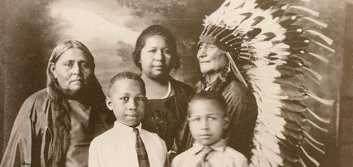
However, while many black families are proud to proclaim their Native Heritage, what is rarely passed around our dinner tables is an important fact in American History. This fact being that even the 5 Civilized Indian Tribes held slaves. A lot of black people jump at the chance to proclaim the above statement because oppressed people typically wants to identify with other oppressed people but the truth is stranger than fiction. Native Americans were oppressed by Europeans but they both had black slaves. In fact, Native Americans knew the layout of the land better than anyone else and it was they who taught the Europeans how to track and to capture slaves. (This is why in last weeks Underground Episode the little boy asked the black slave, “You used to live with the Indians didn’t you? And you taught my daddy how to track.” He used to live with the Indians because he was their slave same as he is the slave to the little boys father. Underground is a very well written TV show).

“Though the harsh treatment of enslaved Africans largely paled in comparison to that of white slaveholders, Blacks still were treated as an underclass among Native Americas. The Five Civilized Tribes even established slave codes that protected owners’ property rights and restricted the rights of Blacks.”

(Barbara-Shae Jackson, The Atlanta Black Star)

What’s deep about my family history is this:

Cherokee is one of the tribes who took part in the Trans-Atlantic Slave Trade (along with Chickasaw and others). In addition, the term “Cow-Boy” is also derivative of slavery. The slave boys who handled the cows were called cow boys. So when you watch Quentin Tarantino’s Django the content is actually not out of context far as the cow boy theme is concerned and my maiden name is potentially much more deep than we know.

Why I Write Black

two generations

Because flowers grow in strange places

like tattered pieces of wood and recycled paper


Because history is frost bitten

and winter refuses to be comforted by the sun

bluish-white and numbed pain

cold skin

and prickling feeling


Because the sky don’t stay dark forever

but light ain’t taught in history class


Because some skirts

are too heavy

to lift without permission

Because Dust Tracks on The Road

was subtracted 3 chapters

Because some truths

are too big to sacrifice

on American alters


Because Zora died broke

and Nina died sad

Because their voices still sing

Because strange fruit still swings


Because ignorance is worth more than rubies

and diamond gems

Because no one has picked up the pieces

of truth

underneath the ruble

of bombed out churches

on 16th streets

Because little girls ain’t little girls no more

but crushed bones

and melted skin

a strike of disobedience

against premeditated sin


Because hope is stronger than despair

Because freedom is worth more

than all the

raisins in the sun