
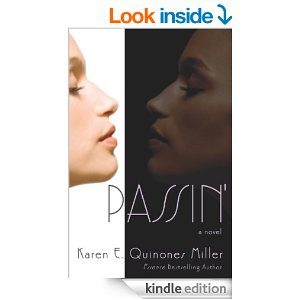
Passin‘ is not a self-published book, but I would like to use it as an example. I actually borrowed it from the library and intend on returning it soon. Not that it wasn’t a good read, but I wouldn’t purchase it. Here’s why: I enjoy a book that makes my mind play it out in my head like a movie. I want to see the characters develop as real breathing people, I want them to have real issues and problems, and I want to see the story in action, and let’s just say this movie’s a little slow. Not that this book didn’t have all of that, it’s just slow getting to the point I perceived to be the main event (the meeting of the man). So it’s an alright read; I wouldn’t give it 5 stars, though. More like 3 stars. I really am enjoying the read, it’s just that I’m a bit disappointed by what the book description told me and how the story is unfolding (yea, still reading it, I’ll probably move up to 4 stars by the time it’s over, who knows lol). The story is an interesting tale of a young woman passing in the new millennium (2007). Racial passing occurs when a person classified as a member of one racial group is also accepted as a member of a different racial group by passing as that different racial group. (Did I confuse anyone?) So a black woman pretending to be white is an example of passing to keep it simple. But what made me check out the book is this excerpt from the description:
“When a successful African-American businessman thinks Shanika is the white woman of his dreams, her world spins out of control. With her future on the line, she’ll have to go beyond skin-deep to discover what’s really worth reaching for–and the person she truly wants to be.”
I know I know, how woman of me, but who doesn’t love, love? Anywho, it’s not a bad story so far, but what’s disappointing is my assumption that the meat of the story would surround this event. But halfway through the book, there’s no mention of this African American man. The story is pretty much just about Shanika’s, I’m sorry Nicole’s, struggles with “racial” (I don’t really believe in a race but for the sake of clarity) identity and her inner conflictions about living a lie (and her hatred of self…my 2 cents). In fact, we don’t meet Mr. Right until close to the end of the book. I’m probably just being picky, but I really did borrow the book to specifically see how this relationship was going to evolve. I’m not finished with the book so I may be doing a part 2 of this same post about how I judged a book by its descriptive cover, but we’ll cross that bridge when we get there.
The point is that this inspired a post about how important book descriptions are to books, especially self-published books. We have talked about book cover designs, a little bit of editing, and even common sense reasons to self-publish. Now let us talk about the content of the book, starting with the description.
When a reader decides to buy a book, one of the first things that strike them is the book cover, the sample, and of course they’ve got to read those reviews. But another important element that plays a role in the buying experience is the book synopsis, summary, or description. If you think this is something I pulled out of my hat, just visit your nearest library or bookstore. You’ll see people scrolling through aisles and turning over the backs of books. Some of them flip through the pages and may even begin to read the first paragraph just to see if it grabs their attention.
The good thing is that if the description of your book has little to nothing to do with what the book is actually about, no one will know until after they buy the book and after they read it. The bad thing is that if they give a bad review, they’ll be your first and only customer. The truth is that book descriptions play a big role in book buying, and as I always say, it’s a good idea to produce your books the way you buy them. If a striking book cover makes you go for the bait then you should also have a book cover design that is also striking. Likewise, if reading the synopsis of a book is what makes you buy, then as an author you want to make sure your book description is also just as fantastic. “If your book description doesn’t grab them and make them feel ‘the need – the need to read’ then you’ve just lost a customer….” (Mark Edwards).
(For the record, Karen’s description was pretty good and achieved the desired effect, it made me pick it up and check it out which means I would have probably picked it up and bought it, so that’s not my complaint since I’m sure her book sells are doing better than mine. My complaint is just about the accuracy of her description of what’s actually in the book, but I digress).
A good summary will give readers just enough information about your book to get them excited about reading the whole thing. For this reason, it should be clear, brief, and simply breathtaking.
Below are 7 ways to improve on book descriptions by Mark Edwards as featured on the blog Catherine Caffeinated
(there are actually 11 but these are the ones I thought worth excerpting far as importance is concerned, 7 is a perfect number after all…isn’t it?):
1. Make it clear. Your potential reader needs to know with a quick skim read what kind of book this is, what it’s about and what the story is. The story is the most important element here – if you’ve written an erotic romance that will give Fifty Shades a run for its money, make sure people know that. Though remember, it’s the relationship at the heart of Fifty Shades that made it such a smash. You need to get that across in a very lucid way.
2. The first line is the most important. If you don’t get the first line right, they won’t read on (this applies to the book itself too). Your first line needs to encapsulate the whole book. It needs to draw people in, hit them where it feels good and make the hairs on the back of their neck stand up. Not easy – but worth spending time on.
3. Don’t be boring. The moment your potential reader feels bored, they’re gone, clicking on to the next book on the also-bought bar. Every line has to be compelling and move the story on. Just like your book, in fact.
4. Make them laugh, cry, cower. It’s all about emotions. How is your book going to make people feel? Is it heartbreaking or hilarious? Chilling or hotter than Angelina Jolie sunbathing in Death Valley? Again, look at the words most used in your genre. They are clichés for a reason. They work.
5. Use testimonials. If you have some quotes from well-known writers or experts, use them. These are generally best in a block rather than scattered through the text. If you’ve got a quote from your Auntie Maureen, you might as well use that too. Just don’t reference her as your auntie.
6. Make your characters live. As well as the story, it’s vital to get a good sense of your characters across – and, most importantly, their big problem. What terrible dilemma do they have to resolve? What personal demon do they need to conquer? You need characters and problems people will identify with – but they have to be big problems. Having a broken dishwasher just isn’t exciting enough.
7. Make the reader desperate to know what happens. You have to end your description with a cliffhanger. You need to lead the reader to the point where they are so curious that, were they a cat, it would kill them. Make sure you don’t give too much away. Be intriguing. Make them feel like Anastasia when Christian tells her he’s about to show her something really new and exciting. Make them go ‘Holy crap!’”

 The PBS Blog