Why Many Black History Accounts on Social Media Are Wrong

We are living in an era where Black history is being erased every day, so I understand the excitement over discovering all the amazing things our people have done.

However, while I love me a good fun fact, I cannot help but notice that many of the Black history memes floating around social media are often grossly inaccurate or lacking context.

And some are flat-out wrong altogether.

And I am not talking about small pages either. Many of your favorite Black history accounts with millions of followers put out false information every day in the name of Black history.

Yes, this includes those on Substack… not really sure why ya’ll think this isn’t also a social media platform.

With a culture so rich and expansive as ours, we really do not need to embellish what we’ve done. The work is already powerful on its own.

Here are just a few things I wish we would explain more deeply. I am starting with this one because someone told me to “Shut up” on Instagram for pointing it out.

Mary Beatrice Kenner invented the maxi pad.
Context:

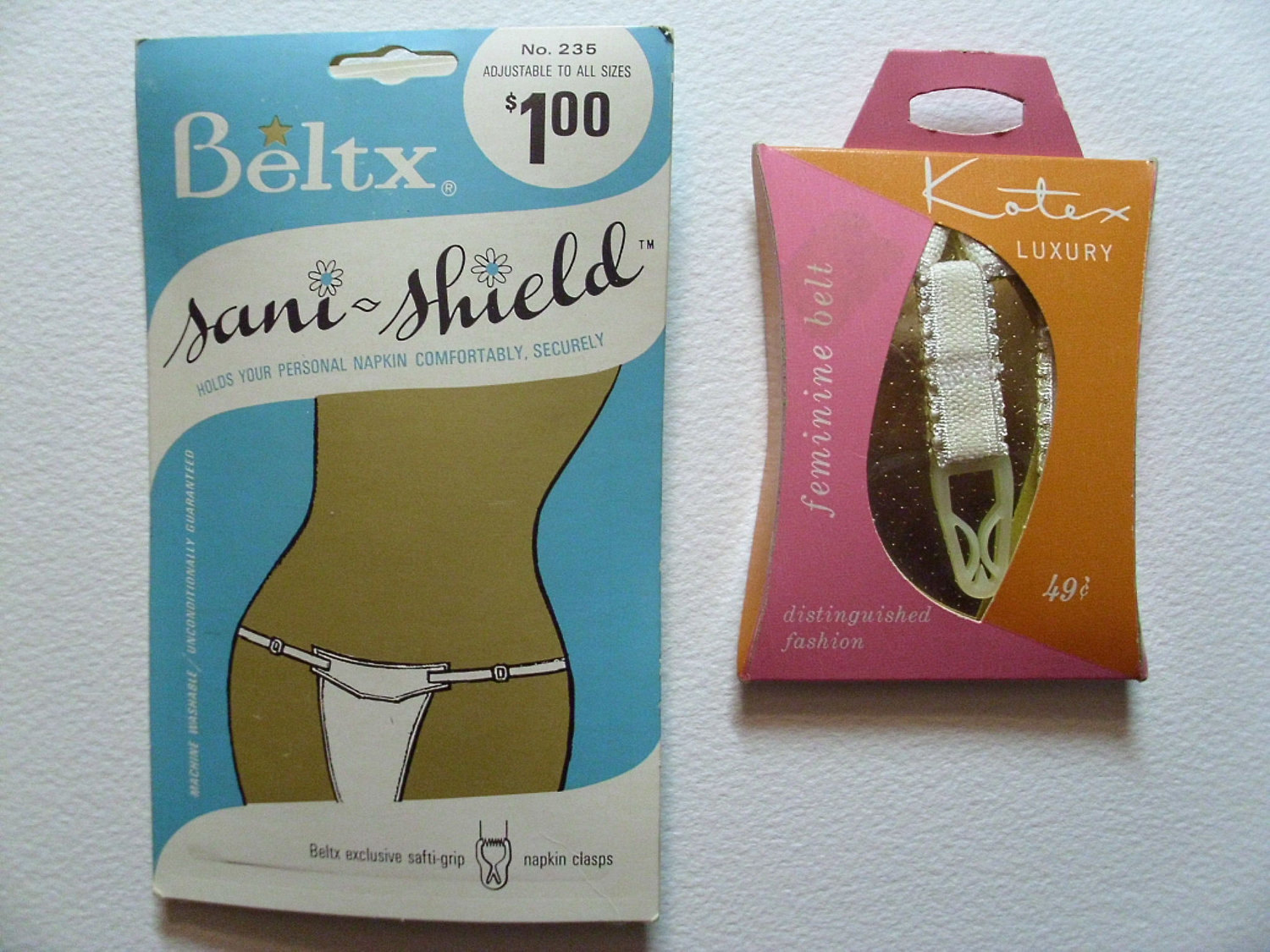
What Kenner invented was called the sanitary belt and moisture-resistant pocket, which is not exactly the same as our modern disposable menstrual pad.

Kenner’s patent eventually expired, leading people to take credit for her invention. A company also expressed interest but pulled back after learning she was Black.1

If Kenner had not been rejected, it is highly likely that she would have also invented the disposable pad, likely based on her original idea. However, what she invented was not the same as today’s adhesive pad, as many of these posts insinuate without proper context.

Here is a timeline from a website on A short history of modern menstrual products:

  • 1880s–1890s: Early disposable pads were made of cotton and gauze, often marketed to women traveling by land or sea.
  • 1896: Johnson & Johnson marketed “Lister’s Towels: Sanitary Towels for Ladies,” which were a notable early commercial attempt but failed due to social stigma.
  • 1918–1921: Nurses in WWI used high-absorbency wood-pulp bandages, leading to the creation of Kotex, the first successfully marketed disposable pad.
  • 1926: Johnson & Johnson introduced Modess Sanitary Napkins.
  • 1956/1957: Mary Kenner patented an improved adjustable sanitary belt with a moisture-resistant pocket.

What I would change on this timeline, though, is that Kenner’s invention was in the 1920s, but because of racism, the sanitary belt did not come out until the late 1950s.

This is what I mean by adding context or looking deeper into what we read.

Let’s look at another one.

Claudette Colvin was the first to give up her seat before Rosa Parks.

Context:

She was not the first, but one of many. Irene Morgan did it in 19442, and Ida B. Wells did it in 1884.3

There was also Aurelia S. Browder, who did it in April 1955, almost eight months before Rosa Parks’s arrest and a month after Claudette Colvin’s.

History is not the linear event we think it is. There is so much that happened, and so many people it happened to, we might never know about.

What Claudette Colvin and Rosa Parks represent is the culmination of many years of work and sacrifice by many different Black women.

And one more.

Lewis Howard Latimer invented the light bulb.
Context:

What Lewis Howard Latimer invented was an improved process for manufacturing carbon filaments for electric light bulbs.

In simpler terms, his invention made using light bulbs in homes and businesses more practical. His filaments could be heated to high temperatures without breaking, resulting in longer-lasting, more efficient, and affordable light bulbs.


These are a few easy ones I thought of because I see them a lot, but there are many more.

Before you sit in the Amen corner of anybody’s Black history post (including mine), make sure the information they are sharing is correct. Google (and Google Scholar) is right there.

  1. Sluby, Patricia C. “BLACK WOMEN AND INVENTIONS.” Women’s History Network News, no. 37, 1993, pp. 4.. ↩︎
  2. Lang, Martin. “Irene Morgan and her Impact on Freedom Riders.” ↩︎
  3. Orr, Nicole. Famous Women in History: Ida B. Wells: Crusader for Justice. Curious Fox Books, 2025. ↩︎

Black History Fun Fact Friday – Phillip  B. Downing and the First Mailbox


Every day, we use our mailbox, checking it for packages and letters and bills. You look at it every single day but did you know a black man invented it? Thanks to Phillip L. Downing (some sources and memes say Paul but so far I have only been able to verify that his name was Phillip), you don‘t have to travel to the post office every day. You can just walk a few steps from your home. But Downing didn’t call it a mailbox. He called it a Street Letter Box.

Downing was born in Providence, Rhode Island on March 22, 1857. His father, George T. Downing was an abolitionist and business owner. His grandfather, Thomas Downing, was born to emancipated parents in Virginia and also had a successful business in the financial district of Manhattan in 1825. Thomas Downing also helped to found the United Anti-Slavery Societies of New York City.

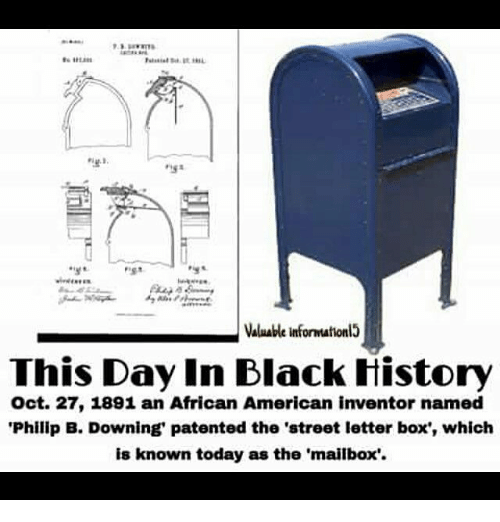
Coming from a family of business owners, it‘s no surprise that Phillip would become an inventor. During the late nineteenth and the early twentieth century, Downing successfully filed five patents with the United States Patent Office. Among his most significant inventions were a street letterbox (U.S. Patent numbers 462,092 and 462,093) and a mechanical device for operating a street railway switches (U.S. Patent number 430,118), which he invented before the predecessor of today‘s mailbox. On June 17, 1890, the U.S. Patent Office approved Downing’s application for “new and useful Improvements in Street-Railway Switches.” His invention allowed the switches to be opened or closed by using a brass arm next to the brake handle on the platform of the car. Then, on October 27, 1891, his two patents for a street letter box also gained approval.

Downing’s design resembled old school mailboxes (see image). A tall metal box with a secure, hinged door to drop letters. Until this point, people wanting to send mail had to travel to the nearest post office. This is how the enslaved “heard it through the grapevine,“ communication started on slave plantations where information passed from person-to-person, by word of mouth. The Black person who was sent to the post office to get the mail would linger long enough to get a drift of the conversation from the group of white people who congregated there. The mail carrier on his way back to the master‘s house would retell the news he heard so that the other slaves knew what was going on in the world. While many records accredit this to the news that came through the telegraph, it actually began before then. The “grape-vine telegraph” (Washington, p. 9) was unofficially invented first as mouth-to-mouth rumors, gossip, and worldly conversations and news of the war from Southern blacks on the plantation.

Knowing this, it is not surprising that a Black man would make these “conversations” easier by inventing a mailbox. To this day the term, “I heard it through the grapevine,” is still a common saying for someone who has heard gossip. The phrase has even been recorded as a song by Gladys Knight & the Pips in 1967 and by Marvin Gaye in 1968.

Before, those wishing to send mail usually had to travel to the post office but Downing’s invention changed that. Instead, the street letter box would allow for drop off near one’s home and easy pickup by a letter carrier. His idea for the hinged opening prevented rain or snow from entering the box and damaging the mail.


Misty Brown, “Ever Wonder,” Afro-American February 6, 1988; Eyvaine Walker, Keeping a Family Legacy Alive: Unforgotten African Americans (Atlanta, GA: Twins Pub, 2011), 316 – 317. “Philip Downing, Boston, Retires After 31 Years Service in Custom House,” The New York Age, April 9, 1927.

Mahoney, E. (2017, October 31) Philip B. Downing (1857-1934). Retrieved from https://www.blackpast.org/african-american-history/downing-philip-b-1857-1934/

Washington, B. (1995). UP From Slavery. Dover Publications Inc. Edition. Original Publisher, Doubleday, Page, circa 1901, NY. Chapter 1: A Slave Among Slaves, p.9

Black History Fun Fact Friday –Black Inventors / Inventions

There’s a funny story behind this post. My stomach was growling and I thought “Hmmm, what if there was a device where you could hook up to your body parts and see what’s going on in there??” Like, say your stomach hurts or you’re hungry or your leg is in pain, you could hook up to some technology screen type deal and see what is causing those changes. OK, you may already know but I mean in a way where you could see it .(medical genuis smarty pants lol) You can go to the doctor and already know what needs to be done. Anywho, that’s when I thought it would be fun to look at some inventors / inventions that we may not have known about.

The Pencil Sharpener


lovesharpener
The Love Sharpener

Also, known as The Love Sharpener, The Pencil Sharpener was patented by a black man named John Lee Love. John did not invent the pencil sharpener* but what he did invent would carry on to the same pencil sharpeners we use today. A carpenter in Fall River, Massachusetts, John invented several devices and in 1897, he patented a portable pencil sharpener known as the “Love Sharpener.” (*The first ever pencil sharpener was patented in France by mathematician Bernard Lassimone in 1828. A decade later another Frenchman, Therry des Estwaux, designed  a conical-shaped device that, when a pencil was inserted and twisted, all sides of the pencil were whittled away at once and make the sharpening process much quicker.).

Heating Furnace — Ventilation System

Alice H. Parker, an African-American woman from Morristown, NJ developed, in 1919, an early concept of the modern home heating system. Her system gave birth to the thermostat and the forced air furnaces in most homes today, replacing what was then the most common method for heating – cutting and burning wood in fireplaces or stoves. Parker’s invention would be better known today as Central Heating.

The Mailbox

What would you know, a black man invented the mailbox. Known as The Street Letter box back then, Philip Downing designed a metal box with four legs which he patented on October 27, 1891. He called his device a street letter box and it is the predecessor of today’s mailbox. (A fellow blogger wrote a post about Downing awhile back. Check it out here!)

The Sanitary Belt, The Walker, The Toilet Tissue Holder

il_fullxfull.317594681
Sanitary Belts

Before pads and tampons menstrual huts were common where women would be separated from communities while on their cycle (known biblically as a time of uncleanliness). Later women began using cloth or rags which is where the term “she’s on the rag” came from. Common forms of protection rabbit skins, rags, menstrual aprons (aprons??) homemade knitted pads and eventually, the sanitary belt. I heard of the sanitary belt from my mom, otherwise I would not have a clue what this is. Mary Beatrice Davidson Kenner, a black woman, had some pretty cool inventions, the Sanitary Belt being one of them. She also invented the walker and toilet tissue holder. Pretty neat. (Ladies, you can learn more about the evolution of the pad HERE.)

Toilet

Thomas Elkins, a black man, invented a lot of things (to include an improved refrigerator). Known then as a Chamber Commode, the modern toilet was patented by Thomas Elkins on January 9, 1872. Elkins’ commode was a combination bureau, mirror, book-rack, washstand, table, easy chair, and chamber stool.  (The flush toilet goes back to the 1500s but the idea failed to catch on until later).

The First “Perm”

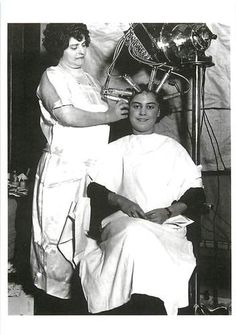
A woman getting a permanent (perm)

Did you know that Perm is short for Permanent? The first concept of the perm was invented by a black woman named Marjorie Joyner. The granddaughter of slave owner and slave, Marjorie developed an invention called “The Permanent Waving Machine” which permed or straightened hair by wrapping it in rods. Later, a black man named Garret Morgan (inventor of the Traffic Signal and Gas Mask) invented our modern version of the perm by accident. In his tailor shop, Garrett was thinking of a solution he could use to polish the needles to a high gloss and stop them from scorching clothes. When Morgan doctored this liquid, he decided to test the effects of the liquid on dog’s hair and saw how the texture had smooth out. Later trying this on human hair, the relaxer was born. Delighted with his success, Morgan coined his hair division the G.A. Morgan Hair Refining Company. This Company was also responsible for the black hair oil dye and the curved tooth iron comb (to be used as a hot comb.)

Blood Bank

Charles R. Drew was an African-American surgeon who pioneered methods of storing blood plasma for transfusion and organized the first large-scale blood bank in the U.S. Ironically, he died due to an accident that blocked blood flow to his heart (there’s a myth that he died at an all-white hospital among whites who refused to operate on him but this story cannot be verified. According to my research, Drew was treated at Alamance General Hospital, a facilities-poor “White” hospital. The White doctors at Alamance began work immediately but Drew’s injuries were so severe and his loss of blood so great that he could not be saved. It is possible that due his prominence he was treated better than most blacks were during the time but further research / insight is needed.)

Feeding Tube

Bessie Blount was a physical therapist who served during WWII. She invented an electrically driven feeding tube device that enabled wounded soldiers to consume a mouthful of food when biting down on a tube. At the time, it was hard to get a patent and she donated this invention to France. In 1951, she received a patent for a modified version from the U.S. called the portable receptacle holder, smaller tube that could be worn around the neck. However, many of Blount’s inventions are not very well known since she signed over her inventions to France.