Unfamiliar Faces – Lost to History: Before Parks

“They said they didn’t want to use a pregnant teenager because it would be controversial and the people would talk about the pregnancy more than the boycott,” Colvin says.

https://www.bbc.com/news/stories-43171799

Was Rosa Parks the only woman to refuse to give up her seat on a segregated bus? Below are a few of the women left out of the history books. 


Irene Morgan – We have all heard of Rosa Parks, but there were at least three women who refused to give up their seats on the bus in the Jim Crow south throughout history. Eleven years before Parks, Irene Morgan, later known as Irene Morgan Kirkaldy, a black woman, was arrested in Middlesex County, Virginia, in 1944 for refusing to give up her seat on an interstate bus according to a state law on segregation. The Irene Morgan Decision inspired the men and women of CORE to create a nationwide protest movement called “The Journey of Reconciliation” when groups of civil rights activists rode buses and trains across states in the South in 1947, a precursor to The Freedom Rides of 1961.

The Irene Morgan v. Commonwealth of Virginia, handed down a landmark decision on June 3, 1946, when they agreed that segregation violated the Constitution’s protection of interstate commerce. Irene Morgan v. Commonwealth catalyzed further court rulings and the Civil Rights movement. Eight years later, the Supreme Court decided in Brown v. Board of Education that segregation violated Equal Rights Protection.

Irene Morgan died on August 10, 2007.

maxresdefault1

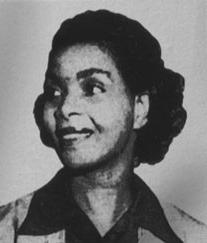
Claudette Colvin – Born on September 5, 1939, in Montgomery, Alabama, Claudette Colvin refused to give up her seat to a white passenger months before Rosa Parks on March 2, 1955. Colvin was only 15 years old but she was poor. She didn’t have the NAACP or the connections Parks had. As a result, little is know of her. The NAACP considered using Claudette but they said she was too young. They also looked away because she was pregnant and they did not want to represent a young, unwed mother and bring about negative attention to the movement. They thought Colvin’s condition would make blacks look bad. Colvin went on to serve as a plaintiff in the landmark legal case Browder v. Gayle, which helped end the practice of segregation on Montgomery public buses. Today, Claudette Colvin is still not a name you hear very often concerning bus desegregation, even though she was there before Parks.

“Whenever people ask me: ‘Why didn’t you get up when the bus driver asked you?’ I say it felt as though Harriet Tubman’s hands were pushing me down on one shoulder and Sojourner Truth’s hands were pushing me down on the other shoulder. I felt inspired by these women because my teacher taught us about them in so much detail,” she says.

8634838_orig

Aurelia Browder – After Colvin, Aurelia Browder followed suit and was arrested on April 19, 1955, for refusing to give up her seat. Browder was born on January 29, 1919. She joined the NAACP, SCLC (Southern Christian Leadership Conference), the Women’s Political Council (WPC), and the Montgomery Improvement Association (MIA). Aurelia could join all the organizations she wanted but with six children and no husband, her refusal to give up her seat on a bus did not stick, even though she was before Parks.

Mary Louise Smith – Mary was born in 1937, in Montgomery, Alabama. She attended and graduated from St. Jude Educational Institute. On October 21, 1955, at the age of 18, Mary was returning home on the Montgomery city bus. At a stop after Mary had boarded and seated, a white passenger boarded. There was no place for the white passenger to sit and Mary was ordered to give up her seat. She refused. Mary was arrested and charged with failure to obey segregation orders and given a nine dollar fine, which her father paid.

Irene, Claudette, Aurelia, and Mary Louise was followed by Susie McDonald, and Jeanetta Reese, all had been arrested and charged with violating various policies regarding segregated seating on city buses.


Discover more Black History Fun Facts and Lost to History Facts HERE.

Tales of African American History Found in DNA

Very interesting article. Check it out:

“The history of African Americans poses special challenges for geneticists. During the slave trade, their ancestors were captured from genetically diverse populations across a portion of West Africa. Adding to the complexity is the fact that living African Americans also may trace some of their ancestry to Europeans and Native Americans.”

Black History Fun Fact Friday – Medical Apartheid

This Week’s episode of Black History Fun Fact Friday is the recommendation of Harriet Washington’s Groundbreaking book Medical Apartheid.

ec2d5b63c1c9fe0a8ec648f7f75c3fd1

Medical Apartheid is about the deliberate infection of people with deadly or debilitating diseases, exposure of people to biological and chemical weapons, human radiation experiments, injection of people with toxic and radioactive chemicals, surgical experiments, interrogation and torture experiments, tests involving mind-altering substances, and a wide variety of others. Medical experiments on children, the sick, mentally disabled individuals, and most especially Blacks, often under the guise of “medical treatment” go back for centuries.


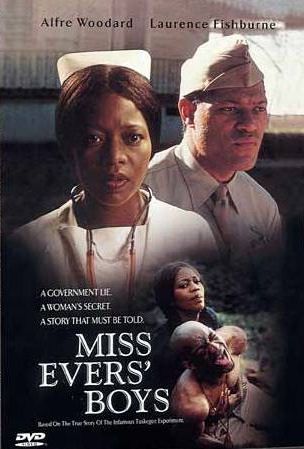
ea_d_38868_0_MissEversBoysOne well-known case of experimentation on Blacks is The Tuskegee Syphilis Experiment, a clinical study conducted between 1932 and 1972 by the U.S. Public Health Service to study the natural progression of untreated syphilis in rural African-American men in Alabama. Mrs. Evers Boys starring Alfred Woodard and Lawrence Fishburne is a movie modeled after this experiment. The men were told that they were receiving free health care from the U.S. government and for forty long years had to tackle the deadly side effects of a disease many of them didn’t know they had. Also, it must be stated that many of these men did not previously have the disease before the experiments began.

The Public Health Service started working on this study in 1932 during the Great Depression, in collaboration with the Tuskegee Institute, a historically black college in Alabama. Investigators enrolled in the study a total of 600 impoverished sharecroppers from Macon County, Alabama. Of these men, 399 had previously contracted syphilis before the study began, and about 201 did not have the disease. Because these men were poor and often had no access to free medical care, the enticing sound of free medical care, meals, and free burial insurance for participating in the study prompted many of the most reluctant to take part. None of the men infected was ever told he had the disease, nor was any treated for it with penicillin after this antibiotic became proven for treatment.

According to the Centers for Disease Control, the men were told they were being treated for “bad blood“, a local term for various illnesses that include syphilis, anemia, and fatigue.

9780385509930_custom-11bb499dd9e2430b63af7a3b00d4cbf9b26dd62c-s6-c30The product of years of research, Medical Apartheid is an excellent book and source of study by Harriet A. Washington on the dark history of medical experimentation on Blacks from the colonial times to the present. She speaks in depth about the history of such organizations as Planned Parenthood and The Negro Project, known previously as The American Birth Control League (whose true purpose was to rid the world of so-called “weak breeds” who were downgrading the American population through a system known as Eugenics), to other frightening tools on unwilling and unknown people.

Throughout the 1840s, J. Marion Sims for example, often referred to as “the father of gynecology”, performed surgical experiments on enslaved African women, without anesthesia. The women—one of whom was operated on 30 times—regularly died from infections resulting from the experiments. In order to test one of his theories about the causes of trismus (locked jaw) in infants, Sims performed experiments where he used a shoemaker’s awl to move around the skull bones of the babies of enslaved women. He also addicted the women in his surgical experiments to morphine, only providing the drugs after surgery was already complete, in order to make them more compliant.

A documentary that is a great compliment to Harriet’s book is called MAAFA, an explosive exposé of the racist eugenics agenda of the abortion industry in the United States. It makes the case that, though abortionists claim to advocate privacy, women’s rights, and reproductive choice, their true motive is racial genocide and ethnic cleansing and goes back for centuries.

MAAFA can be watched for free on YouTube HERE.

Get Medical Apartheid on Amazon HERE.


Publicationbhff

And that’s it for this week’s episode of Black History Fun Facts. Here’s Last Week’s Post in case you missed it:

Week #5: Negro Spirituals

Black History Fun Fact Friday – Timbuktu

2344_1timbuktu_060Timbuktu is a city in the West African nation of Mali, situated north of the River Niger on the southern edge of the Sahara Desert. Founded by nomads, it is most known as “The City of Gold.” While some scholars and proposed travelers attempt to debunk the “myth” (claiming to have reached the city where the homes are made of mud bricks), Timbuktu was one of the most important centers of trade and intellectual life in West Africa, flourishing through participation in long-distance trade networks directed north across the Sahara. The city is known as having traded goods that flowed through the center including salt, ivory, and gold. One of the reasons for Timbuktu’s wealth is the water supply. There are many wells containing sweet water in Timbuktu, where the Niger in flood canals delivers the water to the city. Grain and animals are abundant, so that much milk and butter is consumed.

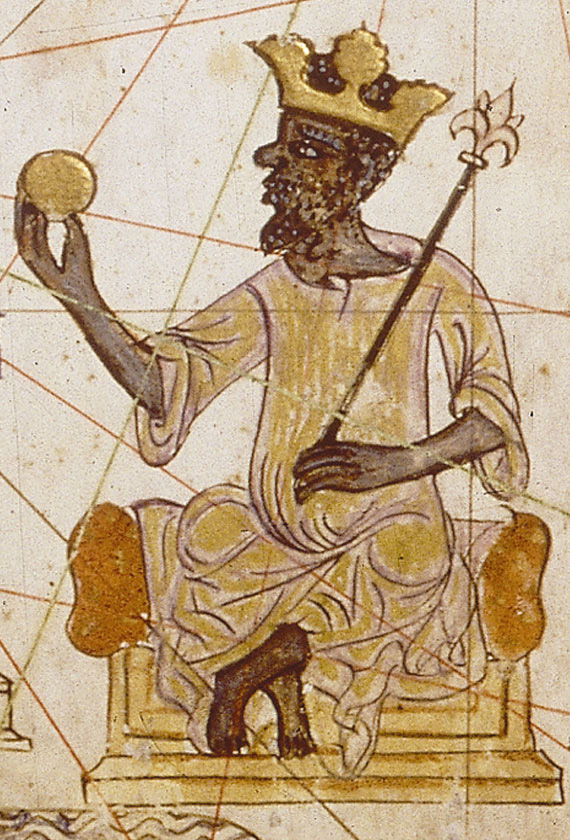
A picture from a medieval atlas, drawn in modern day Spain. It shows the King of Mali, Mansa Musa, who reigned between 1312 and 132, wearing a Gold Crown, Gold Ingot, and Gold Scepter.

During the fourteenth century, the story of Timbuktu as a rich cultural center spread throughout the world. The beginnings of which can be traced to 1324, when the Emperor of Mali made his pilgrimage to Mecca via Cairo. In Cairo, the merchants and traders were impressed by the amount of gold carried by the emperor, who stated that the gold was from Timbuktu. Furthermore, in 1354 the explorer Ibn Batuta wrote of his visit to Timbuktu and told of the wealth and gold of the region. Thus, Timbuktu became renowned as an African El Dorado, a city made of gold.

A great book to read is “From Babylon to Timbuktu” by Rudolph R. Windsor:

61nHWsjEGjL._SY344_BO1,204,203,200_“Until comparatively recent times, knowledge that black Africa was the seat of highly evolved civilizations and cultures during a time when Europe stagnated was limited to a small group of scholars. That great empires, such as Ghana, and later, Mali flourished for centuries while Europe slept through its Dark Ages almost has been ignored by historians. Thousands of years before that, civilization began with the black races of Africa and Asia, including the Hebrews, who were jet black. Because of the scarce literature on the contributions of blacks to world civilization, most people today hold the erroneous opinion that the black races have little real history. It was not known, for instance, that the ancient Hebrews, Mesopotamians, Phoenicians, and Egyptians were black. Now, a growing body of literature is presenting the illustrious history of blacks and their enormous contributions.”

And that’s it for this week’s episode of Black History Fun Facts. Below is last weeks episode in case you missed it:

Publicationbhff


Week #7:

The Immortal Life of Henrietta Lacks


Black American History: Why It Matters

It is no secret. Racial tension in the United States has not dwindled. In fact, not only does racism, discrimination, and police brutality continue today but it does so with just as much vigor as if it had been torn from the pages of the 1940s, 50s, and 60s. It is today’s current events that will add to the history our children will one day read about. However, to understand one’s future one must first understand the past.

I spend a lot of time speaking about ancient black history but the truth is that many of us do not even know our current American history. The past is filled to the brim with African American contributions but our understanding of these endeavors is either unknown or utterly flawed. Uncle Tom was not a sell out, Christianity was not beat into black people, Rosa Parks is not the first person to refuse to give up her seat on a bus, Negro spirituals was not made up babble, and black people did not die for the right to vote (we died for Freedom). These are just a few of the common misconceptions that are not only regurgitated as truth, but even taught in our schools. And it is the inspiration behind why I write black.

Not only is slavery being taken out of school textbooks, but many people have no idea concerning what these times were truly like. Nor can many people name more than a handful of individuals in relation to black history itself. Many African Americans in particular have no idea of their rich and glorious past which started long before slavery. I write these books because we cannot guarantee that our present will preserve the rich legacy concerning the true birth of a nation. Today Martin Luther King Jr. and Rosa Parks are the only names many people know and it is a disservice to the many other influential individuals in the black community. Even so, what happens ten years from now? Will Martin King and Rosa Parks names ring foreign? What would have happened if someone long ago did not write about them? Would we have known? Can we depend on modern society to teach history? What happens ten years from now? Will we understand what slavery was really about? Sharecropping? Tenant Farming? Does the black man and woman know who they were before slavery?

The Stella Trilogy is a series of short stories about one family and their search for identity amidst the African American fight for freedom. These books are my attempt to remind all people of our  forgotten legacy so we never forget what freedom looks like.

Stella: The Road to Freedom – Joseph’s Story (Book 3)
Stella: Beyond The Colored Line (Book 2)
Stella: Between Slavery and Freedom (Book 1)

51PZaD59VsL._SX331_BO1,204,203,200_Featured Image -- 4819

Why I Write Black

two generations

Because flowers grow in strange places

like tattered pieces of wood and recycled paper


Because history is frost bitten

and winter refuses to be comforted by the sun

bluish-white and numbed pain

cold skin

and prickling feeling


Because the sky don’t stay dark forever

but light ain’t taught in history class


Because some skirts

are too heavy

to lift without permission

Because Dust Tracks on The Road

was subtracted 3 chapters

Because some truths

are too big to sacrifice

on American alters


Because Zora died broke

and Nina died sad

Because their voices still sing

Because strange fruit still swings


Because ignorance is worth more than rubies

and diamond gems

Because no one has picked up the pieces

of truth

underneath the ruble

of bombed out churches

on 16th streets

Because little girls ain’t little girls no more

but crushed bones

and melted skin

a strike of disobedience

against premeditated sin


Because hope is stronger than despair

Because freedom is worth more

than all the

raisins in the sun

Silver’s Coming Attractions – “The Road to Freedom: Joseph’s Story (The Stella Trilogy Book 3),” by Yecheilyah Ysrayl

Check out Colleens post of my coming attraction! Coming Soooon.