The internet. We all know it, and in 2024, babies are born with it in their hands.
In today’s world, looking something up on the web is normal behavior, and for some, the first thing they do when they wake up in the morning. Whether you grab your phone or use the computer to log in at work, we don’t go a day without typing something into a search bar or scrolling on social media.
But it was not always this way.
Before anyone ever heard of the internet, its seeds were planted in 1957 in the historical context of the Cold War. In the 1960s, government researchers also used it to share information.
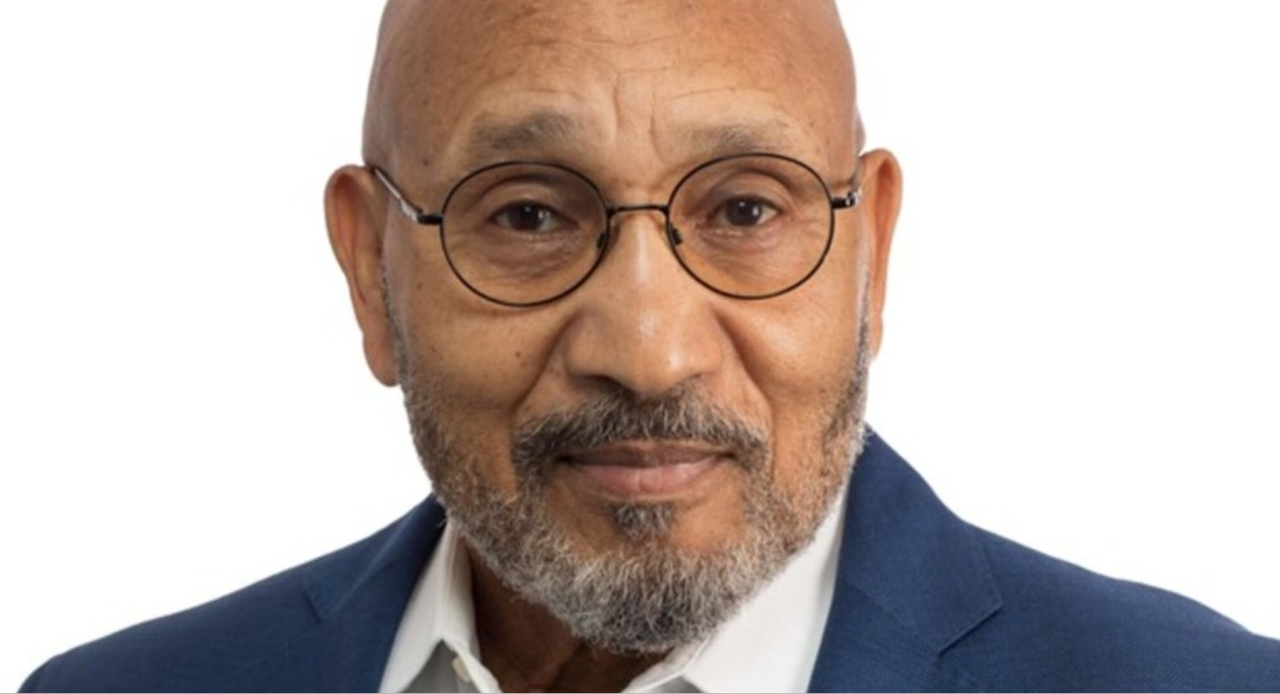
Today, we are learning about the man who created the computer code for .com.
Emmit McHenry was born in Forrest City, Arkansas, in 1943 and was raised in Tulsa, Oklahoma, renowned for being a prosperous Black community. While McHenry came of age years after the Tulsa Race Riot, footage from Pastor Solomon Sir Jones shows that by 1925 and even into the 1940s, Black Wall Street was rebuilt.
Thus, McHenry grew up surrounded by people with a strong sense of community and entrepreneurship.
“It was in a way kind of an extended family and they took pride in your doing well. So if you did well, the teachers really got excited about that and worked with you on it. Yeah, it was a really wonderful experience for me.”
– Emmit McHenry on growing up in Greenwood
The Victory of Greenwood
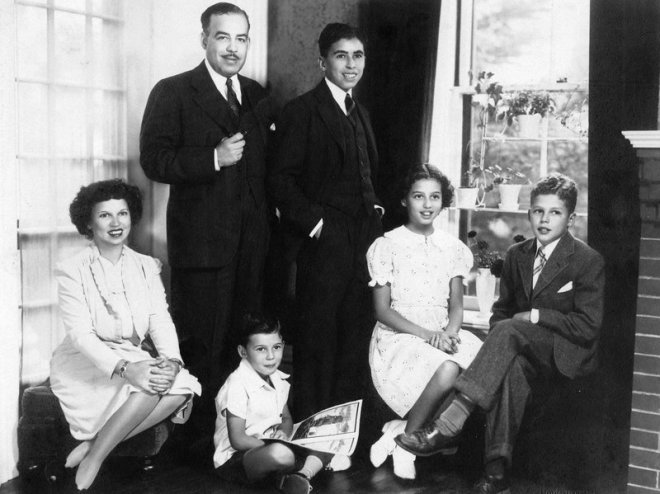
Emmit McHenry
McHenry’s great-grandfather was a carpenter and whiskey still operator by trade. Great-grandmother McHenry was a businesswoman in addition to a farmer. When it came time to bring their crops to market, the Black farmers and sharecroppers in Arkansas knew they could rely on her to negotiate fair rates for them.
Emmit McHenry graduated from Booker T. Washington High School and pursued a Bachelor of Science in Communications from the University of Denver on a wrestling scholarship. He majored in physics, but when he discovered communications, he changed his major. He graduated with a degree in communications in 1966.
McHenry and his partners established the engineering firm Network Solutions in 1979. However, like many other black-owned businesses, they had trouble getting funding. McHenry and his associates maxed out their credit cards and mortgaged their residences. The business prospered. Still, a deal with the National Science Foundation was the diamond in the crown for Network Solutions. The first internet domain name addressing system for the US government was covered under the contract.
That’s when McHenry created a complex computer code that was not complex to ordinary people searching the web. It allowed those of us without communications degrees to understand the internet and send and receive emails without having to study computer science.
We know McHenry’s invention today as .com.
Emmit McHenry’s work paid off on Dec. 31, 1992, when Network Solutions was the only bidder on a National Science Foundation grant to further develop the domain name registration service for the Internet. Network Solutions was granted an exclusive contract as the sole domain name registrar for .com, .net, and .org. These top-level domain (TLD) names continued the work Network Solutions was already doing.
May has always been an exciting month. As a kid, I looked forward to the school year ending and the warm weather welcoming me just in time for my birthday at the end of the month. Summer also means swimming and dancing in the water from the fire hydrant and water guns!
Introducing Lonnie Johnson, the inventor of the super soaker!
Lonnie Johnson was born in Mobile, Alabama, on October 6, 1949. Signs of Lonnie’s brilliance could be seen when he was a child reverse-engineering his sister’s baby doll to understand how the eyes closed. He also built his own go-cart from a lawnmower engine he attached to scraps he found in the junkyard.
Before enlisting in the Air Force, he worked as a research engineer at Oak Ridge National Laboratory. He also worked at the Air Force Weapons Laboratory in Albuquerque, New Mexico, as the acting chief of the Space Nuclear Power Safety Section.
Johnson holds a B.S. degree in Mechanical Engineering, an M.S. degree in Nuclear Engineering, and an honorary Ph.D. in Science from Tuskegee University.
In 1989, Johnson formed his own engineering firm and licensed his most famous invention, the super soaker. It generated over $200 million in retail sales and became thenumber-one-selling toy in America.
Today, Johnson is president and founder of Johnson Research and Development Co., Inc., a technology development company, and its spin-off companies, Excellatron Solid State, LLC; Johnson Electro-Mechanical Systems, LLC; and Johnson Real Estate Investments, LLC.
As of 2023, Lonnie Johnson’s net worth was an estimated $160 million. This substantial fortune is primarily the result of the royalties he received for the Super Soaker, which generated billions of dollars.
So the next time your child plays with a super soaker, be sure they know about its amazing inventor!
Title: Black History Facts You Didn’t Learn in School |Author: Yecheilyah Ysrayl | Publisher: Literary Korner Publishing | Release Date: February 24, 2024 |Cover Art by David Colon | Edited by Writing Endeavors®
It’s been a long time coming!
What started as a profound series on this blog has been transformed into a full-length history book you can carry with you!
Inspired by the Black History Fun Fact Friday series, I am incredibly honored to finally introduce the book version, Black History Facts You Didn’t Learn in School.
My greatest hope is that after reading this book, you are equipped with enough information to spark conversation and, if necessary, participate in your own activism for the continual education and restoration of Black historical truth.
On July 20, 1969, the world watched as America walked on the moon. In Black America, something very different was happening. We were in the middle of the Harlem Cultural Festival, a series of music concerts held in Harlem, Manhattan, and New York City during the summer of 1969 to celebrate black music, culture, and black pride.
Also known as Black Woodstock, it is the subject of the Hulu documentary Summer of Soul, appropriately named and highly recommended. Some call it “The Revolution that Could Not Be Televised,” because the footage has been unseen until now.
Why hide film showing a sea of beautiful black people having fun? Nevermind.
Also, in July of this year, Black America mourned the loss of another Civil Rights Activist. Just fifteen months after the death of Dr. King, we saw the death of his baby brother Rev. A.D. King.
Note:
In this post, I will occasionally refer to Dr. King as Martin to distinguish him from the other King. This informal approach is in no way intended to be disrespectful to either man.
Who Was A.D. King
Alfred Daniel “A.D.” King, the father of Alveda King, was born on July 30, 1930, in Atlanta, Georgia. On June 17, 1950, he married Naomi Barber, with whom he had five children.
Like his brother, A.D. graduated from Morehouse College, but he was less interested in academics. Although he eventually yielded to the calling of a pastor, he initially strongly resisted that as well. A.D.’s grassroots connections would come in handy later in life when he would help to recruit people for Civil Rights Demonstrations.
While Dr. King knew the boardroom and could maneuver his way around intellectuals, A.D. knew the streets (street smart if you will) and was responsible for organizing and strategizing many of the marches King is famous for, becoming known as a master strategist. He had a gift for leading the youth and had his ear to the ground about what the people wanted, and Martin depended on him heavily.
A.D. faced many of the same struggles as Martin and several other civil rights leaders during the 1950s and 60s, including being arrested in an October 1960 lunch counter sit-in in Atlanta. A.D. and his wife also escaped a bombing to their home.*
*Bombings were so often in the black community during that time that Birmingham had been nicknamed Bombmingham.
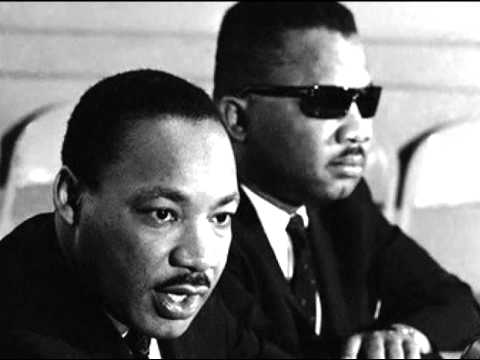
Rev. A.D. and Dr. King did not only look alike, but they also sounded alike and were nicknamed “Sons of Thunder” by King. Sr.
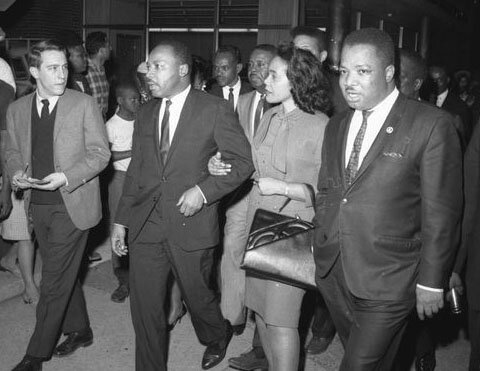
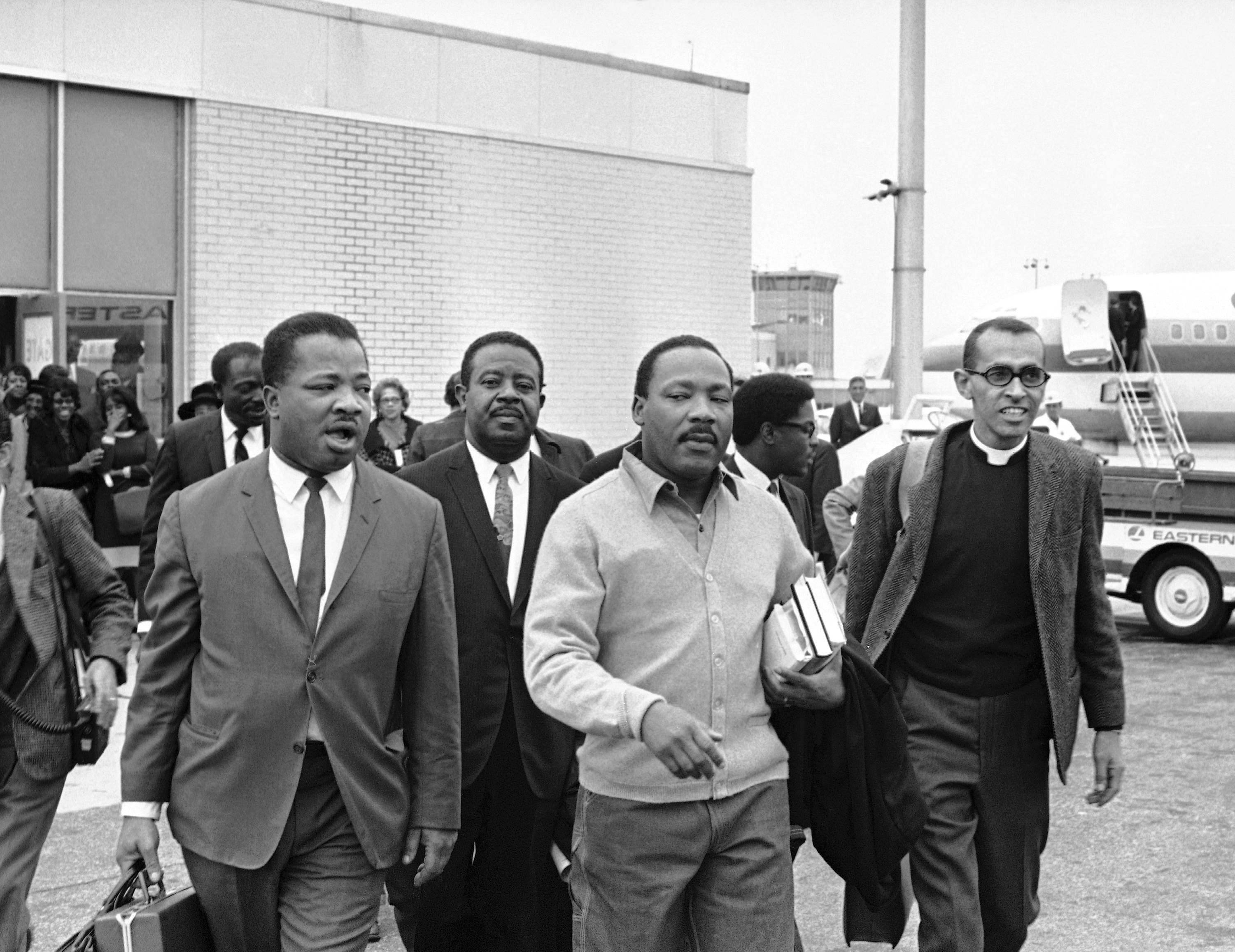
Rev A.D. King, younger brother of Martin Luther King (first from left). Photo: Pinterest
A.D.’s personality is said to have been relaxing with a sense of humor.
Cause why he got them glasses on? Brother did not want the spotlight.
Although his activism mirrored Martin’s, A.D. did not like the limelight and had no intentions of usurping that authority from his brother. Friends and family say A.D. King was humble and was not worried about walking in his brother’s shadow. Instead, he played his part and let Martin play his. A.D. supported his brother one-hundred-percent and was in the middle of every movement:
When Dr. Martin Luther King, Jr., was murdered on April 4, 1968, it hurt A.D. deeply, and he never recovered, as he felt it was his responsibility to protect his brother, A.D.’s widow, Naomi King, once recalled.
On July 21, 1969, at the age of 38, a year and a half after Martin’s death, A.D. mysteriously drowned in the family swimming pool.
It is a mysterious death because A.D. King was a “very good swimmer,” according to his niece, Bernice King, Martin’s daughter. According to Derek King, A.D. King’s son, emergency workers noted there was no water in his lungs. “Ain’t no water in his lungs,” one of them said, “he was dead before he hit the water.”
Why is the legacy of little-known Civil Rights icons like A.D. King important?
I am sure you’ve heard the news.
“The Texas Senate has voted to pass a bill that would remove a requirement for public school teachers to teach that the Ku Klux Klan is “morally wrong.”
“The Texas Senate on Friday passed legislation that would end requirements that public schools include writings on women’s suffrage and the civil rights movement in social studies classes. Among the figures whose works would be dropped: Susan B. Anthony, Cesar Chavez, and Martin Luther King Jr., whose “I Have a Dream” speech and “Letter from a Birmingham Jail” would no longer make the curriculum cut.”
It used to be Dr. Martin Luther King Jr. was the only name we knew and were taught in history class. Now they are doing away with him, too, it seems.
As more is revealed about the truth of who Dr. King was beyond the “I Have A Dream” speech (including that when he was born, Martin Luther King Jr.’s name was Michael…read more about that here), it is no surprise to me that systems are now trying to limit the already limited information we have on him.
Thus, it is also no surprise little is known of his brother, although he was so prominently involved in everything Dr. King stood for. Their mother, Alberta King, was also killed.
There is definitely something strange about this.
Family matriarch Alberta Williams King is flanked by her sons, the Rev. Martin Luther King Jr. on her right and Rev. A.D. King on her left. Isaac Newton Farris, the husband of her daughter, Christine, stands behind them. (AJC file photo) Credit: contributed
Now that you know A.D. King existed, the next time you see a photo of Dr. Martin King, also look for Rev. A.D. King. Chances are he was right there, hiding in plain sight.
“Beginning in about 1890 and continuing until 1968, white Americans established thousands of towns across the United States for whites only. Many towns drove out their black populations, then posted sundown signs.” – James W. Lowen
When I first published this article in 2017, I got much controversy about it. I didn’t take it personally for two reasons. First, very little literature covers sundown towns, and not much is said about it in the limited topics covered during black history month.
The other reason is, although these towns were known as sundown towns, the people of the town did not call it that. It was only a well-known fact that some blacks were not allowed in some towns, and if they visited, they had better leave before the sun sets or risk lynching. Therefore, when I wrote about it, some people thought I was making it up.
Follow me on Instagram @yecheilyah
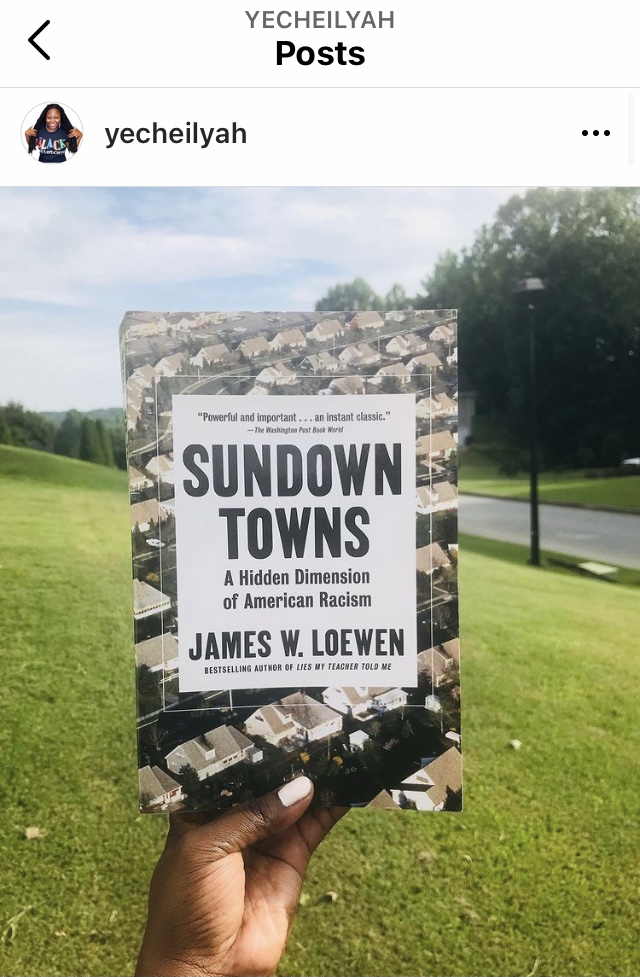
This past week, I posted this image to my Instagram, and I was surprised to see how many more people had not heard of this. For this reason, today, we are revisiting our black history fun fact on sundown towns.
“Is it true that ‘Anna’ stands for ‘Ain’t No Niggers Allowed’?” I asked at the convenience store in Anna, Illinois, where I had stopped to buy coffee. “Yes,” the clerk replied. “That’s sad, isn’t it,” she added, distancing herself from the policy. And she went on to assure me, “That all happened a long time ago.” “I understand [racial exclusion] is still going on?” I asked. “Yes,” she replied. “That’s sad.”—conversation with clerk, Anna, Illinois, October 2001.
Anna, Illinois, was named after the daughter of the town’s founder but got its more derogatory name after the 1909 lynching of a black man in Cairo, IL, and the mob of angry white citizens who drove out Anna’s 40 or so black families following the lynching. It is at this point that Anna, IL became a sundown town.
A sundown town is a town with an exclusive population of non-whites on purpose. They are towns with overwhelming populations of non-whites and are so deliberately. Sundown towns were also known as “Sunset Towns.”
“A sundown town town is an organized jurisdiction that for decades kept African Americans or other groups from living in it and was thus “all-white” on purpose.”
Side Note: In the black community, black kids are constantly warned to “come in the house when the street lights come on,” so many of us had to be in the house before the sunset. I wonder if Sundown Towns had something to do with this. Not to say black parents are the only ones with this command, but it’s food for thought.
Although signs were posted, forced exclusion was also implemented:
“There were also race riots in which white mobs attacked black neighborhoods, burning, looting, and killing. Across America, at least 50 towns, and probably many more than that, drove out their African American populations violently. At least 16 did so in Illinois alone. In the West, another 50 or more towns drove out their Chinese American populations. Many other sundown towns and suburbs used violence to keep out blacks or, sometimes, other minorities.”
– America’s Black Holocaust Museum, James W. Loewen, PhD; Fran Kaplan, EdD; and Robert Smith, PhD
The Beginning
Sundown towns began after slavery and the Civil War when blacks left the plantations and poured into every city and corner of the country. This was followed by the system we know as Jim Crow.
Jim Crow laws were state and local laws that enforced racial segregation in the southern and northern United States to keep blacks in a state of servitude. It included having to look down and step to the side when a white person walked by, drinking from separate water fountains, entering the rear of the bus, sitting in the balcony of the movie theater (which came to be known as “Nigger Heaven,”), attending separate schools, and more.
While Jim Crow and segregation are most notably known as a southern practice (“The Jim Crow South”), it also existed in the north. In fact, many parts of the north were more segregated than the south, and when it comes to Sundown Towns, these communities mainly existed in the north as the Great Migration brought floods of blacks into northern cities. Many suburbs to this day are mostly white because they were either part of redlining -the systematic denial of various services to black residents either explicitly or through the selective raising of prices – or its white residents ran its black residents out of town, and the descendants of those people kept it that way.
I’ll use Chicago as an example, still one of the most segregated cities in America. Yes, I said Chicago. Remember, we started this conversation with Anna (“Ain’t No Negroes Allowed”), Illinois.
From Time .com / Bettmann / Getty Images
Dr. Martin Luther King Jr. visited Chicago in 1966 due to the high poverty rate in black neighborhoods and rented an apartment on the west side. He was there as part of what he would call The Poor People’s Campaign and the Freedom Movement. On August 5, 1966, King led a march through Cicero, an all-white district, and was hit in the head with a rock by members of the angry mob.
Years later (the early 80s), my brother-in-law and his friends would be chased out of this same area, racial slurs hitting their backs as they rode their bikes out of Cicero.
This statue below is of Orville Hubbard, which sits outside of the City Hall in Dearborn, Michigan, was the cause of much controversy when people started to learn more about his past.
Hubbard was the mayor of the then all-white suburban town outside of Detroit from 1942 to 1978 and, in a 1969 speech acquired by the New York Times, said that “If whites didn’t want to live with N–they sure didn’t have to.” He went on to say this was a free country, and this was America.
“City police cars bore the slogan ‘Keep Dearborn Clean,’ which was a catch phrase meaning ‘Keep Dearborn White,’ ” according to David Good, a lifelong resident of the city who is the author of ‘‘Orvie: The Dictator of Dearborn,” a biography of Mayor Hubbard.
“Out here in Dearborn where some real Ku Klux Klans live. I know Dearborn, you know I’m from Detroit, used to live out there in Easten. And you had to go through Dearborn to get to Easten. Just like riding through Mississippi once you got to Dearborn.” – Malcolm X
Over time the name “Sundown-town” faded, but Sundown Suburbs still exist. A sundown suburb is a discrete way in which Sundown-towns live today when large white populations migrate to the suburban part of the city with the express purpose of separating themselves from the minority population. We can see this in our Cicero example.
An Instagram video inspired today’s post, where a group of young black people engaged in a debate about whether light skin blacks are treated better than dark skin blacks. This debate spun out of control and eventually led to a full-blown argument that made it difficult for the viewer to comprehend what each party said. In the young people’s voice was a lot of hurt and pain. The caption on the video read: “Does Light-Skin Privilege Exist in America?”
Not to bestow to Willie Lynch any gift of prophecy, but when he said to “pitch the light-skin slave against the dark-skin slave and the dark-skin slave against the light skin-slave,” it was as if he c-sectioned the calendar and saw color bias in black people’s future.
Even if one does not wholly believe The Willie Lynch Letter is entirely accurate, one cannot ignore the Black community’s divisions based on skin color in a way that is strangely accurate to William’s letter. To add to this, Willie Lynch did not say these divisions will help for a few days, weeks, and months. In 1712, William Lynch said that if implemented “properly,” slave owners could expect these divisions to keep the blacks mentally enslaved and divided for generations.
It is 2021, but skin-tone is still an important physical characteristic among some black people that sometimes cause divisions in the black community. Historically, people immediately noticed a black person’s skin-tone and recognized it as a critical component in joining churches, fraternities and sororities, and other social interactions. Throughout history, variations in skin tone have reflected social status and hierarchies. The most notable social experiment was the paper bag test, used widely among African Americans to determine inclusion in certain activities and groups.
The Brown Paper Bag Test
The Brown Paper Bag Test, known widely as “The Paper bag Test,” was a form of racial discrimination practiced within the African-American community in the 20th century by comparing an individual’s skin tone to a brown color paper bag.
If a person’s skin tone matched or was lighter than the brown bag, they would be more likely to be accepted than a person whose skin tone was darker than the paper bag.
Many famous black clubs and social organizations used this test to determine membership, including churches and employers.
The Lighter the Skin, the Better the Chances
In Spike Lee’s movie, School Daze, two groups of black sorority women are at odds over which group’s hair and skin color are best. In the film, the Gamma Rays had to be “paper bag light.”
The Alpha Kappa Alpha Brown Paper Bag Test
A letter from 1928, written by sophomore Edward H. Taylor, at Howard University discusses the Alpha Kappa Alpha brown paper bag test and colorism. Watch the Yard details the statements made in the student newspaper “The Hilltop.” Watch the Yard said the article:
“accused fraternities of “splitting the various classes into groups of different shades — yellow, brown, and black.” According to Taylor, “The light-skinned students are sought after by the fraternities and sororities, particularly the latter, as members and the dark ones passed by. The darker brown students then form their own cliques while the blacks are left in the cold.”
Jack and Jill Brown Paper Bag Test
Jack and Jill of America was established in 1938 with a mission of “nurturing future African American leaders by strengthening children through leadership development, volunteer service, philanthropic giving, and civic duty.”
But an article from the Pittsburg Courier says Jack and Jill has seen its share of negative press from the Black community over the last 81 years. Similar to African-American sororities and fraternities, in the early years, Jack and Jill had a reputation of only being for elite “light-skinned Blacks”. The article says:
“some Blacks saw it as open only to those who had ‘good hair’ and were able to pass ‘the paper-bag test.’”
Resumes Used to Emphasize “Light Colored”
Nadra Kareen Little from ThoughtCo. discussed colorism in her article about skin tone discrimination. The article said:
“Colorism didn’t disappear after the institution of slavery ended in the U.S. In black America, those with light skin received employment opportunities off-limits to darker-skinned blacks. This is why upper-class families in black society were largely light-skinned.”
Her article mentions a writer Brent Staples who discovered this while searching newspaper archives near the Pennsylvania town where he grew up. She said:
“In the 1940s, he noticed, Black job seekers often identified themselves as light-skinned. Cooks, chauffeurs, and waitresses sometimes listed ‘light colored’ as the primary qualification—ahead of experience, references, and the other important data. They did it to improve their chances and to reassure white employers who…found dark skin unpleasant or believed that their customers would.”
Article from the NY Times that gave an example of a job ad from the 1950s that specifically requested applicants with light-colored skin.
“The owner of Chock full o’ Nuts, a white man named William Black, advertised in the tabloids for ‘light colored counter help.’
Advertising jobs for people with lighter skin or “Eurocentric” features is no longer legal or acceptable when doing business, but research shows that these preferences still play a role in our society. The same NY Times article reported that:
“Researchers tell us that it affects how people vote; who appears in Hollywood movies and television news shows; who gets hired and promoted in corporate America; and even who gets executed for murder.”
“Passing is a deception that enables a person to adopt certain roles or identities from which prevailing social standards would bar him in the absence of his misleading conduct. The classic racial passer in the United States has been the “white Negro:” the individual whose physical appearance allows him to present himself as “white” but whose “black” lineage makes him a Negro according to dominant racial rules.”
– Randall Kennedy, Racial Passing
Racial passing was a common practice among lighter-skinned African Americans and is the focal point of book two of The Stella Trilogy, where Stella changes her name to Sidney McNair, marries a white man, and has biracial children whom she raises as white. This narrative is taken directly from historical accounts of light-skin blacks (mixed or not) passing and living their lives as Europeans.
As a child of a white mother and a light-skinned black man, Gregory Howard Williams was a person who assumed that he was white because his parents pretended to be white. Not until he was ten years old, when his parents divorced, did Williams and his brother learn that they were black.
Dr. Albert Johnston passed in order to practice medicine. After living as leading citizens in Keene, N.H., the Johnstons revealed their true racial identity, and became national news.
Many lighter-skinned blacks pretended or classified themselves as white in the US, which gave them access to the rights and opportunities that other blacks could not enjoy. In the image we see here, Dr. Albert Johnston passed to practice medicine. After living as leading citizens in Keene, N.H., the Johnstons revealed their true racial identity and became national news.
For Stanford historian Allyson Hobbs, a similar situation occurred where she discovered a cousin she had never met. This cousin lived in California as a white woman from her mother’s instruction, who sent her away from Chicago many years ago. The mother thought her daughter would have the best chance of success living as a white woman.
“She was black, but she looked white,” Hobbs said. “And her mother decided it was in her best interest to move far away from Chicago, to Los Angeles, and to assume the life of a white woman.”
This came around and bit the mother when her husband died and her daughter, now fully immersed in her life, said that she would not attend the funeral, saying, “I can’t. I’m a white woman now.”
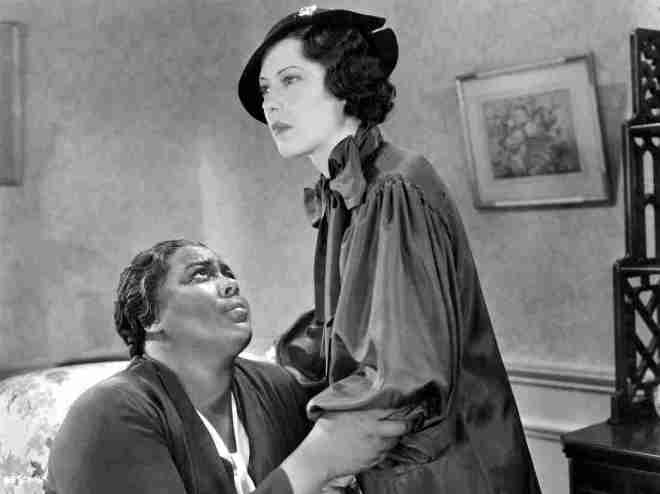
The most famous instance is probably art imitating life in the 1934 film “Imitation of Life,” starring Fredi Washington playing a black woman who passes as white. They made this movie at a time where passing was a widespread practice for fair-skinned blacks. They remade this film in 1959.
Colorism
Colorism is prejudice or discrimination against individuals with a dark skin tone, typically among people of the same ethnic or racial group, where lighter-skin is treated more favorably than darker skin. The brown paper bag test was used to determine who was acceptable and not based on colorism or color bias. When darker-skinned blacks bleach their skins or attempt to look lighter for the special treatment given to lighter skin (such as to join an organization), it is like passing.
While this is fading as dark skin is becoming more and more appreciated, that video of those young people arguing is proof there is still some work to do.
Mixed-Ish
MIXED-ISH – ABC’s “mixed-ish” stars Mykal-Michelle Harris as Santamonica Johnson, Arica Himmel as Bow Johnson, and Ethan Childress as Johan Johnson. (ABC/Mitch Haaseth)
In the latest Mixed-Ish episode, Johan (pronounced Yohan) allowed his peers to think he was Mexican, thus passing for Mexican. Alicia’s sister Denise’s remark that Rainbow’s parents had indirectly caused this by living in a community where race, specifically blackness, was not discussed or considered has some truth to it. People think that by saying, “I don’t see race,” this is a compliment, but it is not. The one who does not see race also does not see racism.
“You all taught that poor boy of being ashamed of being black. You took him to that commune where…nobody talked about race, and that taught him not to be proud of his blackness.”
Why is there truth to this? Because one cannot be proud of what one does not know exists. If Johan does not know what it means to be black and all his people’s rich experiences, how can he see the shame in not telling his peers who he really is? Johan allowed his peers to think he was Mexican because he does not fully understand who he is as a black boy.
[Side Note: Can someone explain to me why they chose The Color Purple as the movie to help a black boy understand blackness? I can think of tons of movies from the 80s that are better suited to teach blackness to black children. The Color Purple ain’t one of them. They could have put on Cornbread, Earl, and Me.]
It turned out the kid who called Johan the racist Mexican slur was also black. This is another example of color bias within the African American community. Now, whether the child understood Johan to be black reflects the school system and the lack of representation of black people and black history. Contrary to the popular myth, not all light-skinned black people are mixed. Blacks produce a variety of skin-tones within the race, but that is a topic for a different day.
All Black is Beautiful
Today, “Blackness” (black skin) is promoted in pop culture. I hate to say it this way, but “dark-skin is in.”
With actresses like Daniel Kaluuya and Lupita Amondi Nyong’o, people once looked down on for being “ugly” for their dark skin tone (“too dark”) are now looked upon as being sexy, beautiful, and exotic. Dark skin is now socially acceptable, highly praised, and elevated, among many now seeing the beauty of brown skin.
While this is not a bad thing, the hope is that it has not become some fad in which dark-skin is fetishized. We would not want a reversal of the paper bag test in which light-skinned blacks are looked down on in the way dark-skinned blacks have always been. Blackness is not a trend that goes in and out of style and should not be treated as such.
The message here should be that all black is beautiful, no matter the shade.
I love entrepreneurship. I talk about it. I live it. I stand behind it. I encourage all people, especially black people, to go on and do it if it is within their means to do so. If you’ve ever had a desire to own your own business, I say to go for it.
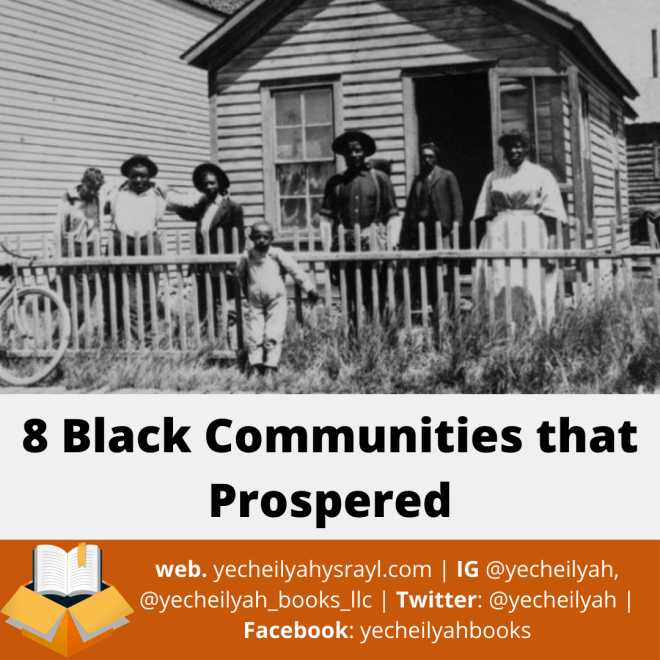
Here are some black-owned communities that prospered to get your blood pumping.
Free Blacks of Israel Hill
This community was the inspiration for the backstory of Renaissance: The Nora White Story. Nora is a descendent of the free blacks of Israel Hill. It is how her father Gideon inherited five acres of land and why, although Nora’s not very impressed, they’re doing well financially compared to those around them. It was during my trip to New Mexico in 2016 while reading Melvin Patrick Ely’s book Israel on The Appomattox, winner of THE BANCROFT PRIZE, A New York Times Book Review, and Atlantic Monthly Editors’ Choice that the first inklings of the back story emerged.
The community was settled in Prince Edward County, Virginia, in 1810-1811 by ninety formerly enslaved persons. These slaves (now freedmen) received freedom and 350 acres from Judith Randolph under the will of her husband, Richard Randolph. These Israelites and other free Blacks worked as farmers, craftspeople, and Appomattox River boatmen. Some labored alongside whites for equal wages, and the family of early settler Hercules White bought and sold real estate in Farmville. Israel Hill remained a vibrant black community into the twentieth century.
Rosewood
The Rosewood community came back into people’s consciousness when John Singleton made a movie for it starring Ving Rhames in 1997. The quiet town prospered in 1870 when a railway depot was set up to transport the abundant red cedar, from which the town got its name, from Rosewood to a pencil factory in cedar key. By 1900 it was predominantly Black with a school, turpentine mill, baseball team, general store, and sugarcane mill. The community had two dozen plank two-story homes, some other small houses, and several small unoccupied plank structures.
Blackdom
There was much revelation during my New Mexico trip. During that time, I learned of Blackdom, another little-known Black community about 18 miles southwest of Roswell, New Mexico, and was founded by Frank and Ella Boyer. Walking 2,000 miles on foot from Georgia to New Mexico, Boyer left his wife and children behind to cultivate land in the West’s free territory before sending his family some three years later. At this time in history, Blacks had begun migrating from the south in significant numbers in a movement called “The Great Exodus” following the Homestead Act of 1862, particularly in Kansas. Henry was a wagoner in the American-Mexican war when he first set eyes on the New Mexico land. The Artesian Water sprang in abundance as more and more blacks were invited and nourished on the land. Blackdom had its own school and post office.
Mound Bayou, MS
The first all-black town in Mississippi, Mound Bayou was founded by two former slaves, Isaiah Montgomery and his cousin, Benjamin Green. In December of 1886, according to a Cleveland Mississippi article of July 1887, Montgomery and Green bought 840 acres of land from the Louisville-New Orleans & Texas Railroad for $7 an acre. That acreage would serve as the site of Mound Bayou.
The men were successful, reaching a population of 4,000 people (99.6 percent black) by 1907. The community had a train depot, a bank, a post office, numerous thriving industries, various stores and eateries, a newspaper, a telephone exchange, and, eventually, a hospital. Mound Bayou was a flourishing community.
Nicodemus Township in Graham County, Kansas
This town was founded in 1877 by seven members, six of whom were Black along the south fork of the Solomon River. Benjamin “Pap” Singleton, a former slave and Underground Railroad conductor, helped produce the “Kansas Fever” of the late 1870s. Tens of thousands of African Americans left their homes headed for Singleton’s Cherokee County colony or Nicodemus, in Graham County, Kansas.
Promoted as the “Promised Land” throughout the south, founders hosted visits by potential settlers. By 1879 the town’s population stood at about 700.
The All-Black Community of Boley, Oklahoma
The all-black community of Boley, OK, was founded in 1904. With Railroad access and land that helped, Boley became one of at least 20 Black towns in Oklahoma to thrive. By 1907, it had at least 1,000 residents, and twice that many farmers settled outside of town. There were several businesses and an industrial school.
Fort, Mose, Florida
Located just north of St. Augustine, Fort Mose was the first free black settlement in what is now the United States. King Charles II of Spain issued what would become one of the first proclamations that any male slave on an English Plantation who escaped to Spanish Florida would be granted freedom if he joined the Militia and converted to catholicism. We see this a lot throughout history. Whether we are talking Catholicism, Islam, or Christianity, none of these religions had anything to do with the black man, woman, and child’s natural Israelite way of life (Muhammad converted blacks to Islam a thousand years before the Europeans came with Christianity.)
In any event, by 1738, there were hundreds of blacks, mostly runaways from the Carolinas, living in what became Fort Mose. They were skilled workers, blacksmiths, carpenters, cattlemen, boatmen, and farmers. They created a colony of freed people with accompanying women and children that ultimately attracted other fugitive slaves.
Black Wall-Street
There were over twenty black communities in Oklahoma.
Greenwood, a neighborhood in North Tulsa, Oklahoma, was one of the most successful and wealthiest black communities in the United States during the early 20th Century. It was popularly known as America’s “Black Wall Street” due to its financial success that mirrored Wall Street. During the oil boom of the 1910s, which gained the town such titles as “Oil Capital of the World”, the area of northeast Oklahoma around Tulsa flourished, including the Greenwood neighborhood. Home to several prominent Black business people, the community held many multimillionaires.
Greenwood had grocery stores, clothing stores, barbershops, banks, hotels, cafes, movie theaters, two newspapers, and many contemporary homes. The dollar circulated thirty-six to one-hundred times, which means that sometimes it took up to a year before the dollar left the community. To put this in perspective: today, the black dollar leave the black community in fifteen minutes.












 The PBS Blog