The reviews are coming in! Here’s what Jeremy had to say!
“This book is full of the kind of history that should be taught in school but instead, is relatively unknown. The author did an outstanding job putting this material together, which took ten years and tons of research. It’s a must-read for anyone who’s into history.
The author focuses on people and groups who have been pivotal in black history. She gives a voice to the marginalized and makes us aware of the contributions of the family of historical figures like Frederick Douglas and Martin Luther King Jr. Each chapter gets the dirt on whitewashed or forgotten pieces of history.
Read this book to learn about the aftermath of the Civil War and how slavery was reconstructed in the form of criminal justice. The book is compelling and hard to put down as you discover a series of horrific truths about history.
This book contributed significantly to my view of American history, as it has put a lot of things in perspective. I see how slavery was reworked into other forms of slavery and evolved in complexity into the Bernaysian economic system based on Freud’s fear of human nature.
Reading this, a lot of light bulbs went off for me. It dawned on me that nothing that ever happened is ever really over, like slavery and public relations. I can’t recommend this book enough!”
Jeremy Lamkin, Amazon Customer Review
Thanks so much Jeremy!
If you read this book, please be sure to leave a review on Amazon and Goodreads! The book is also on Barnes and Noble; reviews are welcome there as well!
Scroll down until you see Review this Product. Click on Write a Customer Review.
Give it the number of stars you think it deserves, and write your review.
Facts to Know:
You don’t have to like a book to review it. All reviews help the author!
If you don’t have the book, it is currently 99 cents for Women’s History Month (all March) and free with Kindle Unlimited. After march, the ebook goes back to its original price of $9.99.
Blog reviews count! Simply link to my blog or let me know you’ve reviewed it and I’ll repost it.
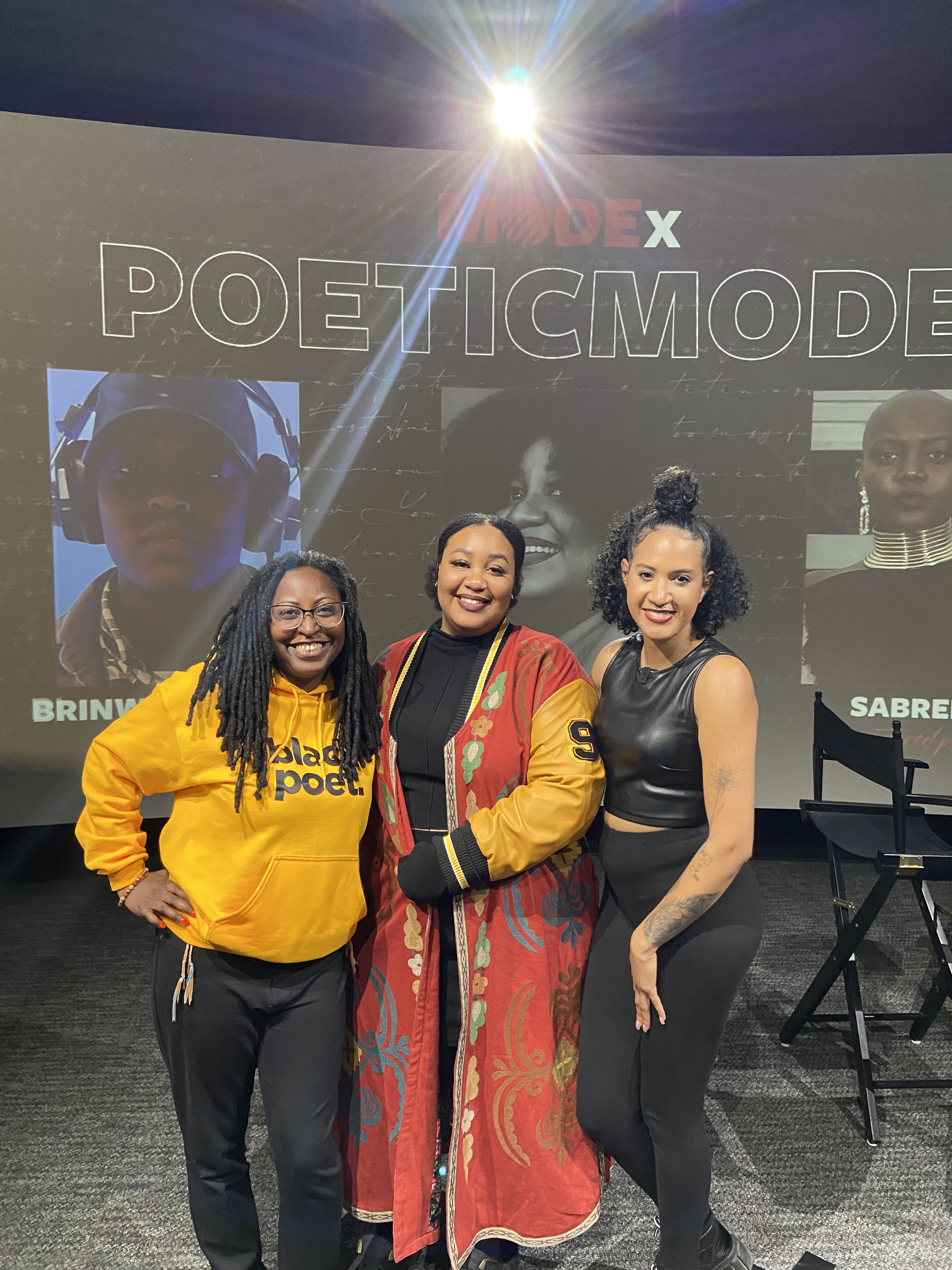
I met up with some amazing poets in Atlanta (there were more of us, but it was late and several poets had already left) for Modex’s first Poetic Mode feature on Wednesday night. There were three open-mic poets, four features, and the host also did a poem.
I was honored to be one of the features. The difference is the featured poets are paid to perform. *Does happy dance.*
The only downside (which is not a downside in the grand scheme of things) is that I felt out of place, considering I have not done much spoken word lately, let alone in Atlanta, so they were talking about stuff I didn’t know anything about, lol. But I listened humbly and vowed I’d get more involved.
At the end of the sessions, there was a panel where we were asked questions so the audience could learn more about us. I liked this part the most because the questions had us thinking deeply and going inward, and I love a good thought-provoking convo.
I wished it had been longer so that more audience members could have asked their questions, but it was at the end and we were tired and hungry from such a long day. We had been there since six, not counting travel time to the venue, which for me meant leaving the house at 4-ish (because I’m an hour away from the city and Atlanta’s traffic is trash), and it was now approaching 10 pm.
Either way, it was nice to meet poets and talk about poetry stuff outside of the internet. I love ya’ll, but talking to people face-to-face was refreshing.
Now, for today’s exciting book news:
As the reviews start to come in, I want to give more of you a chance to get your hands on this book.
In honor of Women’s History Month, the ebook version of Black History Facts is 99 cents for March.
After March, the price will return to $9.99, so don’t wait!
Take this chance to get your copy, and don’t forget to leave a review on Amazon when you are done!
About.
“Black History Facts You Didn’t Learn in School” is a historical guide on Black Americans’ accomplishments, contributions, and struggles. It includes the experiences of Black individuals who have often been marginalized, overlooked, or omitted from mainstream historical accounts.
From the resilience of women like Anna Douglass, first wife of Frederick Douglass, to the many Black communities that prospered, recognizing and celebrating Black history helps to ensure that these stories are acknowledged and that the achievements and resilience of Black people are valued and appreciated.
Here’s what readers have to say:
“The author has taken the time to identify the importance of black individuals that sacrificed and or gone to the extra mile to contribute. Why these people are often forgotten is unfortunately seen on a regular basis. Over time all those forgotten will be highlighted as this book does. An excellent read.”
Louis Glass
“I remember her sharing these facts that were on her blog weekly and I looked forward to them. The fact that she compiled them and expounded on what was there to give you all this black history atlas is a blessing. Not many people are giving you the history that isn’t washed over and dressed up in a new outfit. It’s commendable and appreciative for someone to provide this level of nuggets that are given.”
Natashia Crawford
“This book provides readers with a thorough examination of lesser-known but incredibly significant facets of the black experience, serving as a monument to the richness and diversity of black history. From African ancient civilizations to the American civil rights movement, each chapter reveals a historical jewel that offers priceless insights into the tenacity, inventiveness, and accomplishments of black people across time.”
SLT
“Black History Facts You Didn’t Learn in School!!! Well-researched and thought-provoking book that sheds light on the powerful but often overlooked contributions of Black Americans. Super informative and educational. Highly recommend it!!”
“The enlightening compilation “Black History Facts You Didn’t Learn in School” questions the traditional historical narratives and highlights a multitude of noteworthy occasions, personalities, and movements that are frequently disregarded or sidelined in traditional schooling.
This book provides readers with a thorough examination of lesser-known but incredibly significant facets of the black experience, serving as a monument to the richness and diversity of black history. From African ancient civilizations to the American civil rights movement, each chapter reveals a historical jewel that offers priceless insights into the tenacity, inventiveness, and accomplishments of black people across time.
By emphasizing Black history’s crucial significance in influencing communities and cultures all around the world, it undermines the limited perception of Black history as merely a footnote in the greater story.”
In High School, my history teacher made us watch American History X.
For those who’ve seen it, you know how graphic the movie is. And yet, we sat there, fifteen and sixteen years old, consuming this content with no explanation or breakdown of what we were looking at.
As an adult, I can watch it with new eyes and understand the powerful messages embedded within. But, as a teen, I found the movie disturbing, particularly the part where Derek made that Black man put his mouth on the concrete. It took years for me to get that image out of my head. Even now, if I watch it, I fast-forward past that part. It still disturbs me.
I had never seen anything like that before and was surprised that my white male teacher had allowed us to watch it. Nothing was censored. We saw everything, from the racist violence to the rape in the jail scene. And I had questions no one could answer.
It’s a powerful film with tons of messages about race, racism, and life choices, and it changed me.
I just wish my teacher had given a lesson to accompany it rather than allow us to be babysat by the TV.
This is one of many examples of why I am so adamant about how we present history and teach it. My biggest prayer, and hope, is for the young people coming after me to have a deeper understanding of history in ways I didn’t.
Yecheilyah (e-see-lee-yah) is an Author, Blogger, and Poet of nine published works including her soon-to-be released short inspirational guide “Keep Yourself Full.” Learn more by exploring Yecheilyah’s writing on this blog and her website at yecheilyahysrayl.com. Renaissance: The Nora White Story (Book One) is her latest novel and is available now on Amazon.com.
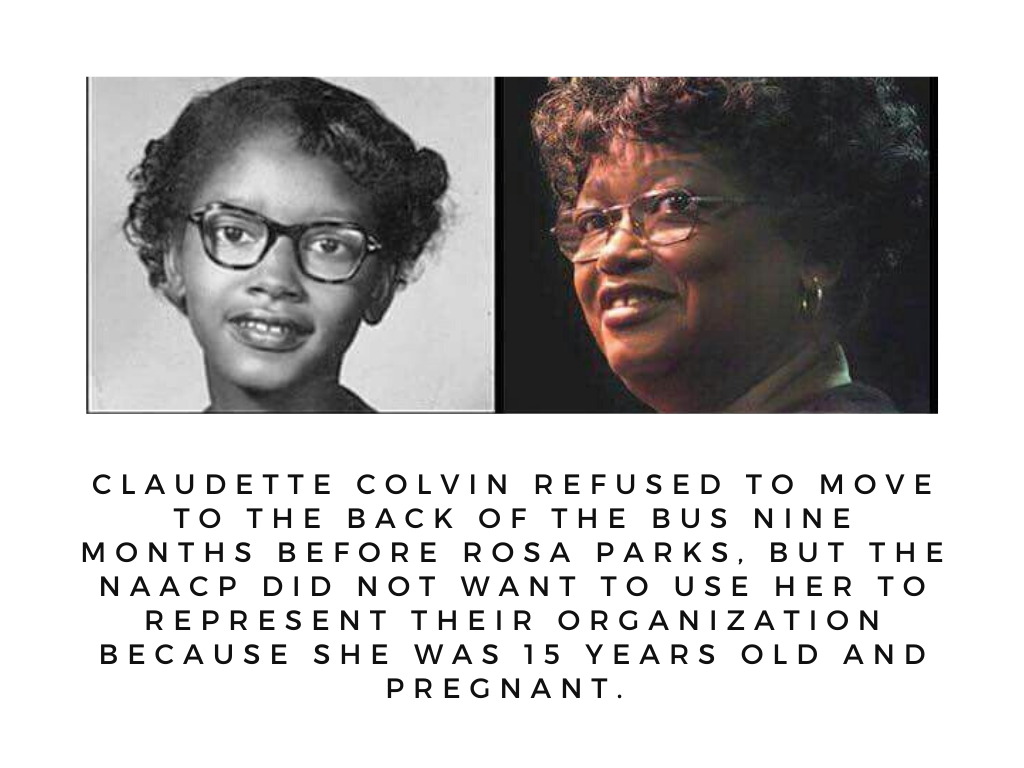
“They said they didn’t want to use a pregnant teenager because it would be controversial and the people would talk about the pregnancy more than the boycott,” Colvin says.
Was Rosa Parks the only woman to refuse to give up her seat on a segregated bus? Below are a few of the women left out of the history books.
Irene Morgan – We have all heard of Rosa Parks, but there were at least three women who refused to give up their seats on the bus in the Jim Crow south throughout history. Eleven years before Parks, Irene Morgan, later known as Irene Morgan Kirkaldy, a black woman, was arrested in Middlesex County, Virginia, in 1944 for refusing to give up her seat on an interstate bus according to a state law on segregation. The Irene Morgan Decision inspired the men and women of CORE to create a nationwide protest movement called “The Journey of Reconciliation” when groups of civil rights activists rode buses and trains across states in the South in 1947, a precursor to The Freedom Rides of 1961.
The Irene Morgan v. Commonwealth of Virginia, handed down a landmark decision on June 3, 1946, when they agreed that segregation violated the Constitution’s protection of interstate commerce. Irene Morgan v. Commonwealth catalyzed further court rulings and the Civil Rights movement. Eight years later, the Supreme Court decided in Brown v. Board of Education that segregation violated Equal Rights Protection.
Irene Morgan died on August 10, 2007.
Claudette Colvin – Born on September 5, 1939, in Montgomery, Alabama, Claudette Colvin refused to give up her seat to a white passenger months before Rosa Parks on March 2, 1955. Colvin was only 15 years old but she was poor. She didn’t have the NAACP or the connections Parks had. As a result, little is know of her. The NAACP considered using Claudette but they said she was too young. They also looked away because she was pregnant and they did not want to represent a young, unwed mother and bring about negative attention to the movement. They thought Colvin’s condition would make blacks look bad. Colvin went on to serve as a plaintiff in the landmark legal case Browder v. Gayle, which helped end the practice of segregation on Montgomery public buses. Today, Claudette Colvin is still not a name you hear very often concerning bus desegregation, even though she was there before Parks.
“Whenever people ask me: ‘Why didn’t you get up when the bus driver asked you?’ I say it felt as though Harriet Tubman’s hands were pushing me down on one shoulder and Sojourner Truth’s hands were pushing me down on the other shoulder. I felt inspired by these women because my teacher taught us about them in so much detail,” she says.
Aurelia Browder – After Colvin, Aurelia Browder followed suit and was arrested on April 19, 1955, for refusing to give up her seat. Browder was born on January 29, 1919. She joined the NAACP, SCLC (Southern Christian Leadership Conference), the Women’s Political Council (WPC), and the Montgomery Improvement Association (MIA). Aurelia could join all the organizations she wanted but with six children and no husband, her refusal to give up her seat on a bus did not stick, even though she was before Parks.
Mary Louise Smith – Mary was born in 1937, in Montgomery, Alabama. She attended and graduated from St. Jude Educational Institute. On October 21, 1955, at the age of 18, Mary was returning home on the Montgomery city bus. At a stop after Mary had boarded and seated, a white passenger boarded. There was no place for the white passenger to sit and Mary was ordered to give up her seat. She refused. Mary was arrested and charged with failure to obey segregation orders and given a nine dollar fine, which her father paid.
Irene, Claudette, Aurelia, and Mary Louise was followed by Susie McDonald, and Jeanetta Reese, all had been arrested and charged with violating various policies regarding segregated seating on city buses.
Discover more Black History Fun Facts and Lost to History FactsHERE.









 The PBS Blog