Yecheilyah’s Book Reviews – The Romeo and Juliet Delusion: Finding Freedom After Trauma by Lori Abbott

Title: The Romeo and Juliet Delusion: Finding Freedom After Trauma

Author: Lori Abbott

Publisher: ‎ Lori Abbott

Published: April 16, 2023

Pages: 125


This is the second memoir I’ve read that grabs your attention from the opening page and delivers an essential message about addiction without holding back.

Lori Abbott is a well-educated attorney with over 15 years of experience in family and criminal law. Yet, she has not discerned that something is off with the guy at the bar. In fact, she finds herself incredibly drawn to him.

Romeo’s energy is electrifying and pulls her in at first glance. Once they start to talk, the attraction is mutual. Though they are each in a relationship now, the chemistry is undeniable.

Abbott and Romeo break it off with their spouses and eventually get together, and that’s when things get weird.

The first red flag was when Romeo invited Lori to his lake cabin in Nisswa, Minnesota, and opened the door using a credit card.

Then, he takes her to a place he said was his house, which looked like a college dorm. She asks about the Harley he said he had, which is nowhere around. Romeo becomes anxious and insists they leave for dinner. Lori complies.

Later, when she asks if they could return to the house, he says they can’t.

Huh?

Abbott catches Romeo in a series of lies but lets it slide, which she later realizes becomes a dangerous pattern.

Romeo loses control and smashes Lori’s car’s radio as the situation worsens. She is then forced to call his mother after he vanishes for several days.

It turns out that Romeo is a meth and heroin addict who is in and out of trouble. He is on child support for his daughter and has a felony case. The lake house was his parent’s year-round lake home, and the house belonged to a roommate who kicked him out. Romeo spends his nights at casinos or crashing on someone’s couch.

And these ain’t spoilers either because chile, things actually get worse.

This book stands out because the author does not shy away from the fact that while Romeo was addicted to drugs, she was addicted to Romeo. Abbott continues to fall for him because he persuades her that he is a victim of his past.

“What I did not realize at the time was that I was already becoming addicted to Romeo—one of the many lessons I have learned the hard way about addiction. I went from stagnation to intoxicating, reckless abandonment in a dangerously short period of time. The dichotomy between those two existences was the greatest rush I had ever felt in my life, and I was hooked.”

-Lori Abbott

The way the author ignored her intuition, knowledge, and awareness to excuse Romeo’s behavior is a warning for all women struggling to leave abusive relationships. Romeo would do the most outlandish things, and Abbott would close her eyes to it because she believed he could change.

“If you do not want to be doing something, but cannot stop doing it, you have a problem. Period.”

-Lori Abbott

This honest, well-written, and vulnerable story is a guide for women overcoming addiction, domestic abuse, and toxic relationships.

Trigger Warning: If you are struggling with similar addictions, be aware the author does not hold back in her descriptions. Proceed with caution. 

IMG-7478

Ratings:

  • Strong Introduction: 4/5
  • Authenticity / Believable: 5/5
  • Organization: 5/5
  • Thought Provoking: 5/5
  • Solid Conclusion: 4/5

Overall: 5/5

Grab Your Copy of The Romeo and Juliet Delusion Here
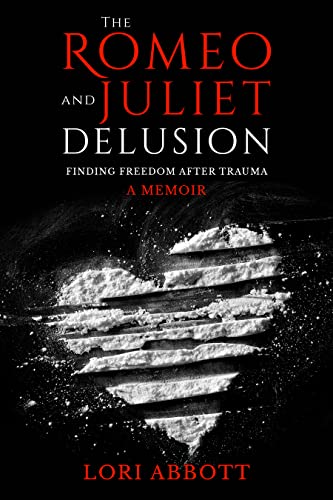
51b+a0zsqEL

The review registry for 2023 is closed. To learn how to have your book reviewed on this blog for 2024, click here.

We have two more books to promote that were registered before the deadline!

Stay tuned for our next dope read!

Yecheilyah’s Book Reviews is a reputable review service that features writers from all over the world, both traditionally and independently published. We are listed on Kindlepreneur as a top-tier book review blog and Reedsy as one of their vetted active book blogs that provide insightful, excellent book reviews.

*Books are read in the order they are received.


4 Lessons I Learned from the Movie American Gangster

CEVWBh1UkAIumVq

American Gangster is based on the true story of real-life drug kingpin Frank Lucas, who, by the 1960s, constructed an international drug ring that spanned from New York to Southeast Asia. The film features Denzel Washington as Lucas and a New York City cop (Russell Crowe) who busted a big-time heroin ring.

I have a love-hate relationship with this movie. I love the many lessons the movie provides but dislike how the message can be perceived. The movie can easily cause young people to admire drug dealing. Frank takes care of his family, runs the show, and even works with the cop to lessen his sentence at the end.

However, if we can get past the drug part, there are many good and bad lessons throughout the film. A young person with the proper guidance can also easily see how this life only leads to one of three places: Death, jail, or that old drunk on the corner at fifty telling the teenagers how you used to run the block as you beg them for some change. There is no in-between. Drug dealers don’t get pensions.

Lesson #1: Influence Can Be Good and Bad

“I want what you got Uncle Frank. I wanna be you.”

In the film, Frank’s nephew, Stevie Lucas, is an excellent baseball player who has played since childhood. Now, at the prominent financial level to do so, Frank schedules a meeting for his nephew Stevie (T.I.) with the Dodgers. This is an amazing opportunity for Stevie to fulfill his dream of playing baseball, but he does not show up for the meeting. Even worse, he doesn’t want to play baseball anymore. Now that he is a part of his Uncle’s multimillion-dollar drug enterprise, he desires to be a drug kingpin just like Frank.

In an age where people can choose to become social media influencers, it often gets underscored that being influential is not only about persuading people to do the right things. Being an influencer can also mean influencing people to do wrong morally or in a way that dramatically changes their lives for the worse. Influence is also not only verbal. You don’t have to say a word to influence someone to do something; your actions alone are enough.

“You know Frank, quitting while you are ahead is not the same as quitting.”

Another example of using influence negatively is Frank moving his entire family to New York to participate in his drug enterprise.

Social influence occurs when someone’s emotions, opinions, or behaviors are affected by others.

Frank played a significant role in his brothers lives. You can tell (at least in the movie) that they looked up to him and already admired him. Frank did not have to travel to North Carolina and recruit them into his drug empire. He already had their love. However, Frank used his influence to charm his country family to come to the city and become part of his drug business, directly or indirectly. Frank is responsible for his part in taking advantage of his brother’s innocence. Even his mother in the film said: “If you were a preacher, they would have all been preachers.” They would have followed their big brother anywhere. We all have people who watch and look up to us, even if we don’t know it. Frank could have used his money to invest in legitimate companies for his brothers, leaving them out of his shenanigans and out of jail.

Lesson #2: Say Less and Follow Your Own Advice

“The loudest one in the room, is the weakest one in the room.”

Nicky Barnes, one of the biggest heroin dealers, was known by the New York Times as “Mister Untouchable” because the cops couldn’t touch him. He was also known for his arrogant demeanor and flashy dress. When Frank’s brother Huey adopts the same colorful look, Frank gives his brother some critical advice: “The loudest one in the room is the weakest one in the room.”

The quote is self-explanatory and goes hand in hand with other quotes like, “The more you talk, the less you know.” It speaks to how, when people talk a lot, it is usually nothing but talk.

However, another lesson the movie shows from the quote is how we should follow our advice. Later in the film, when his wife buys him expensive fur, Frank wears it to the Ali/Fraizer fight, causing him to stick out like a sore thumb among his peers, many of them fellow drug kingpins and some cops.

The same “clown suit” he warned his brother not to wear he was now symbolically wearing with that loud fur coat. It is the same coat that made the police take notice and pay attention to him. From this one mistake, they learned of Frank’s every move.

Lesson #3: Be the CEO of Your Life / The Business Mind

“Nobody owns me though. That’s ’cause I own my own company and my company sells a product that’s better than the competition, at a price that’s lower than the competition.”

We have already established that selling drugs only leads to a future of death and despair, so this point doesn’t justify Lucas’s actions. However, despite the kind of business he ran, people with a business mind can still learn from the movie. You can learn a lesson from anything if you pay enough attention to it.

One of Frank’s many experiences had to do with launching a new product that was cheap but still held quality. In the 1970s, heroin was often diluted with sugars, chalk, flour, or powdered milk to stretch it so addicts understood that the drug would have a lower potency. Frank stepped outside of this established heroin supply chain by cutting out the middleman and not diluting the heroine.

To create his one-of-a-kind product, Frank went directly to the source, a heroin producer in Saigon, Vietnam. In the movie, Frank didn’t dilute his heroin, which made it more potent. He also sold the undiluted, more powerful drug at a lower price.

The lesson is not that you should run your own drug empire. The lesson is that when building a business, you sometimes have to step outside your comfort zone and take risks to reach new levels. It also speaks to the power of authenticity. You don’t have to dilute your self-worth to be accepted. Give people the raw, unadulterated you; it will be more powerful than any filter you could have come up with.

Lesson #4: Not Everything Is As It Seems

Lucas_Brothers

Finally, I learned not to believe everything I see. Upon researching the film, I learned that much of the movie is made up to achieve the dramatic effect that movies do. Denzel is an even more exaggerated version of what the real Frank Lucas was like.

In real life, Frank Lucas was also not Bumpy Johnson’s driver for fifteen years, and he was not with Bumpy when he died. The real Frank also diluted his heroin, though not as much as other dealers. Frank also collected numerous mink and chinchillas aside from the one his wife bought him and was just as flashy as Nicky Barnes. This is partly why undercover cops could catch him with the fur on because he wore them. Denzel Washington’s version in the movie is also much wiser and more strategic than Frank, who is rumored to have been illiterate.

The persona of the cop, Richie Roberts, was also exaggerated in the movie. Roberts did not have a child and was not in a custody battle with his ex-wife. He also had a much smaller role in capturing Frank Lucas.

As I’ve said since starting this post, selling drugs is never something to aspire to, and the lessons I learned in the movie should not be perceived as implying that I advocate selling drugs. This last lesson proves that what young people see on TV is not always true. People are looking up to a Frank Lucas who did not exist in the same way he is portrayed on film.

The movie’s role is to entertain, even if that means embellishing a character’s role. If you are a young person reading this, don’t believe everything you see. Even salt looks like sugar, and spoiled milk is still white.

Do Black Lives Really Matter

Abortion is the number one killer of black lives in America. It has killed more Black lives than AIDS, Cancer, Sexually Transmitted Diseases, and even the entire Vietnam War, but no one speaks out about this. Alcoholism, drug addiction, child abuse, and molestation plague the Black community, but no one speaks out about this. 70% of African American women are single, and 42% have never married. This means 70% of African American women are left alone and unprotected, and 70% of Black children grow up without fathers. Contrary to popular belief, fathers provide more to the household than just money. They provide financial stability, yes, but also protection, leadership, and guidance for our children.

In fact, the state of the black man and woman relationship is worse today than it was over 50 years ago (and even during slavery. We were more communal as a people during slavery than we are today). In the 1960s, 40% of Blacks had their own businesses and 87% of black families were two-parent. Today, less than 7% of blacks own their own business and only 25% of black families are two-parent. But, no one talks about this. However, African Americans have been told over and over again what the problems are so this post is really not about that. This is not just about Slavery, Jim Crow, and Discrimination. This is about the revolution of self.

The African American community is in a state of spiritual crisis. As a community of people, we continue to fight for change that never comes. We continue to vote in an attempt to change our political clout. We continue to march, speak, and debate about the many changes necessary in this world, from education to discrimination and from discrimination to gender equality. But while we seek to change everything around us, we have yet to seek to change ourselves. We know what our problems are, but what we need at this point are solutions. Solutions that are deeper than government-funded organizations, protest marches, and ballot boxes. People cannot change anything around them if they cannot first change what is inside them, no matter their color.

In the words of the African Proverb, “When there is no enemy within, the enemy outside cannot hurt you.” Freedom is deeper than social economics. Freedom is spiritual and spiritual freedom begins inside the individual. To change the way that we live, we must first change the way that we think. Otherwise, if we continue to depend on outside sources to change our current conditions, we will be marching for the next 50 years while our sons’ blood cries out to us from the ground.

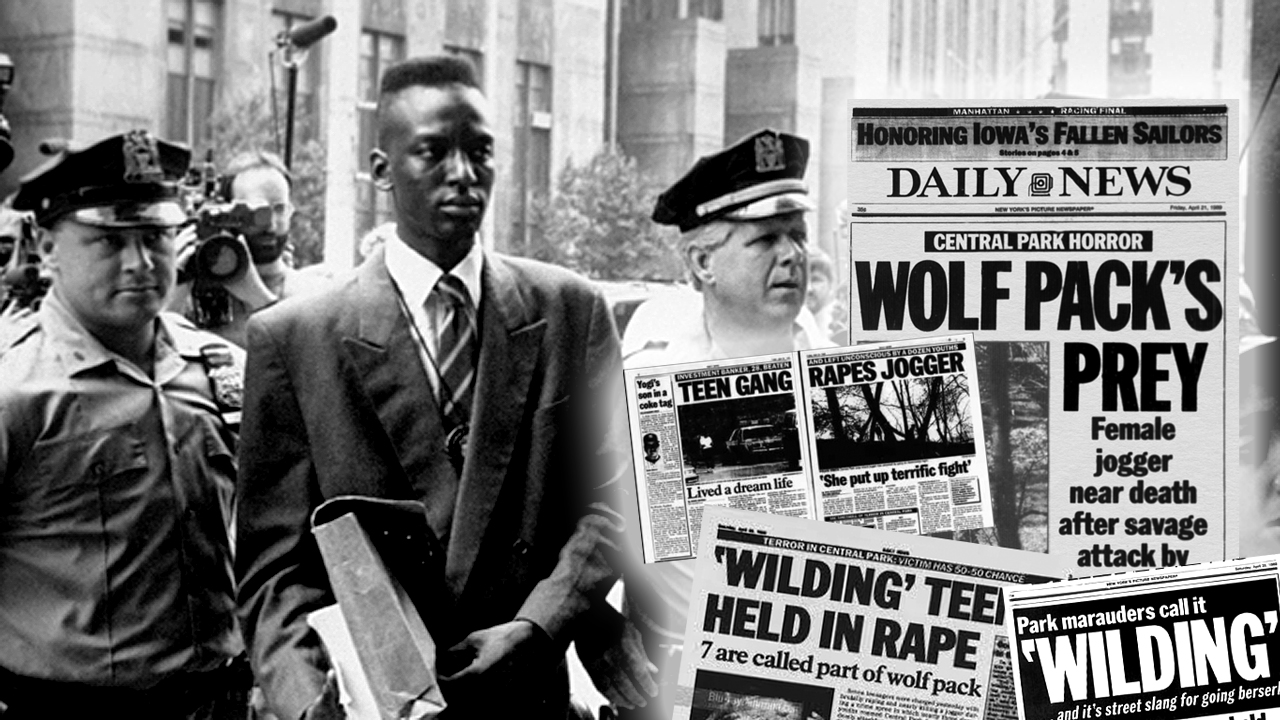
The Central Park Five

Central Park Five

I was only two years old in 1989 so I obviously was not aware of these men when the story first broke. In 2002, when the man who committed the crime stepped forward and these men were officially declared innocent, you can still say that I was a baby being only 15 years old. As I think about my life and the things I was doing then, graduating Middle School and entering High School, I cannot help but to think about these men who, at 15, was on their way to jail.

You can say that they were doomed from the beginning. Let’s set the scene. In 1989, big cities like Chicago and New York City was overflowing with crack addiction within the black community.

“Crack popped up in Miami and Los Angeles in the 1970s. The Drug Enforcement Agency didn’t pay it much mind then. It was nothing more than a different version of cocaine, the agency figured. Crack arrived in New York City in the early 1980s before most of the public had heard anything about it. The department was understaffed. Budget cuts from the 1970s, when the city was almost bankrupt, had forced the NYPD to lay off nearly a third of its officers from 1975 to 1982. Meanwhile, crack began its spread across New York. It was cheaper than cocaine. Anybody could afford it, and anybody could sell it — anybody could buy a gram of coke, chop it up, cook it, and flip it for double the money. So now, all of a sudden, you have got a product that is saleable to a mass new audience,” Robert Strutman, a former New York city D.E.A. agent, told PBS Frontline in 2000. “And that is what the New York drug peddlers did. They mass-merchandized cocaine.” The media world first noticed crack in 1984, when the Los Angeles Times reported that “cocaine sales explode with $25 rocks.” According to a 1999 paper in Columbia University’s Souls journal, reporters began using the word “crack” in 1985. The earliest instance was a November 1985 story in the New York Times: “new form of cocaine, known as crack, was for sale in New York City.” By 1986, crack was available in 28 states. Newsweek called the drug’s impact a “national crisis.”

Source:

-The Voice, http://www.villagevoice.com/news/cheaper-more-addictive-and-highly-profitable-how-crack-took-over-nyc-in-the-80s-6664480

You can be sure that this was by no accident. The media practically advertised crack cocaine. Crack destroyed the Black community like no other weapon could. I speak not from a Google search or a spectator of the news, I speak from experience. I watched the drug take over the minds and bodies of those close to me. As a 90s kid, with crack being born in the 80’s, by the time I was growing up it was at its peak and those addicted were completely strung out. You see, it was cheaper than other drugs. This meant that everyone, including parents became junkies. No, not just parents, children.

This created gangs, drug dealers, and naturally, much violence. Because the victims of crack are African American in the majority, almost all crimes are presumed to be related, in some way, to blacks in the inner cities with an emphasis on  males. So when a group of young men go to Central Park New York to hang out and witness numerous attacks that lead them to head home for curfew around the same time a young white woman (28yrs) is raped and beaten beyond recognition, it is no secret why police decide to bring these men in for questioning. Besides, it is a trend that has existed for centuries. Had this been 1929 instead of 1989, these men would not have had the “privilege” of an arrest, they would have just been hung from the nearest tree.

“Isa 42:22 But this is a people robbed and spoiled; they are all of them snared in holes, and they are hid in prison houses: they are for a prey, and none delivereth; for a spoil, and none saith, Restore.”

Falsely Convicted

On April 19, 1989, five young men, ages 14 – 16 were recorded on video confessing to attacking, raping, and almost killing Central Park jogger Trisha Meili. In two separate trials, five young men were coerced into video taped and written confessions that sent them to prison. Still, after the confession, all of the young men pleaded not guilty and claimed that their videotaped confessions were concocted by the cops.

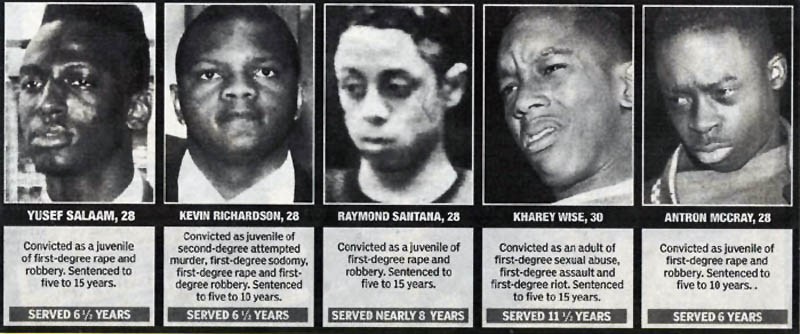
The story of the crime, as told by the police and prosecutors, was that a group of young people, were “wilding” through Central Park and after harassing a few other people, eventually led to the beating and sexual assault of the woman jogger. The story quickly exploded into the public eye, and I am sure those of you older than me remember the story. Because of the taped confessions, the jury ruled the young men guilt in two separate trials in 1990. Antron McCray, Kevin Richardson, Raymond Santana, Yusef Salaam, and Korey Wise served sentences ranging from five to thirteen years.

Korey, the oldest of the group, got the most time and was still enduring his sentence when he got into a confrontation with a man named Matias Reyes at the prison where they were both serving sentences. The confrontation was over something simple but Reyes apology had a far deeper meaning. Korey, presuming it was because of their jailhouse brawl, dismissed the man’s apology.

On August 12, 2001, just months after the only DNA collected at the crime scene, which was never tied to any of the accused, was matched, Korey got out of prison. Matias Reyes had committed to the crime that sent these young men to prison. In 2002, one year later, the young men were exonerated. However, their innocence did not ring as loudly as their assumed guilt.

Adult Central Park 5
The Central Park Five as Adults

In 2012, a documentary was premiered of this case titled “The Central Park Five”. For those of you on Netflix, you should find it there. Otherwise, I highly recommend you activate your Google skills and find it. It is a story far too familiar and is well worth the watch.