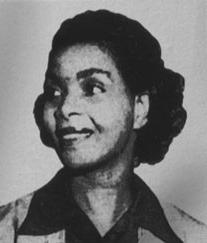
Black History Fun Fact Friday – Dr. Sonnie Wellington Hereford III

Its late but Friday is not over people! Well, not for some of us anyway so we’re going to squeeze this article on in.

Today, we have a special fun fact for you. My maiden name is Hereford and I have a mother, brother, and sisters who still carry this last name. In fact, I’ve met very few people with this name I was not related to. Unlike Johnson, Brown or Jackson (no shade to those with these last names), Hereford is not as common. So when I came across this man online, I was noticeably interested. My mother says that my grandfather, her father, is from Alabama and that Sonnie looks like her dad. This has prompted me to do more research on the man and to plan a visit to Alabama to discover more. It’s possible we had a Civil Rights Activist in the family and didn’t know it. In 1961, Hereford was one of the plaintiffs suing the Huntsville school system to end segregation, and in 1963, his son, Sonnie Hereford IV, was one of the first four black children to enroll in a previously all-white public school in Alabama. But, let’s start from the beginning.

herefords_then_and_now2

Dr. Sonnie Wellington Hereford III was born on January 7, 1931, in Huntsville, Alabama. The family had no running water or electricity and Sonnie had to walk seven miles to school. The school, next to a garbage dump, didn’t have a library or cafeteria, much like most black schools at the time. Hereford was a farmer but developed a love for education. Even though his school had no library, the teachers were invested in him as they were in all their students. Though lacking in resources, black schooling at the time was exceptional, involving a strong community spirit and discipline. Teachers took on more than just a role as a teacher but they were also mothers, fathers, and mentors. For this, Sonnie received a good education and decided he wanted to become a doctor.

Sonnie graduated first in his class and applied to the University of Alabama for their pre-med program. However, Sonnie’s application was denied because of his color so he enrolled at Alabama A&M University instead. Hereford graduated from A&M in 2 years and went on to receive his medical degree from Meharry Medical College. He began his career at Huntsville Hospital in Huntsville Alabama and went on to play important roles in the struggle for Civil Rights. Not only was he a doctor but he also helped to aid men and women attacked during the Selma to Montgomery march, welcomed Martin Luther King Jr., to the city in 1962 and helped to integrate the city at various establishments. In fact, school desegregation is what Sonnie became most known for.

Sonnie IV was among four children chosen to desegregate schooling in Alabama and on September 3, 1963, Hereford took his six-year-old son to school but they could not get in. Instead, a mob waited for them and none of the other children were admitted to the other schools either. Sonnie didn’t give up, he returned but the school was locked down and guarded every day with armed troops. Eventually, Hereford contacted the federal judge and over time an order was issued to desegregate the schools in Huntsville. On Monday, September 9, 1963, Hereford successfully enrolled his son at Fifth Avenue School making Sonnie Hereford IV the first African-American student admitted to a previously all-white public school in Alabama. That following week, Sunday, September 15, the church bombing occurred in Birmingham killing four little girls at the 16th Street Baptist Church.

Sonnie Hereford continued to go on to inspire change and even co-authored a book, Beside the Troubled Waters: A Black Doctor Remembers Life, Medicine, and Civil Rights in an Alabama Town.

Sonnie died at 85 years old, two weeks before the ribbon cutting ceremony at the Sonnie Hereford Elementary School in Huntsville Alabama, named for him by the Huntsville board of education. The school ranges from Pre-K to sixth grade.

Screenshot (77)

Learn more about Sonnie at the informative video below!

https://www.facebook.com/drsonniehereford/

Huntsville Revisited – Dr. Sonnie Wellington Hereford III

Hundreds attend funeral for Dr. Sonnie Hereford III, Huntsville civil rights pioneer

Huntsville City Schools breaks ground on new Sonnie Hereford Elementary
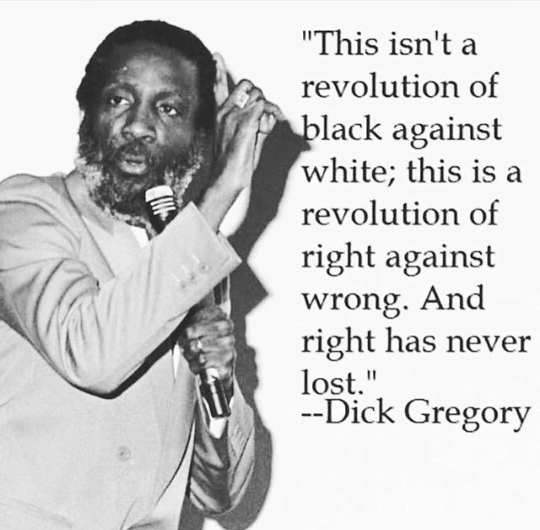
 

My Favorite Dick Gregory Quotes

Dick Gregory, October 12, 1932 – August 19, 2017

“If everyone likes you, your not real enough.”

“This isn’t a revolution of Black against White. This is a revolution of right against wrong and right has always won.”

“They act like America was good and got bad. America ain’t never been good!”

“If they took all the drugs, nicotine, alcohol and caffeine off the market for six days, they’d have to bring out the tanks to control you.”

“Momma, a welfare cheater. A criminal who couldn’t stand to see her kids go hungry, or grow up in slumbs and end up mugging people in dar corners. I guess the system didn’t want her to get off relief, the way it kept sending social workers around to be sure Momma wasn’t trying to make things better.”

“I waited at the counter of a white restaurant for eleven years. When they finally integrated, they didn’t have what I wanted.”

“Poor is a state of mind you never grow out of, but being broke is just a temporary condition.”

“The most difficult thing to get people to do is to accept the obvious.”

“Education means to bring out wisdom. Indoctrination means to push in knowledge.”

“My belief is, you know, certain things have to be explained that’s never been explained.”

“A free man is a man with no fears.”

Black History Fun Fact Friday – Historic Rivals: W.E.B. Dubois vs. Booker T. Washington

Today, I thought I’ll do something fun. I would like to do a few of these so let’s call this part one. Let’s see who was at war and why. Of course, we have to start with the famous rivalry of all time:

W.E.B. Dubois vs. Booker T. Washington

Yecheilyah sits in a chair with papers as W.E.B. Dubois and Booker T. Washington step into the ring. Dubois adjusts his tie, shaking hands with members of the NAACP (National Association for the Advancement of Colored People….am I the only one who finds it odd this organization still refers to us as Colored people?? Deuteronomy 28:37…anyway, as usual, I digress lol).

Washington sits in a chair. Surrounded by students, he crosses his legs and flips through a book.

“Ya know,” Washington looks up, “I’ve read The Souls of Black Folk. I must say I am not very impressed.”

Dubois brushes lint from his jacket, “I didn’t think you would be.”

EC: *Clears throat*. Alright gentlemen. We’re about to start.

NAACP members and students step down from the ring and sits in the audience with those reading this blog.

Washington puts his book to the side. “Noted”, he said staring at Dubois. “Besides, I must say Yecheilyah, I love what you’re doing with your work. It is my belief that we should be accountable for ourselves in every way.

EC: “Than…”

“Booker, your proposal”, interrupted Dubois, “that we should take accountability for ourselves is not only unfounded but also paradoxical. It would be difficult for Negros to gain any real power, for instance, if they are denied the right to vote.”

Washington put up a hand, “IF, Negros had real power, it would be in education in the crafts, industrial and farming skills and ownership of their own businesses.”

“And how, Mr. Washington, do you suppose Negros could operate these businesses sufficiently without an education?”

Washington sighs, “I do not care to venture here an opinion about the nature of knowledge. It is clear to anyone who reflects on the matter that the only kind of knowledge that has any sort of value for a race is knowledge that has some definite relation to the daily lives of the men and women who are seeking it.”

Dubois throws his hands into the air, “You’re promoting submissiveness by asking the Negro to relinquish fundamental privileges. First, you ask him to relinquish his political rights and then his civil rights. This only speeds up the process to which Negros have regressed.”

Washington stands, pointing his finger at Dubois “You’re taking my words out of context. I am simply stating that it is my aim to teach students to live a life and make a living by which after they graduate they can return to their homes and find profit and satisfaction in building up the communities from which they’ve come.”

EC: Gentlemen, please. We don’t have time for this. I respectfully ask for you to both be silent so that we can give the people a little bit of a background on you. Is that alright?

NAACP member runs up to ring, hands Dubois a drink of water as he loosens his collar and takes a drink. Member returns to his seat among the bloggers, “I concur. Let’s move on”, said Dubois.

Washington returns to his seat, crosses his legs, “Indeed.”

As you can see, these two were not besties. Tensions always existed among Black intellectuals and Blacks who were more grassroots and this separation exists today. W.E.B. Dubois and Booker T. Washington are great examples of this.

William Edward Burghardt DuBois was born free in 1868 in Great Barrington, Massachusetts in an integrated community. He attended local schools and excelled in his studies. When Dubois finally encountered racism, the experience changed him and he decided to further his education with a focus on equal rights for Black Americans. Dubois was the first Black man to earn his Ph.D. from Harvard in 1895.

Cheers erupt from members of the NAACP. Dubois takes a bow.

Booker T. Washington was born into slavery in 1856 in Virginia. After the Civil War, he worked in a salt mine and as a domestic for a white family and eventually attended Hampton Institute, one of the first all-black schools in America. After completing his education, Washington began teaching and in 1881 was selected to head The Tuskegee Normal and Industrial Institute in Alabama. The school’s purpose was to give African Americans practical, hands-on skills and would later be known as Tuskegee University.

Whistles come from Washington’s students. He waves.

Dubois wanted to focus on creating an educated black intellectual class he called The Talented Tenth, in which ten percent of the intelligent of the race would lead and guide the direction of the other ninety percent.

Dubois: That is right. Political power and sovereignty should remain important.

*Washington rolls eyes*

Washington on the other hand, born into slavery, thought former slaves and their descendants should be financially independent and that black communities could prosper only by way of owning their own businesses.

Washington: Indeed. Blacks should elevate themselves through hard work and material prosperity.

*Dubois coughs*

Both sought to advance the plight of African Americans and by the early 20th century both Washington and Dubois were two of the most influential Black men in the country. However, their ideologies were very different. Dubois was more focused on education and civil rights as the only way to achieve equality. Washington was more grassroots and focused on fundraising for the Institute and teaching young people how to work with their hands, farm, and entrepreneurship. Dubois and Washington’s differences came to a head in 1903…

Washington: How do you young people say it now? ‘Bring that up.’

Dubois: Let’s hear the entirety of the matter first.

EC: Umm. If I can just finish this real quick. I’m almost done.

Washington: May I ask a question?

EC: Sure, of course.

Washington: What is a Bestie?

EC: Its just short for like Best Friends.

Washington: I see. And I assume one would have to be friends first before they are best friends. Am I correct in this assumption?

Dubois: You are taking up all the time.

EC: We do need to move on but I’d love to explain it to you later.

Washington: I would like that.

*Dubois shakes his head*

The men go silent. Smiles and waves at readers.

Dubois and Washington’s differences came to a head in 1903 when Dubois published The Souls of Black Folk where he directly criticized Washington and his approach.

EC: That’s a little below the belt, don’t you think?

Dubois: Well, Negros should stand up against Washington’s contentions.

EC: Dang.

Washington: I am not going to justify that with a response.

Dubois: Then don’t respond.

Washington: Do not tempt me, Mr. Dubois.

EC: Well, that’s our time. Gentlemen, thank you, both for taking the time out of your super busy schedules to have this discussion. I know you have lives to save. Literally. I do hope you can find some common ground.

Washington: I doubt it.


In the end, Dubois and Washington did agree on something. Though they had two different ways of going about it, they each thought education was important to advancing ones life.

Stay tuned for our next rivals!

Unfamiliar Faces – Lost to History: Before Parks

“They said they didn’t want to use a pregnant teenager because it would be controversial and the people would talk about the pregnancy more than the boycott,” Colvin says.

https://www.bbc.com/news/stories-43171799

Was Rosa Parks the only woman to refuse to give up her seat on a segregated bus? Below are a few of the women left out of the history books. 


Irene Morgan – We have all heard of Rosa Parks, but there were at least three women who refused to give up their seats on the bus in the Jim Crow south throughout history. Eleven years before Parks, Irene Morgan, later known as Irene Morgan Kirkaldy, a black woman, was arrested in Middlesex County, Virginia, in 1944 for refusing to give up her seat on an interstate bus according to a state law on segregation. The Irene Morgan Decision inspired the men and women of CORE to create a nationwide protest movement called “The Journey of Reconciliation” when groups of civil rights activists rode buses and trains across states in the South in 1947, a precursor to The Freedom Rides of 1961.

The Irene Morgan v. Commonwealth of Virginia, handed down a landmark decision on June 3, 1946, when they agreed that segregation violated the Constitution’s protection of interstate commerce. Irene Morgan v. Commonwealth catalyzed further court rulings and the Civil Rights movement. Eight years later, the Supreme Court decided in Brown v. Board of Education that segregation violated Equal Rights Protection.

Irene Morgan died on August 10, 2007.

maxresdefault1

Claudette Colvin – Born on September 5, 1939, in Montgomery, Alabama, Claudette Colvin refused to give up her seat to a white passenger months before Rosa Parks on March 2, 1955. Colvin was only 15 years old but she was poor. She didn’t have the NAACP or the connections Parks had. As a result, little is know of her. The NAACP considered using Claudette but they said she was too young. They also looked away because she was pregnant and they did not want to represent a young, unwed mother and bring about negative attention to the movement. They thought Colvin’s condition would make blacks look bad. Colvin went on to serve as a plaintiff in the landmark legal case Browder v. Gayle, which helped end the practice of segregation on Montgomery public buses. Today, Claudette Colvin is still not a name you hear very often concerning bus desegregation, even though she was there before Parks.

“Whenever people ask me: ‘Why didn’t you get up when the bus driver asked you?’ I say it felt as though Harriet Tubman’s hands were pushing me down on one shoulder and Sojourner Truth’s hands were pushing me down on the other shoulder. I felt inspired by these women because my teacher taught us about them in so much detail,” she says.

8634838_orig

Aurelia Browder – After Colvin, Aurelia Browder followed suit and was arrested on April 19, 1955, for refusing to give up her seat. Browder was born on January 29, 1919. She joined the NAACP, SCLC (Southern Christian Leadership Conference), the Women’s Political Council (WPC), and the Montgomery Improvement Association (MIA). Aurelia could join all the organizations she wanted but with six children and no husband, her refusal to give up her seat on a bus did not stick, even though she was before Parks.

Mary Louise Smith – Mary was born in 1937, in Montgomery, Alabama. She attended and graduated from St. Jude Educational Institute. On October 21, 1955, at the age of 18, Mary was returning home on the Montgomery city bus. At a stop after Mary had boarded and seated, a white passenger boarded. There was no place for the white passenger to sit and Mary was ordered to give up her seat. She refused. Mary was arrested and charged with failure to obey segregation orders and given a nine dollar fine, which her father paid.

Irene, Claudette, Aurelia, and Mary Louise was followed by Susie McDonald, and Jeanetta Reese, all had been arrested and charged with violating various policies regarding segregated seating on city buses.


Discover more Black History Fun Facts and Lost to History Facts HERE.

Silver’s Coming Attractions – “The Road to Freedom: Joseph’s Story (The Stella Trilogy Book 3),” by Yecheilyah Ysrayl

Check out Colleens post of my coming attraction! Coming Soooon.