
So last week, in a post called 3 Reasons I am Not a Professional Author, I spoke about how I started using a Family Tree to build my characters. I do this using Microsoft Word which I am learning more and more about each day. Family Trees can also be done in Microsoft Power Point.
What this method helps me to achieve is a greater depth in character development. It helps me to create a background, a foundation if you will, for my characters so that they evolve into real living people and are not just stick men and women with names. By creating a background, I can better design the main character out of the genetics of the people that came before them. In this way, I am not just making people up, but they are coming from an ancestral bloodline of sorts. Your primary characters can actually have a lineage and a family to which they belong to go with the personality your writing gives them.
Over the course of this week, I have put together a sample Family Tree and a few steps to help you to get started. I thought I would be able to accomplish this over the weekend but quickly discovered it was a lot more work than I remembered. To make this as simple as possible I will give you the steps as to do this the easiest way possible (which is not exactly how I put mine together but it works). Please understand that this is just a sample and that you can go much deeper than what is presented. To save time, I only scratched the surface here:
Step #1: WRITE
So if you read the previous post to which I mentioned this method, you know that I don’t use a timeline when I write. I start by writing the story as it comes to me. You can use this method either way. It is however, a good idea to start writing first because the juices start to flow and you have an idea of the characters you can start adding to the chart. Once I’ve written a few pages and I have an idea of the characters, I can then proceed to build on their lives by way of the timeline. All of this is simultaneously done as I’m writing so the timeline is not completely finished in one sitting. I may get to a point in the book where I want to switch some things around or change some names. In simplest form, I’m writing the story and using the family tree to organize my characters as I move along the process. The chart also helps me to sit back and take a full view of everyone even after the book is finished, to study the characters, and to recall names quickly. It’s easier for me to look at my chart instead of rely on memory or scan the document, to recall an important feature so as not to create inconsistencies when I’m writing. I know it seems like a lot and some of you are probably asking yourself, “Shouldn’t I just write so that the emotion and descriptive language makes the characters realistic?” Of course. The chart does not replace writing in personality and all of that good stuff, it just helps with names and family history.
Step #2: OPEN MICROSOFT WORD

Step #3: GO TO THE INSERT TAB

Step #4: CLICK ON SMART ART (it is between Shapes and Chart in Microsoft 2007 & 2010)

Step #5: When you get into Smart Art, CLICK ON THE HIERARCHY CHART and choose a chart
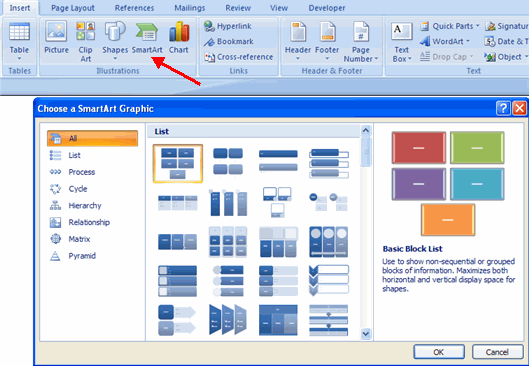
Step #6: Start building, adding names and traits or whatever it is you want to add
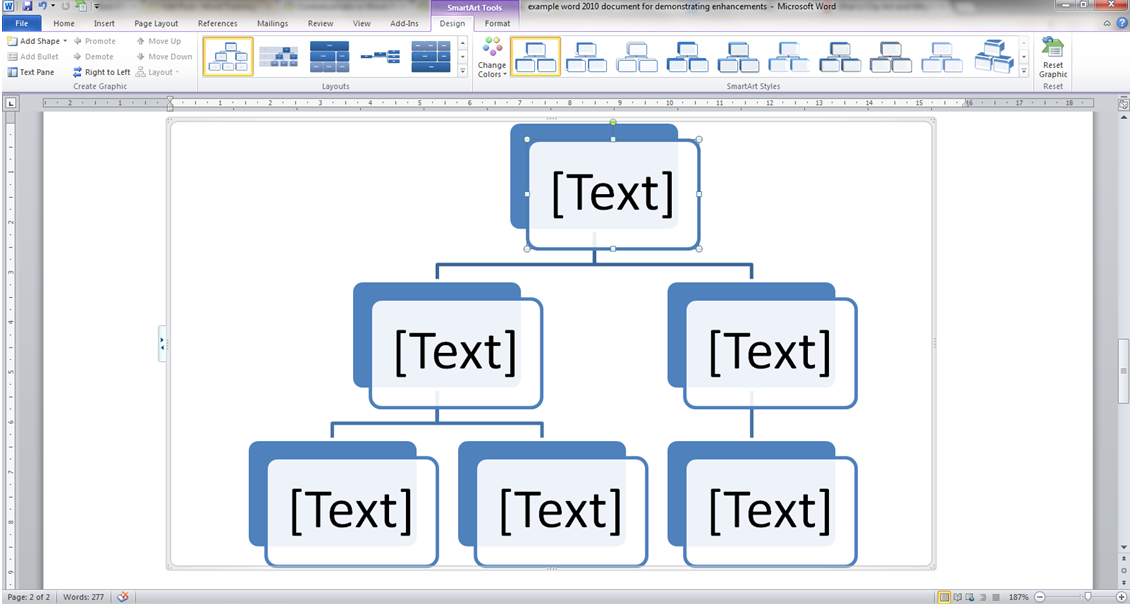
Remember that this is not a normal family tree. You don’t have to just add names but in this chart you will also add other important things about the character, such as height, weight, hair and eye color, etc.
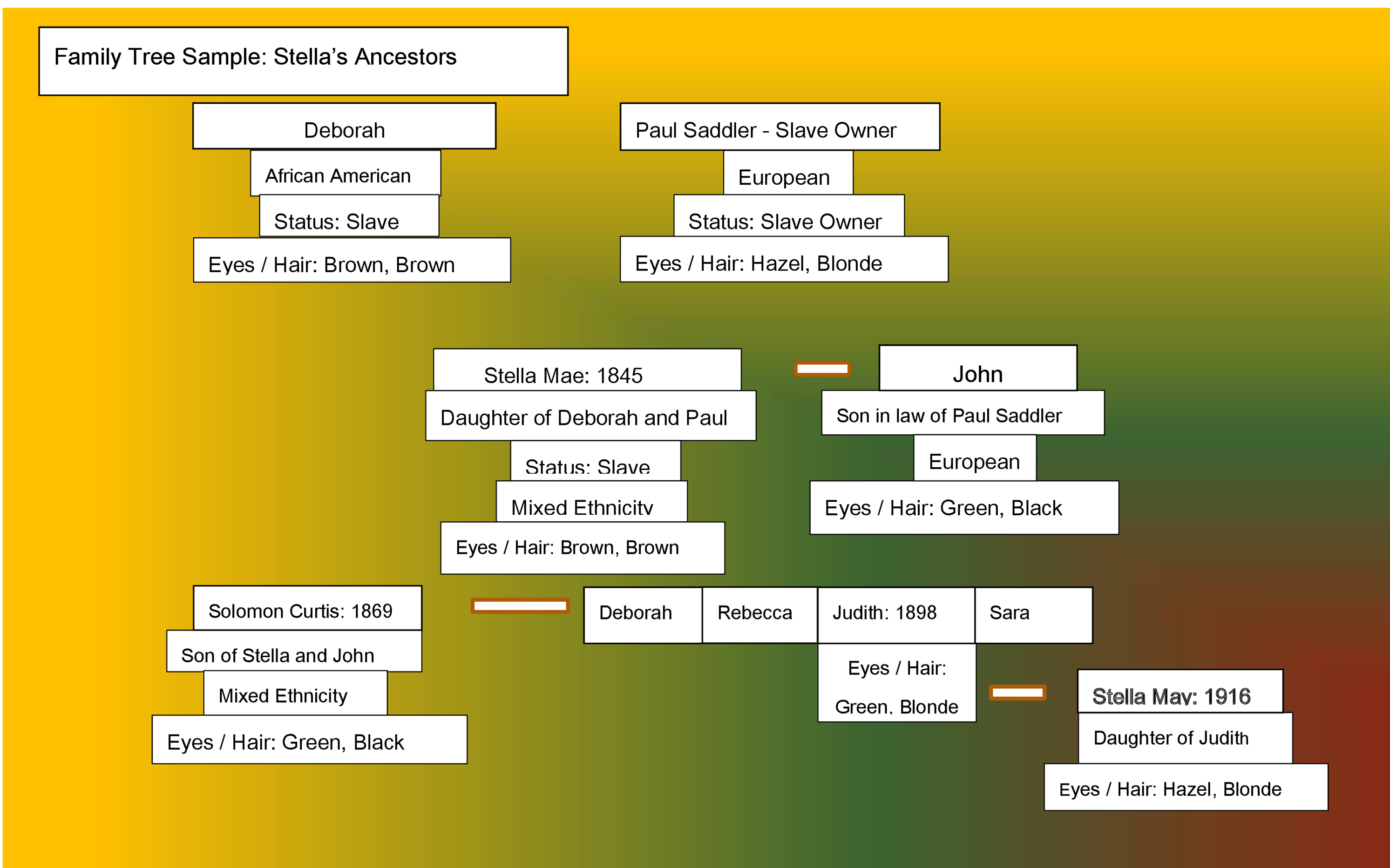
OK so I hope that you can see this well. This is my chart which I created using a slightly different design than the Smart Art. I customized it and created my own boxes. I saved it as an image file and then used Microsoft Publisher to crop out the white spaces that come from Word.
In my chart, we see that Stella is named after her great grandmother Stella Mae.
When Blacks stepped off the slave ships and into the shoes of their new lives, their ancestral names were stripped away. After chattel slavery ended, one of the first signs of freedom was for slaves to change their names. Having started with just a first name, they wore the last names of their masters, in which the majority of them continued to wear after emancipation. Others altered their last names slightly after freedom to disassociate from their masters. Another percentage went far as to just make up a last name, as in Booker T Washington’s case. According to his Autobiography, “Up From Slavery”, Booker noticed while in class that many of the students had two names. So when the teacher called for his name he calmly announced “Booker Washington” so as to fit in. Later, he found out that his mother had named him “Booker Taliaferro”. And just like that he became Booker T. Washington:
“By the time the occasion came for the enrolling of my name, an idea occurred to me which I thought would make me equal to the situation; and so, when the teacher asked me what my full name was, I calmly told him “Booker Washington”, as if I had been called by that name all my life; and by that name I have since been called.”- Up From Slavery, Page 17, Boyhood Days
Instead of take on the last name Saddler, the first Stella decides to take the last part of her first name, Mae, and change it into May. Her family would then go on to be known as the May’s.
Interpretation of Chart:
- Deborah was a slave on Paul Saddlers Plantation. They produce a daughter who Deborah names Stella Mae.
- Stella Mae and John produce a son who Stella names Solomon Curtis. According to the chart, he inherits his father’s green eyes and black hair but this is an error on my part. His eyes are actually Brown like his mothers, but he inherits his father’s jet black hair.
- Solomon goes on to have four girls: Deborah, Rebecca, Judith, and Sara.
- Judith, the middle daughter, goes on to give birth to a daughter who she names Stella, after her grandmother.
- We see that Judith inherits her green eyes from her father Solomon and her grandfather John. For the sake of space I did not include Judith’s mother in the sample chart; she is white.
- Stella inherits her eye and hair color from her great great grandfather Paul. Stella’s father is also not included in the chart; he is black.
As genetics would have it, Stella is easily capable of easing on pass the color line by inheriting more external European features than African American.
3 Reasons I am Not a Professional Author
(The post where I originally mentioned this in case you missed it)
see also

 The PBS Blog