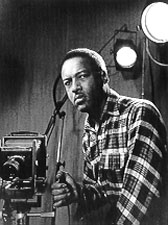
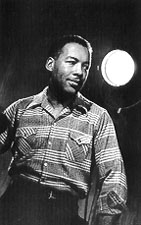
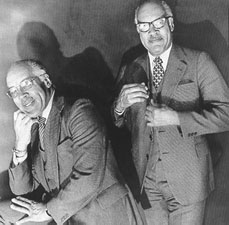
Yes indeed, twins make history again. Meet Marvin and Morgan Smith, painters who focused on capturing the positive side of Harlem during the decline of the Harlem Renaissance and the birth of The Great Depression.
“During the 1930s, ’40s, and ’50s, Harlem spread itself before the cameras of Morgan and Marvin Smith like a great tablecloth, and eagerly they went about devouring what it had to offer.”
– Gordon Parks Sr.
We often discuss the writers of the movement and the musicians while the artists are often left out. Names like Kwame Brathwaite, Aaron Douglass, Lois Jones, and Morgan and Marvin Smith, are not as well known.
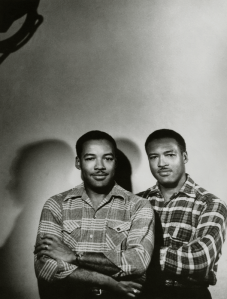
Morgan (right) and Marvin (left) Smith were born on February 16, 1910 in Nicholasville, Kentucky. The boys found a talent for art but wouldn’t pursue it much until the sharecropping family moved to Lexington in the late 1920s. Here Morgan and Marvin attended Dunbar High School, the only Black High School in Lexington at the time, and developed further their artistic abilities. They worked with oil paintings and sculptors until eventually, cameras.
In 1933, Morgan and Marvin graduated High School and pursued their art full time. However, Kentucky at the time provided little to no support for the young men and as I imagine, they could not grow in the way that they wished. They moved to Cincinnati with hope of a better future but not finding opportunities there, decided to move on to New York.
Marvin and Morgan
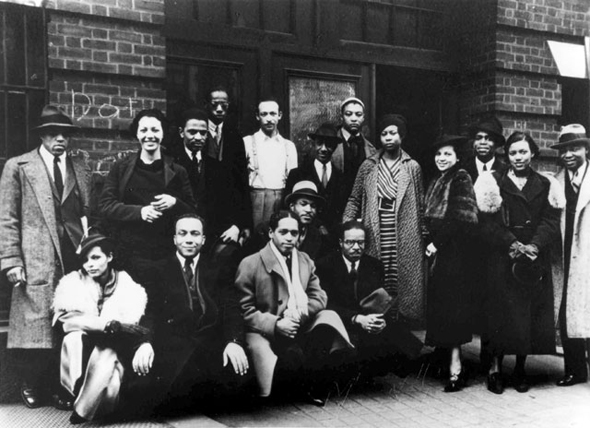
When they arrived to Harlem the twins did manual labor for the WPA or Works Progress Administration and took art lessons from Augusta Savage (another sculptor of the Harlem Renaissance) at her studio. Through Savage the twins became connected with the 306 Group, a collective of African American artists who worked and socialized together in Harlem, New York in the 1930s. The name of the group came from the address of a studio space, 306 W. 141st Street, used by two of the artists, Charles Alston and Henry Bannarn.
Marvin and Morgan became acquainted with prominent figures through Savage but it wasn’t until 1937 when the twins really came into the public’s eye when Morgan won an award for his photo of a boy playing.
Awwue!
After 1937, the twins decided to focus their attention on the community of Harlem overall. Their interest was in capturing the good instead of the bad. With the stock market crash of 1929 and The Great Depression smacked down in the middle, there was plenty to complain about, I am sure, and much of the glitter and glam of the Harlem Renaissance had begun to fade. People weren’t as interested in Black culture and art during these tough times which brings Marvin and Morgan into focus.
They look more alike as old men than they did when they were younger…or is it just me??
Over the next 40 years with their paint brushes and cameras, the brothers would record what remained, refusing to document anything negative. What’s cute is that the brother’s married identical twin sisters on the same day and three years later both divorced on the same day. They would die exactly ten years apart, Morgan smith at 83 and Marvin at 93. I am happy to see that they both lived full lives.
There’s a funny story behind this post. My stomach was growling and I thought “Hmmm, what if there was a device where you could hook up to your body parts and see what’s going on in there??” Like, say your stomach hurts or you’re hungry or your leg is in pain, you could hook up to some technology screen type deal and see what is causing those changes. OK, you may already know but I mean in a way where you could see it .(medical genuis smarty pants lol) You can go to the doctor and already know what needs to be done. Anywho, that’s when I thought it would be fun to look at some inventors / inventions that we may not have known about.
The Pencil Sharpener
The Love Sharpener
Also, known as The Love Sharpener, The Pencil Sharpener was patented by a black man named John Lee Love. John did not invent the pencil sharpener* but what he did invent would carry on to the same pencil sharpeners we use today. A carpenter in Fall River, Massachusetts, John invented several devices and in 1897, he patented a portable pencil sharpener known as the “Love Sharpener.” (*The first ever pencil sharpener was patented in France by mathematician Bernard Lassimone in 1828. A decade later another Frenchman, Therry des Estwaux, designed a conical-shaped device that, when a pencil was inserted and twisted, all sides of the pencil were whittled away at once and make the sharpening process much quicker.).
Heating Furnace — Ventilation System
Alice H. Parker, an African-American woman from Morristown, NJ developed, in 1919, an early concept of the modern home heating system. Her system gave birth to the thermostat and the forced air furnaces in most homes today, replacing what was then the most common method for heating – cutting and burning wood in fireplaces or stoves. Parker’s invention would be better known today as Central Heating.
The Mailbox
What would you know, a black man invented the mailbox. Known as The Street Letter box back then, Philip Downing designed a metal box with four legs which he patented on October 27, 1891. He called his device a street letter box and it is the predecessor of today’s mailbox. (A fellow blogger wrote a post about Downing awhile back. Check it out here!)
The Sanitary Belt, The Walker, The Toilet Tissue Holder
Sanitary Belts
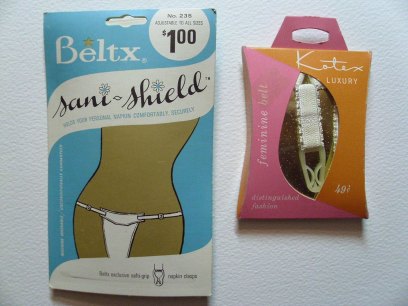
Before pads and tampons menstrual huts were common where women would be separated from communities while on their cycle (known biblically as a time of uncleanliness). Later women began using cloth or rags which is where the term “she’s on the rag” came from. Common forms of protection rabbit skins, rags, menstrual aprons (aprons??) homemade knitted pads and eventually, the sanitary belt. I heard of the sanitary belt from my mom, otherwise I would not have a clue what this is. Mary Beatrice Davidson Kenner, a black woman, had some pretty cool inventions, the Sanitary Belt being one of them. She also invented the walker and toilet tissue holder. Pretty neat. (Ladies, you can learn more about the evolution of the pad HERE.)
Toilet
Thomas Elkins, a black man, invented a lot of things (to include an improved refrigerator). Known then as a Chamber Commode, the modern toilet was patented by Thomas Elkins on January 9, 1872. Elkins’ commode was a combination bureau, mirror, book-rack, washstand, table, easy chair, and chamber stool. (The flush toilet goes back to the 1500s but the idea failed to catch on until later).
The First “Perm”
A woman getting a permanent (perm)
Did you know that Perm is short for Permanent? The first concept of the perm was invented by a black woman named Marjorie Joyner. The granddaughter of slave owner and slave, Marjorie developed an invention called “The Permanent Waving Machine” which permed or straightened hair by wrapping it in rods. Later, a black man named Garret Morgan (inventor of the Traffic Signal and Gas Mask) invented our modern version of the perm by accident. In his tailor shop, Garrett was thinking of a solution he could use to polish the needles to a high gloss and stop them from scorching clothes. When Morgan doctored this liquid, he decided to test the effects of the liquid on dog’s hair and saw how the texture had smooth out. Later trying this on human hair, the relaxer was born. Delighted with his success, Morgan coined his hair division the G.A. Morgan Hair Refining Company. This Company was also responsible for the black hair oil dye and the curved tooth iron comb (to be used as a hot comb.)
Blood Bank
Charles R. Drew was an African-American surgeon who pioneered methods of storing blood plasma for transfusion and organized the first large-scale blood bank in the U.S. Ironically, he died due to an accident that blocked blood flow to his heart (there’s a myth that he died at an all-white hospital among whites who refused to operate on him but this story cannot be verified. According to my research, Drew was treated at Alamance General Hospital, a facilities-poor “White” hospital. The White doctors at Alamance began work immediately but Drew’s injuries were so severe and his loss of blood so great that he could not be saved. It is possible that due his prominence he was treated better than most blacks were during the time but further research / insight is needed.)
Feeding Tube
Bessie Blount was a physical therapist who served during WWII. She invented an electrically driven feeding tube device that enabled wounded soldiers to consume a mouthful of food when biting down on a tube. At the time, it was hard to get a patent and she donated this invention to France. In 1951, she received a patent for a modified version from the U.S. called the portable receptacle holder, smaller tube that could be worn around the neck. However, many of Blount’s inventions are not very well known since she signed over her inventions to France.
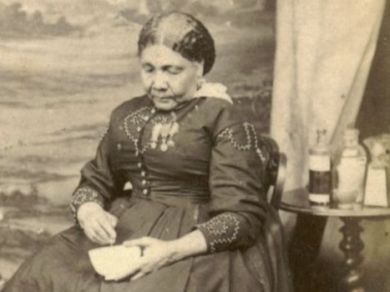
Mary Seacole was born Mary Jane Grant in Kingston, Jamaica in 1805. A mixed raced woman, her mother was Jamaican and her father Scottish. In her autobiography Mary referred to herself as Creole. Legally, she was called a Mulatto, a term equivalent to Negro or Colored. In fact, Colored is a term that originally meant one of mixed race before being widely accepted as something to which to refer to all blacks. Although retaining its name in the National Association for the Advancement of Colored People, in Britain it was the accepted term for black, Asian, or mixed-race people until the 1960s.
In any event, I find it interesting that blacks are the only people whose nationality changes in such a way. We have been and are called: Colored, Negro, Mulatto, Creole, Black, Afro-American, African American and of course the N word. Blacks from different eras literally have different classifications on their birth certificates. These are not nationalities. These are bywords, proverbs, and mockeries.
Nevertheless, Mary was a nurse in the Crimean War and learned from her mother who was also a Nurse and worked in a boarding house nursing soldiers. Mary’s mother was also what was considered a traditional healer. Traditional healer usually refers to the use of natural herbs and earth grown roots that are used instead of modern medicine. It combines knowledge, skills, and practices based on beliefs, and experiences of different cultures.
In 1836, Mary married Edwin Seacole, a naval officer who sadly, died in 1844. I imagine this was hard on Mary since her mom died shortly before her husband.
Mary traveled a lot which I love considering I also love to travel. She visited other parts of the Caribbean, including Cuba, Haiti and the Bahamas, as well as Central America and Britain before her marriage. On these trips, she combined her knowledge of traditional medicine that she got from her mom with European medicine and after her husband’s death remained in Kingston where she spent time in Panama nursing during the start of the Cholera Epidemic.
In 1853, Mary applied for the Florence Nightingale’s Nursing Team at the start of the Crimean War but was refused. Instead of giving up, Mary went to the location anyway with her own money and came to assist in the healing of people at the military hospitals and distributed remedies for cholera and dysentery.
Mary also opened the British Hotel near Balaclava in 1855 which served also as an officer’s club and served food. Using the Hotel as a foundation, Mary loaded mules with food, wine and medicine and brought these to the battlefield to help the soldiers. She received special passes that allowed her to look after the wounded and the dying.
Awwue! She was beautiful!
One of the things I love about Mary’s story is that it does not end badly as many stories do. When she returned to London she was bankrupt because of the soldiers who ran up tabs at the hotel, but newspapers started a campaign to help raise money for Mary backed by money funded by the British Army. In 1857, her autobiography, Wonderful Adventures of Mrs. Seacole in Many Lands, became a Bestseller and the Seacole Fund helped her to live comfortably in Paddington, London, until her death in 1881. All the good Mary had done to others had been returned to her.
Welcome back to Black History Fun Fact Friday. Today, as promised, we are looking at the life of William Still.
Since it’s been a busy week, I did not actually get to write an article. I usually stay up late to draft these but I couldn’t do three articles last night. So, I am posting a brief biography of Still’s life from the National Underground Railroad Freedom Center which you can find at the source below.
“William Still was born in Burlington County, New Jersey. His father, Levin Steel, had been enslaved, purchased his own freedom, and changed his name to Still to protect his wife, Sidney. Mrs. Still had tried to escape once before she succeeded, but could only bring two of her children with her. William Still had little formal education but studied whenever he could. In 1844, William moved to Philadelphia.
In 1847, he found a job as a clerk and janitor for the Pennsylvania Society for the Abolition of Slavery. He soon began aiding fugitive slaves, often sheltering them until they could find their way farther north. One fugitive was his older brother, Peter, who had been left behind when his mother escaped forty years earlier. These experiences led William to save careful records about the people he helped. Meanwhile, Still purchased real estate, opened a store selling stoves, and later founded a successful coal business.
Before the Civil War Still had destroyed many of his records about aiding fugitives, because he feared they would be used to prosecute people. After the war, his children persuaded him to write the story of his exploits and the people he helped. Still’s book, The Underground Railroad (1872), is one of the most important historical records we have. Although Still recognized the many contributions of white abolitionists, he portrayed the fugitives as courageous individuals who struggled for their own freedom. Still proudly exhibited his book at the Philadelphia Centennial Exposition in 1876.”
I read the book a couple years ago and wrote a Black History Fun Fact about it (that you can find under the Black History Fun Fact page on the sidebar) I heard then Oprah was making a movie about it. Looks like its about to come out. Thanks Nikki for sharing.
Since the TV show I want to feature today as part of our “Movie” Night Friday was Underground anyway, I decided to combine it with Black History Fun Fact Friday since it is on the same lines.
Today, we are discussing Underground, one of the most powerful TV shows on right now. (One of the deepest movies is GET OUT. You must check into it if you have not gone to see it).
First, let’s catch you up:
Wikipedia: About Underground
Photo Credit: WGN America – Underground
“Driven by the dreams of a courageous blacksmith named Noah, some plantation slaves in 1850s Georgia band together to attempt a daring escape. The fight for their lives, their futures and their freedom leads to Noah’s risk-filled plan to travel hundreds of miles away via the Underground Railroad. The landmark 10-episode anthology is created by Misha Green (“Sons of Anarchy”) and Joe Pokaski (“Daredevil”) and co-executive produced by John Legend, who also oversees the series’ score, soundtrack and musical elements.”
Trailer of Season One:
We are now in Season Two and it is already off to a blood racing start. One of the reasons I love this show is because it is well-written, something that does not happen often on television. What I mean by well-written is that the history is accurate. While there are plenty of sad parts (as slavery was not pretty) it is well balanced with factual information. The creators (and actors) of this show didn’t just throw something together. They did their research.
Who Ran the Railroad – The Underground Railroad is often portrayed as being ran mostly by white abolitionists with lots of people. While white abolitionists and Quakers surely helped, a lot of the people running the show were free blacks from the North too and I love how the program shows this (though subtly) by having Rosalee and the others front and center of the operation and not in the background just being “carried” by the helping whites. “…very few people, relatively speaking, engaged in its activities. After all, it was illegal to assist slaves escaping to their freedom. Violating the 1850 Act could lead to charges of “constructive treason.” Being an abolitionist or a conductor on the Underground Railroad, the historian Donald Yacovone related in an email to me, “was about as popular and as dangerous as being a member of the Communist Party in 1955.”
– Henry Louis Gates Jr.
The most noted black man who helped to run The Underground Railroad is William Still who operated with the assistance of white abolitionists. William Still, a free-born Black, became an abolitionist movement leader and writer and was also one of the most successful Black businessmen in the history of the City of Philadelphia. Next week, I’ll do a Black History Fun Fact on him with more details.
Humanizing Harriet Tubman – Another thing I see is that the writers and directors of Underground humanizes Harriet Tubman. As much as we complain about too many “slave stories” we really don’t know as much about slavery as we think we do, first because we weren’t there and second because we don’t study history. All we really know about Harriet are the quotes we read but in this show she is brought to life and has feelings. She is brave but also fearful. She is fierce but also concerned. She’s a warrior but still a woman; a gentle mother-like figure to Rosalee (The Black Rose) as she takes her under her wing. One of the ways to which Harriet is humanized in addition to these emotions is the calling of her by her nickname: Moses.
Female Moses – Also, called “General Tubman” people began to call Harriet Tubman Moses because of her leading her people out of slavery like Moses led the children of Israel out of Egypt. The powerful thing about this to me is that we are the same people. There is countless evidence of the physical appearance of the ancient Israelites but not just the physical appearance but also the culture of the people. After the destruction of Jerusalem in 70 c.e. by the Roman Emperor Titus and his general Vespasian, we fled into East Africa (Ethiopia, Egypt, the Sudan, etc.) and from there migrated to other parts of the African continent, widely settling on the West Coast to the extent that some tribal African nations still observe Hebrew customs and traditions. Tribes such as the Yoruba, Congo, and Ashanti can still be found keeping laws that can also be found in the Old Testament.
Upon The Transatlantic Slave Trade and our enslavement in the U.S. and pretty much everywhere else (we did not just come into America but were spread across the four corners) we sang many songs (spirituals) that told the history of who we were as a people before slavery. These songs, like “Go down Moses” and “Wade in the Water” (for which a lyric is, “Who’s that dressed in white, must be the Israelites”) was not just the symbolism of a spiritual people but the history of a people who lived the lyrics. Thus, Harriet’s nickname is powerful not just because her leadership in freeing her people from America is symbolic of Moses freeing us from Egypt, but also because she is his ancestor. In the words of Malcolm X, “You are the people of the book. You are the lost sheep.”
Harriet Tubman’s Spells – Speaking of Moses, I was excited to see that they put this in the show because it is a fact we don’t hear often. Harriet Tubman suffered from severe headaches, and seizures. She also had a form of narcolepsy where she would fall asleep without notice. Her condition caused her to have visions believed to have helped her in her missions. They showed this in Wednesday’s episode when she fell asleep at the table.
Aldis Hodge as “Noah”
Full Beards – I love the full beards and the masculine image of the black man. It was a subtle thing but present. I imagine Moses, David, or Gideon wore beards like that. Nonetheless, this is how men grew their beards back then, very thick and covering the whole lower face. Sometimes you couldn’t even see their mouths.
Photo Credit: WGN America: Underground
Slave Examinations / NFL Combine Evaluations – Speaking of black men, they showed you how enslaved blacks were inspected when they were looking at Noah’s teeth and body when he was in jail. (Speaking of jail, such physical examinations also happen there.) Enslaved blacks were naked and examined before they were bought to show potential buyers that they were of good stock and to determine how useful that person would be based on age, size and health. With the NFL combine, evaluators try to project the player’s longevity. Players strip down to bare minimums to have their bodies pricked and prodded for size and strength in an eerily similar way as their ancestors were pricked and prodded by slave buyers. The more they can get out of a player, the better. Enslaved Blacks worth was similarly judged by what the plantation owners believed they could get out of the enslaved long term.
Moss on the Tree – Another subtly, it is a testament to the story’s attention to historic detail. As Noah is trying to escape his captors, he notices the moss on the tree. This told him which direction he was going because there’s a tendency for moss to grow on the north side of the tree in the Northern Hemisphere.
Sweet-grass Baskets – The baskets the women carried on their heads are sweet-grass baskets, one of the oldest handcrafts of African origin used to separate the rice seed from its chaff. Speaking of women, we didn’t even talk about how fearless they were. I loved the part when Elizabeth thought they were going to pull out sewing items but they pulled out guns but I will stop here.
I hope I’ve sparked enough curiosity for you to go ahead and watch the show! Or at the very least get some young people you know to watch it as a History lesson. It airs every Wednesday @ 9:00a CST on WGN. (No one paid me to say this. Maybe I should ask for a check).
Today I introduce to you Meta Vaux Warrick Fuller, the first black woman to receive a federal commission for her art. Fuller’s artwork became the precursor to the resurgence of African themes in art seen during the Harlem Renaissance Movement. Not only a time of Jazz, Literature, and Flapper women, this explosion of black artistic culture also included artwork which is not discussed as much as let’s say the literature and the music.
Born in Philadelphia in 1877, Fuller was the youngest of three children born to William and Emma Warrick. Prominent hair stylists who owned a flourishing Philadelphia store, Fuller’s father was a prosperous barber and the owner of several shops. Her mother was a hairdresser with wealthy white clients who were served in the family’s shop. The family also took vacations to the same places as did their upper-class white Philadelphian clients and lived in a three-story house. Why is it then that Fuller’s name is different from her parents?
Meta was named after one of these clients, Meta Vaux, the daughter of a Senator Richard Vaux. It makes me think about many blacks during the time and whether or not we felt we needed to assimilate into white society in order to fit into the culture of America. For instance, both W.E.B. Dubois and Meta (who was close with Dubois) felt that blacks were capable of the highest achievements but also that this meant to be educated as whites were educated. In addition, despite eventually producing “African” themed art, Meta rejected DuBois initial suggestion that she concentrate on African-American themes when they first met in Europe.
While Meta was successful and is highlighted here as an unfamiliar face, a precursor if you will to The Harlem Renaissance, the movement itself was not all rainbows and whistles. While the artistic explosion is something I love (being a poet and all) I hate that some blacks (as talented as we are) felt at the time that they needed to fit in with White America in order to make it, a truth not everyone is willing to acknowledge but this is Black History Fun Fact Friday so we must keep it real. As Carl Van Vechten titled his book, for many blacks Harlem was, at the time, “Nigger Heaven”.
Fuller’s Work: Ethiopia Awakened
Nonetheless, in October of 1889, Fuller arrived in Paris where for the next three years she would study with prominent French sculptors which would have a major impact on her work. While in Europe this is where she would encounter Dubois for the second time and it was the beginning of a friendship that continued for many years. Dubois and Thomas Calloway was organizing a Negro exhibit for the Paris Exposition and visited Meta’s studio to her surprise.
When Meta returned to the States, she established a studio in Philadelphia where art organizations flourished and in the early 1900s through the twenties she continued to do well. In 1928, she was selected to show her work at The Pennsylvania Academy of Fine Arts.
In 1909 she did a 15-piece work for The Jamestown Tercentennial Exposition illustrating black’s progress in America since the Jamestown settlement. Fuller also received a gold medal for “The Jamestown Tableau,” and this established her reputation as an artist and began a long and committed career. Despite my personal feelings, it is refreshing to study the faces of some of the unknown artists of this most important time in history.