Black History Fun Fact Friday – Emmit McHenry

The internet. We all know it, and in 2024, babies are born with it in their hands.

In today’s world, looking something up on the web is normal behavior, and for some, the first thing they do when they wake up in the morning. Whether you grab your phone or use the computer to log in at work, we don’t go a day without typing something into a search bar or scrolling on social media.

But it was not always this way.

Before anyone ever heard of the internet, its seeds were planted in 1957 in the historical context of the Cold War. In the 1960s, government researchers also used it to share information.

Today, we are learning about the man who created the computer code for .com.

Emmit McHenry was born in Forrest City, Arkansas, in 1943 and was raised in Tulsa, Oklahoma, renowned for being a prosperous Black community. While McHenry came of age years after the Tulsa Race Riot, footage from Pastor Solomon Sir Jones shows that by 1925 and even into the 1940s, Black Wall Street was rebuilt.

Thus, McHenry grew up surrounded by people with a strong sense of community and entrepreneurship.

“It was in a way kind of an extended family and they took pride in your doing well. So if you did well, the teachers really got excited about that and worked with you on it. Yeah, it was a really wonderful experience for me.”

– Emmit McHenry on growing up in Greenwood

The Victory of Greenwood

Emmit McHenry

McHenry’s great-grandfather was a carpenter and whiskey still operator by trade. Great-grandmother McHenry was a businesswoman in addition to a farmer. When it came time to bring their crops to market, the Black farmers and sharecroppers in Arkansas knew they could rely on her to negotiate fair rates for them.

Emmit McHenry graduated from Booker T. Washington High School and pursued a Bachelor of Science in Communications from the University of Denver on a wrestling scholarship. He majored in physics, but when he discovered communications, he changed his major. He graduated with a degree in communications in 1966.

McHenry and his partners established the engineering firm Network Solutions in 1979. However, like many other black-owned businesses, they had trouble getting funding. McHenry and his associates maxed out their credit cards and mortgaged their residences. The business prospered. Still, a deal with the National Science Foundation was the diamond in the crown for Network Solutions. The first internet domain name addressing system for the US government was covered under the contract.

That’s when McHenry created a complex computer code that was not complex to ordinary people searching the web. It allowed those of us without communications degrees to understand the internet and send and receive emails without having to study computer science.

We know McHenry’s invention today as .com.

Emmit McHenry’s work paid off on Dec. 31, 1992, when Network Solutions was the only bidder on a National Science Foundation grant to further develop the domain name registration service for the Internet. Network Solutions was granted an exclusive contract as the sole domain name registrar for .com, .net, and .org. These top-level domain (TLD) names continued the work Network Solutions was already doing. 


For More Black History Fun Facts You Didn’t Learn in School, be Sure to Visit the Archives Here

And Grab Your Copy of the Book Here!

Black History Fun Fact Friday – Lonnie Johnson and the Super Soaker Water Gun

Black History Fun Fact Friday is back!


May has always been an exciting month. As a kid, I looked forward to the school year ending and the warm weather welcoming me just in time for my birthday at the end of the month. Summer also means swimming and dancing in the water from the fire hydrant and water guns!

Introducing Lonnie Johnson, the inventor of the super soaker!

LJ

Lonnie Johnson was born in Mobile, Alabama, on October 6, 1949. Signs of Lonnie’s brilliance could be seen when he was a child reverse-engineering his sister’s baby doll to understand how the eyes closed. He also built his own go-cart from a lawnmower engine he attached to scraps he found in the junkyard. 

Before enlisting in the Air Force, he worked as a research engineer at Oak Ridge National Laboratory. He also worked at the Air Force Weapons Laboratory in Albuquerque, New Mexico, as the acting chief of the Space Nuclear Power Safety Section.

Johnson holds a B.S. degree in Mechanical Engineering, an M.S. degree in Nuclear Engineering, and an honorary Ph.D. in Science from Tuskegee University.

In 1989, Johnson formed his own engineering firm and licensed his most famous invention, the super soaker. It generated over $200 million in retail sales and became the number-one-selling toy in America.

Today, Johnson is president and founder of Johnson Research and Development Co., Inc., a technology development company, and its spin-off companies, Excellatron Solid State, LLC; Johnson Electro-Mechanical Systems, LLC; and Johnson Real Estate Investments, LLC.

As of 2023, Lonnie Johnson’s net worth was an estimated $160 million. This substantial fortune is primarily the result of the royalties he received for the Super Soaker, which generated billions of dollars.

So the next time your child plays with a super soaker, be sure they know about its amazing inventor!

gettyimages-50472413


For More Black History Facts You Didn’t Learn in School, Be Sure to Get Your Copy of the Book Here!

1687711849

Black History Fun Fact Friday – Phillip  B. Downing and the First Mailbox


Every day, we use our mailbox, checking it for packages and letters and bills. You look at it every single day but did you know a black man invented it? Thanks to Phillip L. Downing (some sources and memes say Paul but so far I have only been able to verify that his name was Phillip), you don‘t have to travel to the post office every day. You can just walk a few steps from your home. But Downing didn’t call it a mailbox. He called it a Street Letter Box.

Downing was born in Providence, Rhode Island on March 22, 1857. His father, George T. Downing was an abolitionist and business owner. His grandfather, Thomas Downing, was born to emancipated parents in Virginia and also had a successful business in the financial district of Manhattan in 1825. Thomas Downing also helped to found the United Anti-Slavery Societies of New York City.

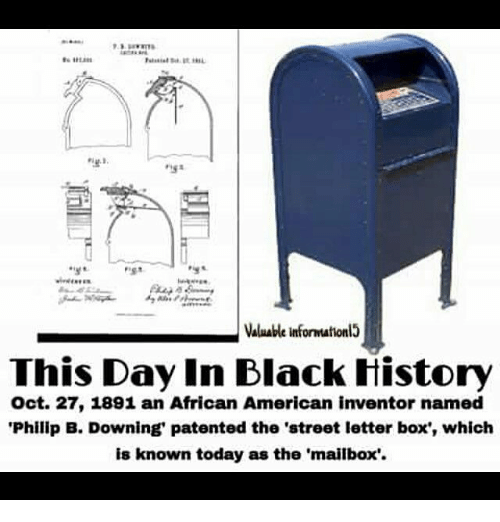
Coming from a family of business owners, it‘s no surprise that Phillip would become an inventor. During the late nineteenth and the early twentieth century, Downing successfully filed five patents with the United States Patent Office. Among his most significant inventions were a street letterbox (U.S. Patent numbers 462,092 and 462,093) and a mechanical device for operating a street railway switches (U.S. Patent number 430,118), which he invented before the predecessor of today‘s mailbox. On June 17, 1890, the U.S. Patent Office approved Downing’s application for “new and useful Improvements in Street-Railway Switches.” His invention allowed the switches to be opened or closed by using a brass arm next to the brake handle on the platform of the car. Then, on October 27, 1891, his two patents for a street letter box also gained approval.

Downing’s design resembled old school mailboxes (see image). A tall metal box with a secure, hinged door to drop letters. Until this point, people wanting to send mail had to travel to the nearest post office. This is how the enslaved “heard it through the grapevine,“ communication started on slave plantations where information passed from person-to-person, by word of mouth. The Black person who was sent to the post office to get the mail would linger long enough to get a drift of the conversation from the group of white people who congregated there. The mail carrier on his way back to the master‘s house would retell the news he heard so that the other slaves knew what was going on in the world. While many records accredit this to the news that came through the telegraph, it actually began before then. The “grape-vine telegraph” (Washington, p. 9) was unofficially invented first as mouth-to-mouth rumors, gossip, and worldly conversations and news of the war from Southern blacks on the plantation.

Knowing this, it is not surprising that a Black man would make these “conversations” easier by inventing a mailbox. To this day the term, “I heard it through the grapevine,” is still a common saying for someone who has heard gossip. The phrase has even been recorded as a song by Gladys Knight & the Pips in 1967 and by Marvin Gaye in 1968.

Before, those wishing to send mail usually had to travel to the post office but Downing’s invention changed that. Instead, the street letter box would allow for drop off near one’s home and easy pickup by a letter carrier. His idea for the hinged opening prevented rain or snow from entering the box and damaging the mail.


Misty Brown, “Ever Wonder,” Afro-American February 6, 1988; Eyvaine Walker, Keeping a Family Legacy Alive: Unforgotten African Americans (Atlanta, GA: Twins Pub, 2011), 316 – 317. “Philip Downing, Boston, Retires After 31 Years Service in Custom House,” The New York Age, April 9, 1927.

Mahoney, E. (2017, October 31) Philip B. Downing (1857-1934). Retrieved from https://www.blackpast.org/african-american-history/downing-philip-b-1857-1934/

Washington, B. (1995). UP From Slavery. Dover Publications Inc. Edition. Original Publisher, Doubleday, Page, circa 1901, NY. Chapter 1: A Slave Among Slaves, p.9

Black History Fun Fact Friday – Mary Beatrice Davidson Kenner, Inventor of the Sanitary Belt, a precursor of the Modern Self-Adhesive Maxi Pad

Welcome back to Black History Fun Fact Friday. Today, I’d like all of the women readers to thank Beatrice Kenner!

Some of the most common forms of protection for women during their cycles were grass, rabbit skins, sponges, rags, menstrual aprons, homemade knitted pads, or other absorbents. Usually, women used some form of cloth back in the day. These cloths are why “she’s on the rag” is a popular expression used to refer to menstruating women.

While she did not invent the modern version of the Maxi Pad, Mary Beatrice Davidson Kenner developed the sanitary belt, one of the first versions of the modern-day pad.

Mary was born in Monroe, North Carolina, on May 17, 1912, and came from a family of inventors. Her sister invented a children’s board game that explored family ties called “Family Treedition.” Mary’s father, Sidney Davidson, patented a pants presser in 1914. According to historian and former U.S. Patent Examiner Patricia Sluby, a maternal grandfather of the daughters was of German and Irish descent who invented a tricolor train light. It’s safe to say that developing things was in Mary’s blood, pun intended.

Mary-Beatrice-Davidson-Kenner

The sanitary belt was a belt used to hold pads in place before designing self-adhesive maxi pads.

Mary invented the sanitary belt with a moisture-proof napkin pocket, but the company that showed interest in the pads rejected the invention because Mary was a black woman. For this, the sanitary belt didn’t become widespread until 1956, thirty years after its design. Learning this has taught me the power of patience and how everything comes to be in its time. It may have seemed like a lifetime to Mary, but eventually, her invention saw the light of day. Mary received five patents for her invention between 1956 and 1987.

While mostly known for her invention of the sanitary belt, Mary had other groundbreaking designs like the toilet paper holder, and the mounted back scrubber and washer for showers. Mary has been an entrepreneur from the start, operating her own floral business in Washington, D.C., when she was not inventing things.

Adhesive Maxi Pads (a sticky side that stuck to the lining of a woman’s panties) were invented in the 1970s, so the sanitary belt did not last very long. But without the belt, someone would not have thought to make things easier by eliminating the belt and just going with the napkin.

If you are a young woman like me and have never used the belt, you can Google Sanitary Napkins (or talk to your mom or grandmother), and learn that the strap was uncomfortable and inconvenient. While tampons existed, using them for younger women was considered sexually improper. (A pretty good article to study up on the evolution of pads can be found HERE.)

Life happens in stages, and good things come to be because someone took a risk on something others may not have found useful. Mary’s invention helped women who didn’t want to use tampons to get by and paved the way for all of the pads currently on the market.